

Three years ago, I watched a hotel developer from Miami lose $47,000 on a single China furniture order. He’d found a supplier on Alibaba with a five-year Gold Supplier badge, a 4.8-star rating, and — most importantly — the little blue shield that says “Trade Assurance.” The order was straightforward: 120 room sets for a boutique property in Key West. The deposit went through. The production timeline looked tight but manageable. Then the factory went quiet. Six weeks in, the supplier’s Alibaba storefront vanished. The Trade Assurance claim? Denied. The reason, buried in the fine print: “Supplier failed to ship within agreed timeframe” doesn’t trigger a payout if the supplier claims “force majeure” due to raw material delays. The buyer had never set foot in Foshan. He’d never heard of Longjiang. He thought the blue shield meant what it sounds like it means.
It doesn’t.
The Brutal Truth About That Little Blue Shield
Trade Assurance isn’t insurance. It’s not a guarantee. It’s a conditional escrow mechanism with more loopholes than a back-alley contract in Dongguan.
Most buyers treat it like a seatbelt. Buckle up, drive fast, feel safe. The reality? It’s more like a warning label on a motorcycle helmet. It might help in a minor spill. In a real crash, you’re still eating pavement.
Here’s the rule of thumb I give every first-time buyer: If the supplier can find a way to stall, obscure, or technically comply while materially failing, they will. And Trade Assurance gives them plenty of runway.
What Trade Assurance Actually Covers (And Where It Cracks)
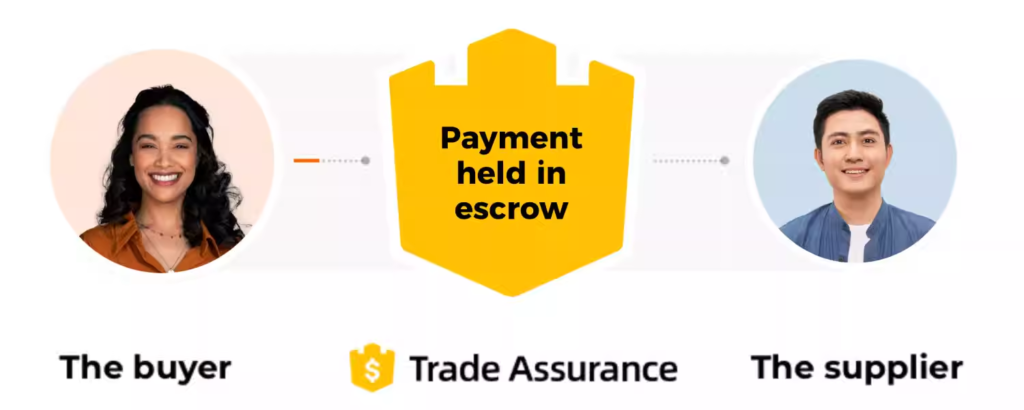
China furniture sourcing is the process of identifying, vetting, and contracting manufacturers in mainland China to produce custom or catalog furniture for export — a practice that spans everything from mass-market dining chairs in Nankang to high-end hospitality casegoods in Guangdong. Within that ecosystem, Alibaba Trade Assurance functions as a payment protection layer: Alibaba holds the buyer’s funds until predefined shipping or quality conditions are met, and promises a refund if the supplier breaches those terms.
Sounds clean. It isn’t.
What happens when the “defect” is subjective?
I visited a factory in Anji last November — a mid-sized operation producing upholstered seating for the European market. The buyer had specified foam density at 35kg/m³. The factory delivered 32kg/m³. Not a dramatic difference. But over two years, those sofas sag. The buyer filed a Trade Assurance claim. Alibaba’s resolution team requested a third-party inspection report. The buyer hadn’t ordered one. The factory produced a lab certificate from a local testing center showing “compliance with general upholstery standards.” Claim denied. The buyer was out $12,000 in product value plus another $8,000 in shipping they’d already paid to get the goods out of Yantian port.
And here’s the thing — the factory wasn’t technically wrong. They were ethically wrong. Trade Assurance doesn’t adjudicate ethics. It checks boxes.
The “Shipped on Time” Mirage
One of the most common triggers buyers rely on is the shipping deadline. If the supplier doesn’t ship by the agreed date, you get your money back. Right?
Actually, that’s not quite right — what most buyers miss is that “shipped” in Alibaba’s system often means “supplier uploaded a tracking number.” I learned this the hard way in Dongguan. A supplier printed a label, pasted it on a box, and scanned it into the Alibaba portal. The system registered “shipped.” The box sat in their warehouse for another three weeks. By the time the goods actually moved, the buyer’s project timeline was wrecked. Trade Assurance? The shipment had technically been “initiated.” No breach.
The tracking number is not the truth. It’s a data point.
The Factory Side of the Story
Walk into any furniture district in Foshan — Shunde, specifically — and you’ll hear a different narrative. Suppliers complain that Trade Assurance is a one-way street. Buyers dispute perfectly good orders because they overcommitted to their own clients. International buyers, they say, file claims as a negotiation tactic.
There’s some truth to that. I’ve seen it. A designer in Los Angeles ordered 80 dining chairs, then realized her client had changed the spec to a different wood species. She filed a quality dispute to avoid eating the cost. The factory, a solid operator in Longjiang with ten years of export history, got slapped with a frozen account while Alibaba investigated.
But let’s be honest. The power imbalance favors the buyer with a credit card and a dispute button over the factory with rent to pay and workers to feed. The real problem isn’t that Trade Assurance is unfair to suppliers. It’s that buyers misunderstand what they’re actually holding in their hands.
A comparison:
| What Buyers Think Trade Assurance Does | What It Actually Does |
|---|---|
| Guarantees product quality matches the sample | Only covers quality if explicitly defined in the contract terms uploaded to Alibaba |
| Refunds the full order amount if anything goes wrong | Caps refunds at the initial payment amount; shipping costs are rarely recoverable |
| Protects against supplier fraud or disappearance | Only if the supplier never ships at all; partial or fraudulent shipments are harder to prove |
| Replaces the need for factory audits or inspections | Doesn’t; it’s a payment tool, not a vetting mechanism |
| Covers custom furniture with subjective specs | Struggles with anything that can’t be measured with a caliper or verified with a photo |
The Interi Furniture Reference Point
While some buyers gravitate toward large-scale manufacturers in Foshan, others find that mid-sized specialists — operations like Interi Furniture, which focuses on project-based hospitality and residential custom pieces — offer a different risk-reward equation. These aren’t the $50-million giants with armies of sales staff. They’re often 80-to-150-person shops with tighter quality control and more flexible MOQs. The catch? They may not have the Alibaba presence or the Trade Assurance volume that signals “safe” to a distant buyer. That doesn’t make them riskier. It makes them less visible in a system that rewards visibility over substance.
I’ve sent buyers to factories like this — operations without flashy storefronts but with real workshop floors, real R&D teams, and real export documentation. The ones that survive fifteen years in this market don’t do it by gaming escrow platforms. They do it by not getting sued.
A Real-World Analogy: The Used Car Lot
Buying a China furniture order through Alibaba Trade Assurance is like buying a used car because the dealership offers a “30-day powertrain warranty.” The warranty is real. It exists on paper. But if you didn’t lift the hood, check the transmission fluid, or take it to your own mechanic before signing, that warranty is just a piece of paper that makes you feel better while you drive off the lot.
The warranty doesn’t make the car good. Your diligence does. Same with furniture.
A supplier with Trade Assurance and a slick video tour is still a stranger on the internet. The blue shield is not a background check. It’s not a factory audit. It’s not a quality guarantee. It’s a payment delay mechanism with a dispute form.
And here’s the real kicker — the suppliers who know the system best are often the ones you should worry about most. They’ve been on Alibaba long enough to learn exactly which claims get approved, which documentation stalls investigations, and how to structure their contract terms to minimize exposure. Experience is a double-edged sword. In the hands of an honest factory, it means smooth exports. In the hands of a corner-cutter, it means smooth evasion.
Your Actionable Framework: Before You Click “Pay Now”
Don’t treat this like a terms-of-service checkbox. Walk through it.
Step one — Vet the supplier like they owe you money. Because they will. Check their business license against the National Enterprise Credit Information Publicity System. Ask for a video call from the factory floor, not the showroom. (And yes, this happens more than anyone admits — buyers who never once see the actual workshop.) Request references from buyers in your country, then actually call them.
Step two — Define “quality” in writing. Not “good quality.” Not “as per sample.” Specific metrics. Foam density. Wood moisture content. Veneer grade. Hardware brand. Finish gloss level at 60 degrees. Attach photos with annotations. Upload this as your Alibaba contract attachment. The platform’s default terms are vague by design — they favor the supplier.
Step three — Structure payment in phases. 30% deposit. 60% after third-party inspection (not after shipment — after inspection). 10% after installation or 60 days post-delivery. Trade Assurance can hold the middle tranche, but only if you configure it that way. Most buyers don’t.
Step four — Order a pre-shipment inspection. Not from the supplier’s buddy. From a recognized third party — SGS, Bureau Veritas, or a reputable local inspector you find independently. Cost: roughly $300-$500. Value: everything. A clean inspection report is your only real leverage in a Trade Assurance dispute.
Red flag that contradicts conventional wisdom: A supplier who pushes hard for 100% Trade Assurance coverage upfront is not necessarily safer. In fact, it can signal cash-flow desperation. Legitimate factories in Guangdong often prefer a standard T/T structure with documented milestones. They don’t need Alibaba to hold their hand. They’ve got banks, credit lines, and long-term clients. The ones who insist on the platform’s escrow for the full amount? Sometimes they’re one dispute away from closing shop.
Step five — Document everything in the Alibaba messaging system. Not WhatsApp. Not WeChat. Alibaba’s dispute team can only review communications within their platform. That “quick clarification” you sent over Telegram? Invisible to the arbitrators.
FAQ: The Questions Buyers Actually Ask
Q: If a supplier has Gold Supplier status and Trade Assurance, can I skip the factory visit?
A: No. Gold Supplier is a paid subscription, not a merit badge. I’ve seen factories in Nankang with ten-year Gold status and no functional quality control department. The visit isn’t about seeing machines — it’s about seeing whether the owner looks you in the eye when you ask about rework rates. That doesn’t translate to a webpage.
Q: What’s the biggest mistake buyers make when filing a Trade Assurance claim?
A: They wait too long. Alibaba’s window for claims is tight — often 30 days after the expected delivery date. Buyers who try to “work it out” with the supplier privately burn through their eligibility. File early. You can always withdraw the claim if the supplier resolves the issue. But once that window closes, the blue shield is just a logo.
Q: Can I get my shipping costs back if the order is junk?
A: Almost never. Trade Assurance covers the product value you paid through their platform. If you already paid $4,000 to a freight forwarder to get a container of defective chairs from Shenzhen to Savannah, that money is gone. The platform doesn’t touch logistics costs. This is why pre-shipment inspection matters more than escrow.
Q: Are Alibaba Chinese suppliers more likely to scam personal buyers than hotel project buyers?
A: It depends on the order size, not the buyer type. Small orders — a few thousand dollars — get less attention from both the supplier and Alibaba’s dispute team. They’re not worth the arbitration cost. Large project orders get more scrutiny because the supplier has more to lose if their account gets frozen. But a $200,000 hotel order also attracts more sophisticated obfuscation. The scam scales with the stakes.
Q: Is my China furniture order protected if I use Trade Assurance?
A: It depends on what you mean by “protected.” If you mean “can I get my deposit back if the supplier ghosts me before shipping?” — usually, yes, if you filed within the window and messaged through Alibaba’s platform. If you mean “will I receive furniture that matches my quality expectations and project timeline?” — no. Trade Assurance does not protect against mediocrity, delays, or the thousand small failures that turn a sourcing experience into a nightmare. It protects payment. It does not protect outcome.
The Hard-Earned Lesson
At the end of the day, the blue shield is a feature, not a strategy. I’ve watched too many smart buyers outsource their judgment to a platform algorithm designed to maximize transaction volume, not buyer welfare.
The best protection isn’t escrow. It’s the uncomfortable work of verification, specification, and relationship-building that no platform can automate. The factory that answers your technical questions at 10 PM China time. The one that sends you a video of your actual sofa being upholstered, not a stock clip. The one that admits a delay before you have to ask.
That factory might not have the shiniest Alibaba page. They might not even use Trade Assurance. But they’re the ones who show up when the container arrives and something’s wrong.
So here’s the question I leave with every buyer: Are you paying for protection, or are you paying for the feeling of protection? Because in the furniture game, those are two very different invoices. And only one of them gets you the chairs you actually ordered.