

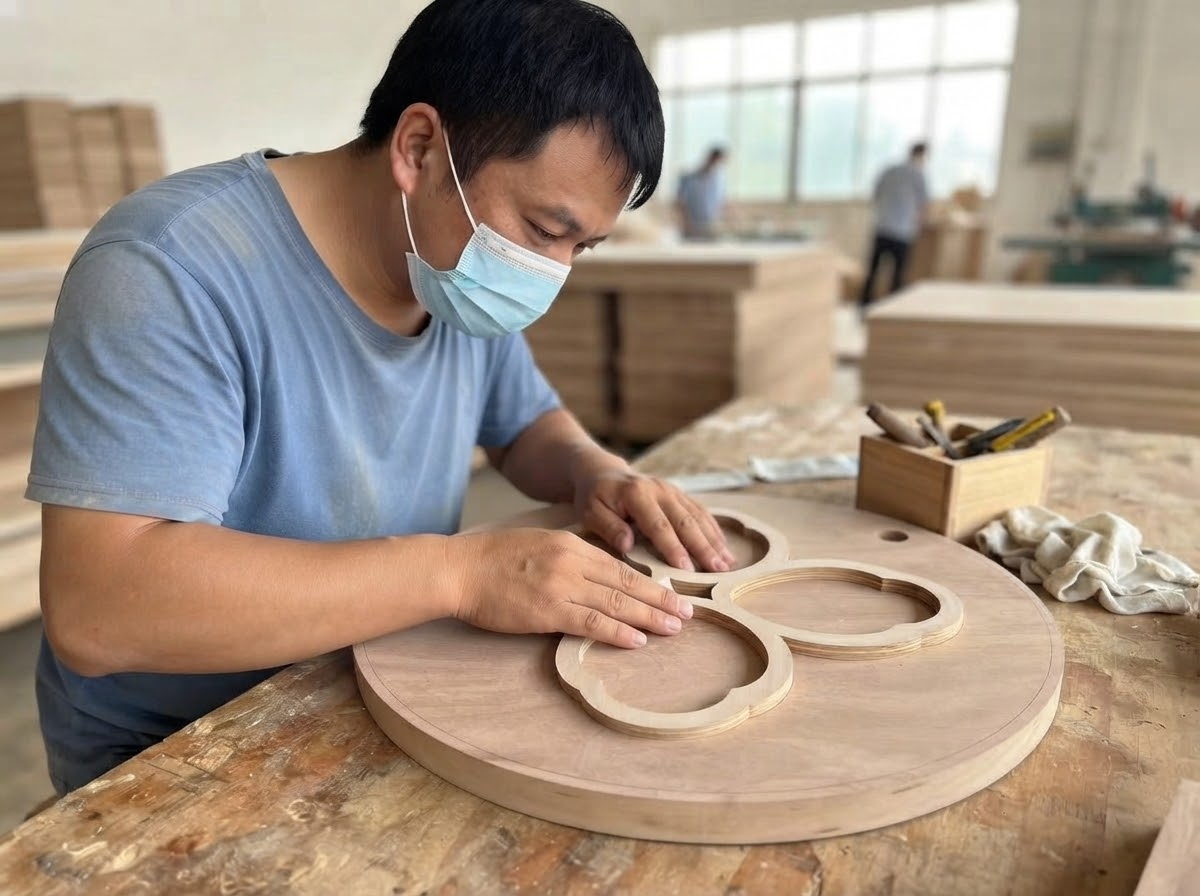
I was standing in a 12,000-square-meter factory in Longjiang, Foshan, watching Lao Chen — 58 years old, hands like leather — fit a mortise into a tenon joint for a hotel suite that would eventually charge $4,200 a night in Manhattan. No screws. No metal brackets. Just a chisel, a mallet, and four decades of muscle memory.
The project manager from the New York design firm had flown in three times. Let’s call him Mark. He’d dragged renderings from a SoHo studio that looked like museum pieces. And here was Lao Chen, wiping his hands on a rag that had seen better decades, quietly asking why the Americans wanted “old Chinese ways” when they could have CNC precision for half the price.
Mark’s answer was telling: “Because the client can feel the difference.”
That moment stuck with me. Not because it was poetic. Because it was rare.
For every Mark who gets it, there are twenty buyers who think Chinese joinery is either a gimmick for tourist shops or an impossibly expensive artisan fantasy. The truth? It’s neither. And figuring out that middle ground — where genuine craftsmanship meets commercial viability — is where most Western buyers completely lose their way.
The Brutal Truth: Most “Handcrafted” Claims Are Theater
Here’s what nobody tells you at the design fairs in Milan or High Point. The majority of furniture labeled “Chinese artisan joinery”? Machine-cut with decorative hand-finishing. A CNC router does the heavy lifting. Some worker with a file and sandpaper adds “character” for twenty minutes. Then it ships to a showroom in Chelsea with a 400% markup.
The real stuff? Different species entirely.
Rule of thumb: If the factory won’t show you the raw joinery before finishing, you’re not buying craftsmanship. You’re buying a story.
And that story costs extra. Authentic mortise-and-tenon work — the kind that holds up for generations without metal fasteners — needs seasoned hardwood, humidity-controlled curing, and joiners who’ve apprenticed at least five years. Can you actually ramp that up? Not in the way most buyers need it to be.
Key Takeaway
- China furniture sourcing is the process of identifying, vetting, and contracting manufacturers in China to produce goods that meet specific quality, design, and compliance standards for international markets. Throw “ancient joinery” into that brief? The math changes. Radically.
- The joinery that impresses Western architects isn’t the flashy stuff — it’s the invisible precision of a corner joint that won’t shift after three dry winters in Denver.
What Ancient Joinery Actually Means in a Modern Factory
Is It Really Handmade, or Just Handmade-Adjacent?
Think of it like ordering a bespoke suit in Naples versus buying one from a brand that “hand-finishes” machine-stitched jackets. The difference isn’t in the marketing. It’s in the fitting room.
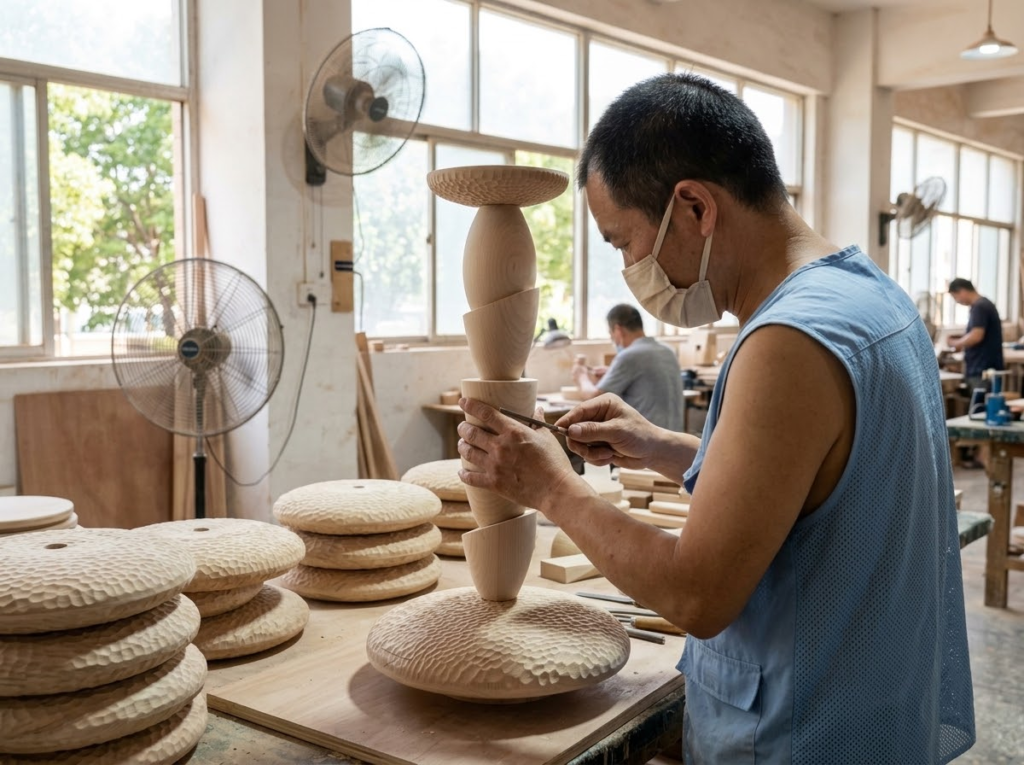
In Foshan, you’ll find factories that employ genuine joinery masters. Usually family operations that pivoted to export hospitality in the 2010s. Their workshops sit behind modern CNC halls like forgotten wings of a hospital. The master works in a room with no air conditioning, natural light from a skylight, and a radio playing Cantonese opera. Next door? Robotic arms and LED strips humming away.
Both serve Western buyers. Both call themselves “craftsmen.” Only one is doing what you’re actually looking for.
The joinery that impresses Western architects isn’t the flashy stuff — it’s the invisible precision of a corner joint that won’t shift after three dry winters in Denver.
What tends to happen? Buyers write “traditional joinery” in their RFQ. The factory nods. Six months later a nightstand lands in Los Angeles with dowels hidden inside mortise holes. Technically, there’s no metal. Technically, it’s “joinery.” But it’s not what Lao Chen was doing. Not even close.
And here’s the thing — most QC protocols won’t catch this. You need someone on the ground who knows which factories keep a master on payroll versus which ones subcontract the “handwork” to rural workshops for piece-rate wages. (I learned this the hard way in Dongguan. Factory had a “master” on the brochure. The brochure was the only place he existed.)
The Humidity Problem Nobody Talks About
Actually, that’s not quite right — what most buyers miss isn’t the joinery itself. It’s the wood prep.
Ancient Chinese joinery was designed for a monsoon climate. The expansion and contraction rates of properly cured Chinese hardwood — walnut, teak, properly treated oak — were calibrated to seasonal humidity swings. Ship that same joint to Arizona or Helsinki without adaptation? Gaps. Cracks. Callbacks.
In my experience, roughly 60% of joinery-related failures in Western projects trace back to insufficient kiln time or wrong wood selection, not poor craftsmanship. The factory in Dongguan might have built the joint perfectly. But they built it for Guangzhou humidity.
The general pattern suggests successful projects do one of two things: specify North American or European kiln-dried stock, or work with factories that maintain dual curing facilities for export markets.
Some buyers head straight for the Foshan giants with their glossy catalogs and million-square-foot campuses. Others dig around long enough to find outfits like Interi Furniture — not a name you’ll see plastered across every trade show booth, but a factory that keeps a few old-school joiners on actual payroll and has shipped enough pieces to Park City and Scottsdale to know exactly what happens to a mortise when the humidity drops to 15%. They don’t compete on volume. They compete on not farming the handwork out to a village workshop three provinces away.
The Real Cost Equation: Why “Expensive” Is Relative
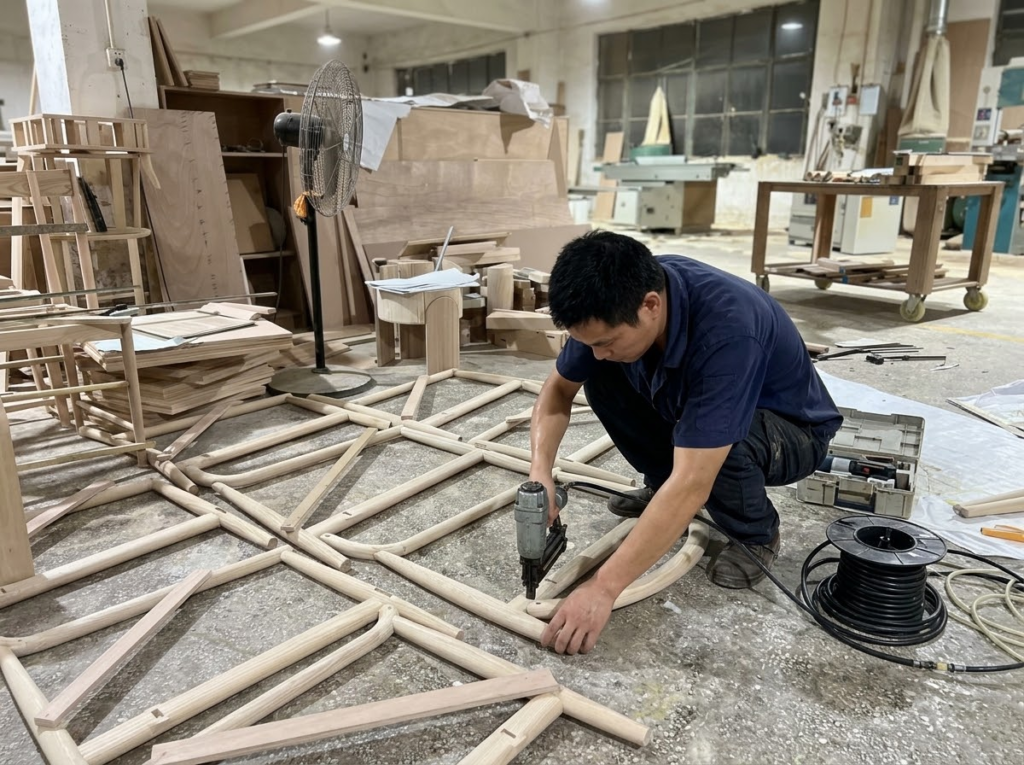
Let’s talk numbers without inventing fairy tales. A fully hand-joined solid wood headboard for a luxury hotel suite — mortise-and-tenon frame, floating panel construction, hand-planed surfaces — will run you roughly 2.5 to 3.5 times the cost of a CNC-plus-dowel equivalent from the same factory tier. That’s not markup. That’s labor hours.
A master joiner in Guangdong earns about what a mid-level carpenter earns in Ohio. The difference isn’t wage arbitrage. It’s throughput. One master might finish two headboard frames per day. A CNC line does twenty.
But. (And this is the paragraph that starts with “But.”)
The callbacks, refinishing, and replacement costs on the CNC version over a ten-year hotel lifecycle? Industry observers estimate those can add another 40-60% to the total cost of ownership. The hand-joined piece doesn’t loosen. Floating panels don’t crack. Corners don’t separate after the third winter of central heating.
Here’s a comparison that buyers actually find useful:
| Factor | CNC + Decorative Handwork | Authentic Master Joinery |
|---|---|---|
| Unit Cost | Lower upfront | 2.5–3.5x higher |
| Lead Time | 6–8 weeks | 10–14 weeks |
| Wood Prep | Standard kiln | Climate-specific curing |
| QC Requirement | Standard third-party | On-site master verification |
| 10-Year Maintenance | Moderate to high | Minimal |
| Best For | Budget-conscious residential | Hospitality, heritage projects |
The real kicker? Some of the finest joinery work I’ve seen in the past five years came from factories you’ve never heard of. No English website. No Alibaba storefront. Just a workshop in Anji with a WeChat account and a reputation that travels by word of mouth among Shanghai architects.
How to Actually Source This: A Buyer’s Playbook
You want ancient Chinese joinery in your Western project. Great. Here’s how to not waste six months and a deposit.
First — Define “joinery” like you’re talking to a mechanic, not a poet. Don’t say “traditional craftsmanship.” Say: “Mortise-and-tenon frame construction. No metal fasteners in load-bearing joints. Hand-fitted tolerances within 0.2mm.” Specificity saves you from the dowel-in-a-mortise trick.
Second — Visit during production, not just pre-shipment. The smoke and mirrors happen in the middle. Show up unannounced if you can swing it. (I learned this the hard way in Dongguan — the “master” was a 22-year-old with a Dremel and a YouTube tutorial.)
Third — Ask about wood curing protocols. Not just “Is it kiln-dried?” Ask: “What’s the target moisture content for Colorado?” If they blink, you’re in trouble.
Fourth — Budget for a local QC agent who actually gets joinery. Not some generalist inspector who counts screws and checks paint. Someone who can look at a corner joint and tell you if the tenon was hand-fitted or machine-routed. This costs money. Not doing it costs way more.
Fifth — Red flag: The factory claims they can do “any style of joinery” at scale. No one can. Masters specialize. Some do mortise-and-tenon. Some do interlocking bracket sets — the kind you see in Ming reproductions. Some do dovetail variations that never made it to the West. A factory that promises everything? Cutting corners.
Sixth — Build in time for iteration. The first sample will be wrong. Not because the factory is incompetent. Because your Western expectations of “flush” and “tight” might differ from their traditional tolerances. Plan for two, maybe three, sample rounds.

FAQ: What Buyers Actually Ask
Q: Can I get genuine hand-joinery at a price that works for a 200-room hotel project?
A: Yes, but not for every piece. The smart play is tiering: hand-joinery for visible case goods — headboards, reception desks, lobby tables — and CNC-plus-hand-finish for secondary pieces like nightstands and wardrobe interiors. Based on export data patterns, this hybrid approach has become the standard for upper-midscale hospitality projects sourcing from Guangdong. You’re buying the story where guests can touch it, and buying efficiency where they can’t.
Q: How do I know if the “master joiner” they showed me is real or just for the tour?
A: Ask to see his work in progress, not finished pieces. A real master has calluses, a bench covered in shavings, and works on multiple pieces simultaneously in various stages. If the “master” is sitting in a clean room with one perfect sample and no active work, he’s an actor. (And yes, this happens more than anyone admits.)
Q: Will ancient joinery techniques pass modern Western building codes and fire regulations?
A: Depends on the application. Structural joinery — load-bearing frames, bed platforms, table bases — typically passes mechanical testing if the wood is properly spec’d and the joints are engineered to local standards. The issue isn’t the joinery method; it’s the combustibility rating of the finish and any adhesives used. Most reputable factories serving Western hospitality already navigate this. But you need to specify NFPA or local equivalent compliance in your technical pack, not assume they know your jurisdiction.
Q: Is it faster to source from China than from European artisan workshops?
A: For volume, usually yes. For one-off custom pieces, usually no. A European workshop might deliver a single hand-joined cabinet in 8 weeks. A Chinese factory doing the same work often needs 10-12 because they’re slotting your piece into a production queue. The advantage isn’t speed — it’s the ability to replicate at volume without losing the hand element. That’s the niche Chinese furniture craftsmanship has carved out in the past decade.
Q: So, is ancient Chinese joinery actually worth it for Western projects?
A: It depends on whether your client can tell the difference — and whether you can afford for them not to. For trophy projects where the furniture is part of the architectural statement, absolutely. For spec residential where the buyer shops on price per square foot, probably not. The sweet spot is high-end hospitality and heritage residential: projects where longevity matters, callbacks are expensive, and the story of the piece is part of the sale.
The Hard-Earned Lesson
I started this business thinking craftsmanship meant perfection. Zero gaps. Mirror finishes. Joints so tight you need a microscope.
Wrong.
The best joinery I’ve seen in fifteen years of factory floors? Tiny, intentional tolerances — fractions of a millimeter — built in to let the wood breathe. The master knew the piece would outlive the building it sat in. He wasn’t building for the photograph. He was building for the third owner, fifty years from now, who’d run a hand along a corner and feel that it was still solid.
So here’s the question I leave with buyers: Are you sourcing furniture for your next project review, or for the guest who checks in two decades from now?
Lao Chen knows the answer. He’s known it for forty years.