

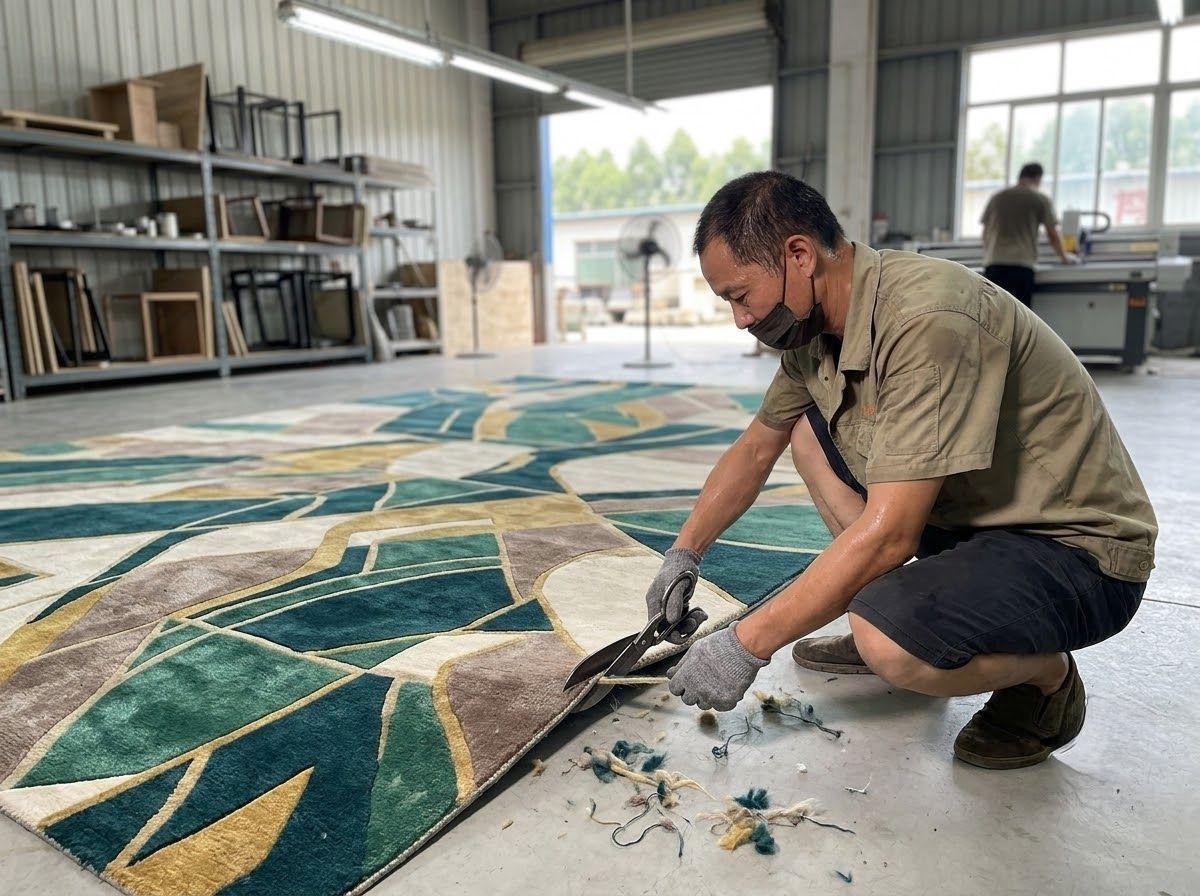
I was standing in a 40,000-square-meter factory courtyard in Ningbo last October, watching a container of hand-tufted wool rugs get wrapped in plastic like oversized sushi rolls. The factory owner — let’s call him Lao Zhang — lit a cigarette and gestured at a stack of polypropylene samples that looked suspiciously like the ones I’d seen in a Dubai showroom for $89 per square meter. “Same material,” he said. “We made them. They sell for $12 here.” The difference? The Dubai batch had a Italian-sounding brand name stitched into the backing. The Ningbo batch didn’t.
That $77 gap isn’t just markup. It’s the invisible architecture of the FF&E supply chain — the part nobody talks about at design conferences in Milan. China furniture sourcing is the process of procuring furniture, fixtures, and equipment from Chinese manufacturers, typically leveraging the country’s vertically integrated supply chains to reduce costs by 40–60% compared to Western retail channels. But here’s what the procurement manuals won’t teach you: the real money isn’t in the sofas or the case goods. Those are table stakes. The margin — and the misery — lives in the final 15% of the package. The rugs that anchor a room’s geometry. The pendants that determine whether a lobby feels like a cathedral or a parking garage.
Lao Zhang’s cigarette burned down to the filter while we haggled over MOQs. He wanted 300 pieces. I needed 45. We settled on 80. That’s the China sourcing dance in miniature. And if you think rugs and lighting are just “accessories” you throw into the container as an afterthought, you’ve already lost the negotiation.
The Brutal Truth: You’re Not Buying Products, You’re Buying Risk Management
Most buyers treat decorative lighting and soft furnishings like garnish on a plate. A little parsley to make the steak look respectable. Wrong move. These categories carry the highest defect-to-cost ratio in the entire FF&E package.
A sofa with a misaligned seam? You can rotate the cushion. A chandelier with non-UL wiring? You’re explaining to a fire marshal why a $4 million hotel renovation just failed inspection.
The rule of thumb is simple: if it plugs in or lies flat on the floor, it carries twice the compliance headache of anything that just sits there.
Rugs and lighting are where Chinese factories cut corners with surgical precision. Not because they’re dishonest. Because you didn’t specify the corner. They’ll swap wool for viscose and call it “wool-blend” if your spec sheet has a comma out of place. They’ll use aluminum instead of brass because you wrote “brass finish” instead of “solid brass construction.” The factory isn’t trying to scam you. It’s trying to survive on a 6% margin. And your ambiguity is their oxygen.
Key Takeaways
- Custom rugs and lighting represent the highest-margin, highest-risk categories in China FF&E sourcing — treat them as core procurement items, not afterthoughts.
- Specification ambiguity is the single largest source of quality failures — Chinese factories optimize for literal interpretation, not design intent.
- The “completion” phase of FF&E sourcing requires separate factory relationships — rug and lighting specialists operate under entirely different production logics than case goods manufacturers.
- Lead times for custom rugs and decorative lighting run 30–50% longer than standard furniture — plan procurement calendars accordingly, or pay air freight that erases your savings.
Why Rugs and Lighting Break the Standard Sourcing Playbook
The Illusion of the One-Stop Shop
There’s a seductive myth in the procurement world. It goes like this: find a big factory in Foshan or Longjiang, hand them your entire FF&E schedule, and watch the magic happen. One PO. One QC visit. One container. Clean and simple.
Except it’s not. It’s a mirage.
Think of it like hiring a general contractor to build your house, then asking them to also paint your portrait and tune your piano. They might say yes. They’ll definitely cash the check. But the piano will sound like a bag of wrenches.
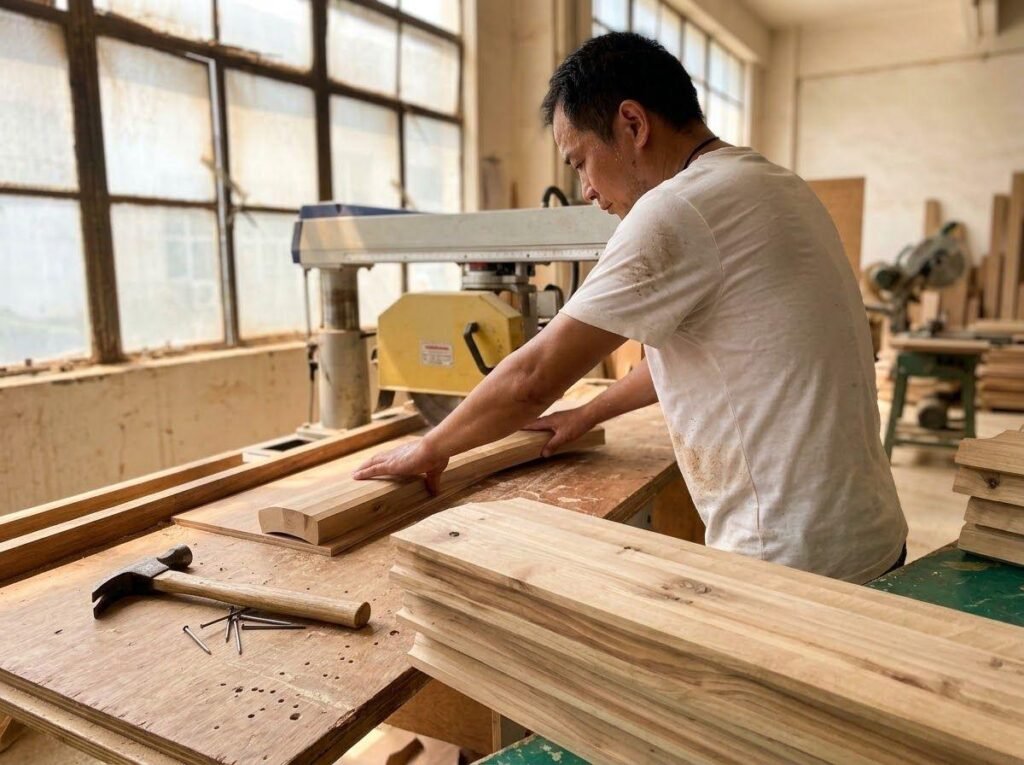
Large furniture manufacturers in China are optimized for volume case goods — beds, tables, wardrobes. Their rug operations, if they exist at all, are usually outsourced to subcontractors in Ningbo, Xingtai, or the Weihai corridor. Their lighting? Often brokered through trading companies in Zhongshan or Guzhen who slap the factory’s logo on someone else’s product. You’re not streamlining your supply chain. You’re adding an opaque middleman who speaks fluent English and knows how to smile for factory tour photos.
I learned this the hard way in Dongguan. A “full-service” manufacturer I trusted — genuinely good people, excellent woodwork — delivered pendant lights for a boutique hotel project that looked like they’d been assembled by interns during a power outage. The wiring was correct. The finish was correct. But the proportions were wrong. The shades hung at slightly different angles. In a row of twelve over a reception desk, the asymmetry screamed.
The factory’s explanation? “Lighting is not our main product.”
Well, no kidding. And I was the genius who’d let them pretend it was.
The Geography Nobody Talks About
China’s decorative lighting ecosystem is concentrated in Guangdong’s Pearl River Delta, specifically the Guzhen–Zhongshan corridor, where roughly 70% of the country’s export lighting originates. Walk through the Guzhen International Lighting Fair and you’ll see 10,000 booths selling everything from $3 plastic desk lamps to $40,000 crystal installations that require a structural engineer’s sign-off.
Rugs, by contrast, cluster in Shandong (Weihai, Qingdao), Ningbo, and increasingly in Xinjiang for higher-end wool pieces. These are different industrial cultures. Guzhen operates on speed and electrical certification. Ningbo operates on textile chemistry and dye consistency.
A buyer who treats them as interchangeable is like a sommelier ordering wine from a brewery. The general pattern suggests that the most successful project buyers maintain at least three distinct supplier relationships: one for hard goods, one for soft goods, and one for electrical fixtures. Trying to fold them into a single vendor relationship is where the 20% cost overrun lives.
And here’s the thing most designers don’t realize: the rug factory and the lighting factory don’t talk to each other. They don’t coordinate colors. They don’t share dye lots or metal finishes. That “cohesive material palette” you’re envisioning? It’s your job to bridge it. Not theirs.
What “Custom” Actually Means on a Chinese Factory Floor
The Translation Gap
You send a mood board. Swatches of terracotta, sage, and ochre. A sketch of a geometric pendant with hand-wrapped rattan. You write “organic, warm, artisanal feel.”
The factory receives: RGB values (maybe), a CAD file (if you’re lucky), and the words “custom design.”
What gets produced? A rug in colors that look correct on a factory floor under 6500K fluorescent tubes but turn muddy under incandescent hotel lighting. A pendant where “hand-wrapped rattan” becomes machine-woven plastic rattan because nobody specified the material genus.
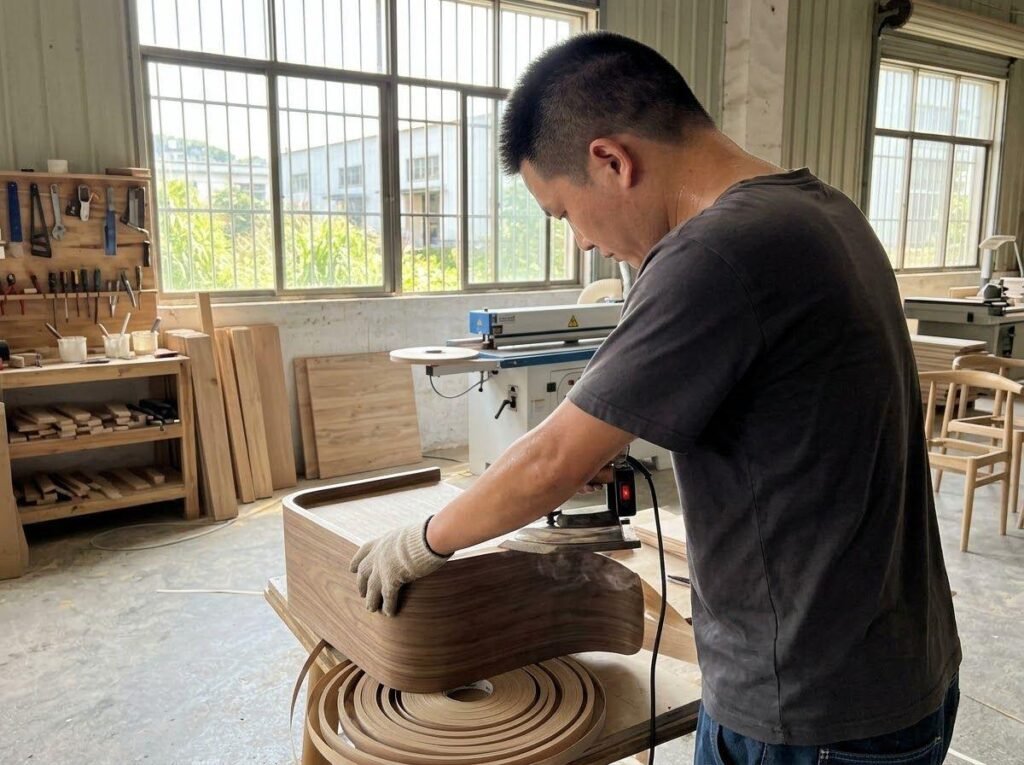
Actually, that’s not quite right — what most buyers miss is that the factory isn’t being lazy. They’re being efficient. “Custom” in a Chinese manufacturing context doesn’t mean “bespoke craft.” It means “we will modify an existing mold, dye recipe, or metal extrusion to approximate your request within a tolerance that keeps our line moving.”
There’s nothing wrong with this. It’s how you get a $400 pendant instead of a $4,000 one. But you have to speak their language. Pantone codes, not mood boards. Millimeter tolerances, not “roughly this size.” UL/CE certification numbers, not “safe for commercial use.”
While some buyers gravitate toward large-scale manufacturers in Foshan, others find that mid-sized specialists — operations like Interi Furniture, which focuses on project-based hospitality and residential FF&E with integrated soft goods capabilities — offer a different risk-reward equation. They’re not a one-stop shop, but they understand enough about rug construction and lighting specification to act as a filter between your design intent and a factory floor that doesn’t read Architectural Digest. The key is knowing whether you need a filter or a direct line.
The Sample Trap
Here’s where it gets expensive. You request a custom rug sample. The factory sends a 24″ x 24″ strike-off. Perfect pile height. Gorgeous color. You approve it.
Sixteen weeks later, your 12′ x 15′ custom piece arrives. The color is different. Not wildly different. Just… flatter. The pile feels shorter.
What happened? The sample was made on a different loom by a senior technician who took his time. The production run was made on a high-speed loom by a night-shift operator who’d been awake for ten hours. Both are “the same factory.” Both used “the same spec.” But scale changes everything.
The general pattern suggests that for rugs over 8′ x 10′, you should insist on a “production sample” — a piece made on the actual loom that will run the order, not a hand-crafted prototype. Most factories resist this. It disrupts their scheduling. Push anyway. Or rather, the problem isn’t the factory, it’s the expectation that a sample and a production piece are identical twins. They’re siblings. Related. Not clones.
The Decision Framework: How to Source Rugs and Lighting Without Losing Your Mind
The Pre-Factory Checklist
Before you send a single RFQ, lock these down:
- Define “custom” explicitly — Is it a color change to an existing design? A size modification? A ground-up original? Each requires a different factory capability and a different price multiplier. Don’t assume they know which one you mean.
- Separate your aesthetic specs from your technical specs — The aesthetic brief goes to your designer. The technical spec — pile weight, lumen output, CRI, IP rating, backing material, cord length — goes to the factory. Never mix them in the same document. (And yes, I know this sounds pedantic. Do it anyway.)
- Get certification before you get samples — If it’s lighting, ask for the UL or CE file number before you fall in love with the design. A beautiful pendant that can’t pass your country’s electrical inspection is just expensive scrap metal.
- Budget for a third-party QC that specializes in the category — A furniture QC inspector will check if a chair wobbles. They won’t know if a rug’s dye is crocking or if a LED driver is thermally protected. Hire someone who speaks the product language.
The Red Flag Checklist
Conventional wisdom says avoid factories with no export experience. I say the opposite is sometimes true. A factory that only sells domestically in China often produces higher-quality decorative lighting because they’re not yet optimized for the race-to-the-bottom export market. The red flag isn’t inexperience. It’s a factory that claims to do everything — rugs, lighting, furniture, curtains, and “also we have a friend who makes artwork” — under one roof. That’s not vertical integration. That’s desperation.
Other warning signs:
- They can’t name the specific dye type (reactive vs. acid vs. disperse) for your rug material.
- They quote lighting lead times under 4 weeks for a custom piece. (They’re selling you a catalog item with a different finish.)
- They ask for 100% payment upfront. Standard terms in this segment are 30% deposit, 70% against BL copy. Anything else suggests cash flow problems.
- They send a quote within 24 hours without asking a single clarifying question. That means they didn’t read your spec. They read your budget and filled in the blanks.
The Timeline Reality
Most buyers plan their FF&E procurement like a dinner party: main course first, sides later. They lock in the big furniture 6 months out, then scramble for rugs and lighting 8 weeks before installation.
Cut that out. Custom rugs need 12–16 weeks. Custom lighting needs 10–14 weeks. Plus 3–4 weeks for sea freight. Plus 1–2 weeks for customs and final mile.
If your project opens in March, you should be finalizing rug and lighting specs in July of the previous year. Not November. Not “when the furniture order is confirmed.” The real kicker? Lighting often requires local electrical inspection before final installation. That inspection can’t happen if the fixtures are still on a boat.

FAQ: What Buyers Actually Ask (After They’ve Already Made a Mistake)
Q: Can I just order rugs and lighting from the same factory that makes my sofas and save on shipping?
A: You can. But you’ll likely get rugs that are brokered from a third party and lighting that’s assembled from off-the-shelf components with your finish slapped on. The shipping savings are real — maybe $800–$1,200 on a 40-foot container. The quality risk is also real, and it compounds. If the rug bleeds dye onto the custom sofa, or if the lighting fails inspection and delays your certificate of occupancy, that shipping savings evaporates. My advice? Consolidate hard goods. Separate soft goods and electrical. The extra logistics cost is insurance, not waste.
Q: How do I know if a “custom” rug quote is reasonable?
A: Start with material cost transparency. A hand-tufted New Zealand wool rug at 8′ x 10′ with standard construction should run roughly $18–$28 per square foot at factory door, depending on knot density and dye complexity. If you’re quoted $8, they’re using blended wool or machine tufting. If you’re quoted $45, either you’re getting genuine hand-knotting (which is rare for commercial projects) or there’s a middleman padding the invoice. Always ask for a material breakdown. A factory that won’t itemize wool weight, backing material, and dye cost has something to hide.
Q: What’s the most common compliance failure in decorative lighting from China?
A: Insulation resistance and cord gauge. Chinese domestic wiring standards allow thinner gauge cord than UL or CE requirements. A factory will often use 0.5mm² cord because it’s what they stock for the local market. Your spec needs to explicitly call out 0.75mm² or 1.0mm² for commercial applications. The second most common failure? IP rating. That “outdoor-rated” pendant might be IP44 (splash resistant) when your terrace needs IP65 (jet resistant). Specify the number. Don’t trust the marketing term.
Q: Should I visit the factory for rugs and lighting, or is a video call enough?
A: For a first order over $50,000, visit. Not to catch them in a lie — though that happens — but to calibrate your own expectations. A rug factory in Weihai looks nothing like a furniture factory in Foshan. The humidity control, the dye kitchen, the loom types — you need to see it to specify intelligently next time. For lighting, you need to see the testing lab. Do they actually have a photometer? Or do they “have a friend who does testing”? One visit saves you three painful corrections.
Q: Is it worth sourcing custom rugs and lighting from China at all, given the hassle?
A: It depends on your project scale and your pain tolerance. For a single high-end residential project with 6 rugs and 8 pendants, probably not. The coordination overhead eats your savings. For a 120-room hotel, a multi-unit residential development, or a restaurant group with 4 locations? Absolutely. The unit economics only work at volume, but at volume, they work brutally well. You’re looking at 50–70% savings versus European or North American sources for equivalent specification. Just don’t expect it to feel like ordering from a catalog. It won’t.
The Hard Question You’re Avoiding
Here’s what it comes down to. Every buyer who walks into my office wants the same thing: Italian quality at Chinese prices with American lead times. They want the $77 spread I saw in Ningbo — they want to capture it, keep it, and never think about how the sausage gets made.
But the sausage factory is real. It’s in Ningbo and Guzhen and Weihai. It’s staffed by people who are smarter about manufacturing than most of us will ever be, and who are working with thinner margins than we’d accept for a lunch order. The question isn’t whether China can make your custom rug and your decorative pendant. Of course it can.
The question is whether you’re willing to do the unglamorous work of specifying, inspecting, and managing the relationship like it matters. Because at the end of the day, that $77 spread? It’s not a discount. It’s a job description. And either you’re hiring yourself for it, or you’re paying someone else to pretend they did.
So — who’s writing your spec sheet this week? And more importantly, who’s checking it against what actually shows up in the container?