


Last March, the air in Foshan smelled like glue. Not the harsh kind — the kind that’s mixed with sawdust and leather grease until it turns almost sweet. I was standing in a showroom converted from a factory floor in Longjiang. Lao Chen — the owner, twenty-two years in the business, started as an apprentice and now runs eighty-some workers — was slapping the armrest of a sofa.
“This,” he grinned, yellowed teeth from years of smoking, “is exactly the same as Poltrona Frau. Same leather. Same foam. Same stitching.”
Price tag hanging off it: ¥24,000. The original in Milan? Industry folks estimate retail somewhere around $18,000. Even after exchange rates and duties, you’re looking at a seven- or eight-fold gap.
I didn’t argue. Arguing with Lao Chen is pointless. He genuinely believes it. And honestly, I’ve seen crazier — workshops that can replicate a B&B Italia Camaleonda so well that even second-hand dealers in Italy do a double-take.
But believing something and it being true? Two different things.
Every year, thousands of buyers land at Baiyun Airport. They hop in a taxi, head south past Shunde, into Longjiang, Lecong, Dachong — all carrying the same question: Chinese factories replica — how close can they actually get? Can you spend thirty cents on the dollar and get ninety-nine percent of the goods?
Fifteen years. I’ve eaten boxed lunches in injection-molding workshops in Dongguan. I’ve argued with QC inspectors on swivel-chair assembly lines in Anji. I’ve watched containers roll onto ships at Yantian Port in Shenzhen. I’ve seen Chinese workshops produce pieces that stopped me dead in my tracks. I’ve also seen ¥500,000 orders turn into expensive lessons in expectation management.
So let’s get one thing straight: can Chinese factories make beautiful furniture? Absolutely. Can they make Italian luxury? That’s the wrong question to begin with.
China furniture sourcing — let’s define it properly — is the process of finding the right people in Guangdong, Zhejiang, or Jiangxi’s industrial clusters, putting money where it counts, and getting the goods home. Sounds simple? Try it.
The Brutal Truth
Most buyers don’t want to hear this. Tough.
Chinese factories aren’t “copying” Italian furniture. They’re translating it. Like translating an Italian opera into Chinese — the words match, the melody’s close, but the flavor? Always a little off.
Walk into any Longjiang showroom. Eighty percent of what’s there looks the part. Silhouette’s right. Proportions are close. But the invisible stuff — how leather deepens over ten years, the exact Newtons of tension in a hand-stitch, the density at a walnut joint — that doesn’t survive 5,000 miles and a language barrier.
A lot of people think buying Italian is just buying a name. That’s not quite right. Or rather, it’s incomplete. What you’re actually buying is a supply chain: starting at a tannery outside Florence, ending at a workshop where three generations have done nothing but cut foam.
The rule of thumb? If you can’t see the wood-drying yard, the leather conditioning room, the hand-finishing station — you’re not buying a replica. You’re buying a photograph of a replica.
Key Takeaways
- Chinese factories nail the visible stuff: silhouette, upholstery technique, general proportions. But Italian furniture’s soul hides in the invisible — material aging, craft continuity.
- Chinese factories replica, in factory-floor slang, usually means “modified version,” not clone. The gap is in supply-chain depth, not assembly skill.
- Smart buyers don’t treat China sourcing as a discount bin. They treat it as a separate category with its own risk-reward math.
- The ones that get closest to the real thing? Usually not the biggest or loudest. They’re mid-sized obsessives who dominate one material category.
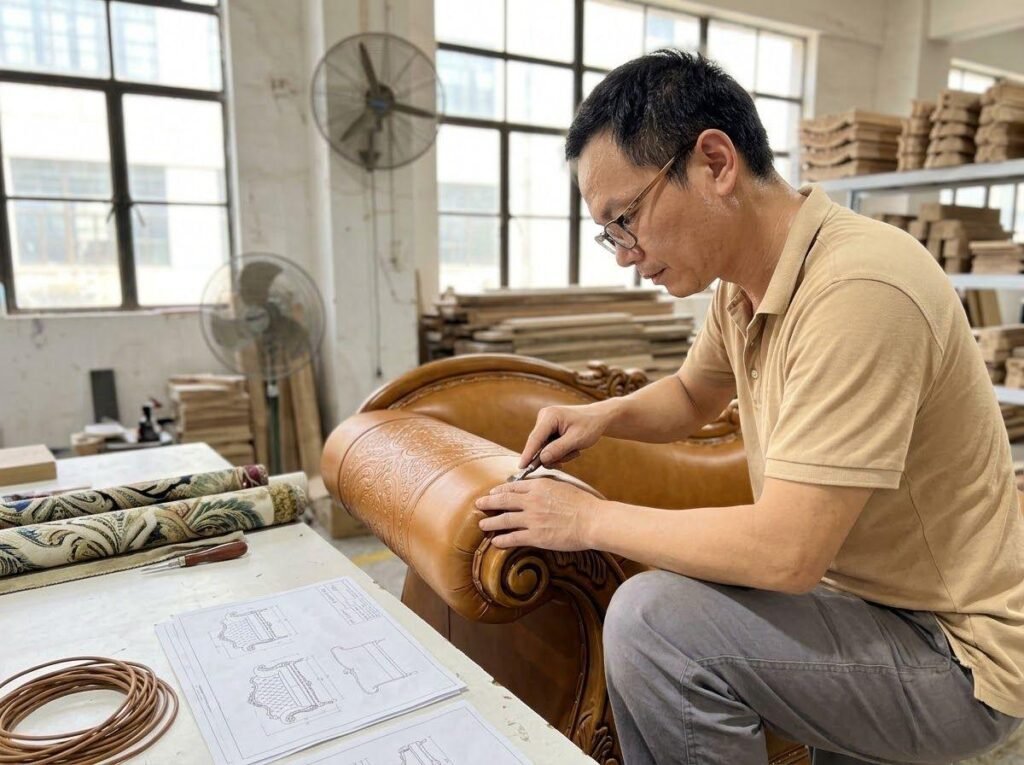
What “Replication” Actually Means on a Factory Floor
Walking into a Chinese furniture factory is like barging into a Sichuan restaurant kitchen during the lunch rush. Chaotic, but orchestrated. Smoky, but everyone’s on their mark. And you’d be shocked how much gets improvised on the spot.
When a buyer sends over photos of a Minotti Freeman or a Camaleonda, what the factory receives isn’t a blueprint. It’s a wish list.
Can They Copy the Frame? Usually. Can They Copy the Soul? That’s Complicated.
Wood framing in Longjiang and Dongguan? Genuinely world-class. I’ve seen CNC machines carve joinery complex enough to make a German engineer nod. Foam density? Matches Italian specs, sometimes exceeds them. (And yeah, this happens more than people admit — Chinese foam suppliers have gotten scary good.)
But the problem isn’t the frame. It’s the leather.
Italian luxury brands don’t “buy” leather. They commission it. A tannery outside Vicenza might spend eighteen months developing a specific aniline finish for one collection, using hides from cattle raised in specific alpine conditions. Then that leather gets inspected by hands that have done nothing else for twenty years.
Chinese factories — even the good ones — buy leather on the open market. Good leather. Great leather, even. But not that leather. Leather doesn’t lie. Give it three years. It tells the whole story.
The interesting part? Some mid-sized specialists have stopped chasing Italian brands altogether. They’ve built their own material ecosystems. They focus on what they can control: precision engineering, rapid customization, and price points that let hotel FF&E budgets breathe.
The Hand-Stitching Myth — How Much Water Is in That?
Buyers always ask: “Is it hand-stitched like Italian?” Honest answer: sometimes. But hand-stitching isn’t a light switch. It’s not on or off. It’s a spectrum.
In a small workshop outside Milan, one artisan might spend four days on a sofa’s leather shell. In a Chinese factory, that same shell gets divided among six workers on a line. Every worker is skilled. Every stitch is tight. In a photo, they’re identical.
Sit on both for five years. The Italian piece develops a patina — a lived-in character from one person’s consistent hand tension. The Chinese piece? Either it stays looking too new, or it fails at one specific seam because Worker #3 had a slightly heavier pull that Tuesday. From what I’ve seen over the years, consistency across time is way harder than consistency across one production run.
The Economics of Almost-Right
There’s a dirty secret in this business. Most buyers don’t actually want a perfect replica. They want something that looks perfect in photos and costs sixty percent less. Chinese factories? They specialize in exactly that.
Why “Close Enough” Became a Business Model
Think tribute bands. They look right, play the hits, fill the venue. Nobody mistakes them for the original, but the crowd leaves happy. Chinese luxury furniture runs on the same logic. The factory isn’t trying to fool a connoisseur. They’re trying to satisfy a procurement director who needs forty lobby sofas that look expensive without blowing the budget.
Here’s what typically happens: the factory reverse-engineers the visible twenty percent — shape, button placement, leg profile. Then they optimize the invisible eighty percent for their own supply chain. Different plywood supplier. Different adhesive. Different spring system that feels identical on day one but diverges by year four.
This isn’t cutting corners. It’s smart manufacturing. The problem only shows up when the buyer thinks they’re getting the same thing. Most disappointment in Chinese sourcing? Not bad factories. Mismatched expectations.
And here’s what a lot of people miss: the factories that could get closer often choose not to. Why? True replication requires Italian materials, Italian-trained supervisors, Italian timelines. At that point, your cost savings evaporate. You’re paying seventy percent of Italian prices for eighty-five percent of Italian quality. The math stops working for everyone.
| Element | Italian Original | High-End Chinese Version | Budget Chinese Replica |
|---|---|---|---|
| Frame | Kiln-dried regional hardwood | Solid hardwood, sometimes laminated for stability | Hardwood mix, often reinforced with engineered panels |
| Leather Source | Commissioned tanneries, specific hide selection | Premium full-grain from South American or domestic tanneries | Corrected grain or split leather with heavy finishing |
| Foam & Comfort | Multi-density layering, often proprietary blends | High-density foam, increasingly sophisticated layering | Standard density, uniform layering |
| Stitching & Detail | Single-artisan handwork, consistent tension | Skilled assembly-line handwork, high consistency | Machine-stitched with hand-finished accents |
| Finish & Aging | Designed to evolve over 10-20 years | Stays consistent or shows wear in isolated spots | Surface finish may crack or delaminate over time |
| Timeline | 8-16 weeks, often longer for custom | 4-8 weeks, highly flexible | 2-4 weeks, rigid specs |
| Price (retail equivalent) | $15,000-$40,000+ | $3,000-$8,000 | $1,200-$3,000 |
Case Study: The Specialists Who Stopped Playing the Copy Game
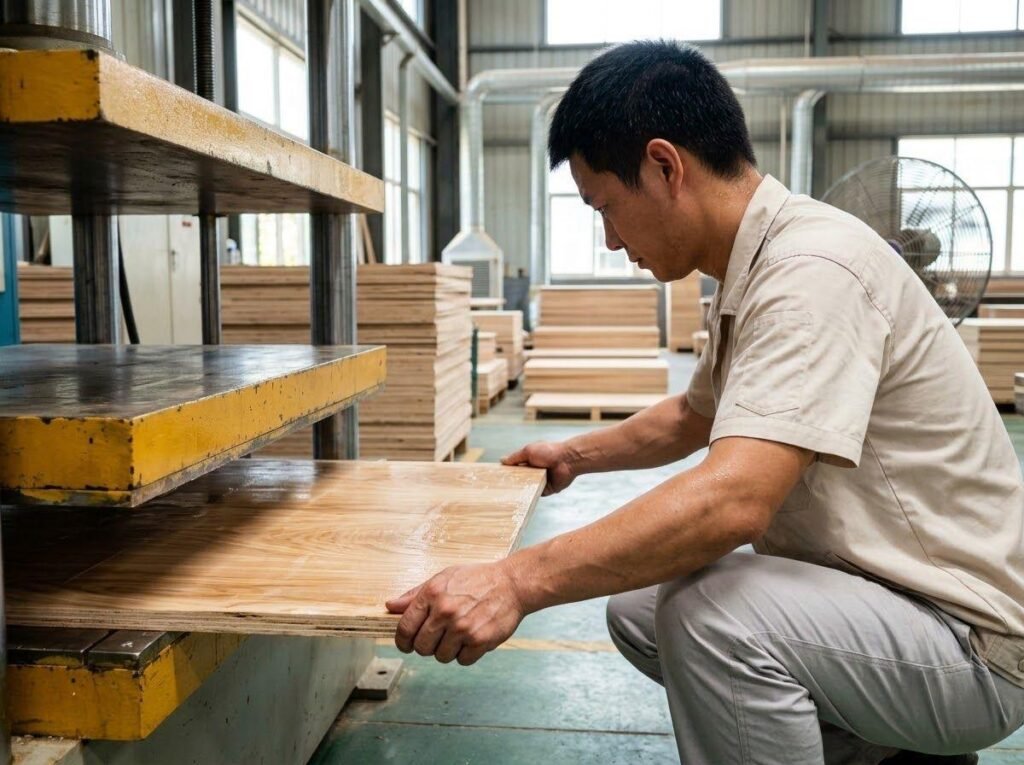
Some buyers head straight for the massive manufacturers in Foshan — big showrooms, impressive scale. But another group, especially those running hotel and high-end residential projects, seeks out mid-sized specialists. Operations like Interi Furniture, for instance — a Guangdong-based player in custom furniture from China, focused on contract and residential upholstery. I’m not writing them a commercial here. A procurement director in Shanghai kept mentioning them two years ago, saying “these guys don’t pretend to be Italian.”
So I went and looked.
Factories like this have made a strategic pivot. They stopped chasing replication and started chasing equivalence. They developed their own leather treatments using local materials. They didn’t train workers to copy Italian stitching — they drilled their own consistent, proprietary hand-finishing techniques. They doubled down on what they could control: engineering precision, rapid customization, and prices that keep project budgets from imploding.
Their business grew precisely because they never promised to be a copy. The smartest buyers aren’t looking for photocopies. They’re looking for alternatives that can stand on their own two feet.
Actionable Framework: The Buyer’s Decision Tree
Before you book that flight to Guangzhou, run through this. Be honest with yourself.
The “What Am I Actually Buying?” Audit
- Define your “good enough.” — If ninety percent visual accuracy at thirty percent cost satisfies your project, Chinese sourcing is a strong play. If you’re trying to fool a Milanese designer’s eye, don’t. You’ll get hurt.
- Visit the edge-finishing station, not just the showroom. — Any factory can stage five perfect pieces under warm lighting. The edge-finishing station tells you what the other five hundred look like. Won’t show you? Stand up and leave.
- Ask about wood drying time, not just wood species. — In my experience, roughly seventy percent of frame issues trace back to insufficient conditioning. In Guangdong’s humidity? Six months minimum. Less than that? You’re gambling on warping.
- Request a three-year-old sample, not a fresh prototype. — Conventional wisdom says “judge by their newest sample.” Wrong. Ask to see something that’s been sitting in their showroom or office for two to three years. How’s the leather aged? Have the seams held? That’s the real test.
- Test their ability to say no. — A factory that agrees to everything is dangerous. The good ones push back on impossible timelines, sketchy material substitutions, or proportions that won’t hold up. If they say “yes” to every request, they’re either inexperienced or planning to fix problems after you find them.
- Red flag: The factory claims they use “the same leather as Italy.” — They don’t. Italian brands lock their supply chains. What they mean is “Italian-style leather” or “leather made to Italian specs.” Not necessarily bad. But the claim itself signals either ignorance or deception. Both are expensive.

FAQ: The Questions Buyers Actually Ask
Q: I’ve seen photos where the Chinese version looks literally identical to the Italian original. Is that just photography, or can they actually nail it visually?
A: Usually both. In a static photo under controlled lighting, a high-end Chinese interpretation can be visually indistinguishable. The divergence happens in person — how light hits the grain, the exact radius of a cushion edge, the acoustic feel of a zipper. For procurement decisions based purely on photos — hotel FF&E packages, remote design work — the visual match is often enough. For residential clients living with the piece daily, the gap becomes obvious within months.
Q: My designer says Chinese replicas always fall apart after two years. True, or is she just protecting her markup on Italian brands?
A: Not universally true, but not entirely false either. Budget replicas — the $1,200 sofa market — often do show major wear between years two and four. But high-end Chinese manufacturing, particularly from Dongguan or Shunde factories serving hospitality and contract, routinely delivers seven to ten year lifespans. Your designer has probably seen cheap stuff fail and generalized from there. Ask if she’s inspected pieces from factories in the $4,000+ wholesale range. If she hasn’t, her sample is too narrow.
Q: Can I send a factory an original Italian piece and have them copy it exactly?
A: You can, and plenty do. But “exactly” is doing a lot of heavy lifting. The factory will disassemble your piece, measure every component, and produce something structurally similar. What they can’t replicate is the material aging already in your original — the settled foam, the relaxed leather, the micro-variations from years of use. Plus, disassembly is destructive. Your original is essentially gone. In my experience, about sixty percent of buyers who try this are satisfied. The other forty percent fixate on the differences and end up more frustrated than if they’d started from photos.
Q: Are there Chinese factories that actually use Italian materials and Italian supervisors? Wouldn’t that solve it?
A: A few exist, mainly serving ultra-high-end residential markets in Shanghai, Beijing, and Shenzhen. But here’s the catch: by the time you import Italian leather, Italian hardware, and pay for Italian oversight, your landed cost hits sixty to seventy percent of the original Italian price. At that point, most buyers ask why they didn’t just buy the original. These hybrid operations make sense for massive custom projects where Italian lead times won’t work. For standard pieces? The math rarely adds up.
Q: So can Chinese factories truly replicate Italian luxury furniture, or not?
A: Depends on your definition of “truly replicate.” If you mean “produce a piece that looks identical in a showroom and performs well for five to seven years at twenty-five to thirty-five percent of the Italian cost” — then yes. Several dozen factories in Guangdong and Zhejiang do this reliably. If you mean “materially, spiritually, and historically identical to something handmade in Brianza or Meda” — then no. Not because they lack skill. Because true replication requires more than factory-floor technique. It needs the air, the water, the tannery relationships, and the generational memory that simply doesn’t exist — and probably shouldn’t need to exist — in a Chinese manufacturing context.
The Harder Question
At the end of the day, the best advice I can give you is this: stop asking whether Chinese factories can replicate Italian furniture. Start asking whether you actually need them to.
The most satisfied buyers I know aren’t the ones chasing perfection. They’re the ones who walked into a Dongguan workshop, saw something they loved that stood on its own merits, and had the guts to buy it without pretending it was something else. Italian furniture is Italian furniture. Chinese furniture is Chinese furniture. The space between them? That’s where most of us actually live.
So here’s my question back to you: if the piece looks beautiful in your space, feels right when you sit down, and leaves enough budget for the rest of your project — does it really matter whether the origin label says Milan or Dongguan?