

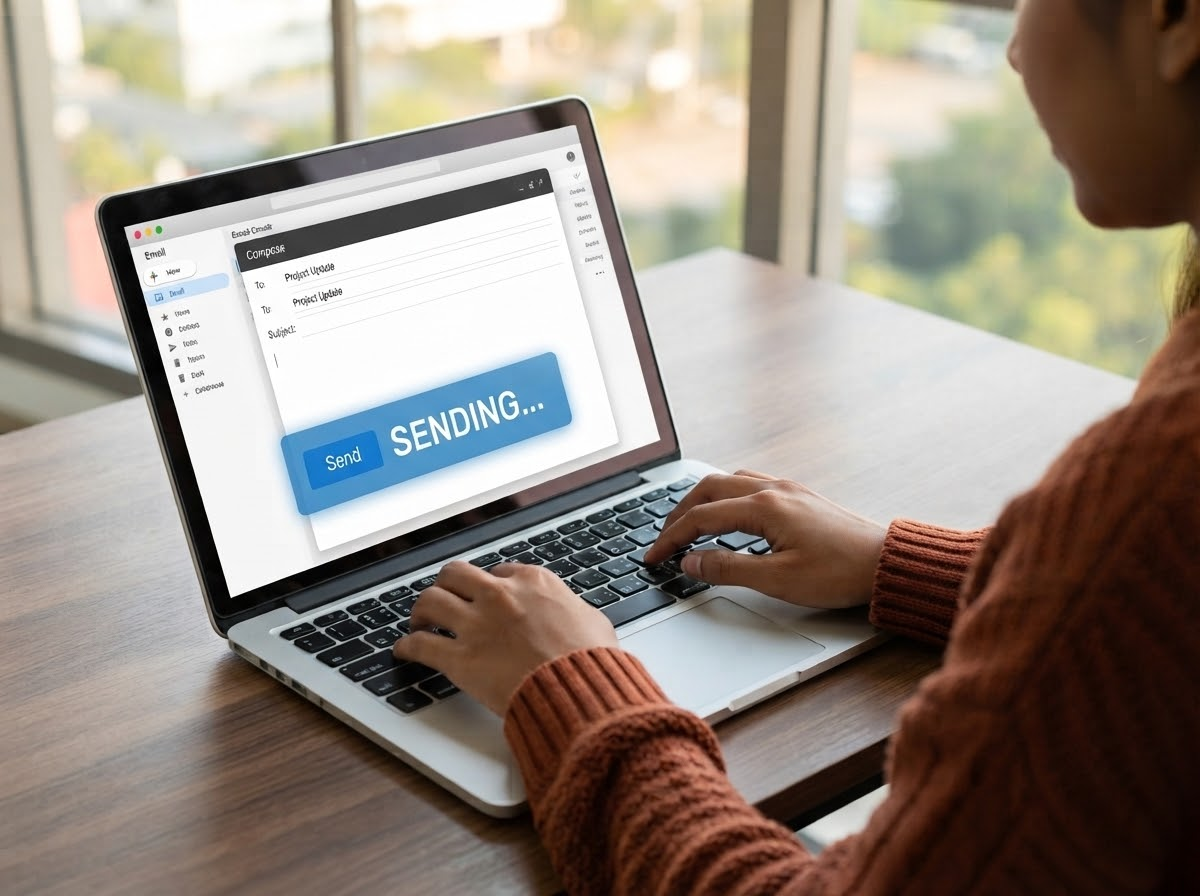
July. Lecong, Foshan. The kind of heat that makes the asphalt shimmer.
I was camped in a plastic chair outside a sample room — 40,000 square meters, sofas stacked to the ceiling — waiting on a delayed QC report. A sales manager named Xiao Li sat down beside me, lit a cigarette, and showed me his phone. 247 unread emails. He wasn’t bragging about being busy. He looked genuinely tired.
Then he tapped one. A buyer from Toronto. 1,800 words. I watched his thumb flick upward — scroll, scroll, scroll — until the scrollbar shrank to a sliver. He archived it. Total time on screen: about eight seconds.
“Actually a nice project,” he said. “Custom sofas. Good attachments.” Another drag on the cigarette. “But I don’t have twenty minutes to find out what he wants.”
That buyer spent a full afternoon on that email. Mood boards. A sustainability questionnaire. A paragraph about his brand’s story. Zero replies — and not because the factory couldn’t do the work. They ship $12 million in upholstered goods a year. He got ignored because the email itself screamed “expensive client, unclear brief.” The factory decided before reading a word. They always decide before reading.
Fifteen years of sourcing in China, and that eight seconds taught me more than any procurement seminar. Here’s what actually happens inside that inbox.
The Brutal Truth: Your Email Isn’t Competing with Other Buyers
Most buyers picture something orderly. A polite queue. Their inquiry filed neatly, waiting its turn beside other inquiries.
Wrong picture. Completely.
Your email lands in the same inbox as a WeChat voice note from the boss about a container stuck at customs, an Alibaba RFQ with a $400,000 order attached, and photos from the QC guy showing cracked table legs on a shipment that loads Thursday morning. That’s the competition. Not other buyers. Everything else in that sales manager’s day.
If your email takes longer to read than brewing a cup of instant coffee, it gets archived. That’s the rule of thumb. Instant coffee, not pour-over. Thirty seconds, tops.
Chinese furniture suppliers triage inquiries with a roughness that surprises first-timers. Big order, fast reply. Small order, slow reply. Unclear order, no reply. Long email? The order size stops mattering — you’ve been filed under “high maintenance” by paragraph two.
And the part that stings: length reads as risk. 2,000 words suggests a buyer who doesn’t know what they want. Ten rounds of revisions. A fight six months later about “what we meant.” The factory isn’t being rude by skipping your email. It’s protecting its margin.
Actually — that’s still not the full story. What buyers really get wrong is the sequence. The “difficult client” label goes on during the first scan. There is no second, more careful read. There’s a skim, a scroll, a decision. Done.
Key Takeaways — read this before you write anything:
- Chinese factory communication fails at the first email when it reads like a briefing document. Keep first contact under 150 words. Under 100 is better.
- No quantity and product in the first two lines? You’re in the “later” pile. In factory inboxes, later means never.
- Every email template China supplier reps actually answer follows the same skeleton: product, quantity, ask, timeline. Yours should too.
- So-called effective sourcing communication China advice online loves “building rapport first.” Rapport comes later. Clarity comes first.
- Your company story doesn’t win replies. Delete the company story.
Why Long Emails Get Ignored — Even When the Factory Needs Your Order
Picture a street food stall in Chengdu at noon. Steam everywhere, people shouting orders, one cook slamming woks who has maybe forty minutes before the rush ends. Now picture two customers. The first walks up and explains his philosophy of Sichuan cuisine, his grandmother’s recipe, and — here’s the fun part — asks seventeen questions about the oil. The second says: “Two portions mapo tofu, extra pepper. Here’s cash.”
Guess who eats.
The first customer probably has more money. Irrelevant. In the rush, clarity beats budget every single time. A factory sales inbox works exactly like that stall: hundreds of messages, one tired person, and a hard limit on patience per email. And the real kicker? The buyers writing those careful, thorough emails usually have real budgets and real projects. They’re just optimising for the wrong moment. Thoroughness is for after the deal starts moving. The first email has one job: get a reply.
Factories don’t reward effort. They reward precision. I learned that in Dongguan, the hard way — and no, I wasn’t a beginner. Eight years in, I sent a 900-word email to a solid wood specialist. CAD drawings attached, timber species spelled out, quality checklist included. Silence for a week. I cut it to 90 words, same attachments. Four hours later: “Your second email very clear. First one too many words, I think you not ready.”
Not ready. Me. With eight years on the ground.
What is the sales manager actually scanning for?
Three things. The order matters.
A number. 500 units. Hotel project. Dining chairs. If the first paragraph contains no quantity, the mental filing happens automatically: “maybe, eventually.” Which is a folder nobody opens.
Where you’re buying from. North American direct-to-consumer brand? Southeast Asian distributor? Domestic China project? Each answer slots you into a pricing tier and decides whether it’s worth waking the English-speaking rep from her nap. Harsh. Also accurate.
How fast you decide. “Ready to place order” and “quote needed by Friday” get fast replies. “Exploring options for Q3” gets buried under next week’s RFQs. You’re not emailing a concierge desk. You’re emailing someone whose commission depends on this month’s containers, not next year’s possibilities.
This is where most tips on effective sourcing communication China miss the mark. They teach you to sound professional. The inbox doesn’t reward professional. It rewards scannable.
There’s also a factory-size dynamic buyers consistently overlook. A 500-worker plant in Foshan has a sales floor triaging hundreds of inquiries a week — you’re a ticket in a queue. Mid-sized specialists run leaner desks. An export-oriented operation like Interi Furniture, focused on custom hospitality and residential upholstery, is the type of factory where your message competes with fewer others. But leaner cuts both ways: less patience for vagueness, because every production slot gambled on an unclear inquiry is a slot they can’t sell to someone definite.
And one thing the guides never mention: timing. Send during Golden Week and your email ages ten days in a dead inbox. Send Sunday night China time, and you’re on top of the pile Monday 8am. Free advantage. Most buyers never think about it.
| The 1,800-word email | The 90-word email | |
|---|---|---|
| Reading time | 6+ minutes | Under 30 seconds |
| First impression | “High maintenance” | “Knows what they want” |
| Typical response | Archived, no reply | Same-day or next-day |
| Signal sent | This client will burn my hours | This client moves fast |
| Right moment for it | After the relationship exists | First contact only |
The “Face” Paradox: Why Your Politeness Is Working Against You
Here’s a contradiction that trips up nearly every new buyer. Chinese business culture, they hear. Guanxi. Saving face. Long dinners, slow trust. So they overcompensate in the email. “We would be deeply honored if you might possibly consider…” “At your earliest convenience, perhaps you could…” “We fully understand if this is not feasible, but we were wondering whether…”
Stop. All of that. You’re not saving face — you’re creating homework.
In my experience, roughly seven out of ten factory sales reps under 35 — which is most of them now — prefer direct, even blunt, first contact. The courtesy dance exists, absolutely. But it happens after the deal is moving, usually over a meal, not in message one. Your first email is not a relationship. It’s a transaction proposal wearing an email’s clothes. Treat it like one.
But here’s where it gets stranger. The factories that do reply enthusiastically to long, deferential emails? Watch those. Hungrier operations. Excess capacity. Sometimes QC problems they don’t mention. The genuinely busy factory — three-month lead time, steady European clients, slots booked through Canton Fair season — has no time to decode your diplomatic masterpiece. They have time for a number, a product, and a deadline.
Or rather — the problem was never really the factory. It’s the expectation. Buyers write for a New York design studio, where context earns trust. Factory sales runs closer to a trading pit. Information density per second is the currency. Two different languages. Same alphabet.
The “3-Part” Email Template That Gets Replies
Fifteen years of bad emails and ignored follow-ups distilled into this: the working email template China supplier reps respond to is stupidly simple. Three parts. Each part has one job, like each station on a production line. Make a part do two jobs and the whole line slows down.
Part one: the subject line is a filter, not a summary
Your subject doesn’t describe your email. It filters who opens it.
- Bad: “Introduction and Partnership Inquiry from [Company]” — filters for nobody
- Good: “500pc Hotel Dining Chairs — Quote Needed by Sept 20”
- Bad: “Exploring Manufacturing Opportunities in China” — exploring means never
- Good: “Upholstered Armchair, Custom — Target FOB $85–110”
The formula: [Quantity] + [Product] + [What you need] + [Deadline, if it’s real]. If the deadline isn’t real, leave it off. Fake urgency is detectable from orbit.
Part two: the body — three paragraphs, nothing more
Paragraph one: who you are, what you want. One sentence each. “We’re a hospitality procurement firm in Austin. We need a quote for 300 lounge chairs for a hotel project. Delivery to Houston by March 2027.” Stop. No company history. No mission statement. Nobody has ever received a factory reply because of a mission statement.
Paragraph two: the specs that change the price. Dimensions. Materials. Certifications, if any. Got reference images? Attach them and write one line: “See attached for style and finish.” Do not describe the pictures in words. The pictures are the words.
Paragraph three: the ask, plus an exit ramp. “Please confirm you can produce this and send FOB pricing by [date]. If the specs or MOQ need adjusting, tell me your suggestion.” That last sentence matters more than it looks. Giving the factory permission to push back doubles your reply rate — a “no, but here’s what works” is still a conversation, and most failed inquiries die because the factory had no graceful way to say “your brief is impossible.”
Part three: the close — one line, nothing on it
“Best regards, [Name]. [Phone, with country code].”
That’s the whole email. One hundred fifty words is the ceiling. Ninety is better.
Red Flags: What to Delete Before You Hit Send
Run this list before every first email. Most of it contradicts business writing courses. That’s why it works.
- Delete the company introduction. If they’re curious, they’ll Google you in ten seconds. First email is not a pitch deck, and email template China supplier advice telling you to “establish credibility first” comes from people who’ve never watched an inbox get triaged.
- Delete the factory-background questions. History, worker welfare, sustainability certs — all valid. All for later, after they’ve replied and want the order. Lead with them and you’ve flagged yourself: difficult client, small quantity.
- Delete the multi-product inquiry. Chairs and tables and lighting in one first email reads like a catalog dream, not an order. Pick one. If it goes well, the rest follows.
- Delete “best price.” Those two words trigger the cheapest-tier quote, built from their cheapest materials. Give a target range instead, or ask for standard pricing with upgrade options listed.
- Delete the 48-hour ultimatum. “If we don’t hear back…” is the fastest way to never hear back. These reps have seen every urgency trick invented. Real deadlines work. Manufactured ones get you muted.
FAQ: The Questions Buyers Actually Ask
Q: My product is genuinely complex. Won’t a short email make me look unprofessional?
A: No — it makes you look decisive. Attach a one-page spec sheet or the drawings and write: “Custom upholstered armchair, specs attached. Please confirm feasibility.” The factory respects that. What reads unprofessional is a request buried under five paragraphs of context nobody asked for. Complexity lives in the attachment. The email is just the delivery truck.
Q: Should I run my email through Google Translate into Chinese?
A: Depends on the factory — and mostly, no. Big export operations in Foshan or Shenzhen handle English daily; a mangled machine translation creates more confusion than warmth. Smaller factories in Anji or Nankang that rarely export direct? A Chinese subject line with an English body can help. But never send a fully translated email without a native speaker checking it. Bad Chinese signals disrespect. Effort without quality is worse than no effort.
Q: How many follow-ups before I quit?
A: Three. One week apart, each shorter than the last. First: forward the original — “Following up on my inquiry below.” Second: “Checking in — still need [product] for [project].” Third: “Final follow-up. If capacity opens up, I’m still interested.” Then stop. In my experience, more than half of non-responses to a good short email mean the factory is at capacity, not that they hate you. Persistence past three crosses into the “difficult” file you were trying to avoid.
Q: Should I skip email and go straight to WeChat?
A: WeChat is faster once a conversation exists. For first contact, email first — it creates the paper trail and reads as more serious. Found the rep’s WeChat on their Alibaba profile or website? Send the email, then a short WeChat note: “Hi, sent an email re: 500 dining chairs. No rush on reply.” Don’t open with the full inquiry on WeChat. Unsolicited long messages there feel intrusive, and first impressions are the whole game.
Q: So — does a short email actually get me better pricing?
A: Not directly. But pricing talks can only happen with factories that reply. Yes — a short, specific first email gets you significantly more responses from Chinese furniture factories, at any order size. The email isn’t where you win terms. It’s where you earn the seat at the table where terms get decided.
The Lesson That Took Fifteen Years
At the end of the day, sourcing in China isn’t about being the smartest buyer in the room. It’s about being the easiest “yes” the factory gets all week. Feels backwards, doesn’t it? Shouldn’t they be chasing you? Sometimes — the small, hungry ones do. But the operations with real capacity, the ones worth building a supply chain around, have options. They pick the buyers who communicate like partners from message one.
Which raises the question I still can’t shake, years after watching Xiao Li archive that Toronto buyer: how many good products and good relationships died in an inbox because someone wrote a beautiful email nobody had time to read?
Don’t make yours the next one.
Keep it short. Send it at the right hour. And save the storytelling for the dinner, where it belongs.