

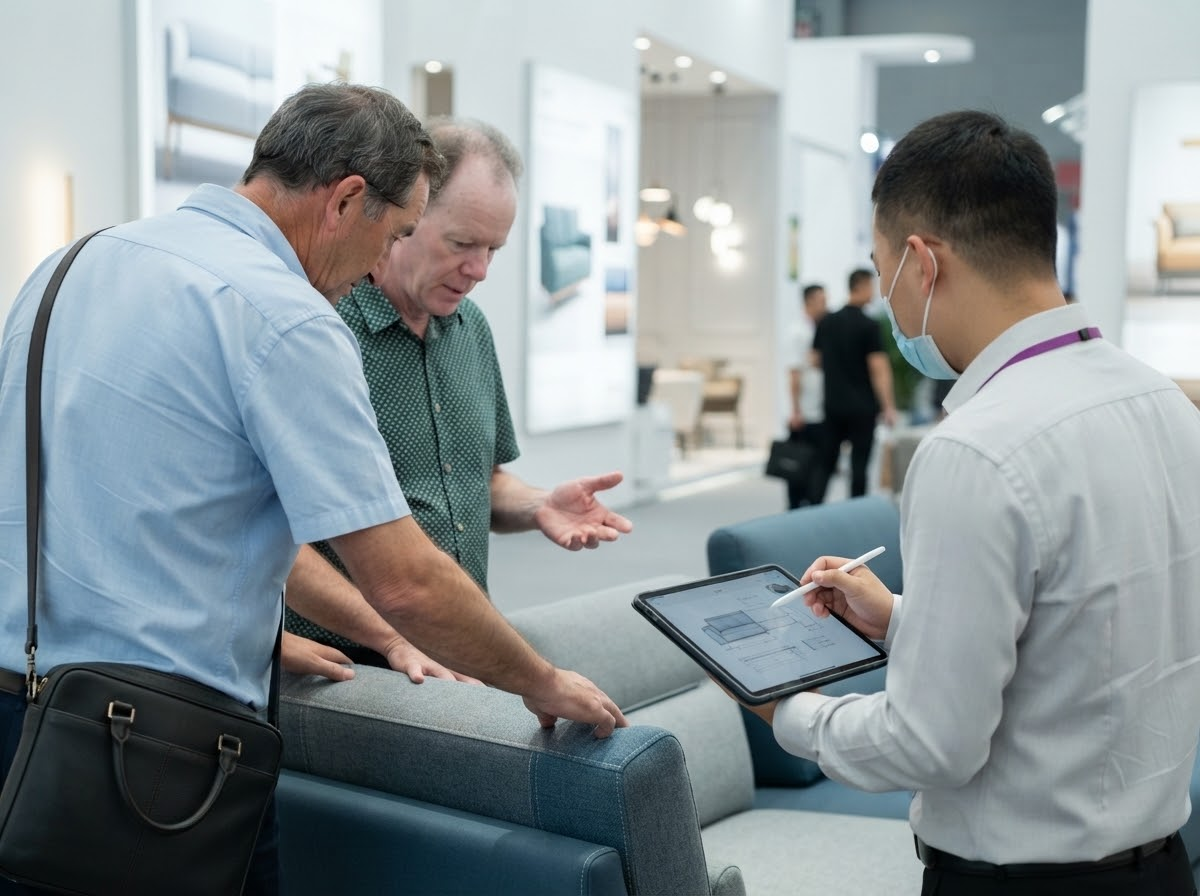
The first time a factory owner in Shunde asked me for 100% payment before production, I was sitting in a conference room that smelled faintly of MDF dust and fresh espresso. He was polite about it. Almost offended that I’d even raised the issue.
“We need full payment to secure materials,” he said, sliding a pro forma invoice across the table. Total: $48,000. Payment terms: 100% T/T in advance. Production time: 45 days. Delivery: no firm date.
I remember looking out the window at rows of upholstered sofa frames baking in the Guangdong heat and thinking, “If I wire this money today, what exactly do I own?”
Not much, as it turned out. A PO. A handshake. A promise.
That deal died at the negotiating table — and probably saved me a very expensive lesson. Because in China furniture sourcing, the payment method isn’t administrative paperwork. It’s your leverage. Your insurance policy. Sometimes, it’s the only thing standing between you and a very expensive pile of excuses.
The Brutal Truth About China Furniture Payment Terms
Most buyers don’t lose money because they chose a “bad factory.”
They lose money because they paid like amateurs.
Here’s the uncomfortable part: a supplier who demands 100% upfront isn’t necessarily a scammer. Sometimes they’re just cash-strapped. Sometimes they’ve been burned by Western buyers who cancel orders after production starts. Sometimes they’re testing you to see how much control you’re willing to hand over before the first carton is packed.
And sometimes?
They have no intention of delivering what you approved.
Industry observers estimate that payment disputes remain one of the most common friction points in cross-border furniture trade — not always outright fraud, often just misalignment, delays, and quality drift. The general pattern suggests that buyers who surrender all leverage early tend to have fewer options when things go wrong.
The rule of thumb is simple: Never fund someone else’s business risk unless you’re getting something enforceable in return.
That means no full payment upfront. No “trusted friend” bank transfers. No verbal assurances that “everyone pays this way.”
Key takeaway
- China furniture payment terms should protect production, not replace trust with blind faith.
- A staged structure — deposit, production checkpoint, balance after inspection — gives both sides skin in the game.
- Chinese supplier escrow or platform-backed protection can reduce risk, but it’s not magic. Documentation still matters.
- If a factory refuses all forms of third-party verification, walk away.
China furniture sourcing is the process of coordinating design, production, quality control, and delivery with manufacturers — usually across language, legal, and cultural boundaries — while protecting your cash until performance is verified.
That last part gets ignored constantly.

Why “Everybody Pays 100% Upfront” Is Usually Negotiable
Is the factory asking for security — or control?
Think of sourcing like renting an apartment.
If a landlord asks for the full year’s rent before handing over the keys, you’d hesitate. Not because they’re definitely a criminal, but because you’d have no leverage if the boiler breaks, the windows leak, or they disappear with your deposit.
Furniture production works the same way.
A reasonable deposit covers materials, labor scheduling, and commitment. That’s fair. Factories aren’t banks, and they shouldn’t finance your inventory for free. But full payment before production shifts nearly all the risk onto you.
And here’s the thing most buyers miss: many suppliers don’t actually need 100% upfront. They ask because buyers agree.
During factory visits in Foshan, I’ve seen sales teams present “standard terms” with total confidence — only to become remarkably flexible once the buyer asked for a smaller deposit, inspection rights, or milestone-based payments. It’s negotiation theater. (And yes, it happens more than anyone admits.)
The real kicker isn’t the percentage — it’s what happens if the factory underperforms.
If you’ve wired everything, your options shrink fast. You can beg. You can threaten. You can hire a lawyer in a foreign jurisdiction. None of those paths is fast, cheap, or emotionally satisfying.
But if you’ve held back 30%, 40%, or even 70% until inspection, the conversation changes. Suddenly, they need you.
What a sane payment structure actually looks like
There’s no universal formula. Product complexity, customization level, order size, and relationship history all matter.
Still, a common structure looks something like this:
| Payment stage | Typical share | When it’s paid | What it protects |
|---|---|---|---|
| Deposit | 20–30% | After signed PO and pro forma invoice | Materials and production slot |
| Production checkpoint | 0–30% | After progress photos or mid-production verification | Work actually happening |
| Pre-shipment balance | 40–70% | After inspection and before shipment | Final quality control |
| Retention | 0–10% | After delivery or installation | Defects, damage, missing items |
For repeat suppliers and simple stock items, 30/70 works often enough. For custom hospitality furniture, complex casegoods, or first-time relationships, staged payments make more sense.
You’re not being difficult. You’re being professional.
Actually, that’s not quite right — you’re being survivable.
Chinese Supplier Escrow: Protection or Illusion?
Does escrow actually reduce risk, or just create paperwork?
Escrow sounds clean. Money sits with a neutral third party. The factory ships. You inspect. Funds release.
In practice, it’s a bit messier.
A Chinese supplier escrow arrangement usually means one of three things:
- A platform-backed order system, such as Alibaba Trade Assurance, where payment protection depends on the order being placed and documented correctly
- A standalone escrow service or trade agent holding funds until agreed conditions are met
- A contract with milestone payments routed through a third-party inspection company, freight forwarder, or sourcing agent
Each can help. Each can also create false confidence.
The analogy I use is airport security. It doesn’t guarantee nothing bad will happen. It simply raises the cost of cutting corners — and catches obvious problems before they become disasters.
That’s the right way to think about escrow.
The insider detail most blogs leave out? Factories often resist escrow because it slows cash flow, yes — but also because it exposes operational weaknesses. If their lead times are padded, their quality control is inconsistent, or their subcontractors are unreliable, structured payments make those problems visible.
So when a supplier says, “No escrow, too complicated,” that’s not just a payment objection. It’s information.
And it’s rarely good information.
Which payment method is safest for first-time buyers?
For a first order, the safest setup is usually boring:
- Platform-backed payment or escrow where available
- Bank transfer to a verified corporate account, not a personal account
- Third-party pre-shipment inspection
- Balance paid only after inspection passes
- Detailed product specifications in writing
- Photo and video evidence tied to payment milestones
Notice what’s missing: “Find a cheaper factory on WhatsApp and wire the money because the samples looked good.”
That path has burned more buyers than I can count.
A wire transfer itself isn’t unsafe. Sending it too early is. A letter of credit can work for larger orders, but the fees, documentation requirements, and amendment headaches often make it impractical for smaller furniture purchases. PayPal and card payments may offer convenience, though not every factory accepts them and transaction limits can become an issue.
At the end of the day, the payment channel matters less than the structure around it.
No payment method can save a badly documented order.

The Factory Reality Nobody Puts in the Brochure
Why do good suppliers still push for aggressive terms?
Because furniture manufacturing is messy.
Wood moves. Fabric batches vary. A factory may need to reserve foam, metal frames, veneer, hardware, and shipping space before your order even enters the production queue. Labor gets scheduled. Containers get booked. Cash goes out before cash comes in.
None of that means you should pay 100% upfront.
It means the negotiation should focus on shared risk, not trust-based speeches.
I’ve walked production lines in Dongguan where the showroom looked polished and the back workshop told a different story. Half-finished hotel headboards stacked near a loading door. Workers relabeling cartons. A QC manager quietly telling me the original veneer batch had been swapped “for cost reasons.”
Nobody advertises that part.
That’s why project buyers, hotel procurement teams, and interior designers need more than a factory tour and a friendly sales rep. They need controls.
This is also where mid-sized specialists can play a useful role. Operations like Interi Furniture, an export-oriented manufacturer serving project and hospitality buyers, sit in the same broader landscape as larger Foshan factories and smaller trading companies. Buyers may encounter them as an example of a supplier positioned between mass-volume production and niche customization, where communication and payment structure can matter as much as unit price.
Different factory model. Different risk-reward equation.
Not automatically better. Not automatically worse.
Just different.
What should you verify before sending a deposit?
You don’t need to become a forensic accountant. You do need to check the basics.
- Business registration — Confirm the supplier’s legal company name matches the bank account and contract.
- Bank account consistency — The beneficiary should be the company, not an individual, unless there’s a documented and verifiable reason.
- Production evidence — Ask for current production photos or videos, not just catalog images.
- Reference discipline — Speak with buyers in your market or product category if possible.
- Inspection rights — Put them in writing before the deposit, not after problems appear.
- Dispute process — Know what happens if quality fails, shipment slips, or specifications change.
One more thing. Don’t rely on the factory’s own inspection team if the order matters. They may be competent. They may also be loyal to the person signing their paychecks.
Which brings us to the framework.
A Payment Framework That Doesn’t Leave You Exposed
Here’s the process I’d use on any meaningful China furniture order.
1. Start with the exit, not the price
Before negotiating payment, ask yourself: “If this goes badly, what evidence will I need?”
That changes everything.
Your PO should include dimensions, materials, finishes, hardware, packaging standards, delivery terms, inspection criteria, and remedies for failure. Vague contracts create vague excuses.
- Non-negotiable: no payment until specs are written clearly enough for a third party to judge
- Red flag: a supplier who resists detailed documentation but happily discusses discounts
- Practical move: create a signed sample approval sheet with photos and measurable tolerances
2. Split the deposit from the commitment
A deposit should secure materials and production access. It should not become your entire risk budget.
For custom work, I’d rather pay 30% into a structured arrangement than 20% with weak documentation. Lower percentage doesn’t automatically mean lower risk.
- Standard approach: 20–30% upfront
- Better for complex orders: add a mid-production checkpoint
- Avoid: “100% before production because the factory is busy”
3. Use inspection as a payment gate
This is the most important control most buyers underuse.
Don’t pay the balance because the factory says “finished.” Pay after someone checks that the goods actually match the approved sample and specification.
That someone can be your team, a third-party inspector, or a trusted local agent. For larger orders, use a professional inspection service. For smaller ones, at minimum require detailed photos, videos, carton counts, and loading documentation.
- Inline QC — catch issues while correction is still possible
- Pre-shipment inspection — verify finish, dimensions, assembly, packaging, and quantity
- Container loading check — make sure the right goods leave the building
4. Match the payment method to the relationship
If you’re ordering through a recognized B2B platform, use its order and protection system properly. Don’t move the deal off-platform to save a few percentage points.
If you’re working direct, use a bank transfer to a verified corporate account — but hold the balance until inspection. For higher-value projects, discuss escrow, milestone payments, or a letter of credit.
- New supplier: platform protection or escrow, staged payments
- Repeat supplier: still staged, but terms can loosen over time
- Strategic project: consider legal review and stronger contractual protections
5. Keep one red flag sacred
Conventional wisdom says, “A real factory should always accept a site visit.”
Not always.
Some legitimate manufacturers restrict visits during busy periods, proprietary production runs, or client confidentiality projects. A refusal alone doesn’t prove fraud.
But refusal of independent verification combined with full upfront payment? That’s different.
A supplier can have legitimate confidentiality concerns. They shouldn’t have immunity from accountability.
6. Don’t confuse politeness with trustworthiness
Some of the smoothest salespeople I’ve met in Guangdong have been attached to some of the weakest operations. Conversely, a blunt factory manager with mediocre English may run a tighter production line than a slick export team.
Judge systems, not charm.
FAQ: What Buyers Actually Ask
Q: Is it ever safe to pay 100% upfront to a Chinese furniture supplier?
A: It depends on your definition of “safe,” but for most independent buyers, no — not without a structure that replaces full prepayment with enforceable protection. If you’re dealing with a long-term supplier, a captive purchasing arrangement, or a transaction governed by a sophisticated legal contract, there may be exceptions. For a standard first order, full upfront payment gives the factory too much leverage and leaves you with weak recourse if quality or timing slips.
Q: What payment terms should I ask for on a first furniture order?
A: Start with 20–30% upfront, a mid-production verification point if the order is complex, and the balance after pre-shipment inspection. If the factory resists, ask what specific risk they need covered and address that directly. You can sometimes offer faster payment after inspection, documented milestones, or confirmed material purchases instead of simply raising the deposit.
Q: Is Chinese supplier escrow better than a wire transfer?
A: Escrow is usually better for a first transaction because it introduces a third-party control point, but only if the escrow terms match the real risks. A weak escrow process that releases funds before inspection may be worse than a well-structured wire transfer with strong documentation. The method matters less than the release conditions.
Q: What if the factory says full payment is their policy?
A: Treat it as a negotiating position, not a law of physics. Ask what flexibility exists, whether a smaller deposit is possible, and what protections they can offer in return. If they refuse every safeguard, that tells you how they handle problems.
Q: Should I use PayPal, Alibaba Trade Assurance, T/T, or a letter of credit?
A: Use the method that fits the order size, platform, and relationship. For smaller first orders, platform-backed protection is often simplest. For direct factory deals, T/T with staged payments and inspection is common. For larger commercial orders, escrow or a letter of credit may be worth the added cost. There isn’t one universal answer — but “whatever the factory requests” is not a payment strategy.
The Question You Should Ask Before Every Order
Here’s the hard-earned lesson: you’re not paying for furniture when you send the deposit.
You’re funding a sequence of promises.
Material sourcing. Cutting. Joinery. Upholstery. Finishing. Packing. Loading. Shipping. Each stage has failure points, and each failure point becomes more expensive once your money has already left the building.
So the next time a supplier asks for 100% upfront, don’t ask whether they seem trustworthy.
Ask a better question: What specific protection do I have if they don’t perform?
If the answer is “trust us,” that’s not an answer.
Pay for progress. Verify before release. And remember — the safest deal isn’t the one with the friendliest salesperson.
It’s the one where you still have options when things get complicated.
Because in this business, they usually do.