


Last April, I watched a hospitality procurement director from Dallas completely lose her mind over a $6 cup of lukewarm Nescafé outside Hall 11 at the Pazhou complex.
She had just blown a $15,000 travel budget in 72 hours—gouged by surge-priced flights, a wildly inflated rate at the Westin, and enough bad exhibition hall food to ruin anyone’s mood. Her mission was supposed to be straightforward. Four days to source bespoke, low-volume, high-craftsmanship lounge chairs for a 60-key boutique resort in Texas Hill Country.
Instead? She got trapped. Trapped in a fluorescent-lit purgatory of 100,000-square-foot mega-booths, all of them pumping out the exact same millennial-pink velvet sectionals and faux-brass barstools. By day three, her Blundstones were scuffed, her patience was entirely shot, and she was loudly declaring to anyone who would listen that original Chinese craftsmanship was a massive, industry-wide lie.
But here’s the kicker. She wasn’t in the wrong country. She was just walking down the wrong aisles.
The reality of sourcing from the world’s factory floor isn’t that original design is dead. It’s that the workshops actually pioneering Canton Fair niche design don’t have half a million RMB to drop on prime exhibition real estate. They’re buried. Hidden in plain sight. You have to know exactly how to scrape the dirt away to find them.
The Brutal Truth About Mega-Factories (And Why They Hate Your Guts)
Let’s rip the band-aid off right now. Those colossal OEM (Original Equipment Manufacturer) factories anchoring the main walkways of the exhibition? They couldn’t care less about your 50-piece custom order.
They just don’t.
I see rookie buyers take this personally all the time. Don’t. It’s not personal—it’s just brutal floor-level mathematics. These operations are built to feed monsters. Their production lines stretch for literal miles out in industrial zones like Longjiang, calibrated perfectly to spit out 5,000 identical dining chairs for big-box retailers in Munich or Atlanta.
When you saunter up to their glossy reception desk with a highly customized rendering, you aren’t bringing them a “fun creative challenge.” You’re throwing a wrench into a CNC machine. Re-tooling a line or sourcing a weird foam density for fifty chairs literally costs them more in operational downtime than your entire deposit is worth.
Sure, a sharp-suited rep will hand you a glossy two-pound catalog, pour you some premium Tieguanyin tea, and promise you the moon.
But the second you turn around? Your mood board goes straight into the trash. If they actually make it, expect it to be a Frankenstein’s monster of miscommunication and cut corners.
Here is my hard-and-fast rule of thumb: If a factory’s showroom features an indoor waterfall, a grand piano, or more than two escalators, your boutique PO is way too small to get anything but their C-team.
Actually, let me correct myself. The problem isn’t their capability. They have the machines and the skilled labor. It’s their economic incentive structure. You can’t ask a freight train to parallel park, so stop getting mad when it crushes your car.
Key Takeaway: The Floor-Level Sourcing Reality
- Canton Fair niche design is a contact sport; it means hunting down low-volume, high-skill workshops hiding on the extreme edges of major trade shows.
- Volume kings won’t respect your small order. Period.
- Chinese independent furniture makers deliver world-class execution, provided you vet their actual factory floor, not just their trade show booth.
- Success means ignoring the front rows entirely and venturing into the fringes.
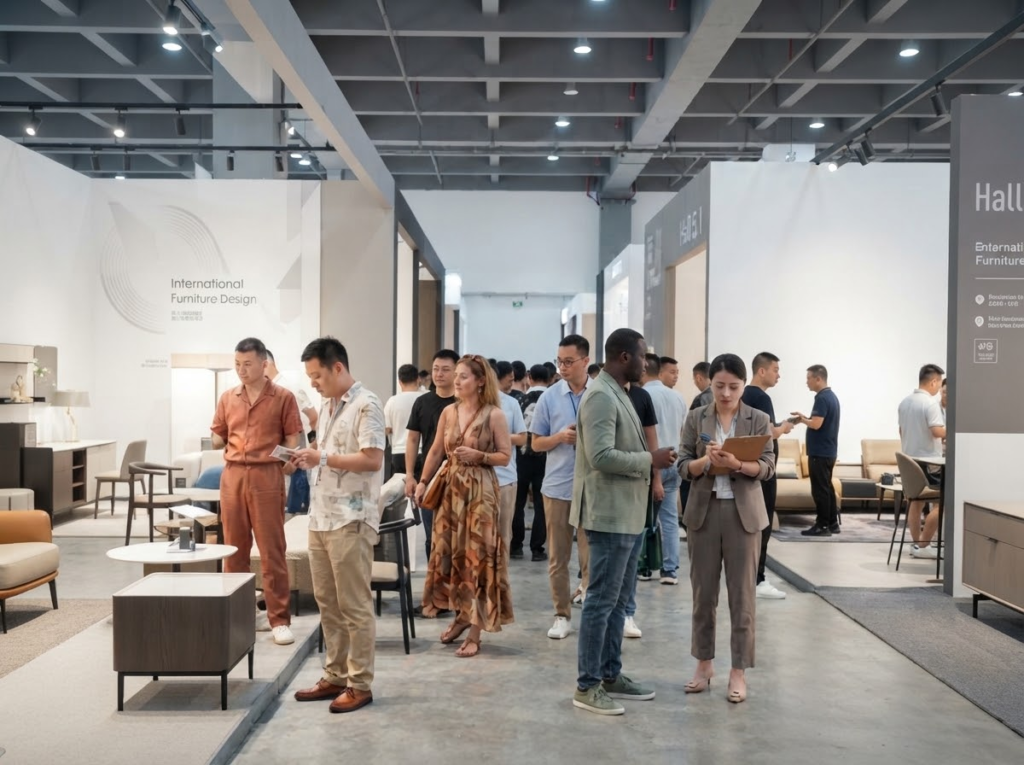
Digging Through the Crates (Hall 11’s Back Alleys)
Finding an independent design workshop at a massive Chinese exhibition is a lot like digging for rare vinyl in a chaotic, poorly lit thrift store. You’re elbow-deep in absolute garbage, surrounded by blaring pop music, desperately hoping your fingers brush against a masterpiece.
And trust me, Pazhou has a lot of garbage.
In my 15 years walking these concrete floors, I’ve learned that the real innovators are consistently shoved into pathetic 9-square-meter booths on the absolute fringes. I’m talking about the back corners near the loading docks. Sometimes they’re stranded in those temporary outdoor tents where the AC is a joke and the carpet smells distinctly like industrial glue.
Why do the best guys hide in the cheap seats?
Because they’re cash-poor and talent-rich. Front-row spots cost hundreds of thousands of RMB. The folks I track down are typically founder-led. Picture a lead designer who spent six years sweating in a Milanese prototyping shop before flying back to Foshan to lease a small warehouse. They blow their limited startup cash on importing raw, FAS-grade black walnut and perfecting their joinery, leaving exactly zero budget for slick trade show marketing or hired booth models.
Walk into one of these micro-booths, and you aren’t dealing with a commissioned middleman reading off a laminated spec sheet. You’re talking to the maniac who stayed up till 3 AM arguing with the sanding department about a quarter-inch edge radius.
The highest-value handshakes happen in the ugliest booths, directly with the founders.
Two years ago, I tripped over a tiny setup near a bathroom corridor. The owner had exactly three chairs out. That’s it. No QR codes. No promotional tote bags. Just three ash wood lounge chairs with exposed mortise-and-tenon joints so tight you couldn’t slide a piece of paper into them.
He didn’t need a massive booth. The product did all the heavy lifting. I flipped the chair upside down—a move that usually reveals a horror show of staples and cheap webbing on mass-market stuff—and it was totally flawless. (And yes, this level of obsessive craftsmanship happens daily, despite what the old-school industry gatekeepers claim). He wasn’t a trader; he was a craftsman who just happened to be sitting at a trade show.
The Factory Kid Rebellion
Let’s bury a tired cliché once and for all. The narrative that China is just a massive, unthinking Xerox machine for Western IP? Dead. It’s been dead for over a decade, though plenty of lazy buyers still stubbornly cling to it.
What’s actually happening is a quiet, ruthless rebellion led by a new generation of Chinese independent furniture designers. The industry is aggressively pivoting from cheap OEM (you draw it, we slap it together) to OBM (Original Brand Manufacturing—we design it, we build it, we own the brand).
Why the sudden shift?
Two major forces collided.
First off, the domestic money shifted. Wealthy thirty-somethings in Shanghai and Shenzhen are violently allergic to the gaudy, faux-European gold-trim garbage their parents bought in 2005. They demand quiet luxury. Culturally resonant minimalism. Things that look good in an architectural digest, not a mobster movie.
Second, look at who holds the keys to the factories now. The industry calls them the “factory kids.” These are the sons and daughters of the original 90s manufacturing tycoons. But unlike their parents, they didn’t grow up breathing sawdust and sleeping on the factory floor. They were shipped off to Central Saint Martins or the Rhode Island School of Design.
They came back, looked at their parents’ polluting, low-margin assembly lines, and essentially said, “Burn it down, we’re doing high-end.”
Wander the specialized design pavilions today, and the aesthetic hits you hard. It’s not a cheap knock-off of a Danish classic. It’s a modernized, stripped-down take on Ming Dynasty proportions, slammed together with crazy contemporary ergonomics.
You’ll spot small workshops obsessing over 45-density, triple-layer foam combinations to get the perfect seat pitch. You’ll see studios successfully merging raw, brutalist concrete casting with warm, steam-bent plywood.
The ultimate unfair advantage of Chinese independent design is having world-class creatives sitting 15 minutes away from the world’s most agile supply chain.
Think about the sheer speed of that. A designer in Brooklyn waits eight long weeks for a prototype revision from Asia. A designer in Dongguan drives down the street, screams at the production manager, and has a fixed physical sample sitting on their desk before dinner. You cannot compete with that iteration cycle.
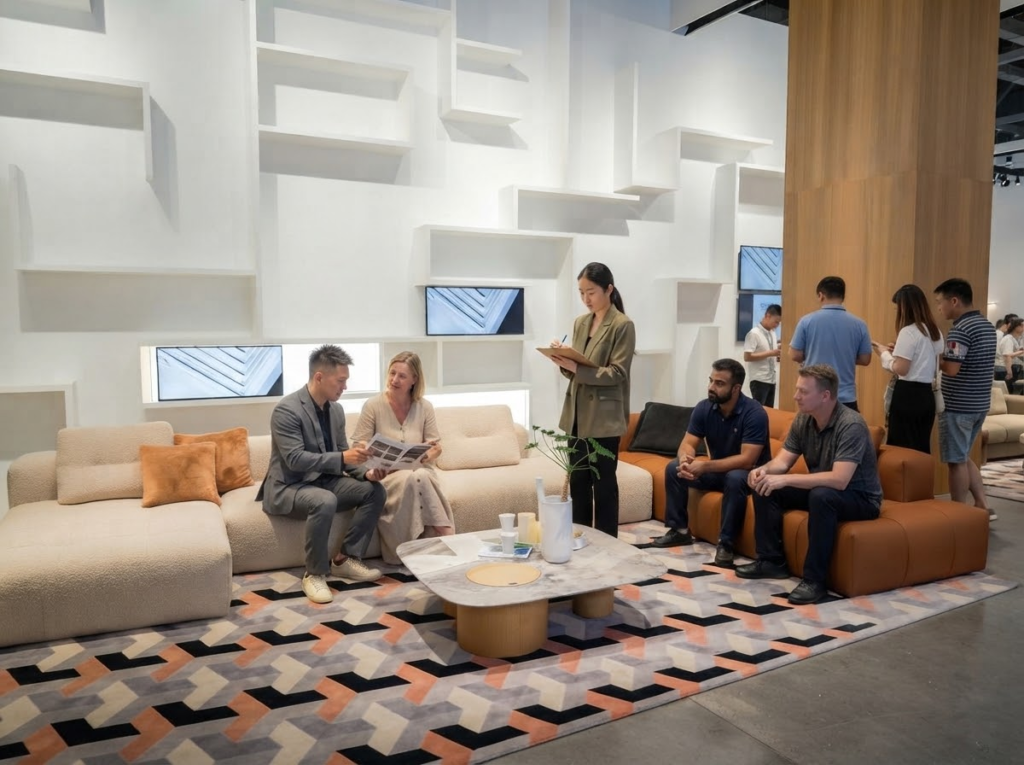
The Sweet Spot (Why Mid-Sized Players Win)
Now, let’s inject some operational reality here. Not every single project calls for a purist, five-person artisanal shop.
If you’re procuring for a 200-key luxury resort, handing the contract to a guy who lovingly builds three perfect chairs a week is a suicide mission. You’ll bankrupt him with cash flow issues, and he will absolutely nuke your installation timeline. But on the flip side, you don’t want to crawl back to the mega-factories and accept their rigid, take-it-or-leave-it abuse.
Enter the mid-sized specialists. They occupy the most lucrative, practical middle ground in the entire sourcing game.
While rookie buyers mindlessly gravitate toward the colossal Foshan volume-pushers (usually chasing an illusion of the lowest unit price), veterans play a totally different angle. They know that mid-sized specialists—take an operation like Interi Furniture, which heavily targets high-end, customizable seating and hospitality casework—offer a radically better risk-reward setup.
They are big enough to have militant quality control processes, English-speaking project managers, and actual export muscle. They know how to load a container so things don’t arrive in splinters. But—and this is the vital part—they remain lean and hungry enough to care about a complex, slightly annoying boutique hotel order.
These are the partners who won’t throw a fit when you send a third-party QC inspector to their floor. They’re the ones who will actively hunt down a specific, fire-rated bouclé fabric from a niche mill instead of forcing you to pick from a dusty, five-year-old swatch binder they keep in the lobby.
They are the operational bridge between “artisanal chaos” and “corporate rigidity.”
Sizing Up Your Partner on the Floor
| Factory Type | Best For | The Reality Check (What they won’t say) |
| Mega-Factory | 1000+ unit runs, big box retail | You are a rounding error. Zero custom materials. Insane line-changeover fees. |
| Mid-Sized Specialist | Boutique hotels, upscale retail | The operational sweet spot. Custom work at moderate scale with professional QC. |
| Niche Design Studio | Bespoke pieces, ultra-luxury residential | Master-level craftsmanship, but high cost, low volume, and serious timeline risk. |
The “Scout and Verify” Playbook
So, how do you actually separate the legitimate niche studios from the smooth-talking traders pushing repackaged garbage? You need a system. Wandering the aisles hoping for divine inspiration guarantees blistered heels and zero viable suppliers.
Here is the exact playbook I use when my boots hit the ground in Southern China.
- Skip the Glitz (Aggressively): I mean it. Walk past the first 20 rows of any hall without making eye contact. Head straight for the back wall and start your grid search in the shadows. The hungry innovators live on the perimeter. The front is strictly for dinosaurs with deep pockets.
- Hunt for the Mess: A flawless, hyper-styled booth makes me deeply paranoid. I want to see raw, unpainted wood frames. I want to see messy material swatches and half-finished prototypes scattered around the floor. A messy booth means they are actual makers experimenting with materials, not just slick catalog-pushers.
- The “Why” Test: Don’t just ask about pricing and MOQs. Point to a chair and ask why they chose a specific dovetail joint over a cheaper dowel, or why they used 35D foam on the backrest instead of 45D. If the rep stammers, avoids eye contact, and needs to “call the boss,” you’re dealing with a middleman. Walk away immediately. A true maker will aggressively defend their material choices.
- Demand the White-Wood Stage: A factory tour isn’t optional, but the shiny showroom is a total distraction. Demand to walk the “white-wood” floor—the area where raw, uncovered frames sit before upholstery. That’s where the liars hide their rotting pine and mismatched scrap wood. A real studio is proud of its naked frames.
- The “Yes Man” Red Flag: Beware the factory that instantly says “yes” to your wild design. If you slide a complex, gravity-defying cantilever chair sketch across the table, and they nod without asking a single aggressive question about weight distribution or export wood moisture content? Run. They are lying to secure your 30% deposit. They’ll butcher the physics later.
A real niche manufacturer will always critique and push back on your design to ensure it won’t collapse in the real world.

FAQ: Trenches and Tactics
Q: My budget only allows for an LCL (Less than Container Load) shipment. Will these guys even talk to me?
A: Yes. That’s precisely why they exist. A massive factory won’t fire up a machine for less than a 40-foot High Cube. But a niche studio eats LCL shipments for breakfast. Just mentally prepare yourself to pay a stiff premium for heavy-duty export crating, because your stuff needs to survive the brutal LCL consolidation process where it shares space with God-knows-what.
Q: How do I prove an independent studio actually makes the stuff, instead of just trading it from someone else?
A: Get out of the exhibition center. Book a Didi and go out to the industrial park. Skip the obligatory tea ceremony in the boss’s office and march straight into the raw materials warehouse. Does the wood on the racks match what they pitched at the booth? If they sold you on solid white oak, but the factory floor is drowning in cheap MDF and paper veneer, you just caught a bait-and-switch. Turn around and get out.
Q: Will my custom designs get ripped off the second I hand over the CAD files?
A: The IP environment is infinitely better than it was in 2010, but you still need a healthy dose of paranoia. Ironically, the best studios fiercely guard their IP because they are the ones constantly getting copied by the mass market. Still, if you’re co-developing a piece, lock it down with a ruthless NNN (Non-Disclosure, Non-Use, Non-Circumvention) agreement drafted by a lawyer physically located in China. Not your local buddy in New York.
Q: I don’t want to spend five grand flying to Guangzhou. Can’t I just dig through Alibaba from my couch?
A: No. You can’t feel the pitch of a backrest or the tension of a spring through a JPEG. Alibaba’s algorithm is entirely rigged for volume players who spend big on SEO and platform ads. Real niche design studios are notoriously awful at digital marketing. Their websites usually look like they were built in 2004 and never updated. You have to physically show up and hunt them down.
The Final Polish
Sourcing real, tactile design in China isn’t a vacation. It’s a grind. It’s not for the lazy, the spreadsheet-obsessed, or the easily intimidated.
It demands that you ignore glossy presentations, question literally everything, and walk concrete floors until your calves scream. The mass-market molds are incredibly seductive. They make the buying process frictionless. But if you take that easy road, your big commercial project is going to look exactly like a fast-casual waiting room.
You have to make a choice right now.
Are you a logistics coordinator just trying to pack a metal box on a boat as cheaply as possible? Or are you a professional trying to curate something that doesn’t feel soulless?
Because here is a hard lesson I learned years ago in a dusty Dongguan industrial park. The most expensive furniture in the world isn’t the bespoke, high-priced armchair from a stubborn independent studio. The most expensive furniture is the cheap, mass-produced garbage that snaps in half six months post-installation, injures a client, and completely torches your reputation.
Next time you’re standing in a massive hall, drowning in a deafening sea of beige, take a breath. Ask yourself: Are you ready to bypass the noise and find the people who actually give a damn about the craft?
See you on the floor. Wear decent boots.