

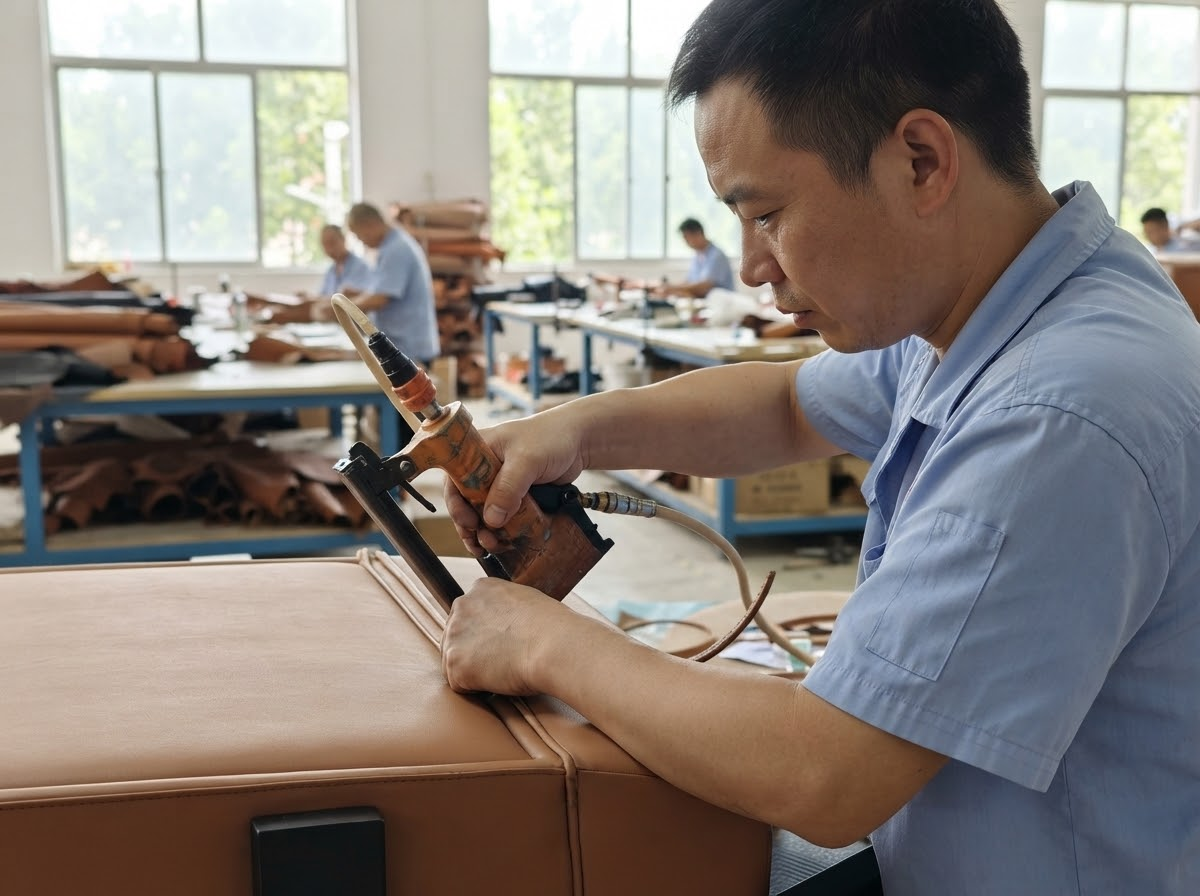
Longjiang in late July is miserable. The humidity traps the smell of toluene and hot sawdust right against your skin. That’s where I was—sweating through my shirt in a tin-roofed showroom—watching a $1.2 million hospitality deal catch fire.
The tragic part? The buyer sitting next to me didn’t realize it yet.
He was the VP of Purchasing for a boutique hotel group out of Chicago. Nice Italian suit. Zero floor sense. He sat across from the factory boss—a guy named Old Li who had been breathing MDF dust since 1998, and whose right index finger was missing its top joint. The VP tapped a heavy, 200-page brand portfolio on the glass table. His grand strategy? He was going to dangle the prestige of his hotel’s logo to bully Li into a 30% price reduction on 500 custom mid-century lounge chairs.
Li just smiled. He poured us another microscopic cup of bitter Tieguanyin tea. He nodded at the Chicago VP’s aggressive target price. Then, he agreed to the bottom-tier rate. No counter-offer. No fight.
The buyer leaned back, looking at me like he’d just cracked the Enigma code. He honestly believed his brand’s gravity had somehow bent the laws of global economics.
He was dead wrong. The second our DiDi pulled onto the highway, I guarantee Li was already on WeChat with his sponge supplier. He was swapping out the high-density HR foam for a recycled, calcium-carbonate-filled nightmare that would pancake flat by Christmas. The buyer won his spreadsheet victory. The factory preserved its margin. And the hotel guests? They ended up sitting on glorified cardboard right as the summer tourist season peaked.
The Brutal Truth About “Brand Leverage”
Let’s get this out of the way right now. You think your embossed logo matters to the guys running the panel saws? It doesn’t.
Your brand prestige? It’s worthless to the Shunde tax bureau. It sure as hell doesn’t cover the spiraling day rates for a half-decent upholsterer either. Buyers strut into these showrooms wielding their corporate names like a magic wand. They expect manufacturers to happily eat a financial loss just for the “privilege” of putting a famous Western name on an export ledger.
It’s a dangerous, arrogant fantasy.
Chinese factory owners are master pragmatists. They operate in a culture where explicitly telling a guest that their target price is mathematically impossible causes a massive loss of face for everyone in the room. So, they never say no. Instead, they engineer a “yes” that fits the exact budget you shoved down their throats.
If you steal the factory’s margin, they steal your chair’s skeleton. It’s that simple.
Key Takeaway: The Illusion of Procurement Power
- The China supply chain reality is about matching raw material costs to strict budget constraints, not trading prestige for unearned discounts.
- Factories run on razor-thin margins. Squeeze them below the market baseline for raw materials, and the difference comes straight out of the invisible structural components.
- The “Quality Fade” is absolutely real. An approved golden sample means nothing if the mass-production run is secretly downgraded to meet your extorted price point.
- Prestigious brands suffer the most reputational damage. You can’t fix a snapped chair frame with clever marketing.
The Anatomy of a Squeeze Play: The Invisible Downgrade
Walk the factory floor with me for a second. Negotiating with a supplier by leading with your brand’s clout is exactly like walking into a steakhouse, demanding Wagyu for the price of a drive-thru burger, and expecting the chef not to swap your steak for grade-D chuck. You get exactly what you force them to serve.
Why Do They Say Yes?
Because they have to keep the belts moving.
To keep an assembly line functional, managers need constant, massive throughput. Rent, machine leases, baseline salaries for core management—roughly 70% of a massive furniture facility’s overhead is entirely fixed. They accept your lowball, prestige-heavy offer just to keep the lights on and the workers busy so they don’t jump ship to a rival operation across the street.
But they aren’t charities. (And yes, this happens daily, even if your procurement team refuses to admit it out loud.)
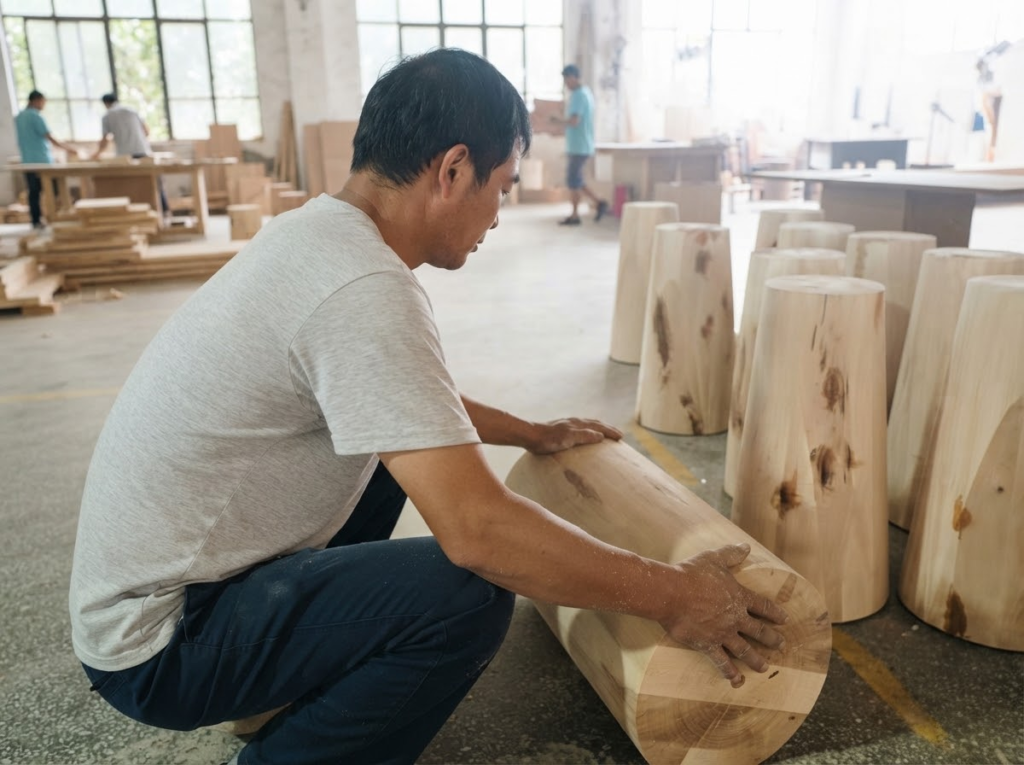
I remember walking through a sprawling facility in Dongguan last year. The floor manager proudly showed me their “A-tier” framing timber. Then he showed me their “B-tier” offcuts. They were separated by nothing but a single blue plastic tarp in the dusty corner of the warehouse. When a prestigious brand squeezes them on price, the workers don’t complain to HR. They just reach under the blue tarp.
What You Can’t See Will Hurt You
Here’s the rub. What most buyers miss isn’t a visible defect. It’s the invisible structural compromise.
When you extort a bottom-tier rate, the factory leaves the exterior veneer completely untouched. The piece will look identical to your approved sample when you pull it out of the carton. The downgrade happens entirely in the shadows.
| Component Squeezed | Your Dream Specification | What The Factory Actually Uses | The Real-World Consequence |
|---|---|---|---|
| Foam Core | 45kg/m³ High-Resilience (HR) | 25kg/m³ stuffed with calcium carbonate powder | The stone powder makes it weigh the same, but cushions collapse permanently within 3-6 months. |
| Wood Frame | Kiln-dried hardwood (8-10% moisture content) | Air-dried mixed scrap rubberwood (15%+ moisture) | Internal warping, cracking, and eventual insect infestations in humid climates. |
| Hardware | 304 Stainless Steel | 201 Steel with a microscopic, quick chrome wash | Hinges and drawer glides rust almost immediately in coastal environments. |
| Finishes | 3 coats of premium NC lacquer | 1 coat of cheap, high-VOC PU spray | The surface scratches instantly and off-gasses chemical smells into your customer’s bedroom. |
If you leave zero profit margin on the table, you are directly paying for structural sabotage.
Regional DNA: Why Your Tactics Fail Geographically
The ecosystem here is vast. Your strategy needs to match the exact tier and region of the manufacturer you are targeting. You can’t run the same playbook in Foshan, Anji, and Nankang. Each manufacturing cluster has its own DNA, its own raw material supply web, and its own threshold for buyer nonsense.
Take Anji. It’s the swivel chair capital of the universe. They pump out millions of office chairs a month. Margins there are measured in fractions of a penny. If you walk in there talking about your luxury brand, they will literally laugh you out of the showroom. They only speak the language of sheer volume.
Foshan is the beast. It’s where the upholstery and complex casegoods live. This is where buyers usually try to play the prestige game, getting drunk on the scale of the massive showrooms.
Finding the Missing Middle
The industry is severely bifurcated. At the top, state-backed megacorporations don’t need your business unless you’re dropping 50 containers a month. At the bottom, ghost factories assemble parts from ten different suppliers in a tin shed.
You need to figure out exactly who is sitting across the tea table. If you want a factory that treats your CAD files like actual engineering blueprints rather than vague suggestions, you don’t go to the volume-obsessed megacorps. You look for the focused mid-tier players. Take a setup like Interi Furniture, for example—they survive the chaos by quietly ignoring the industry’s toxic price wars, choosing instead to execute complex project specs where there is absolutely zero margin for error. A supplier operating at that frequency actually values a long-term partnership, mostly because they are as tired of the race-to-the-bottom games as you are.
But make no mistake: they still won’t subsidize your margins.
A smart, second-generation factory owner will smile at your logo, pour you that cup of tea, and politely decline your impossible target price. They know a massive claim for defective goods will wipe out their entire year’s profit. That factory—the one that actually tells you “no”—is the exact supplier you want to work with.
How to Audit a BOM Without Getting Laughed Out of the Room
If you want to secure competitive Chinese factory pricing without initiating a secret war against your own product specs, change your approach. Stop negotiating like an influencer asking for freebies. Negotiate like a forensic auditor.
- Dissect the CBM (Cubic Meters): Before you even argue about the cost of the chair, look at the packaging. I’ve saved clients 15% simply by redesigning the KD (knock-down) structure of a bed frame so we could fit 40 more units into a 40HQ container. The factory doesn’t care about ocean freight; you do. Fix the packaging first.
- The 15% Margin Rule: I cannot stress this enough. If the factory isn’t making at least a clear 12-15% net profit on your order, they will find a way to make it. You cannot outsmart a floor manager in his own house. Leave them enough meat on the bone so they don’t have to steal your foam.
- Establish hard, physical QA checkpoints: Never rely solely on final, pre-shipment inspections. By the time the chair is upholstered, the sins are buried inside. Tie your payment terms to third-party inspections at three distinct phases: raw material cutting, mid-production (the “white wood” stage before paint), and packaging.
- Red Flag: The factory agrees to your target price immediately without arguing. If they don’t push back hard on a 20% price cut, run to the nearest exit. It means they already know exactly how they are going to cheat you to make up the difference.
Here’s the real kicker. The best buyers I know—the ones who sleep well at night and never deal with product recalls—spend significantly more time on the factory floor holding a moisture pin meter than they do in the boardroom flashing corporate business cards.

Frequently Asked Questions from the Procurement Trenches
Q: What if my volume is massive? Doesn’t a 100-container order give my brand enough leverage to dictate the Chinese factory pricing?
A: Only up to a point. Volume reduces the factory’s setup costs, machine downtime, and allows them to buy raw materials in bulk. That might buy you a 5% to 8% legitimate discount. But prices are ultimately dictated by hard commodities—steel, timber, fabric, foam. Volume does not change the global spot price of polyurethane. If you push past that natural discount, you force them to use inferior materials.
Q: Can’t I just withhold the final 30% payment if the goods arrive and they cut corners?
A: Good luck with that. The factory holds the Bill of Lading (B/L). You don’t get the physical container released at your home port until you pay the balance. By the time you open the doors in Los Angeles and realize the sofas are garbage, the factory already has your wire transfer.
Q: How do I know if I’ve pushed the pricing too far?
A: If the quoted price drops below the localized cost of raw materials. You can (and should) easily check the current market rate for tube steel, foam, and timber in Guangdong. If the finished chair costs less than the sum of its raw parts, you are buying a beautifully painted pile of garbage.
Q: Is it ever okay to just walk away if they absolutely won’t meet my target?
A: Absolutely. Walking away is the single most powerful tool you have. A factory that lets you walk rather than accepting a money-losing order is proving their structural integrity. Keep their WeChat contact. You will likely need them in a year when the cheap factory you went with instead completely ruins your project.
The Final Reality Check
At the end of the day, you get exactly what you pay for.
I’ve opened containers in Los Angeles that smelled so strongly of mold and cheap chemical glue that we had to let them air out for three days before we could safely unload them. That’s what a “clever” procurement victory looks like in the real world.
The manufacturing sector in Guangdong and Zhejiang is the most efficient, brutal, and capable ecosystem on the planet. They have the machinery and the skill to build you a masterpiece that rivals anything coming out of a high-end workshop in Milan. Or, if you force their hand, they can build you a hollow, chalk-filled prop that snaps in half the first time a guest sits down.
The choice isn’t up to the factory. It never was. It’s up to you.
So, next time you sit down in a Foshan showroom, tap your shiny portfolio on the glass, and demand a massive discount just for the honor of serving your brand, ask yourself one question. Are you actually negotiating a brilliant deal, or are you just begging the factory boss to lie to you?