

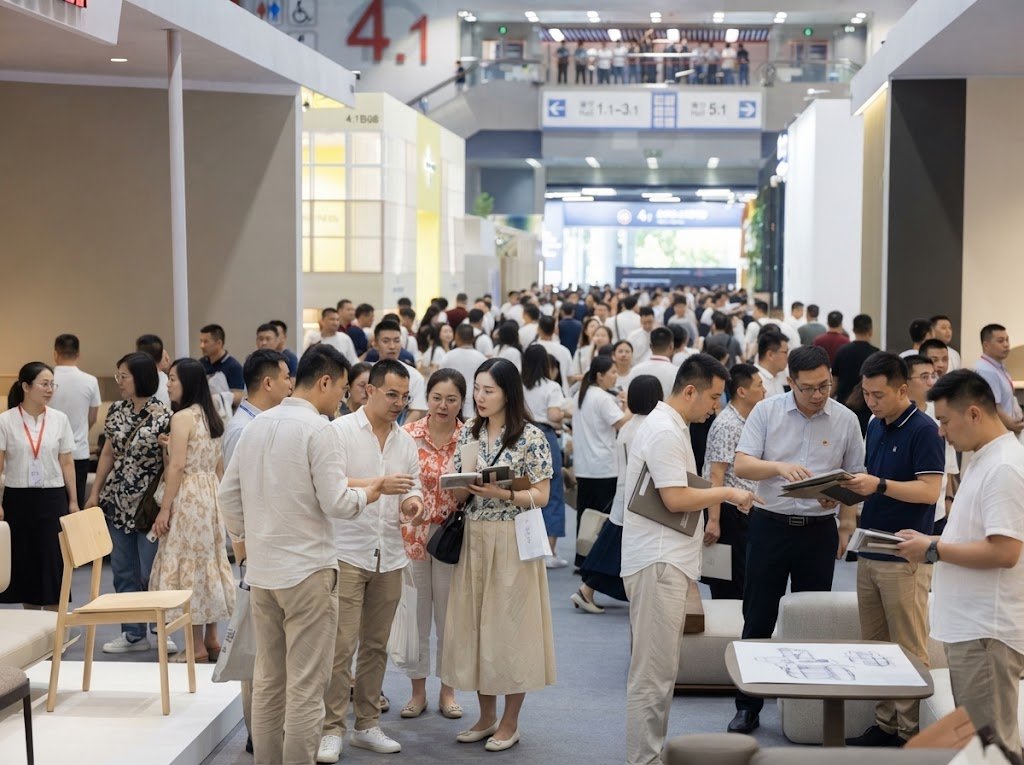
I was standing in Hall 11.2 of the Pazhou Complex last October, four coffees deep, staring at a 10×10 booth that was defying the laws of physics.
The booth was tiny. Maybe big enough for two boucle accent chairs and a marble-topped coffee table. But the backlit wall behind the 22-year-old sales rep was plastered with logos that would make a Wall Street analyst sweat. Four Seasons. Target. Marriott. Restoration Hardware. All proudly displayed under a banner screaming “YOUR DIRECT FACTORY PARTNER.”
It looks incredible on paper. It feels incredibly safe.
But grab a beer at the Westin lobby bar later that night, and the veterans will tell you the brutal truth. It’s mostly garbage.
If a Chinese factory has to lead its sales pitch by flaunting a global conglomerate’s logo on a cheap pop-up banner, they are hiding something. Almost always, that “something” is a chaotic, margin-crushing mess on their actual production line.
Look, here is the uncomfortable reality. Real, high-volume tier-one suppliers live and die by ironclad Non-Disclosure Agreements. A legitimate manufacturer pulling down eight figures a year from a major US retailer will literally lose a multi-million-dollar contract overnight if they stick that client’s proprietary design or corporate logo on a foam-core poster. You think Target lets random Guangdong factories hand out catalogs featuring their proprietary CAD drawings to thousands of walk-up buyers? Please.
China furniture sourcing isn’t just pointing at a pretty chair, drinking a microscopic cup of bitter oolong tea, and wiring a 30% deposit to a random bank account in Hong Kong. It’s the gritty, unglamorous process of qualifying manufacturing partners across messy industrial clusters, constantly balancing your unit cost against real-world compliance. Outsource your critical thinking to a trade show banner, and you’re going to get burned. Badly.
Key Takeaway: The Pazhou Reality Check
- The NDA Rule: True suppliers to mega-brands operate under brutal legal constraints. They hide their best clients, they don’t advertise them.
- The Sub-Contractor Loophole: That booth showing the Wayfair logo? They probably supplied standard zinc screws or a single wooden leg to the actual factory, then audaciously claimed the overarching brand as their own direct buyer.
- The Middleman Illusion: The booth you are standing in probably belongs to a trading company renting the space for the week. It has zero connection to the noisy, dust-filled facility where the goods are actually boxed up.
The anatomy of a fake OEM portfolio
So, let’s ask the obvious question. Who actually built that beautiful, curved boucle sofa sitting in the center of the booth?
Sifting through supplier claims is exhausting. It’s basically a game of corporate cat and mouse. Every single vendor puts their heavily filtered, absolute best-case-scenario photos forward. But eventually, you have to leave the air-conditioned convention center, hop in a Didi, and visit the actual facility.
Three winters ago, I was freezing in a Dongguan showroom. I was nursing a paper cup of hot water, trying to keep my jacket zipped because factories don’t heat their showrooms in January. The sales manager—a sharp guy wearing a suit two sizes too big—handed me a massive, leather-bound portfolio.
The pages were stunning. Beautiful lifestyle shots. Really tight mid-century modern stuff, perfectly styled with fake Monstera plants and that warm, golden-hour lighting.
But on page 12, I caught it. A weird, unmistakable lighting shadow reflecting off the brass leg of a velvet dining chair. I’d seen that exact same photographic anomaly three hours earlier. At a totally different facility. Halfway across the city.
Neither of them made the chair. They both bought a massive digital rendering package off Taobao for 300 RMB to pad out their catalogs.
Total smoke and mirrors.
This is the classic fake OEM portfolio at work. It is explicitly designed to create a halo of technical competence without the factory ever having to spend a dime on actual R&D or engineering. And here’s why it matters: a binder full of stolen JPEGs tells you absolutely nothing. It doesn’t tell you if the factory knows how to manage moisture content in raw timber. It doesn’t show you how they handle the tricky alignment of French stitching on a curved backrest. Or whether they use cheap, brittle EVA glue instead of waterproof PUR glue on their edge banding.
A pretty picture does not guarantee a structurally sound product. It just guarantees they know how to use the internet.
The “Backdoor” Client Claim
Sometimes, it’s not even malicious deception. Or rather, the problem isn’t the factory actively trying to scam you. It’s a fundamental misunderstanding of how the ecosystem actually functions.
Actually, wait—what most Western buyers completely miss is that the factory boss doesn’t even know he’s lying to you.
The Chinese furniture supply chain is hyper-fragmented. It’s a web of sub-contractors that is almost incomprehensible if you’ve only ever shopped at standard retail. Let’s trace a typical upholstered sofa. A raw materials guy in the Longjiang district cuts rough, unsanded wooden frames out of cheap pine. He sells those bare frames in bulk to a massive assembly plant down the road.
That second plant does the real work. They add the 35D high-resilience foam. They cut the fabric. They staple it all together, box it up, and ship it to a massive US retailer.
Next thing you know, the frame guy updates his Alibaba profile with a massive banner: “We supply [US Retailer].”
In his head, he’s telling the absolute truth. His wood is currently sitting in retail stores across North America! But try ordering a finished, export-ready upholstered piece directly from him? You’ll receive a glue-stained disaster with crooked seams. Because he knows absolutely zero about fabric tension, seating ergonomics, or ISTA 3A drop-test packaging. He is a guy who cuts wood. Not a furniture maker. But his doctored portfolio will absolutely make you think he is the master contractor.
Decoding the Canton Fair exhibitor scam
To survive sourcing, you need to understand the brutal economics of trade shows. Prime booth space in China is stupidly, astronomically expensive. We are talking tens of thousands of dollars for just five days of foot traffic.
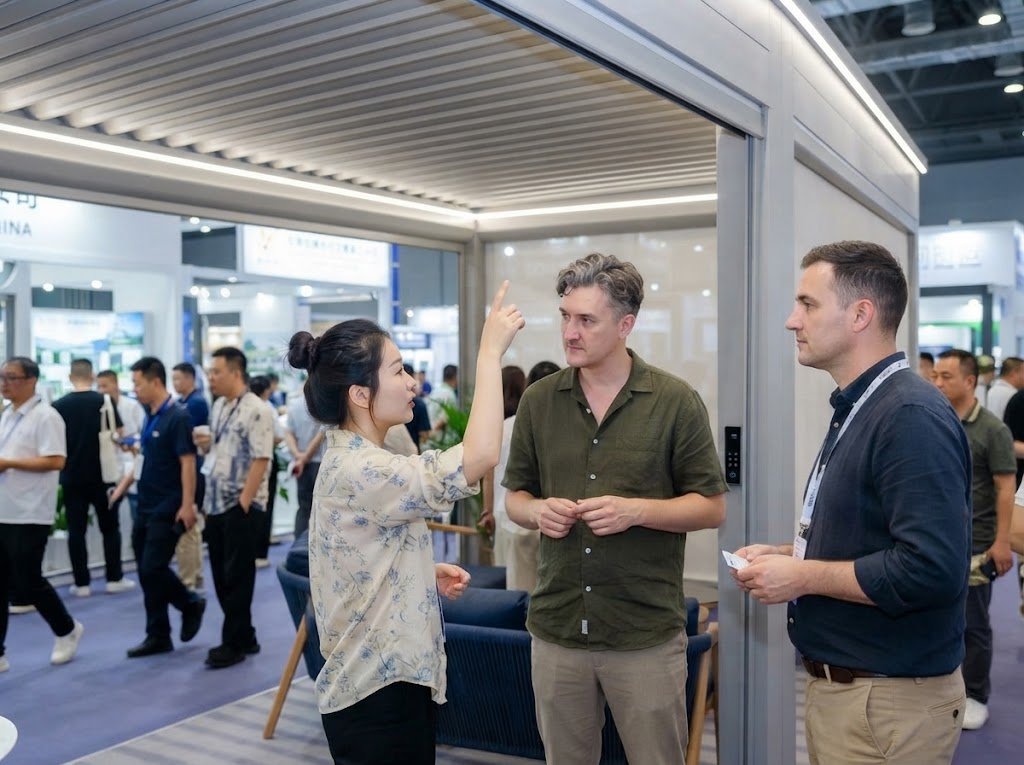
That slick, impeccably dressed, English-speaking crew greeting you with glossy brochures and instant WeChat QR codes? They are almost certainly a trading company. They aggregate a few hero products from a dozen tiny, unregulated, dirty workshops to look like a massive, cohesive manufacturing operation.
And look, trading companies aren’t inherently evil. I work with several excellent ones. Good middlemen provide vital bridge financing for cash-strapped factories. They handle nightmare cross-border logistics, and they act as a vital buffer for the brutal language barrier.
But the Canton Fair exhibitor scam happens when these intermediaries actively masquerade as the direct manufacturer just to capture a higher margin from naive buyers.
They will look you dead in the eye, hand you a premium card stock business card that says “Factory Director,” and swear the production lines are theirs. They’ll even drive you to the facility in a rented Audi A6.
But it’s just a facility they have a loose, transactional relationship with. They literally bribe the floor manager with a carton of Chunghwa cigarettes so they can walk a Western buyer through the aisles for twenty minutes. (And yes, I’ve literally watched the cigarette hand-off happen in a factory parking lot in Zhejiang).
You can spot the fake boss easily if you just open your eyes. The tired line workers don’t look up when he walks past. He doesn’t know the names of the shift supervisors. And the absolute dead giveaway? The guy has to ask someone where the warehouse bathrooms are.

The Guangdong Ecosystem: Finding the Sweet Spot
So, if the mega-booths claiming to supply global conglomerates are mostly smoke, and the tiny booths are risky middlemen putting on a theatrical show… where do you actually go to buy furniture?
You look for the specialized middle class.
The general pattern I’ve seen over 15 years suggests the most reliable partners are the guys who know exactly what they are. And more importantly, they know what they are totally incapable of making.
Rookies step off the plane at Baiyun airport and immediately chase massive Foshan mega-factories, demanding huge MOQs and rock-bottom prices. But veterans look elsewhere. They look for mid-sized specialists. You’ll find operations like Interi Furniture—which focuses tightly on project and high-end residential segments rather than chasing mass-market retail—offer a totally different, much safer risk-reward equation.
These mid-tier factories don’t boast about supplying Walmart. They don’t have massive banners of Target logos hanging from the rafters. Instead, the boss will talk your ear off about their brand new Homag edge-banding machines. They will physically drag you over to a workstation to show you how they source their internal drawer hardware from premium Taiwanese suppliers instead of buying the cheap local knock-offs that break after six months.
The best factories in China don’t name-drop. Their hardware consistency and clean joinery do the talking. They survive on repeat business from discerning mid-market brands and boutique hospitality groups. They don’t survive by trapping naive first-time buyers with flashy, deceptive banners at a trade show. They understand that a sustainable business in the Pearl River Delta means shipping containers that don’t get rejected the second they arrive at the destination port.
The “Show Me” Framework for Qualifying Suppliers
Stop asking factories if they can make something. A commissioned Chinese sales rep will say “yes” to literally anything you ask. You want a sofa made of moon rock? “Yes, no problem, we send you sample next week.” They just want to keep the conversation moving and get you to the 30% deposit stage.
Instead, force them to prove it in real-time. Here is the exact, hard-nosed framework my sourcing team uses on the ground when we audit a new potential partner.
- The Raw Material Ambush — Skip the polite tea drinking in the showroom. Tell them you want to see the raw materials warehouse immediately. Is the raw timber stored off the ground on proper pallets? Is the room’s humidity actively controlled? If the foundational storage is a chaotic, damp mess, your finished dining tables are going to warp and crack the second they hit a dry climate in Arizona or Nevada. Garbage storage equals a garbage product. Period.
- The BOM Drop Test — Point to the exact item sitting on the showroom floor and demand a component-level Bill of Materials. Right then and there. A real factory with a functional engineering department can print this out in a day. A trading company will stall for a week because they have to desperately beg the actual factory for the internal specs, and the factory usually ignores them.
- The “Can we change this?” Trap — Point to a complex structural joint or a tricky weld on a metal chair frame. Ask if it can be modified to save 5% on the unit cost. A real engineer will pause, calculate the machinery constraints in their head, and give you a realistic “No, that will compromise the load-bearing capacity.” A scammer will instantly smile and say, “No problem, very easy, we change it for you.”
- The Export Packaging Audit — Walk out to the loading dock. Look at the cartons waiting to be stuffed into the 40-foot high-cube containers. Are they using 5-ply corrugated cardboard? Is there proper hard-corner protection? A fake factory puts all their money into making the product look pretty and packs it in tissue paper. A real export factory knows the journey across the Pacific is violently rough, and they invest heavily in protective packaging.
Red Flag: The Pristine Factory Floor.
It sounds totally counter-intuitive, but I deeply distrust a spotless factory. I remember walking into an upholstery plant in Anji a few years ago. There was zero sawdust in the air. The sewing machines were brand new. There were absolutely no fabric scraps on the floor.
I walked out five minutes later. Why? Because that is not a functioning business. That is a stage set built explicitly to impress foreign buyers. Real, profitable factories that actually hit their ship dates and make money are loud. They are slightly messy. They are aggressively busy. If the floor is clean enough to eat off of, it means they aren’t producing anything.

The Raw FAQ: What buyers actually ask in the hotel bar
Q: Can’t I just trust the Alibaba “Gold Supplier” badge to weed out the fakes and trading companies?
A: Nope. Not even a little bit. “Gold Supplier” is primarily a paid marketing tier, not a forensic financial audit. “Verified Supplier” is slightly better because third-party inspectors like SGS or TUV actually visit the premises, but let’s be real—that report only proves the company legally exists and owns a desk. It absolutely does not validate their OEM portfolio, their scrap rates, or their quality control processes.
Q: A factory rep showed me a stamped bill of lading with a famous hotel brand’s name on it. That’s hard proof, right?
A: Hardly. Photoshop exists, and it’s heavily used. Or worse, it’s a real, authentic document, but it was for a tiny trial order from 2018 for fifty replacement luggage racks that the hotel immediately rejected for poor quality. Never trust a piece of paper handed to you at a booth without independently verifying the shipping data via customs databases like Panjiva or ImportGenius.
Q: Does geography really matter that much? Can’t a good factory make anything?
A: Absolutely, geography is everything. China’s manufacturing is ruthlessly clustered by material type. If you need ergonomic office chairs, you go to Anji. If you need solid rubberwood furniture, Nankang is the hub. Complex, mixed-material upholstery? You need to be in Foshan or Dongguan. If a single supplier claims to physically manufacture all three of those wildly different categories under one roof, they are lying to your face.
Q: If I’m ordering from a trading company, is it safe to wire the 30% deposit to their offshore Hong Kong account?
A: It depends entirely on your risk tolerance. Wiring money to an offshore account means you have virtually zero legal recourse inside mainland China if things go sideways. Always ask for an account that matches the mainland Chinese business license name exactly. If they refuse, you are taking a massive gamble.
Q: So, is everyone claiming to work with major brands at the show lying?
A: It depends entirely on their willingness to let you mercilessly audit their production line without restrictions, without handlers, and without prior warning.
Let’s get one thing straight before you book your next Cathay Pacific flight to Baiyun Airport. Sourcing in China is incredibly rewarding, but it is a full-contact sport. You simply cannot outsource your due diligence to a shiny piece of cardboard.
The next time a 22-year-old rep claims their tiny, disorganized workshop furnishes every single five-star resort in Dubai, take a breath. Look past the stolen photography. Demand the BOM. Look for the sawdust on the floor.
Are you buying a carefully constructed illusion, or are you partnering with actual builders? The difference between the two isn’t just a sourcing headache; it is your entire profit margin at the end of the day. Stay sharp out there.