


You’re sweating right through your shirt on the sidewalk outside the Pazhou Complex. Eight hours trudging through Phase 2 of the Canton Fair does that to a person. Your shoulder is throbbing because you’re hauling a canvas tote jammed with thirty pounds of glossy paper—catalogs for oversized travertine dining tables you probably don’t even need.
Eventually, you manage to snag a table at that perpetually chaotic Starbucks over in Tianhe. You dump the bag. Order a lukewarm Americano. Pull out a thick, gold-foiled business card.
It belongs to a guy named “Kevin.”
Kevin’s card promises a staggering 50,000-square-meter production facility out in Dongguan. He swore up and down, looking you dead in the eye, that his production lines supply the biggest US retail chains. Sitting there rubbing your temples, you’re already crunching the margin math on those sectionals.
But Kevin doesn’t own a factory. He doesn’t even own a pallet jack.
Kevin is running a trading desk out of a cramped apartment in Shenzhen. The second you wire that 30% deposit, he’s farming your PO out to three different unregistered, dusty workshops. And you better believe those workshops will instantly downgrade your PU foam density to salvage their own razor-thin margins. (And honestly? I see this happen every single sourcing season).
Navigating the furniture supply chain here is basically walking an obstacle course of optical illusions. If you don’t know how to spot a fake factory China setup, you aren’t just risking a delayed container. You’re actively risking a massive commercial disaster that could cost you your best clients.
The Uncomfortable Truth About “Manufacturers”
Key Takeaway: Identifying the Hustle
- Over a third of furniture “manufacturers” at major Asian trade shows are just middlemen.
- Insanely expensive booth designs do not equal factory ownership. Cash buys booth space.
- Real factory bosses talk about edge-banders, MDF yields, and tooling. Middlemen only talk about MOQs and finishes.
- Skipping the physical factory audit is the fastest way to lose a deposit.
Let’s skip the polite industry jargon. The reality most foreign buyers refuse to accept is that they walk into these exhibition halls completely blind to the scale of the hustle.
You stroll past a massive, 150-square-meter booth. The styling is impeccable. The track lighting hits the velvet sofas perfectly. So, your brain naturally assumes the company bankrolling this setup must have serious manufacturing muscle back home.
Wrong. Buying premium real estate at the Canton Fair requires a fat marketing budget, not assembly lines.
Veteran sourcing agents know that a huge chunk of the exhibitors you chat with are trading companies wearing a manufacturer’s disguise. Their business model is dead simple. They grab catalogs from actual factories, slap their own shiny English logo on the cover, rent the booth, and pad the FOB price by 15% to 30%.
When it goes smoothly, you might never realize you’ve been played. You pay a bit more, but the CBMs load on time. But what happens when things go sideways? Say the kiln-dried timber they promised was barely air-dried, and your custom chairs arrive at a Miami port blooming with white mold. The trading company has absolutely zero leverage to fix it. They can’t stop the machines. They just yell at some subcontractor on WeChat and hope you don’t demand a chargeback.
Here’s a rule I live by: If the rep can’t instantly answer a gritty, technical question about their own CNC machines, they don’t own the machines. End of story.
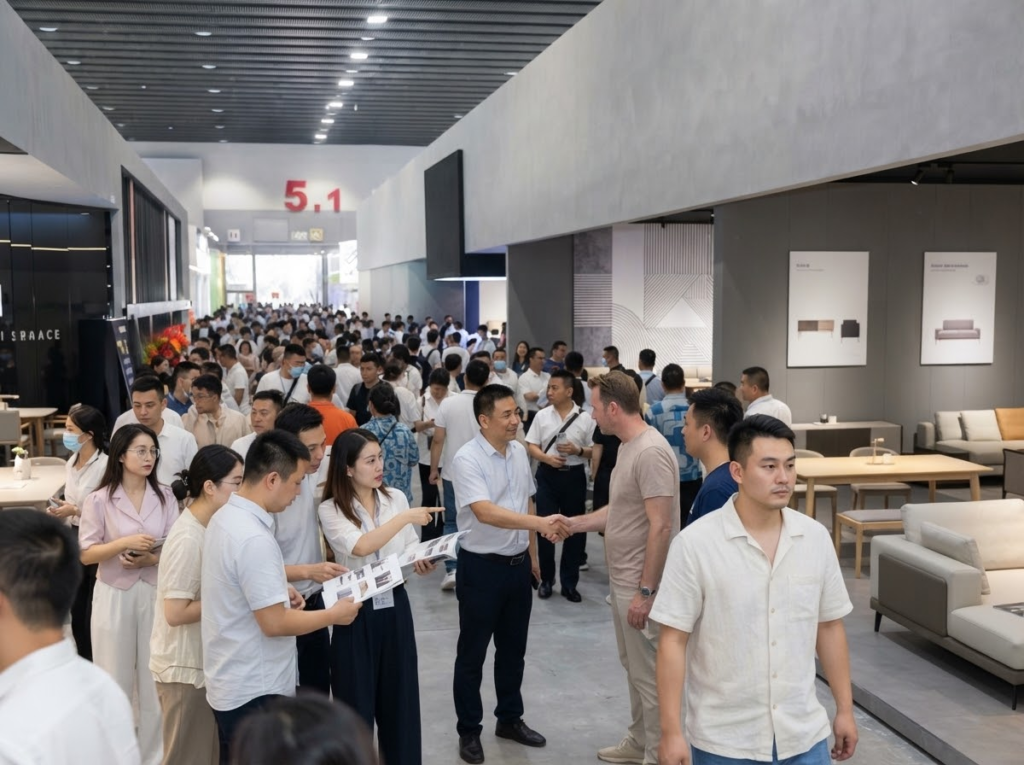
Deep-Dive Analysis: The Catalog Illusion
Let’s talk about that heavy stack of catalogs you lugged back to your hotel. If you really want to dissect a Canton Fair shell company, their printed collateral is the easiest place to start digging.
Treat a furniture catalog like a rigged dating app profile. Everyone uses good lighting, but some players are using entirely stolen identity photos.
You flip through fifty pages of stunning minimalist casework. The photography looks expensive. But look past the furniture. Look at the background of the “factory floor” shots they usually tuck into the last few pages to prove they actually build things.
Do the workers’ polo shirts actually match the logo on the front cover? Or can you spot three different faded company names on the various machines in the background? (I caught this exact discrepancy during a botched hotel project bid two years ago). A lot of trading outfits just rip photos from their various suppliers and digitally stitch them into one Frankenstein brochure.
Does the workshop look too clean?
Real factories—especially the ones grinding it out in traditional hubs—are chaotic. They are loud. They smell intensely like wood dust and industrial adhesives. When an actual manufacturer prints a catalog, they almost always throw in a poorly lit, totally unglamorous photo of their workshop. Why? Because to them, the sheer volume of production is the ultimate flex.
Shell companies buy stock photos of pristine, robotic European manufacturing lines and pray you don’t look closely. Actually, the problem isn’t just the middleman, it’s the buyer’s fantasy. Foreign buyers desperately want to believe they are buying direct from a spotless, automated utopia for 90 bucks a chair.
Look at their product mix. If one brochure offers solid oak dining tables, injection-molded plastic loungers, and hand-blown glass pendants… you are holding a trader’s wish list. No single factory on earth makes all three. The supply chains and tooling requirements live in entirely different universes.
Deep-Dive Analysis: Business Card Forensics
A business card is a tiny piece of evidence, assuming you know how to read it.
Whenever a rep hands me a card, I flip it over before I even read their name. I want to see the address. A shell company almost always lists a sleek office tower in a central business district. Think Tianhe in Guangzhou or Futian in Shenzhen.
Real furniture makers? They operate out of gritty industrial zones in places you’ve never heard of.
What’s hiding in the email domain?
Check the email setup. Well, more specifically, check the consistency across their staff. If Kevin the sales guy uses @sunrisemegafurniture.com but the alleged production manager he CCs uses a generic @163.com or @qq.com address, you’re probably dealing with a decentralized middleman structure.
Watch their body language when you ask for the factory owner’s direct contact. A trader will immediately hesitate. They’ll invent a quick excuse about the boss being camera-shy or not speaking a word of English. A real factory sales rep will practically force you to scan the boss’s WeChat QR code because they want you permanently locked into their ecosystem.
And here’s a massive red flag. Look at the registered English company name. Does it say “Guangzhou Sunshine Furniture Trading Co., Ltd.”? By law, the English name generally has to reflect the Chinese business license. If it literally says “Trading” (贸易), they are telling you exactly what they are. Believe them.

Deep-Dive Analysis: The “Factory Tour” Charade
So, you think you’re smarter than the average buyer. You demand a physical tour before you sign a proforma invoice. You hire a local driver, head out to the industrial outskirts, and Kevin meets you at the gates of a bustling facility.
You walk the floor. You watch guys operating the saws. You feel the upholstery. You leave satisfied.
But did you check the signage on the front gate?
Because the oldest trick in the book is the “sister factory” play. The middleman just calls up a factory he buys from occasionally and says, “Listen, I’m bringing my foreign client by tomorrow afternoon. Let me pretend I’m your export director for a few hours.” The real factory boss plays along because he wants the production volume.
You walk around entirely convinced Kevin owns the joint. In reality, Kevin is just renting the backdrop. When you fly home, he places the order, skims 20% off the top, and the real factory boss goes back to ignoring him.
The Ecosystem: Where Real Specialists Fit In
You might be wondering why any of this matters if the furniture arrives on time, looks okay, and you hit your margin targets.
It matters because this industry is not a monolith. It’s a violently fragmented, highly specialized ecosystem.
While massive big-box buyers run toward giant automated conglomerates in Zhejiang for cheap flat-pack items, savvy buyers looking for custom project work need mid-sized specialists. Take operations like Interi Furniture down in Guangzhou, for example. They focus deeply on custom soft furnishings and hospitality project work. A legitimate, focused manufacturer like Interi isn’t going to pitch you cheap outdoor plastic seating alongside their custom fabric beds. They stick to their lane. They tightly control the supply chain for that exact material class, which means they know exactly why a specific fabric weave will fail in a high-traffic hotel lobby.
When you get stuck with a shell company, you lose all that tactile, specialized knowledge. The trader doesn’t know the rub-count of the fabric. They just know the cost per meter. And when you are outfitting a resort, a 5% failure rate because the middleman quietly swapped in cheaper foam to pad his margin will literally cost you your job.
The Actionable Framework: Vetting on the Fly
You’re standing at the booth. The catalog weighs a ton. The rep is pushy but offering a killer FOB price. How do you separate the actual manufacturers from the ghosts right there on the floor?
Run them through this gauntlet:
- The WeChat Pin Drop: Don’t ask what city they are in. Hand them your phone and ask them to drop a WeChat location pin of their factory gates right now so you can “plan your driver’s route for Thursday.” Middlemen will instantly freeze, look at their screens, and mumble about needing to check their schedule.
- The Machining Question: Point to a complex joint on a chair frame. Ask, “What exact brand of CNC router do you guys use for this cut?” A real factory rep might not know the exact model number, but they will know the brand (like HOMAG or Biesse). A shell company rep will just smile and say, “We use very advanced imported machines.”
- The Digital Footprint Vetting: While you’re chatting, add them on WeChat and immediately scroll their “Moments” feed. Are they posting heavily filtered selfies at clubs in Shenzhen? Or are they posting blurry, poorly framed videos of a forklift loading a 40HQ container in the pouring rain? You want the guy posting the forklift.
- The “Impossible Change” Test: Ask for an absolutely unreasonable structural modification. “Can we change this molded plastic chair to be made of bent plywood instead, but keep the exact same continuous curve?” A real factory will instantly tell you no, explaining the mold costs would be insane. A trader, desperate to keep you talking, will smile and say, “Yes, no problem, just send us the CAD drawings.”

FAQ: What Buyers Actually Ask
Q: Is it always a terrible idea to use a trading company?
A: Not necessarily. If you are a boutique retailer buying tiny quantities of 50 different small SKUs—like mirrors, vases, and accent tables—a good trading company consolidates a massive logistical headache for you. They wrangle 20 different factories so you don’t have to. But for core casegoods or large upholstery runs? You want direct factory control.
Q: The supplier has a “Gold Supplier” badge on Alibaba and a verified factory video. Doesn’t that prove they are legit?
A: Absolutely not. You literally just pay Alibaba for that badge. And those verified videos? I’ve watched trading companies hire local actors to stand in front of a rented factory building, holding a piece of paper with the trader’s logo on it. It’s pure theater.
Q: How can I check their business license if I can’t read a word of Chinese?
A: Ask for a clear photo of their Chinese business license (营业执照). Zoom in on the “Business Scope” (经营范围) section and run it through Google Translate or Baidu. If it explicitly lists “production” or “manufacturing” (生产/制造), they legally have the right to run a physical factory. If it only lists “wholesale,” “retail,” or “technology export,” you’ve got a shell company on your hands.
Q: We always hire a third-party QC inspector, so we’re completely protected, right?
A: You’d think so. But shell companies are notorious for playing games with third-party inspectors. They’ll repeatedly delay the inspection date, claiming the paint isn’t dry or the packaging is delayed, until the absolute last second before the vessel departs. Then, they rush your inspector, praying they won’t have time to actually pull random samples from the bottom of the pallets.
Q: Ultimately, can I trust anyone I meet at these trade shows?
A: It depends entirely on your willingness to do the dirty work. The fair is just a venue. They rent floor space. They do not underwrite the integrity of the people standing in the booths.
The Final Takeaway
At the end of the day, a trade show booth is nothing more than a theatrical set.
The spotlights are perfectly calibrated, the handshakes are practiced, the brochures weigh a ton, and the espresso they hand you is surprisingly good. But you aren’t there to buy espresso. You are there to buy 40-foot high-cube containers of heavy, complex, defect-prone merchandise that your clients expect to be flawless.
Don’t let the sheer convenience of slick English-speaking reps and gorgeous marketing materials blind you to the gritty reality of the Asian supply chain. Get out of the air-conditioned exhibition hall. Hire a local driver. Sit in traffic for two hours to reach the industrial parks in Dongguan, Huizhou, or Guangzhou. Walk the actual production lines. Smell the sawdust. Watch the workers on the line, and look the real factory boss in the eye.
Because if you don’t know exactly where your furniture is being cut, glued, and stitched together… you don’t actually have a supply chain. You just have a very expensive illusion. Good luck out there, you’re going to need it.