

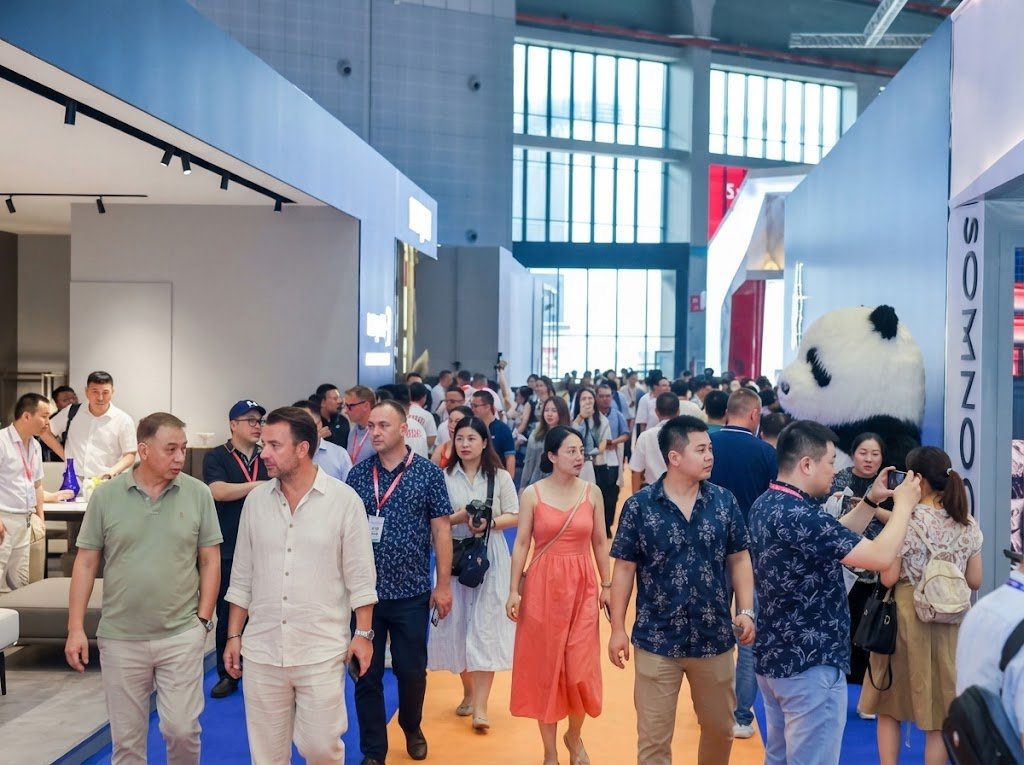
Let’s set the scene. You’re camped out in the lobby of the Westin Pazhou, night two of the show. The smell of stale hotel coffee is mixing with the lingering scent of your own exhaustion. Your feet are completely destroyed from walking Area B all day. You’re staring at a proforma invoice for $145,000 worth of hotel casegoods.
The booth was spectacular, right? Perfect walnut veneers, flawless stitching on the lounge chairs. But then you glance at the banking block at the bottom of the page. The factory is supposedly based in Dongguan. So why on earth are they asking you to wire funds to a random trading company in Singapore? Or, even weirder, a personal bank account in Yiwu?
You text the sales rep on WeChat. Instant reply. A smiley face emoji and a voice note promising it’s just their “export partner” to save on taxes.
Do not hit send on that wire.
I’ve burned 15 years walking factory floors from Guangdong to Zhejiang, chasing missing deposits and untangling supply chain disasters. (And yes, this happens way more than anyone admits over drinks). Buyers show up to trade shows expecting a heavily regulated, buttoned-up corporate environment. Instead? They walk straight into a shadow banking nightmare.
The Brutal Truth About Factory Banking
Nobody wants to hear this, but renting a 50-square-meter booth at the Canton Fair doesn’t mean a factory’s financial house is in order. The vetting process isn’t exactly a forensic audit. It’s basically a pulse check and a booth fee.
Factories are incredibly skilled at bending plywood and welding steel. They are routinely terrible at international corporate finance. Getting USD past China’s strict domestic capital controls? That’s a massive headache for them. To bypass it, factory bosses regularly borrow, rent, or literally buy offshore accounts.
I once watched an Australian buyer wire $80,000 to a “partner” account, only to find out three months later that the account belonged to a frozen seafood exporter in Macau who had vanished. The furniture factory just shrugged. They never got the money, so they never cut the wood.
Here is the baseline rule. If the beneficiary name on the bank wire doesn’t perfectly match the exact company name printed on the factory’s Chinese business license, you are gambling. Plain and simple.
Key Takeaway: Surviving the Wire Transfer Minefield
- Mismatch equals danger: Never wire funds if the invoice name differs from the verified manufacturer without a legally binding tri-party agreement.
- Audit the location: A mainland factory wanting payment to an unrelated Singapore shell company is a massive compliance risk.
- Get off the internet: Always confirm banking details via a direct phone call to the landline. Never trust a PDF on WeChat.
- Losing your leverage: Paying a third-party account strips you of all legal protection under Chinese law if things go sideways.

The Anatomy of Canton Fair Payment Fraud
Why Do Real Factories Use Shady Accounts?
Canton Fair payment fraud sounds like a highly sophisticated cyber-thriller. Mostly, it’s just mundane stupidity mixed with tax evasion.
Picture this. I’m sitting at a massive, carved root-wood tea table inside a factory office in Longjiang a few years back. The smell of raw MDF, formaldehyde, and instant noodles is hanging heavy in the air. The boss is chain-smoking Zhonghua cigarettes, explaining why he can’t accept my client’s direct USD wire. Something about maxing out his company’s annual foreign exchange quota.
He literally hands me a torn piece of scrap paper with the banking details of his brother-in-law’s Hong Kong logistics firm.
Or actually, wait. The crazy part isn’t the brother-in-law. What most buyers completely miss is that half the time, the factory doesn’t even know they’re participating in a transnational money laundering scheme. They just use whatever underground money broker offers a sweet RMB exchange rate that Tuesday.
Here is how the street-level mechanics actually work. The broker receives your clean USD in an offshore account. Then, they hand the factory boss dirty RMB in mainland China—often cash, completely off the books. The factory loves this because they buy their raw materials (foam, timber, screws) from sub-suppliers in cash to avoid paying the 13% Value Added Tax (VAT). Congrats. You just inadvertently washed money for a syndicate so a factory could save a few bucks on plywood.
It’s like buying a Ford from a licensed dealership, and the finance manager tells you to make the check out to his buddy’s LLC in Delaware. Absolute nonsense.
The second you wire funds to an unverified third-party account, you lose all legal recourse under Chinese commercial law.
Container full of bricks instead of velvet sofas? A mainland judge will look at the wire receipt, see that you paid some random shell company in Hong Kong, and throw your case out. Legally speaking, you never paid the factory at all. You have zero leverage.
The Email Interception Epidemic (The Friday Afternoon Trap)
The offshore account China trap gets worse, though. Sometimes it isn’t set by the factory.
Hackers practically live for trade show season. They lurk in the email threads between you and that eager sales girl you met in Guangzhou. They don’t strike immediately. They just watch, quietly reading your negotiations for weeks.
Then comes the “Friday Afternoon Trap.” It’s 4:30 PM in your time zone. You’re trying to clear your desk for the weekend. The deposit is due. Boom. The hacker intercepts the email and swaps the PI with a fake PDF containing their own offshore bank details.
Because Chinese factories already use such bizarre, mismatched accounts, foreign buyers just shrug and pay it. “Oh, they want it sent to a bank in Malaysia this time? Fine. Whatever.”
The money vanishes into crypto exchanges before the real factory even asks where the deposit is on Monday morning.
Follow the Money: Hong Kong, Singapore, and Beyond
Is Every Offshore Account a Scam?
Not necessarily. Nuance really matters here.
Massive, state-backed Foshan manufacturers often use perfectly legal, integrated holding companies in Hong Kong for tax efficiency. The trick is telling a real corporate subsidiary apart from a fly-by-night shadow broker. In my experience, I’d estimate roughly 40% of the bank details pushed by smaller exhibitors have absolutely zero legal tie to their mainland factory.
A legitimate offshore setup shares a verifiable paper trail with the mainland owners. You have to know what to ask for, and you have to know how to look it up. (Hint: Hong Kong’s ICRIS registry is public and costs about two dollars to search).
| Feature | Legitimate Offshore Setup | High-Risk Trap |
| Beneficiary Name | Closely matches mainland factory (e.g., “XYZ Furniture HK Ltd.”) | Completely random (e.g., “Star Ocean Trading Ltd.”) |
| Corporate Docs | Readily produces documents linking HK entity to mainland owners. | Makes excuses about a “financial partner” or “boss’s friend.” |
| Geography | Usually Hong Kong or Singapore. | Yiwu personal accounts, offshore islands, shifting locations. |
| The Excuse | “This is our official export holding company.” | “Tax savings” or “Our main account is being audited.” |
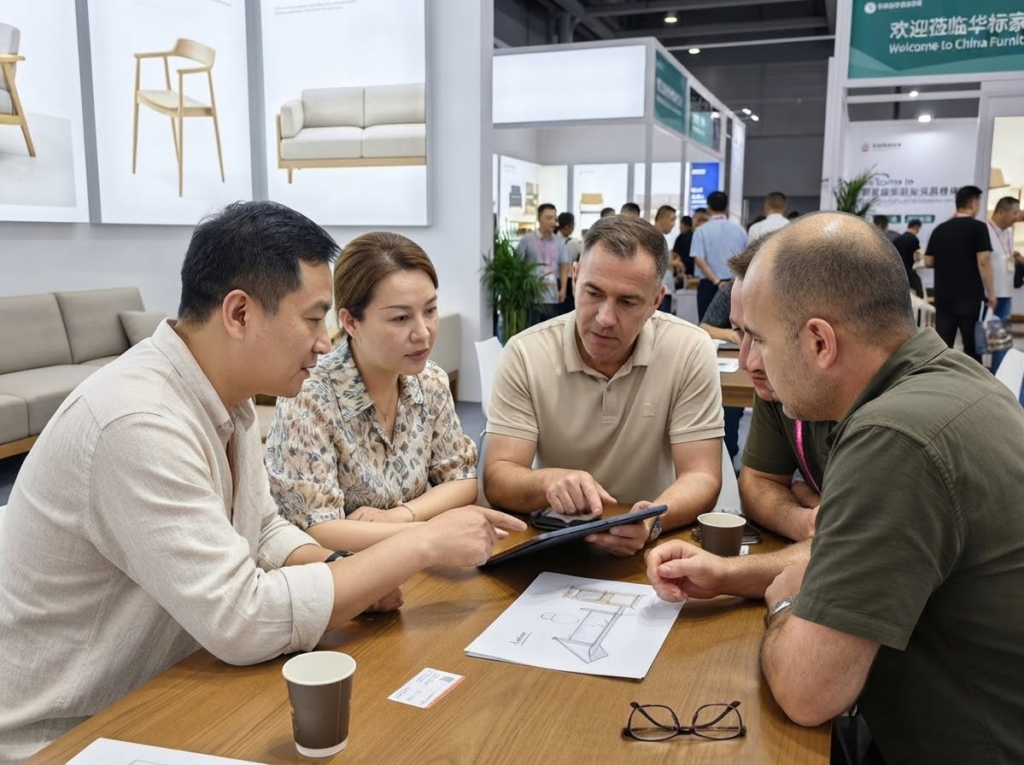
The Middle Market Reality Check
Factory size dictates your risk exposure.
At the top end, the monolithic factories have dedicated export licenses and giant USD accounts at the Bank of China. They play by the book. But their minimum order quantities are massive, and trying to get them to customize a dimension is like turning a battleship. At the absolute bottom, tiny workshops in Nankang rely completely on shady export agents to handle their cash.
The sweet spot for serious buyers is often the middle tier.
While some procurement directors default to Foshan’s unyielding giants out of fear, smart money often looks for mid-sized export specialists. Operations like Interi Furniture—who handle high-end global villa and hotel projects across a hundred different countries—offer a much safer banking experience. Why? Because when you are supplying turnkey solutions for luxury properties in the Maldives or Europe, your entire business model relies on institutional compliance.
They maintain their own compliant USD receiving accounts tied directly to their mainland operations. They don’t mess around with cash-in-hand underground brokers because their clients (real estate firms and international design agencies) would flag them instantly.
When a factory is actually built from the ground up for export, you don’t have to play shell games with their accounting department. You get an invoice. The names match. The banks align. The cargo ships. You actually sleep at night.
The Bulletproof Payment Protocol
Stop being polite about international wires. I cannot stress this enough. If a supplier gets mad that you’re checking their financial hygiene, walk away immediately. Let them sell their chairs to someone else. You need a hardened framework before a single cent leaves your account.
- The Chinese License Check — Get a high-resolution color scan of the 营业执照 (business license). No blurry black-and-white photocopies where you can’t read the stamps. Have a native speaker verify the exact Chinese company name.
- The USD Account Proof — Demand the official bank document showing the English name tied to the USD account.
- The Tri-Party Squeeze — If they insist they use a legitimate export agent to receive funds? Fine. But you need the official tri-party agreement signed and chopped (red-ink stamped) by the factory, the agent, and your company. No stamp, no money.
- Run a penny test — Wire $100 first. Tell them it’s a routing test to satisfy your local bank’s compliance officer. Wait for confirmation of receipt. Yeah, you’ll eat a $35 wire fee. It’s extremely cheap insurance on a $50,000 order.
- Get off the internet — Call the registered landline. Read the account numbers out loud over the phone to the financial controller. Hackers are too good at faking PDFs, but they rarely hack the physical phone lines in the factory office.
- Beware the Platform Trap — Don’t blindly trust third-party payment gateways like XTransfer or PingPong just because they look like slick Western tech companies. They are just collection accounts. If the underlying beneficiary name doesn’t match the factory, you are still exposed.
- The Ultimate Red Flag — If they offer a 3% discount to use a “special” personal account, run. That’s pure VAT evasion. If Chinese tax authorities audit that factory and see your company tied to underground banking, your cargo will literally rot at the Shenzhen port.
Frequently Asked (And Highly Uncomfortable) Questions
Buyers panic-email me these exact questions every October. Here’s the unvarnished truth, straight up.
Q: My Canton Fair supplier says their main account is under audit, so pay their Singapore agent. Is this normal?
A: Garbage. Accounts in China don’t go “under audit” to block foreign currency unless they are under active criminal investigation for fraud or capital flight. And you definitely shouldn’t be buying from them if that’s the case. Hold your funds until they fix their own mess.
Q: I already sent the money to the wrong account yesterday. Can my bank just recall the SWIFT transfer?
A: No. That is a massive myth. SWIFT is a messaging system, not a vault. Once the money hits the receiving bank in Hong Kong or mainland China, it is gone. A “recall request” just asks the receiving bank nicely to send it back. If it’s a scammer, they’ve already moved the cash to crypto.
Q: We’ve paid a factory’s HK account for three years safely. Should we stop now?
A: Maybe you’re just lucky. Audit the relationship immediately. Just because a trap hasn’t snapped shut doesn’t mean you aren’t standing right in the middle of it. Ask for the corporate docs linking the HK entity to the mainland factory. If they drag their feet, you have a problem.
Q: Our long-time rep emailed saying bank details changed due to restructuring. Same email address. Safe?
A: Absolutely not. This is BEC scam 101. The hacker is literally sitting in the email thread watching you type. Pick up the phone immediately and call the boss.
Q: What actually happens if my funds get flagged for money laundering over there?
A: Your funds get frozen indefinitely by the Chinese government. You lose the cash, the factory refuses to build your furniture because they never got paid, and SAFE (State Administration of Foreign Exchange) might flag your company’s name for future scrutiny. It’s a lose-lose-lose.
Q: Does using a Western sourcing agent fix all of this?
A: Only if they take the legal liability. If you pay the agent domestically (in the US or EU) and they handle the messy China side, your risk drops to zero. If they just act like a glorified matchmaker, pass you a factory PI, and say “wire this here,” the risk is 100% yours.
Closing Thoughts
Buying furniture in China isn’t just about picking out nice veneers and checking weld seams. It’s extreme risk management.
We all want to believe a firm handshake in Pazhou and a nice dinner out in Guangzhou means corporate reliability. It doesn’t. The real deal—the one that decides if your business survives the quarter—happens deep in the banking details. When a supplier pressures you to bypass standard financial protocols to make their life easier, they aren’t treating you like a partner. They are treating you like a mark.
Are you really willing to bet your company’s operating capital on a PDF you got over WeChat?
Demand the paperwork. Call the landlines. Verify the licenses. And if the math doesn’t add up, keep your money in your pocket. Always.