


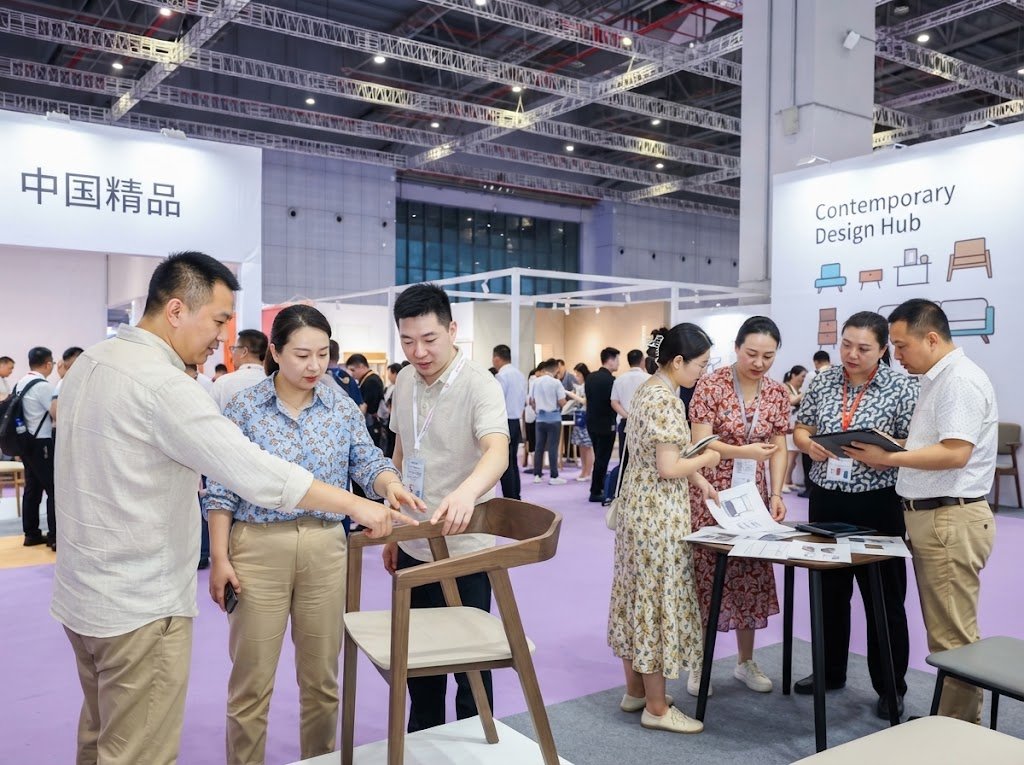
My right heel is currently bleeding through my sock, and I’m on my fourth lukewarm Nescafé of the morning. It’s day three of Phase 2 at the Canton Fair. The massive Pazhou complex feels like an endless, brightly lit casino where the house always wins, and I’m standing here watching a junior purchasing manager from Chicago get completely hustled.
He’s drooling over a sweeping, velvet lobby sectional. The sales rep, wearing a sharp Zara blazer and a fake Rolex, is aggressively dropping names of luxury resorts they’ve allegedly outfitted in Dubai and Macau. The buyer is nodding, mentally calculating his savings, and ready to hand over his CAD files.
I want to walk over and grab the kid by his lanyard.
Because I’ve walked these carpeted aisles for fifteen years. And if there is one miserable, wildly expensive lesson I’ve learned about buying Canton Fair hotel furniture, it’s that the flashiest booth almost always belongs to the most disorganized, chaotic factory. (Or worse, a trading company operating out of a rented desk in Shenzhen). You aren’t buying that pristine floor sample. You’re entering a high-stakes, multi-year marriage with a loud, glue-soaked production line located three hours away in the smoggy outskirts of Dongguan.
The Brutal Truth About Factory Motives
Let’s stop pretending and deal with reality. Factory bosses in Foshan do not give a damn about your boutique hotel’s delicate aesthetic vision. Not even a little bit.
They care about machine yield. They care about keeping their CNC routers running 18 hours a day. They want to know if you’ll hit their MOQ and if your 30% USD wire transfer will clear the Bank of China before Friday afternoon.
Buyers fly 14 hours across the Pacific expecting artisan craftsmen. What they get is an industrial meat grinder.
Here is my golden rule of thumb for walking the fair: If a supplier immediately says “No problem” to your weirdest custom spec before they even check the shop drawings, run away.
Real manufacturers fight you. Hard. They know exactly how specific boucle fabrics pucker on curved radius edges. They know what kind of cast aluminum legs snap during rough ocean transit. The guys nodding and smiling at everything? They are middlemen desperate for a deposit. They’ll figure out the engineering nightmare later. Usually on your dime, while your container is sitting on the water.
Key Takeaways: Surviving the Show Floor
- That glowing trade show booth is just bait. The real vetting happens in a dusty industrial park.
- Legit factories hate bad designs and will aggressively push back on your CAD files.
- China contract sourcing is the grind of dodging slick brokers to find gritty, specialized assembly lines that won’t ruin your commercial project.
- If you don’t physically inspect the raw materials warehouse yourself, you deserve what happens next.
Smoke, Mirrors, and the “Direct Factory” Hustle
Working these aisles is basically Tinder for procurement. Heavily filtered photos. Wildly exaggerated profiles. The reality hits incredibly hard when you finally meet face-to-face under the brutal fluorescent lights of a Chinese industrial zone.
Are you talking to the boss or a broker?
Every single booth claims they own the factory. Nonsense.
Press them on export VAT rebates. Watch how fast they squirm. Or better yet, go visit the plant. I dragged a client to a “massive manufacturing base” in Longjiang last October. The showroom was stunning. Unbelievable lighting, great espresso. But when I bullied my way past the smiling receptionist into the actual production area? Silence. No PU lacquer fumes burning my eyes. No sawdust covering the floor. The workers looked like bored extras in a movie.
It was a rental.
They had literally leased a local assembly line for the afternoon to look legit to foreign buyers. The truest sign of a real furniture plant is the deafening roar of a CNC machine and a yard full of messy MDF offcuts. Pure, unfiltered chaos. If a factory floor looks like a museum, you’re getting scammed by a broker.
And why does that matter? Because when things go wrong—and they absolutely will go wrong—a broker has zero leverage over the actual production line to fix it. They just stop answering your WeChat messages.
The Unseen Anatomy of Commercial Gear
Here’s what residential buyers completely screw up when crossing over to hospitality. Commercial gear gets destroyed. Daily.
A sofa in a suburban living room sees maybe two hours of gentle use a day by someone wearing soft sweatpants. A hotel lobby chair? That poor thing is a punching bag. Exhausted tourists drag hard-shell polycarbonate luggage across the legs. Kids spill acidic orange juice on the armrests. Drunk guests treat delicate side tables like stepping stones.
Why foam dies young and metal rusts
This is why you have to turn off your “designer” brain and turn on your “engineer” brain.
Next time you look at a lounge chair in a booth, grab the bottom and flip it completely upside down. Reps hate this. Let them squirm. Look at the corner blocking. Is it heavily glued and screwed with thick wood, or just blasted with cheap pneumatic staples by a guy making piece-rate? Ask for the exact density of the seat foam. “Very good quality” is not an answer. I want to hear HR45 (45kg/m³ high resilience) or I’m walking to the next booth.
But it gets worse with metal. Let’s talk about stainless steel bases.
A slick rep will promise you 304-grade stainless steel. But unless you physically test it, a bad factory will quietly swap it for 201-grade stainless to save twelve dollars a unit. What’s the difference? 201-grade rusts. Put a 201-grade steel base in a humid coastal resort in Florida, and it will be covered in orange oxidation pits in three months.
In contract work, the invisible stuff—like the strict 10% moisture limit on internal birch frames or the exact alloy of the steel—is what keeps your furniture out of a dumpster in year two.
Macau, 2021. A client bought 300 gorgeous velvet banquettes. The Anji factory rushed it using wet rubberwood to beat the Chinese New Year shutdown. Once that wet wood hit the bone-dry, air-conditioned casino air? It twisted like a pretzel. Fabric ripped at the seams. Total write-off. (I warned them, but hey, the unit price was a “steal”).

Navigating the Supply Chain Dominoes
Another ugly truth? These factories aren’t monolithic empires. They are deeply interconnected, highly fragile ecosystems.
Building commercial casegoods is exactly like trying to run a massive restaurant where you don’t control any of the grocery delivery trucks. You can have the best cooks in the world, but if the meat doesn’t arrive on Tuesday, nobody eats.
Who really controls your timeline?
You look at a stunning marble-topped credenza at the fair. The factory didn’t build it from scratch.
They bought the raw MDF boards from a giant plant in Shandong. The soft-close drawer slides came from a massive hardware market in Jinli. That beautiful, veined marble top? Cut by a stone broker over in Yunfu. The “factory” you are fiercely negotiating with is really just a final assembly and finishing hub.
So when your container is four weeks late? It’s almost never the factory’s fault directly. It’s usually because the local environmental bureau (环保局) unexpectedly shut down the brass electroplating sub-contractor for three weeks due to emissions violations.
Want to instantly sound like a veteran buyer? Stop asking factories how fast they can manufacture your order. Ask how many buffer days they plan for sub-contractor material delays and government shutdowns. Watch their fake smile vanish.
The Sweet Spot of the Middle Market
China’s furniture map is split into weird, hyper-specific tiers.
Up top, you have the mega-corporations in Foshan. 4,000 workers. Dedicated high-rise dormitories. They will completely ignore your emails unless you’re outfitting a 1,000-key Vegas resort. You are a rounding error to them. Down at the absolute bottom? Dirt-floor sheds in Nankang. They’ll gladly accept your tiny 15-piece order, but they will absolutely swap your expensive fire-rated foam for highly flammable garbage to save fifty bucks on the total invoice.
The real money, and the real reliability, is found in the middle.
This is where seasoned hospitality buyers hunt. They look for mid-sized, battle-tested specialists. Look at operations like Interi Furniture—they’re heavily dialed into custom project work and global contract specs, rather than just blindly pumping out generic residential catalog items.
Suppliers in this specific bracket usually keep their own CAD engineers in-house. They can take a messy napkin sketch from your interior designer and turn it into functional 3D shop drawings without the suffocating, slow-moving bureaucracy of a massive corporation. You aren’t dealing with five different account managers.
You want a boss who buys veneer by the container load to keep prices down, but still answers your panicked WeChat messages at 2 AM when the freight forwarder screws up the booking.
The Show Floor Vetting Framework
How do I filter the garbage? I have a ruthless, inflexible gauntlet. I don’t even agree to get in a factory van until a supplier passes this test.
- The Wood Trap: Stop asking “Is this good wood?” It’s a rookie question. Ask: “What is the precise moisture content of the Russian ash in this frame, and do you kiln-dry it yourselves or outsource it down the street?”
- The Engineering Bait: Hand them a CAD printout with a deliberate, fatal structural flaw. Like a heavy cantilevered stone table with zero counterweight in the base. A real contract supplier will instantly point at the paper and tell you it’ll tip over and kill someone. A broker will just nod and quote a price.
- The Packaging Interrogation: Everyone talks about the furniture. Nobody talks about the cardboard. Ask them if their standard carton pricing passes the ISTA 3A drop test. If they look confused, your goods are going to arrive in pieces.
- The Overnight Quote: Anyone pricing a massive, highly customized 250-room hotel package by tomorrow morning is pulling numbers out of thin air. Proper raw material costing takes a week, minimum.
But here is the massive trap most people completely miss.
RED FLAG: The factory brags heavily about doing everything “100% in-house” with zero sub-contractors.
Total lie. The absolute best contract suppliers are master integrators. If a guy says he does solid wood milling, complex brass electroplating, glass tempering, and premium leather stitching all under one roof? He is feeding you a line. Good operations use hyper-niche local shops for the tricky parts, then ruthlessly manage the final assembly and QC themselves.
Look at how a standard retail factory stacks up against a real contract player. Memorize this:
| Vetting Metric | Standard Retail Factory | True Contract Supplier |
| Foam Specs | 25-30 kg/m³ (Squishy, dies fast) | 40-50 kg/m³ (High-rebound, firm) |
| Frame Joinery | Pneumatic staples, maybe some cheap glue | Mortise & tenon, heavy screwed blocks |
| Top Coats | Standard NC (nitrocellulose) lacquer | PU (polyurethane) or heavy catalyzed varnish |
| Fire Ratings | Fakes them or ignores entirely | Strict CAL 117 or BS 5852 compliance |
| Packaging | Thin, single-wall cardboard | 5-ply corrugated, foam corner blocks, crating |
| Modifications | Hates it; pushes their own catalog | Expects it; employs actual CAD jockeys |

FAQs from the Procurement Trenches
My inbox gets completely flooded with the same panicked questions every October during fair season. Here is the raw truth.
Q: Why did the booth sample look flawless, but my massive production run showed up with crooked seams and chipped veneer?
A: Because a 60-year-old master carpenter hand-built your floor sample over a month. Tired kids on an assembly line built your container. To fix this, your contract must legally lock the approved “Golden Sample” to the production floor as a physical QC benchmark. Do not let them hide it in the manager’s air-conditioned office.
Q: Should I just trust the factory’s internal QC guys to check my container before it ships?
A: Absolutely not. Think about the basic economics. Who signs their paycheck? The boss. And the boss desperately wants to ship that container today to trigger your final 70% balance payment. Always hire a grumpy, independent third-party inspector to tear the order apart before it hits the port.
Q: How hard should I squeeze them on the unit price during negotiations?
A: Squeeze too hard, and they won’t say no. They’ll just say “okay” and quietly strip the cost out of your furniture. They’ll thin out the expensive walnut veneer. They’ll swap heavy-duty German hinges for cheap local junk that rusts in a month. You don’t want the absolute cheapest price. You want the correct price for the technical spec.
Q: What happens when they ask for a 50% deposit upfront?
A: Standard terms for legitimate custom hotel orders are 30% TT (Telegraphic Transfer) deposit, and 70% balance paid after your third-party QC passes the goods, but before the container leaves the factory. If they push for 50% upfront, they are undercapitalized and using your money to buy raw materials for someone else’s order.
Q: Can I actually finish sourcing an entire hotel just by walking the fair for three days?
A: No. The fair is just a giant, exhausting speed-dating event. Closing a complex hospitality package means flying to the factory, bleeding over shop drawings, checking the moisture meters yourself, and smelling the glue.
The Bottom Line
Next time you are wandering the Pazhou halls, blinded by massive LED screens and aggressive badge scanners trying to pull you into their booths, stop for a second.
Are you buying showroom candy? Or are you buying a gritty, functional, commercial-grade supply chain?
This job isn’t glamorous. The buyers who actually survive and thrive in this game aren’t the ones who negotiate the lowest unit price on the trade show floor. They’re the ones who know exactly what happens on the assembly line when the lights go out and the foreign buyers go home.