

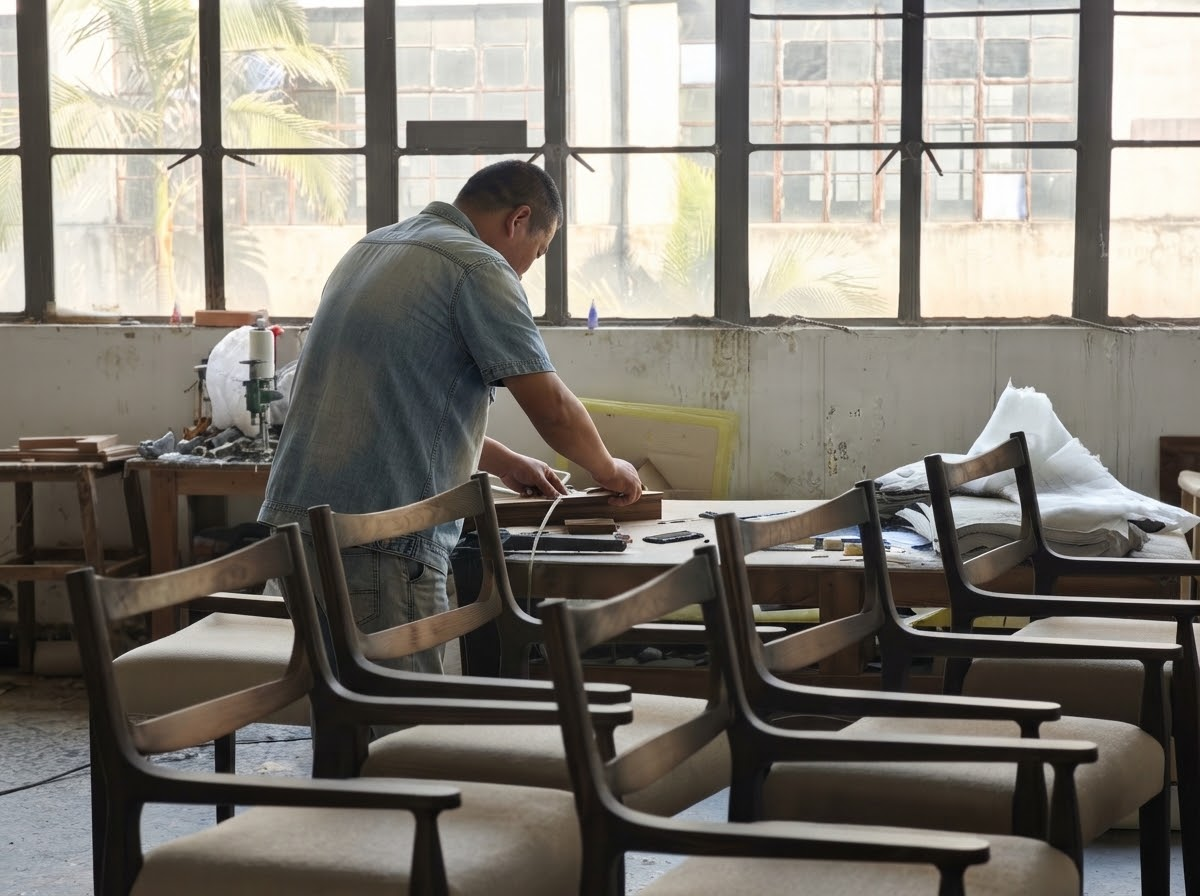
October in Shunde. You know the smell before you even step out of the Didi. It’s this suffocating, permanent mix of sweet PU lacquer, wet cardboard, and the cheap Zhonghua cigarettes all the line bosses smoke.
I was peeling my boots off the sticky concrete floor of a 48,000-square-meter plant last fall, watching a procurement director from a major Chicago hospitality group completely lose his mind. The guy was sweating right through a two-hundred-dollar poplin shirt, practically having a stroke over a $3.85 variance on a custom lounge chair prototype. Specifically, he was yelling about a brushed steel swivel mechanism that didn’t match the control sample.
The factory rep—we’ll call him Old Wang—just smiled, poured another tiny cup of lukewarm tea, and nodded.
What the buyer from Chicago fundamentally didn’t grasp was that Old Wang didn’t even make that metal base. He bought it from a specialist three alleys over. Chicago was screaming at an assembler about a fabrication problem.
I see this exact disaster play out every single week. Over my 15 years dragging my boots across these factory floors—from the humid grit of Dongguan to the freezing industrial parks up in Hebei—I watch foreign buyers treat their China sourcing map like a blind dartboard. They assume a factory is just a building that makes stuff. They demand rock-bottom pricing, zero defects, and expect a 40-foot HQ container loaded by Friday.
But geography dictates capability here. Period. Ignore the weird, hyper-specific DNA of a Chinese furniture cluster, and you aren’t actually managing a supply chain. You’re just pulling a slot machine lever and praying you don’t get fired.
The Brutal Truth About Those Flawless Alibaba Photos
Let’s talk about the deception that agents and middlemen desperately hope you never figure out. You are almost certainly hunting for your product in the wrong zip code.
People get played by online B2B platforms every single day. You scroll through these heavily edited digital showrooms. Beautiful Italian-style minimalist sofas. Perfect studio lighting. No sawdust. Then you automatically assume the actual metal-bending, glue-sniffing reality behind those walls matches the JPEG.
Spoiler: it doesn’t.
My absolute, non-negotiable rule of thumb on the ground: If a factory rep looks you in the eye and swears they manufacture every single component of a mixed-material item in-house… walk out. They are lying.
They assemble. That’s the gig. And their physical address determines if that assembly is going to be world-class or a total nightmare. Why? Because you aren’t hiring a standalone building. You are hiring their neighborhood. The zinc platers down the street. The guys pouring the high-density foam across town. If their local ecosystem is garbage, your luxury hotel beds will be garbage too.
Field Notes: The North vs. South Reality
- The South (Guangdong): Heavy hitters for mixed-material, soft furnishings, and commercial projects. Expensive? Yes. But the supply chain depth is completely unmatched globally.
- The East/North (Zhejiang, Hebei): Built for brutal, margin-shaving volume. Need 10,000 basic metal dining chairs? Go north. Don’t ask them to do luxury, because they can’t.
- The Mid-Sized Sweet Spot: Mega-factories couldn’t care less about your boutique 150-room project. Mid-sized specialists actually read your CAD files instead of treating you like a nuisance.
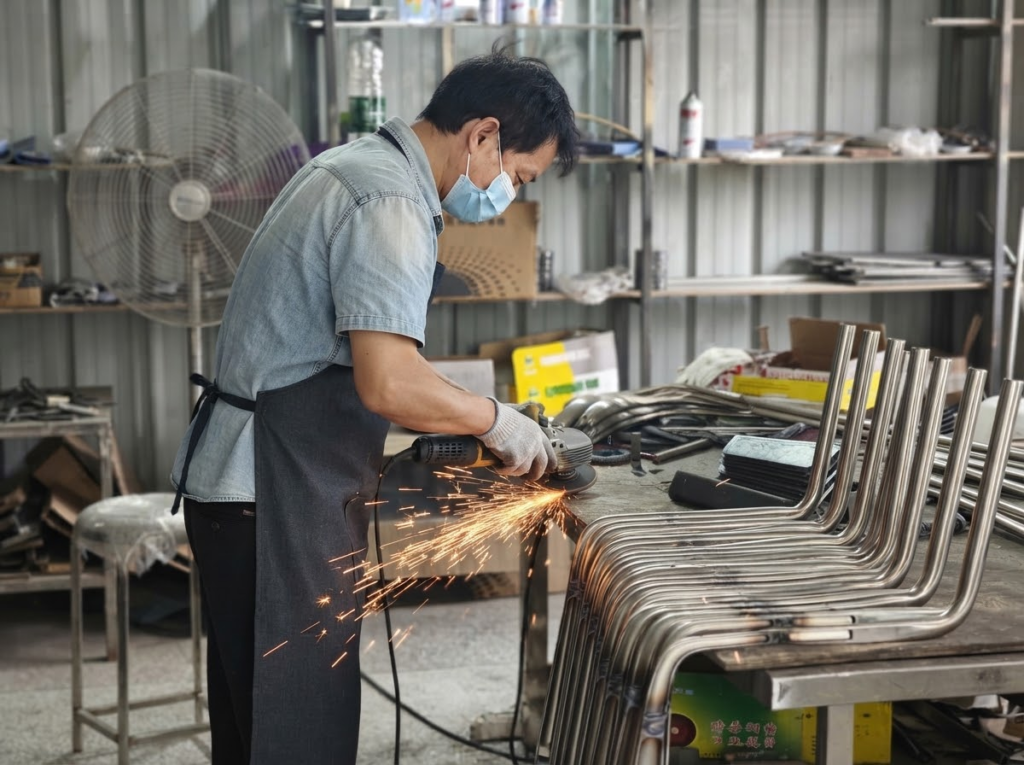
The Pearl River Delta: The Southern Heavyweights
Forget your traditional western idea of a factory. To understand the southern manufacturing hubs—places like Guangzhou, Dongguan, Shenzhen, Longjiang—think of them more like prep stations in a massive, chaotic commercial kitchen. Everything is hyper-specialized.
You don’t fly into Guangdong because the buildings look nice. You fly there because your lead designer drafted some lunatic custom credenza needing a brass inlay sunk flush into solid ash, with integrated LED channels. A factory in Guangzhou can walk out their front gate, haggle with a guy who only mills brass inlays for a living, grab the ash from a timber yard two miles away, source the LEDs from Shenzhen, and have a workable prototype sitting on a desk by Thursday.
I’m not exaggerating. Walk into a local material market in Houjie. You’ll find entire warehouse aisles dedicated to 400 different variations of sofa legs. Just legs. Thousands of them.
But that insane density comes at a steep price. Try sourcing basic, high-volume flat-pack MDF junk in the south, and you’ll overpay by 20% before you even discuss ocean freight.
Rent down south is brutal now. You can’t find cheap labor either. The younger generation? They don’t want to spray lacquer or sand wood for 10 hours a day; they want to drive for food delivery apps. Plus, the government’s environmental crackdowns wiped out the cheap, dirty finishing shops practically overnight a few years back.
What survived is highly professional. I audited a casegoods plant recently where the finishing room looked like a semiconductor lab. Positive air pressure. Water-curtain spray booths. Guys in full hazmat gear. That’s what the south buys you. Execution of the truly hard stuff.
The Eastern and Northern Corridors: The Volume Kings
Head up north toward Hebei, or east out to Zhejiang. The rules completely fly out the window.
Actually, it’s a totally different sport. Forget craftsmanship. Forget matching Pantone fabric swatches under a lightbox. Up here, it’s all about terrifying scale and shaving pennies off the unit cost.
Take Anji county in Zhejiang province. The undisputed heavyweight champion of the office chair. If your butt is currently resting on a mesh task chair, I’d bet cash the gas lift or the nylon casters rolled out of Anji. These places are behemoths. Multi-building complexes running automated welding lines on a relentless 24/7 grind.
It’s like comparing a t-shirt cannon to a bespoke tailor. The eastern and northern clusters own single-category standardization.
But try asking a massive tube-steel factory in Shengfang to suddenly pivot. Hand them a dining chair design requiring curved bentwood plywood and commercial-grade upholstery. Then grab some popcorn, because it will be a spectacular trainwreck.
They lack the micro-ecosystem. Communication stalls out. The fabric vendor is three provinces away. They’ll use a 25kg/m³ foam when you specced a 45kg/m³ high-resilience foam because they honestly don’t know the difference. You’ll blow three grand sending QC inspectors up north just to realize these guys fundamentally do not understand commercial finishing standards.
The Geography Reality Check
| Region | The Real Strength | Who Should Actually Buy Here |
| Guangzhou/Foshan (South) | Soft furnishings, custom projects, mixed materials | Hospitality, commercial spaces, boutique retail |
| Dongguan (South) | Export casegoods, intricate woodwork, flawless lacquer | Designer brands, complex hotel fit-outs |
| Anji (East) | Seating (office, ergonomic, gaming), bamboo | Big-box retailers, Amazon volume sellers |
| Shengfang (North) | Steel tube bending, tempered glass, budget MDF | Entry-level wholesale, budget e-commerce |
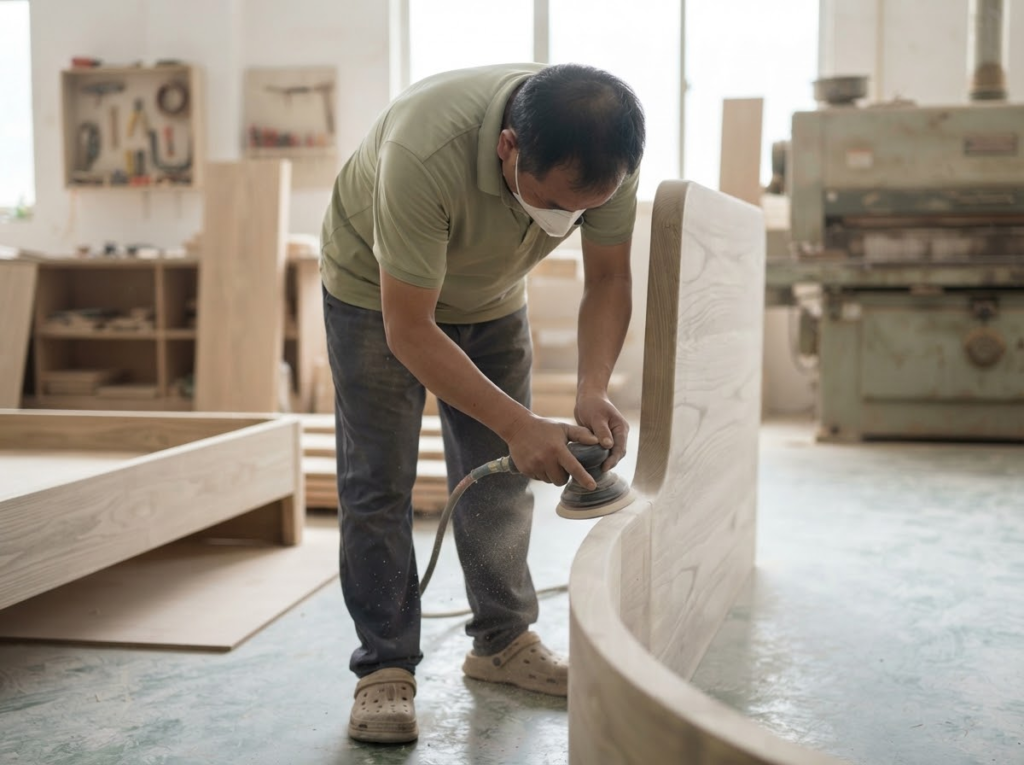
The Mid-Sized Specialist Strategy (Stop Chasing Giants)
This is where most mid-tier buyers completely shoot themselves in the foot. Everyone wants the sheer muscle of a massive mega-factory. They want the bragging rights of a 100,000-square-meter facility. But let’s be real here. Nobody wants to be treated like an annoying gnat.
Say you drop a complex PO for 200 custom guestroom packages into a massive plant that usually spits out 500 containers of folding chairs a month. Total disaster. Your specific welt cord details? Ignored. The concealed hinges you asked for? Replaced with cheap knockoffs. The floor managers get their annual bonuses based on speed and volume, not getting your bespoke stitching right.
Rookies chase the glittering mega-factories. The guys who actually survive out here look for mid-sized specialists.
Take an operation like Interi Furniture over in Guangzhou. I’ve watched their model for a bit. They don’t mess around with cheap whole-house MDF cabinetry or pretend to do everything under the sun. They stick strictly to soft furnishings customization and specific commercial project work. When a high-end resort needs custom lobby seating or intricate guestroom pieces, factories in this specific weight class actually make sense.
With a mid-sized specialist, you usually get an English-speaking project manager who actually opens and reads your CAD files. They don’t just shove your PDFs into a generic production queue. They’re embedded deep enough in the southern ecosystem to source exactly what you need—the right marble, the right high-rub-count fabrics—but they aren’t so bloated that they slap you with a crushing 500-piece MOQ. They handle the volume of a commercial rollout, but they still actually care if the lobby chair sits right.
Your Tactical Decision Tree
Stop blasting the exact same generic RFQ out to 50 random links. You look like a tourist. Narrow your strategy before you even ask for a fabric swatch.
- Define the Mess First: Is your product a knock-down chair in one solid color? Or a mixed-material credenza with smoked veneer and solid ash? If it’s the latter, cross the north off your list immediately. Do not pass go. Book a flight to Guangzhou.
- Face Your Volume Reality: Be honest about your numbers. Need 5,000 basic metal barstools for a discount retail chain? The south will laugh you out of the room on price. Go to Hebei where the tube-benders never sleep.
- Audit the Supply Chain, Not the Showroom: On your factory tour, ask the floor boss where the zinc plating happens. Where do they buy foam? If he stutters, or if the foam guy is 300 miles away, your lead times are going to be a living hell.
- The Perfect English Trap: A beautifully translated PDF catalog, slick Instagram reels, but a facility the size of a gas station? You’ve found a trading company. Nothing wrong with a good trader if you need their network to hold your hand, but know whose margins you’re paying for.
- Packaging Protocols Upfront: Never assume they know ISTA 3A standards for e-commerce. Ask about drop testing before negotiating the unit price. A cheap Hebei chair is completely worthless if it shows up in your US warehouse in pieces.

Q&A from the Trenches
Q: I found a massive factory in Hebei that quoted me 30% less for a hotel lobby sofa than a Guangzhou factory. Photos look identical. Should I jump on it?
A: No. Not unless you enjoy replacing lobby furniture in six months. The Hebei factory is reverse-engineering a photo. They are using lower-density foam, a thinner plywood frame, and cheap zig-zag springs because their local supply chain isn’t built for commercial durability. The price difference is hiding in the materials you can’t see on an inspection report.
Q: With all the freight madness and tariffs, does China still make sense for furniture?
A: Plugging into this ecosystem is still the most ruthless, efficient play on the board. Yes, ocean freight fluctuates wildly. Yes, tariffs bite hard. But for complex, mixed-material pieces? No other country currently has the localized, hyper-dense component networks to match the south’s speed and variety. Vietnam is great for wood casegoods right now, but for complex soft furnishings and mixed media? China still holds the cards.
Q: How do I vet a factory before I spend three grand on a flight to Asia?
A: Ignore the showroom completely. Anyone can buy competitor samples and put them in a nice room. Ask for a live WeChat video tour of their raw materials warehouse, their frame-assembly area, and their finishing room mid-shift. Very few operations can fake a high-functioning assembly line on a random Tuesday morning.
Q: Should I put all my SKUs with one huge factory to save on shipping?
A: Usually, no. Classic rookie move. Smart buyers split orders based on regional strengths. Buy your volume seating in Anji. Buy your custom pieces in Guangzhou or Dongguan. Consolidate the containers at the port through a good freight forwarder, not at the factory level.
The Bottom Line
I once had a factory boss in Longjiang tell me over a terrifyingly strong, throat-burning glass of baijiu at a post-audit dinner: “Foreigners always want to buy an apple at the price of a potato. And then they scream at us when it tastes like dirt.”
He wasn’t wrong.
Picking your manufacturing partners isn’t a geography quiz. It’s a structural decision about what matters most: dirt-cheap costs at extreme high volume, or complex execution and material mastery. You can’t have both from the same assembly line. The math just doesn’t allow it. Stop chasing unicorns. Map your products to the right regional strengths, and you might actually survive your next massive project without losing your mind.