

The email hit my inbox at 11 PM Shanghai time. Subject line: “They just gave me a chair.” No context. I opened it.
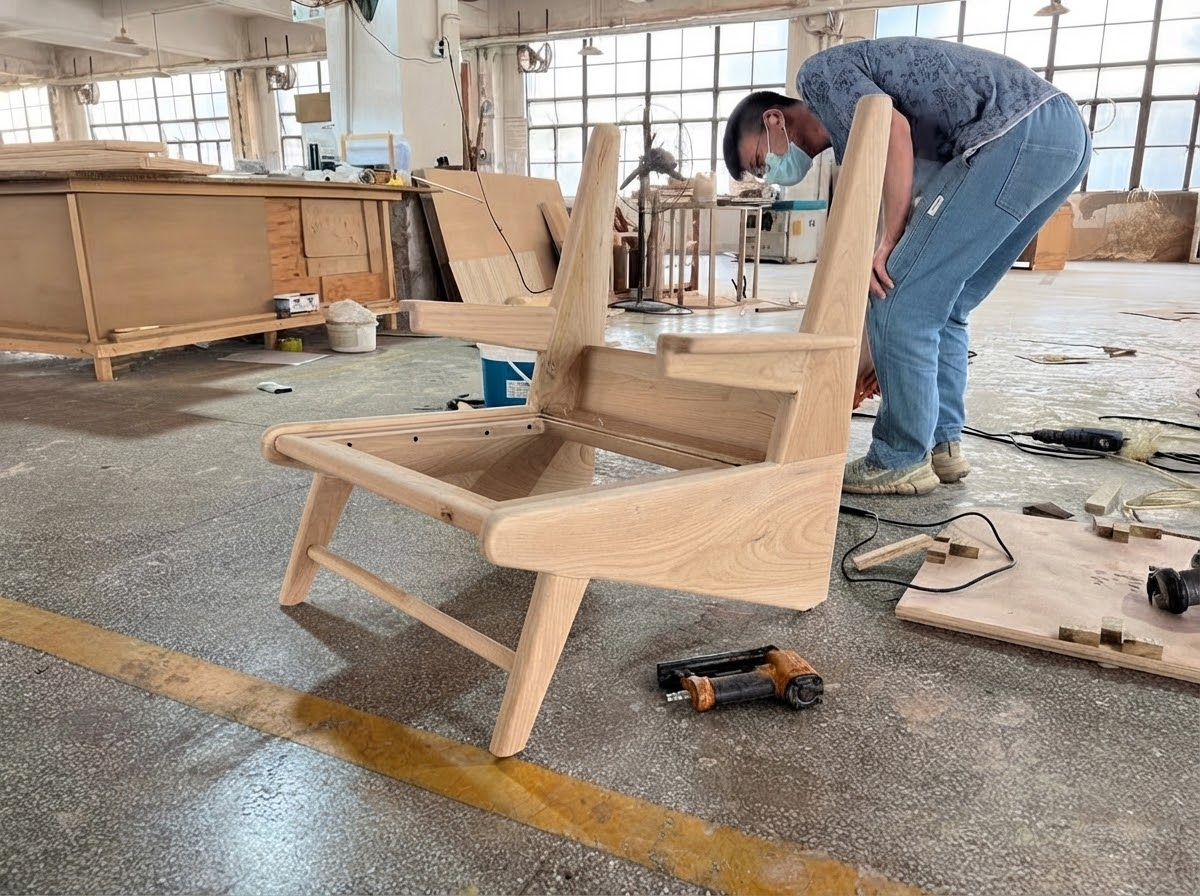
A procurement director I’d met two years prior at a Guangzhou trade show was writing from her hotel in Longjiang — a gritty district of Foshan that doesn’t show up on tourist maps. She’d spent her second day walking factory floors, half-deaf from the CNC routers, when a manufacturer she’d known for all of six hours handed her a fully upholstered lounge chair. Custom fabric. Solid ash. Brass feet. “Take it back,” he said. “Show your client. No charge.”
The thing would have cost her $4,200 at any wholesale tier. She didn’t ask for it. He offered. And she spent the rest of the trip waiting for the other shoe to drop.
It never did. Not in the way she expected.
What she ran into is something I’ve watched play out across Guangdong and Zhejiang for fifteen years. Chinese manufacturers don’t hand out prototypes because they’re nice guys. They do it because, in their math, that chair is cheaper than losing you to the factory next door. But here’s where Western buyers consistently screw up: they treat the free sample like a gift. The factory treats it like a deposit. And the space between those two readings? That’s where million-dollar deals get signed — or die on the vine.
The Brutal Truth: Nothing Is Free, But Not Everything Costs Cash
Let’s rip this band-aid off fast. If you’re a one-off buyer chasing a single custom piece with no volume behind you, forget it. You’re not getting a free prototype. Full stop.
The factories that eat sample costs aren’t philanthropists. They’re gamblers. They look at your pipeline, your brand positioning, your likely reorder rate — and they place a bet. The prototype is their ante. The pot is a supply contract that stretches over eighteen to twenty-four months.
Here’s the rule of thumb I give every buyer who asks: If the factory thinks you’ll place orders worth at least eight to twelve times that prototype’s production cost within a year and a half, the sample is free. They’ll swallow it. They’ll smile. And they’ll never show you the spreadsheet.
But if you’re a spec buyer? A designer with one residential job? Someone who treats 1688 like Amazon? They’ll quote you $800 for the chair and $1,200 to air-freight it. And they won’t blink.
Key Takeaway
- China FF&E sourcing is the process of finding, vetting, and contracting manufacturers in China’s industrial clusters — mainly Guangdong, Zhejiang, and Jiangxi — for custom or spec furniture production.
- Free prototypes aren’t perks. They’re relationship investments made by factories gambling on long-term volume.
- Buyers who get free samples usually show clear project scale, repeat potential, or access to high-visibility installs.
- Your first factory visit counts more than your first email. The prototype call often happens in person, on the floor, inside the first two hours.
Why Factories Hand Out $4K Chairs: The Psychology Nobody Talks About
What Are They Really Buying?
Think of a free prototype like a cat dropping a dead bird on your porch. (I know. Stick with me.) The cat isn’t being generous. It’s proving it can hunt. It’s saying: I can do this. Watch me. The factory isn’t giving you furniture — they’re handing you proof of execution. And in a market where every second supplier claims to make “hotel-grade” pieces, proof is the only thing that actually moves the needle.
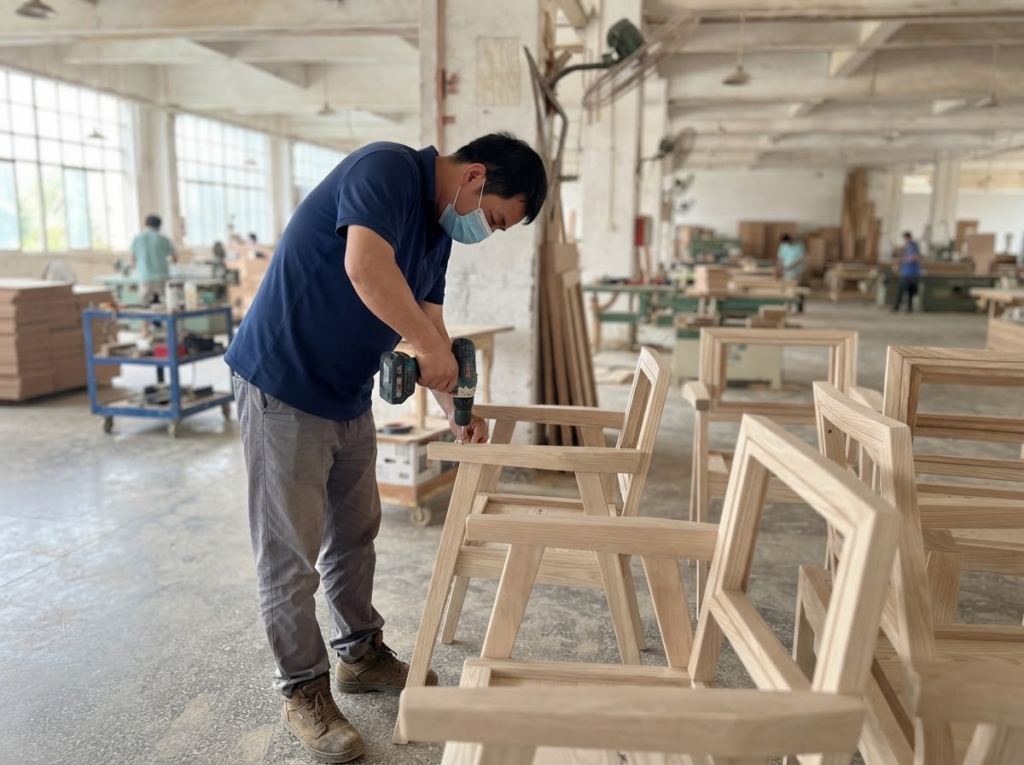
I’ve seen this dance in Dongguan more times than I can count. A buyer walks into a facility the size of a football field, sees German CNC machines humming, meets a production manager who spent six years at a joint-venture with an Italian brand. Suddenly that $3,200 prototype feels like a formality. The owner pours tea. Asks about your next project. Never mentions the sample cost because, in his head, he’s already spent it on the relationship.
And here’s what most analysts miss: the factory usually loses money on the prototype itself. The real margin hides in the tooling fees, the MOQs, the freight consolidation they’ll control later. The prototype is a loss leader in a market where customer acquisition is brutal and designer networks talk.
But — and this matters — the offer only materializes if you send the right signals. Walk in with a Pinterest board and a vague mood? You’ll pay. Walk in with floor plans, FF&E schedules, and a letter of intent from a hospitality group? The conversation flips.
The “Free” Sample That’ll Cost You
Not all free prototypes are built equal. Some are traps.
I learned this the hard way in Anji, 2019. A factory offered me a “complimentary” dining chair prototype for a restaurant project. Gorgeous piece. Perfect joinery. They even air-freighted it to LA on their dime. I recommended them. We signed for 400 units.
The production run was a catastrophe. Wood moisture content was off. Upholstery got farmed out to a subcontractor three hours away I’d never laid eyes on. The prototype and the production line might as well have been different companies.
What tends to happen is this: factories that rush to give you a free sample without asking hard questions are usually hiding something. The good ones grill you first. They want your quality standards, your inspection protocol, your tolerance for variation. They make you earn the freebie because they know they’ll have to match it later.
Where Free Samples Live and Die: The Geography Nobody Maps
Does Location Matter More Than Size?
It does. But not how you’d think.
Foshan gets the glory. The massive showrooms, the mile-long complexes, the trade show buzz — it’s intoxicating. But in my experience, the factories most willing to eat a prototype cost aren’t always the giants. They’re the mid-sized operators with something to prove.
While some buyers gravitate toward massive manufacturers in Foshan, others find that mid-sized specialists — operations like Interi Furniture, which focuses on custom hospitality and high-end residential FF&E. These aren’t assembly-line plants pumping out container loads of identical SKUs. They’re shops with 80 to 200 workers, export licenses, and a portfolio of European or North American projects they use as reference. They’ll build you a prototype not because they have to, but because they need the case study.
Nankang, over in Jiangxi, is another cluster worth watching. Less polished than Guangdong. Rougher around the edges. But the cost structures are different, and the hunger for export buyers is sharper. I’ve seen Nankang manufacturers offer free prototypes to buyers they’d never met, simply because the factory across the street did it last Tuesday. It’s a race to the bottom in some ways. But for a sharp buyer with solid QC controls, that competition is pure leverage.
Dongguan sits in the middle. The city built its name on OEM work for Japanese and European brands. Factories there know spec-grade production. They also know that a free prototype for a Four Seasons project is worth infinitely more than a paid sample from a residential client they’ll never see again.
Your Playbook: Actually Getting the Free Prototype
Before You Get on a Plane
Don’t ask for a free sample in your first email. Just don’t. It screams amateur.
Send a project brief with teeth:
- Project type and scale — “Boutique hotel, 127 rooms, opening Q3 2027”
- Your actual role — “FF&E procurement consultant for the ownership group”
- Real timeline — Dates. Not “ASAP.”
- Reference images — Five, max. Curated. Not a hundred screenshots.
Attach a letter of intent if you’ve got one. Even a non-binding LOI from a recognizable brand changes the math. Factories have smelled enough vaporware to spot a tourist from a thousand miles out.
Reading the Room on the Floor
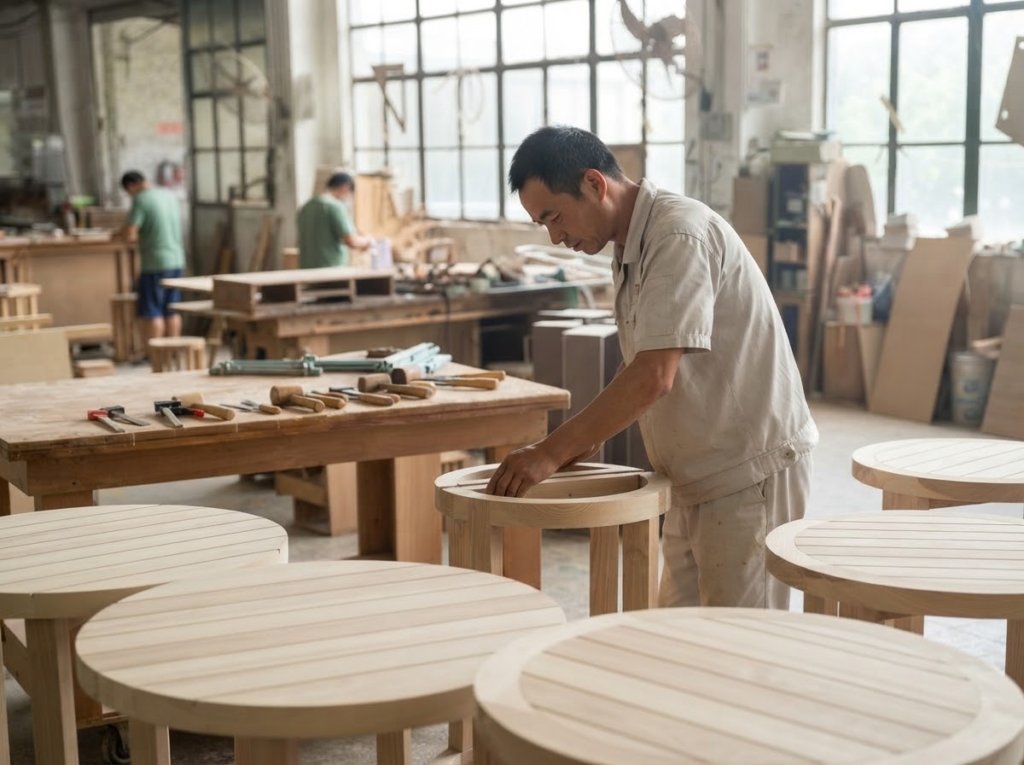
When you land, don’t lead with the sample. Lead with the project. Walk the floor. Ask about QC. Look at what’s currently in production. If you see half a dozen sofas wrapped in plastic with West Elm tags, that’s intel. If you spot a custom headboard going together for a Marriott property, that’s gold.
Bring physical samples. Fabric swatches. Finish chips. A competitor’s piece you want to beat. Factories respect buyers who know materials. It tells them you can actually evaluate what they build.
If the conversation’s flowing, mention your timeline. “We’re looking to lock prototypes by end of next month.” That creates urgency without reeking of desperation.
The Ask — And What to Trade
Here’s where most buyers crash and burn. They ask for a free sample like they’re begging for a favor. Don’t. Frame it as mutual investment.
Try this: “We’re down to three factories for this project. Whoever delivers the prototype closest to spec gets the production order. We’d cover shipping and any specialty materials, but we’d need the prototype itself at no charge.”
What you’re doing is giving them a path to recoup. You’re not begging. You’re negotiating.
And here’s the red flag that flies in the face of every sourcing blog you’ve read: If a factory offers you a free prototype before you’ve talked payment terms, production timelines, or quality standards, walk. That eagerness isn’t confidence. It’s desperation. Or worse — bait-and-switch. The factory that gives away samples too easily usually makes it back by gutting the production run. I’ve watched it happen too many times.
The Follow-Up That Actually Works
Send a thank-you within 24 hours. Include photos from your visit. Reference specific conversations. And — this is the part almost nobody does — send them a competitor’s product shot with a note: “This is what we’re trying to beat on quality and value.”
That single move tells the factory you’re serious, you’re competitive, and you’re giving them a target. Factories love targets.
FAQ: What Buyers Actually Ask
Q: I got quoted $600 for a prototype. Fair game, or are they gouging me?
A: Depends on the piece. Simple upholstered dining chair? $600 is steep. Solid wood bed frame with custom joinery and integrated lighting? That’s cheap. The real question isn’t the price — it’s whether that $600 gets credited against your first order. Ask. If they say no, that’s not automatically a red flag, but it tells you they don’t see you as a volume play yet.
Q: Can I score a free prototype without flying to China?
A: In my experience, maybe one in ten buyers who never set foot in a factory get a genuinely free, high-end prototype. It happens, but only when you’ve got an existing relationship, a strong referral, or a project profile so compelling the factory does the math from a distance. For first-time China FF&E sourcing, you need to show up. The prototype isn’t just about the product — it’s about the factory sizing you up in person.
Q: What if the prototype’s perfect but the production run’s garbage?
A: This is the nightmare, and it happens more than anyone admits. Protect yourself by making the prototype your production master. Photograph it from every angle. Weigh it. Document the internal construction if you can. Then write a clause into your contract: production units must match the approved prototype within defined tolerances. Hire third-party inspection. Don’t trust. Verify.
Q: Do I need Mandarin to negotiate a free sample?
A: No. But it doesn’t hurt. More importantly, you need a translator who knows furniture, not just language. The word “prototype” in a factory context can mean a pre-production sample, a showroom model, or a one-off custom piece — and each carries different cost implications. A good translator saves you more money than a free sample ever will.
Q: So can I actually get free high-end prototypes from Chinese manufacturers?
A: Yes — if you bring project scale, show repeat potential, visit in person, and negotiate the sample as part of a larger commercial relationship instead of a standalone ask. If you’re shopping for one custom sofa for a residential client, expect to pay. If you’re sourcing FF&E for a 200-room hotel, the prototypes should be part of the conversation, not an obstacle.
The Hard-Earned Lesson
At the end of the day, the free prototype isn’t about the chair. It’s about the conversation that happens around it. The owner watching how you inspect the seam. The production manager noticing whether you ask about kiln-drying times. The sales director calculating if you’ll be back in six months with another project.
I still have that Longjiang chair in my office. It’s not the best piece I’ve ever sourced. But it reminds me of something I forget whenever I get lazy: the factories that give you something for free are betting you’ll make them rich later. Your job isn’t to take the gift. Your job is to be worth the bet.
So here’s my question: When you walk into that factory next month, will you look like a buyer they should invest in? Or will you look like someone hunting for a free chair?
I’ll be in Foshan next quarter. If you make it over, grab a coffee. First round’s on me. The prototype, as always, is negotiable.