


It was easily 110 degrees on the tarmac behind a Vegas casino last October. I was standing next to a hotel procurement guy. He was sweating completely through a custom dress shirt, gripping a shipping manifest clipboard like his life depended on it. We were leaning against a concrete pylon, waiting to crack the seal on a 40-foot high-cube container that just dragged its way through Long Beach port out of Foshan.
Inside that sweltering metal box? Three hundred custom lounge chairs destined for a high-limit VIP room. The financial stakes were bordering on a legitimate panic attack. The grand opening timeline was already completely cooked.
At first glance, the goods looked dead-on. The emerald velvet caught the harsh desert sunlight perfectly. The brass legs had that exact brushed patina the interior designer had been screaming about over email for six months.
But the absolute second this procurement director dropped his weight into one of the seats… the cushion just gave up. Bottomed out completely. His knees shot up to his chest like a grown man crammed into a toddler’s playset. You could literally hear the plywood deck underneath taking his full weight.
To scrape back maybe a buck-twenty per unit, the supplier had quietly trashed our engineering spec for high-resilience D45 foam. They swapped in a bottom-tier, low-density sponge. And they did this right after the golden sample was signed off. That single container instantly wiped $20,000 in product equity off the board.
And that number totally ignores the logistics bloodbath that followed. Try air-freighting emergency foam inserts from California and paying double-time to local union upholsterers to rip those chairs apart on a holiday weekend. It’s a complete nightmare.
Guys on LinkedIn love hyping up offshore sourcing as this glamorous, high-stakes treasure hunt. Fly over, drink some aged Pu’er tea, hammer out a brutal unit price, and walk away a margin genius.
Total garbage.
Without your own boots on the concrete—someone actually tracking the raw materials before they hit the staple guns—you’re just wiring cash into a black hole and hoping for the best.
The Brutal Reality of Factory Floor Politics
Let’s get one thing totally straight right now. Hospitality does not equal compliance.
That factory boss taking you out to a sprawling seafood banquet in Dongguan and pouring you endless shots of Maotai? Fantastic host. Probably a guy who genuinely wants to keep your purchase orders flowing.
He is not, however, your quality assurance manager.
When global shipping rates suddenly spike, or the RMB fluctuates against the dollar, or local environmental inspectors force the factory to shut down their spray booths for a week, they don’t call you on WeChat to negotiate a price increase. They just quietly extract the lost margin out of your product.
Suddenly, your specified 0.6mm American walnut veneer becomes a 0.3mm paper-thin skin that chips if you stare at it too hard. Heavy-duty DTC drawer glides get secretly swapped for local Wenzhou knockoffs. They feel identical on day one, sure. But they rust out completely by Christmas. Or the line workers skip the final sanding pass on the underside of a dining table. Because, let’s be honest, they figure your customer isn’t crawling around on the floor to check.
In offshore manufacturing, quality isn’t a fixed baseline you agree upon on paper. It’s a decaying orbit. You have to aggressively, constantly fight to keep it up.
Rule of thumb: If you don’t physically check it, assume it simply didn’t happen.
You build relationships in the Canton Fair showrooms. I get it. But you enforce the actual contract on the assembly line. Skipping independent verification before paying that final 70% balance just makes you a voluntary margin-buffer for the factory’s overhead. And frankly, they will gladly take your money.
Key Takeaway: The Gritty Reality of Production Risk
- Quality degrades by default: Suppliers inevitably drift toward cheaper inputs to protect their own margins. It’s survival math, not a personal attack.
- Timing is literally everything: Catching a warped chair frame mid-production costs pennies to fix. Catching it in your domestic warehouse means a 100% financial write-off.
- Independence is non-negotiable: Factory-provided inspection photos are staged marketing materials. Real verification demands a third party whose paycheck doesn’t rely on the factory boss being happy.
Inside the Anatomy of a Sourcing Disaster
So how do these massive, expensive blowups actually happen? Rarely is it some villainous plot to steal your 30% deposit and vanish into the night. Mostly, it’s just frantic middle managers trying to hit impossible shipping quotas before the truck drivers disappear for the Lunar New Year shutdown.
Why Good Factories Go Bad
Think of a massive furniture plant like a chaotic commercial kitchen during Friday night service. If the line cook runs out of heavy cream, he doesn’t shut down the restaurant. He thins out some milk with butter, slaps it on the plate, and prays nobody at table four notices. (And yeah, I’ve seen exactly this mindset in Guangdong more times than I care to admit).
Let me give you a better example from the trenches.
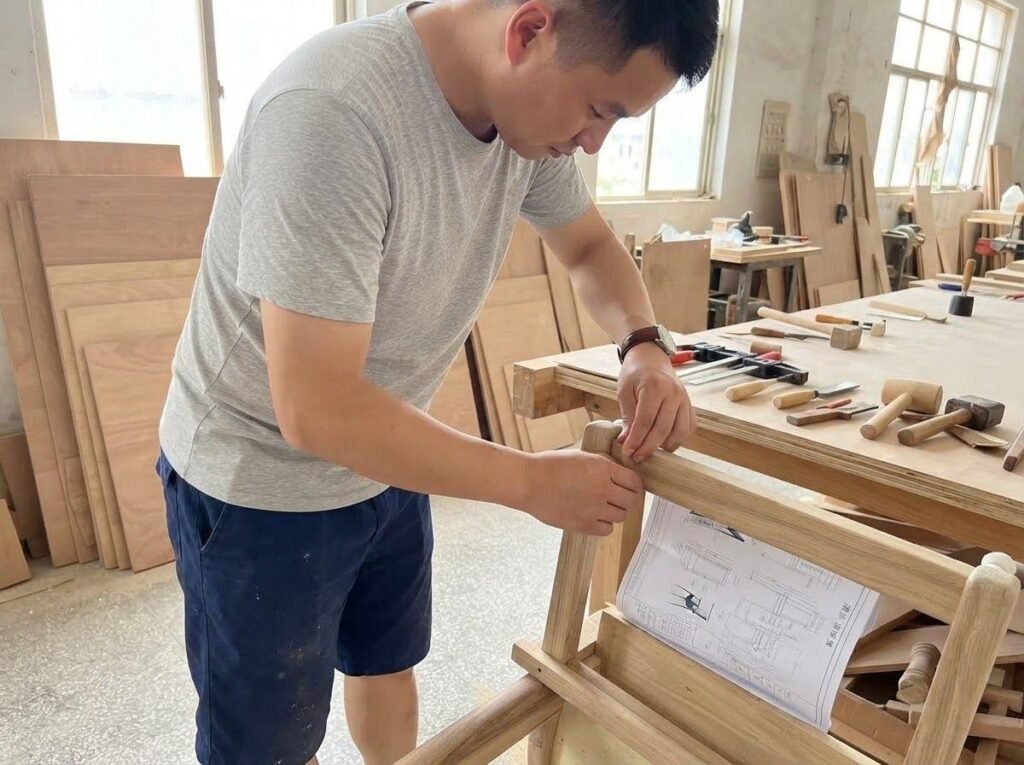
A few years ago, I walked unannounced into a massive upholstery shed in Longjiang. A mid-tier residential brand had hired me for a random inline check on a container of velvet sectionals. I wandered away from the main assembly line and kicked aside a dusty blue tarp near the framing jigs.
Underneath was a towering stack of raw pine framing timber. It was visibly sweating. I pulled out my Delmhorst moisture meter and jammed the pins deep into the end grain. It spiked to 19%. Standard export tolerance is 10%, maybe 12% if you’re pushing it.
The floor manager awkwardly offered me a cigarette, laughed it off, and blamed a “temporary wood supplier.”
Pure smoke and mirrors.
If I wasn’t physically standing in that sawdust, that wet pine would have been buried deep inside those sofas. Fast forward six months in a bone-dry Arizona climate, and every single one of those frames would have warped, squeaked, or violently snapped. The brand would have blamed bad engineering. But the real culprit was just a floor manager cutting a corner on kiln-drying times to save a couple of hundred bucks on his electricity bill.
Are You Inspecting, or Just Looking?
Actually, let me backtrack for a second. The fundamental error most rookies make is thinking that staring at a finished sofa constitutes an inspection.
It’s not. It’s an autopsy.
By the time the piece is boxed up, the real sins are already permanently hidden under fabric, foam, and lacquer. China furniture sourcing is the overarching game of finding and vetting suppliers. But effective China furniture QC is the gritty, systematic teardown of goods against your physical golden sample—before, during, and after assembly. It’s your enforcement arm on the ground. Fly blind without it, and you’ll eventually crash the plane.
The Curing Room Catastrophe
Here’s another classic that catches buyers totally off guard. Finishing schedules.
I was running point on a hospitality order for a boutique resort down in Miami. Three hundred solid ash dining tables, stained pitch black with a heavy PU clear coat. The factory up in Anji was running three days behind schedule, and the freight forwarder was screaming for the containers to make the vessel cutoff at Ningbo port.
To speed things up, the factory quietly chopped the curing time in the drying room by 48 hours. They packed the tables while the lacquer was technically dry to the touch, but it hadn’t fully off-gassed. By the time they arrived in Miami and the client sliced open the cartons, a milky white haze had bloomed—trapped deep under the clear coat. Moisture from the humid sea air had penetrated the uncured finish during transit.
Every single table had to be chemically stripped and refinished locally. A table that cost $400 at the factory suddenly cost $900 to salvage stateside.
A mid-production inspection would have caught the rushed timeline. A guy on the floor would have done a basic 3M cross-hatch tape test on the lacquer and watched the finish peel right off onto the tape.
The Middle Market and Sub-Contractor Roulette
Where you place your purchase order drastically changes the type of oversight you need. The supply chain over there is wildly fragmented. Your defensive strategy needs to match the exact tier of the factory you’re dealing with.
Is Bigger Always Better?
Green buyers think throwing their orders at massive, heavily automated mega-factories solves everything. Big CNC machines mean zero human errors, right?
Not even close.
Drop a $50k hospitality order into a facility pumping out $15 million a month for global big-box retail, and you are literally a rounding error to them. You’ll get the night shift B-team. Your custom veneer spec will get ignored because it slows down their main conveyor line.
Contrast that with the middle market. A ton of veteran buyers find that mid-sized specialists actually offer a way better risk-reward balance. Take an operation like Interi Furniture, for instance—they focus heavily on custom project execution and hospitality pieces. Plants operating in that specific sweet spot are usually agile and hungry enough to actually care about a fifty-room boutique rollout. You get better dialogue. Faster pivots. And they won’t treat your custom dimensions like a massive annoyance.
But here’s the catch nobody talks about. Even those solid mid-tier players rely on a massive, invisible web of local sub-contractors for niche stuff. Powder coating. Specialized brass plating. Glass tempering. If their local plating guy down the street cuts corners on the acid wash prep, your brass chair legs are going to flake and peel in a month. Factory size doesn’t eliminate the need for a third-party inspector. It just shifts what they need to hunt for.
| Factory Tier | Typical Buyer Profile | Primary QC Vulnerability |
| Mega-Monoliths | Big-box retail, global hotel chains | Ignoring custom specs; assigning junior staff to small runs |
| Mid-Sized Specialists | Project buyers, high-end residential | Sub-contractor failures (metal plating, fabric finishing) |
| Boutique Workshops | Niche designers, low-volume custom | Brutally inconsistent finishing; terrible carton packing |
The Ground-Level Survival Guide
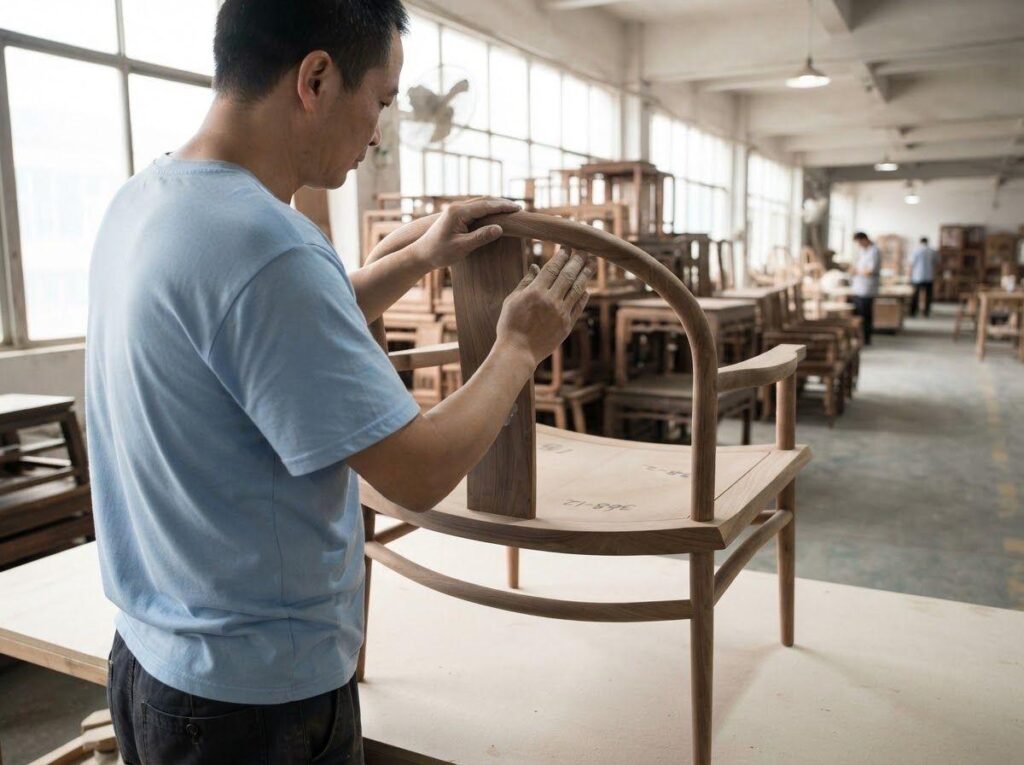
Stop asking factories for “good quality.” That phrase means absolutely zero in international trade. Instead, build a compliance trap so brutally tight that failing your standards becomes a massive financial headache for them.
Here is the exact playbook I use to run interference on high-stakes rollouts:
- Weaponize your POs: Never rely on vague specs or gentleman’s agreements over WeChat. Document exactly what triggers a financial penalty. I use clauses like: “Any fabric dye lot variance exceeding 5% from the physical master sample equals immediate rejection at the supplier’s cost.” Make it hurt to fail.
- Check the guts early (DUPRO): Waiting for final assembly to send an inspector is total rookie behavior. Once they staple that Italian leather over the foam, you’re locked out. Send your guy in before they start shooting staples. Verify the foam density. Check the wood moisture meter. Measure the metal gauge of the internal springs with digital calipers.
- The Pre-Shipment Inspection (PSI): Your absolute last line of defense. A proper independent inspector pulling an AQL 2.5/4.0 statistical sample. They need to aggressively drop-test the cartons, verify finish matching under daylight-balanced bulbs, and physically stress-test the structural joints. If the inspector isn’t sweating by the end of the day, they didn’t push hard enough.
- Mandate specific packing standards: I’ve seen flawless furniture absolutely destroyed by cheap, single-wall cardboard. Specify 5-ply or 7-ply corrugated export cartons in the contract. Require 2-inch EPS foam on all critical corners.
- Babysit the loading dock: You’d probably vomit if you saw how much pristine furniture gets destroyed during container loading. Exhausted warehouse workers paid by the container will literally shove boxes in with forklifts just to save ten minutes. Have a guy on site making sure the 200-pound marble tops stay flat on the floor, not balanced precariously on top of fragile mirrored nightstands.
- The Ultimate Red Flag: The factory boss smiles and says, “Don’t worry my friend, my internal QC team will check it and send you an HD video!”
Hell no. Never accept a factory-shot video as proof of life.
If the guy you hired for QC doesn’t have the explicit, contractual authority to tell the factory to stop loading the container, you are burning your money.

FAQs: The Questions Buyers Actually Ask in the Trenches
Q: Do I really need QC if I’ve bought from this exact same factory for five years without a single issue?
A: Yes. Without a doubt. Complacency breeds margin-skimming. Long-term partners often assume you won’t bother checking anymore, so they slowly downgrade inputs to boost their own bottom line. Or, worse, they farm your order out to a shadow factory down the street when their main line gets overbooked. Don’t penalize yourself for being a loyal customer.
Q: What’s the real, actual cost for someone to inspect my stuff over there?
A: In my experience, a solid third-party inspector in major hubs like Dongguan, Foshan, or Anji runs about $250 to $350 a man-day. Put that up against a $20,000 container of unsellable garbage, and it’s basically free insurance. If you can’t swing a $300 day-rate to protect your shipment, you frankly can’t afford to import.
Q: Am I going to piss off my factory rep by sending in an auditor?
A: If they run a legitimate, export-grade business? No. They expect it. It’s standard operating procedure for global trade. But if they throw a massive fit, act deeply offended, or try to ban your inspector from the assembly floor? That is a blaring siren that they planned to screw you over, and you just ruined their payday.
Q: Can’t I just have them do a quick WeChat video call before I wire the balance?
A: A video call shows exactly what the factory boss wants you to see, at the exact angle he wants you to see it. It won’t pick up the wobble in a chair leg, the rough lacquer under the desk, or the nasty chemical smell of cheap formaldehyde glue. It won’t show you the moisture reading of the internal frame. Videos sell. Inspections verify. So, is a physical, independent Chinese quality inspection truly required? Absolutely.
The Final Word on Factory Friction
Tapping into the Chinese manufacturing ecosystem is still incredibly lucrative—but only if you stop pretending it runs on the honor system.
Distance creates variance. Period. Sitting at your desk 7,000 miles away approving CAD files and stroking fabric swatches feels highly productive. It feels like you’re doing the actual work. But none of that matters if the product crammed into that metal shipping box isn’t what you bought.
So ask yourself. Are you actively managing a global supply chain, or are you just a gambler wiring huge deposits across the Pacific and hoping for the best?
Pay for the inspection. Guard your margins fiercely. And never, ever let the factory grade its own homework.