


The call came Tuesday afternoon. Marcus — not his real name, but close enough — sounded like a man who’d just found out his dog died.
“Your shipment’s delayed,” they’d told him. Thick accent, polite, that broken English that somehow sounds more trustworthy than perfect fluency. Six weeks earlier, he’d been shaking hands with these same people at Canton Fair. Beautiful booth. Polished samples. A sales rep who gripped his palm for three full seconds, looked him dead in the eye, and called him “my friend” before Marcus even got his name out.
Thirteen thousand five hundred dollars. Wired to an account in Foshan. For eighty units of hotel-grade lounge seating. The quote wasn’t stupid-cheap, either. Just… tempting. The kind of number that makes you think you found the sweet spot.
Three months later? WeChat silence. The Foshan address? Shuttered textile warehouse. That “factory tour” they’d arranged? Rented workshop in Panyu. Borrowed machines. Day laborers who didn’t know the company name. And the real gut-punch? The business was still registered. Still showing up in directories. Probably still shaking hands in Phase 2 right now, taking deposits from buyers who haven’t learned the lesson yet.
The Brutal Truth
Nobody at the welcome desk is going to tell you this. The Canton Fair doesn’t check who owns the factory. They check who paid the booth fee. That’s the whole vetting process. A “Gold Supplier” badge? That means the subscription cleared. Not that these people own a single bandsaw between them.
And that booth with the waterfall wall and the espresso machine? Twenty-five grand, easy. For a six-month scam operation, that’s just customer acquisition cost.
Most buyers think they’re being careful. They’re not. They’re being slow.
Here’s the only rule that matters: if you can’t walk into that factory uninvited and find the same people doing the same work, you haven’t found a factory. You’ve found a stage.
Key Takeaways
- China furniture sourcing means finding the people who actually cut wood, weld frames, and staple foam — not brokers who rent credibility by the square meter at trade shows.
- A flashy Canton Fair booth proves one thing: someone had cash for a flashy booth. It says nothing about whether they can build your sofa, whether they’ll be around next quarter, or whether they’re running a Canton Fair furniture scam.
- The dangerous ones aren’t the obvious low-ballers. They’re the polished outfits that look exactly right because they’ve learned to copy every surface detail.
- Real verification happens outside the hall. On the floor. Unannounced. When the lights are on and nobody’s expecting you.

How the Con Actually Works
It’s not complicated. That’s the cruel part.
Register a business in Guangdong. Rent a booth — sometimes direct, sometimes through a broker who specializes in “booth sharing.” Bring samples. Not their samples. Bought off the open market in Shunde, or borrowed from a real factory for a kickback. The sales team? Trained. Professional. Often fluent. They might even have a “factory” to drive you to.
But that workshop? Rented by the day. Filled with temps who don’t know the company name.
Think of it like those fake designer handbag stalls in Shenzhen. The bags look right. The stitching is close. The price is just believable enough. You hand over cash, walk away feeling smart, and two blocks later you realize the lining’s already tearing. Except with furniture, you don’t realize until your deposit’s gone and your hotel opening is six weeks out.
What “Factory Direct” Means Now
The phrase is hollow. In my experience, maybe three out of ten exhibitors in any given furniture hall are actually building what they’re selling. Some are trading companies — honest middlemen who add value. Fine. That’s transparent. The problem is the rest: brokers playing manufacturer, shell entities with no fixed assets, no real workers, and no plan beyond collecting your first payment and vanishing.
Or rather, the problem isn’t the factory. It’s what you want to believe.
These operations run seasonal. Register in spring. Exhibit at Phase 2. Collect deposits through summer. Dissolve by autumn. Industry observers estimate the average lifespan of a fraudulent furniture shell company at eight to fourteen months. Long enough to burn through a cycle of buyers. Short enough that the legal system never catches up.
Why the Show Floor Is Perfect Hunting Ground
Canton Fair isn’t a market. It’s a pressure cooker. You fly in jet-lagged, with a procurement target your boss set in a meeting where nobody understands why a headboard takes twelve weeks. The aisles never end. The lighting’s brutal. After four hours, every booth looks like a life raft.
The scammers know this. They count on it.
Their booths sit strategically — near entrances, close to legitimate heavyweights so they can soak up borrowed credibility. The pitch is calibrated to your exhaustion. “We are direct factory.” “Best quality, best price.” “Send deposit today, start production tomorrow.” It’s not sophisticated. It doesn’t need to be. When you’re dehydrated, your flight to Frankfurt leaves in thirty-six hours, and your boss wants an answer, sophistication is the enemy of getting home.
Is the Factory Tour Just Theater?
Sometimes. Often enough that you should treat every guided tour as a performance until proven otherwise.
I saw this in Dongguan last year. Buyer arrives, gets the chilled green tea treatment, driven twenty minutes to a facility humming with CNC routers. Workers in clean uniforms. Timber stacked by the loading bay. But look closer. (And yeah, this happens more than anyone admits.) Wrong timber species for the order. Uniforms still creased from the package — brand new. The “production manager” explaining the drying kiln can’t tell you the target moisture content. Because he’s an actor. A convincing one. But an actor.
The real factory — if it exists — might be three provinces away. Or nowhere at all.
Not Everything Is Smoke and Mirrors
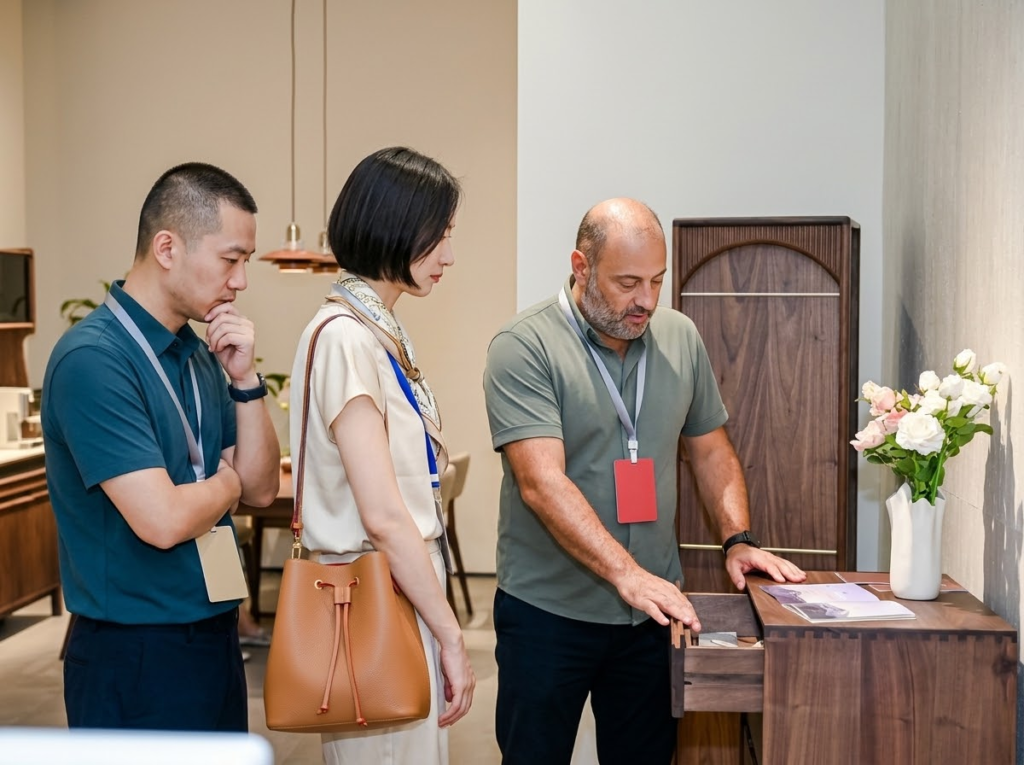
Let’s be straight. For every China trade show fake supplier running a short con, there are dozens of legitimate manufacturers building serious product. The issue is telling them apart when surface signals — booth design, brochure gloss, sales rep charm — have been completely divorced from what’s actually happening on the ground.
Some buyers chase the big names. Thousand-worker campuses in Foshan with in-house veneer shops and their own powder-coating lines. Others find that mid-sized specialists offer a different deal. Operations like Interi Furniture, working custom hospitality and project seating out of Guangdong, where factory-floor agility matters more than booth size. You won’t always find them under the biggest banners at Phase 2, but their model depends on you coming back — not on grabbing your deposit and disappearing.
The guys with the flashiest booths don’t always have the deepest benches. And the factory that can actually build your headboard to spec? Might be a four-story concrete block in Longjiang with a broken elevator and a waiting room that smells like machine oil. The CNC doesn’t care about the wallpaper.
The Survival Framework
You can’t eliminate risk. You can only drag it into the light. Here’s how I handle every new contact at a Chinese furniture fair — and how I sleep after wiring money across the Pacific.
Before You Fly
- Pull the business license. Every real company has one. If they won’t share the full registration number before you land? That’s not caution. That’s a curtain.
- Check the registered address on satellite maps. A “factory” in a Guangzhou residential tower isn’t a factory. It’s an apartment with good Wi-Fi.
- Search the Chinese name plus “投诉” or “骗子.” Local forums hold stories that never make it to English review sites.
At the Booth: The Five-Minute Test
- Ask for the factory’s exact location. Street name. District. Nearest landmark. A real ops manager knows this instantly. A broker stammers or gives you “near Foshan.”
- Ask for phone photos of the factory floor. Timestamped. Their own pictures, not brochure shots. Messy. Real. If they can’t produce five in a day, you’re not talking to a manufacturer.
- Here’s a red flag that breaks the rules: If they fire back a detailed quote same-day on a complex custom order? Be suspicious. Not because they’re efficient — because they’re probably plugging your specs into a trading company template. Real factories need a day or two to check material stock, labor loading, drying schedules. The delay is the signal. The speed is the trap.
After the Handshake
- Visit unannounced. Not the guided tour. Show up at the registered address during working hours with no appointment. If the guard’s never heard the company name, you just saved yourself fifteen grand.
- Check the National Enterprise Credit Information Publicity System. Free. In Chinese. Use Google Translate. Look for abnormal operations, penalties, legal disputes.
- Insist on a factory-specific quality agreement. Referenced to the actual production address, not just the trading office. Chopped with the official seal. A shell company will fight this. Hard.

FAQ: What Buyers Actually Ask Me
Q: If they’ve exhibited at Canton Fair three years running, they’re legit, right?
A: Wrong. Booth renewal is a credit card transaction, not a background check. I’ve seen shell companies do two consecutive cycles before ghosting. What matters is whether the same people show up, whether the company name stays constant, and whether you can trace a physical factory to the same address for multiple years. Longevity at the fair means almost nothing. Longevity at a fixed production address means everything.
Q: They sent a professional factory video. Safe to wire 30%?
A: Hell no. Factory videos are easier to fake than a TikTok dance. Rented space, hired actors, borrowed machines — I’ve seen the whole production. A video proves someone had a camera and editing software. It proves nothing about ownership, capacity, or intent. Don’t send a deposit before an unannounced site visit unless it’s locked in escrow or covered by an LC with inspection clauses.
Q: The price is amazing and they promise three-week delivery. Always a scam?
A: Depends. Standard container goods from a big Foshan player with ready stock? Maybe. Custom hotel furniture with hardwood frames, foam curing, multi-step finishing? Three weeks is physically impossible unless they’re cutting every corner known to man — or farming it out to a mystery shop they won’t name. At best, reckless. At worst, bait-and-switch.
Q: Can I trust the “Gold Supplier” and “Verified” badges?
A: No. Subscription credentials. Surface-level document checks. They don’t mean anyone visited the factory, reviewed the books, or confirmed they can actually build furniture. Treat them as ads, not assurance.
Q: Is the “Gold Supplier” at the trade show going to turn into a shell company after I pay?
A: Depends. Did you verify before you wired? If you met at Canton Fair, took the booth at face value, signed in the hotel bar, and sent money without walking the floor unannounced? Then yeah — there’s a real chance you’re dealing with a Chinese furniture fair fraud operation with no permanent manufacturing presence. If you did the desk checks, visited unannounced, verified the license against the production address, and structured payment with holdbacks? Then no — you probably found the real thing. The difference isn’t luck. It’s legwork.
The Question You’re Avoiding
Walk into Canton Fair next spring with nothing but your procurement list and a pocket full of optimism. Could you spot the shell company in ten minutes flat?
Most buyers can’t. Most don’t want to. The booth is pretty, the coffee’s hot, and the rep called you “my friend.” Believing is easier.
But easy is expensive. And the only thing that costs more than a flight to Guangzhou is the wire transfer you send because you were too tired to look closer.
See you on the factory floor. Try the stairs — the elevator’s probably broken anyway.