

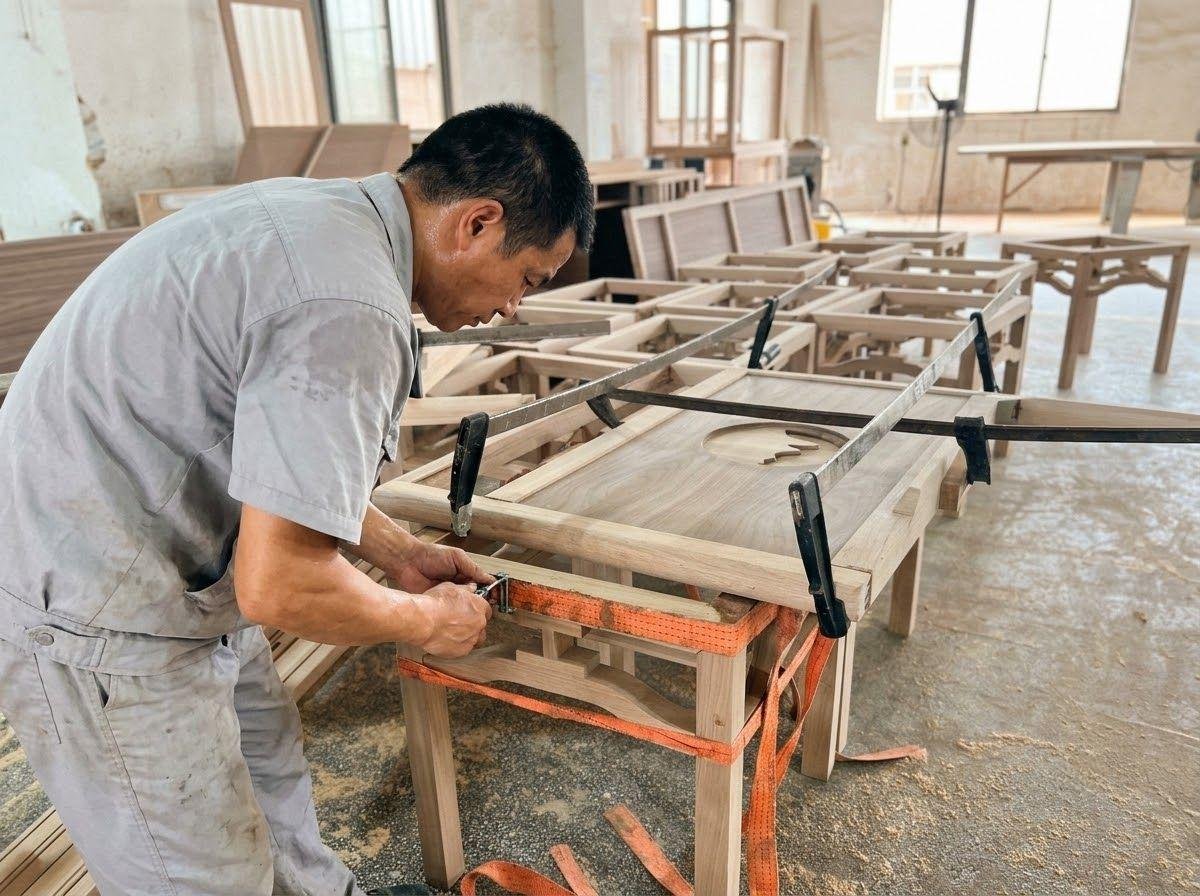
You land at Baiyun at 2 a.m. The driver’s a Hunan guy who spends the whole ride telling you when the furniture bubble’s gonna pop. You roll into Longjiang just as the sky’s turning grey. The security guard at the gate is squatting on the steps, tearing into a baozi. He doesn’t even look up as you drag your suitcase into the workshop. The air hits you first — sawdust mixed with hardener, thick enough to sting. The boss, surnamed Chen, maybe fifty, jeans splattered with primer, walks you to the “sample room.” That’s a corner of the warehouse with a plywood table slapped together. You pull out your iPad. Reference shots from Milan. Chen glances at them. “No problem. Small thing.”
Three weeks later, your freight forwarder in Shenzhen calls. Crate’s here. You pry it open. Legs are two inches short. The veneer looks like it came from a completely different tree — if it was a tree at all. The fabric? Some polyester you’d only find in a Yiwu commodity stall. Twenty-eight hundred bucks. You didn’t buy a sample. You bought a lesson.
China furniture prototype work is basically a translation accident. You send your design over. They send back their interpretation. That gap in the middle? Nobody fills it for you unless you pay for the bridge.
The Brutal Truth About First Samples
Nobody’s gonna tell you this upfront: the first sample is supposed to blow up. Its job isn’t to prove your design genius. It’s to expose how badly you two communicated.
Too many buyers treat a prototype like a dress rehearsal. Wrong. It’s a rough draft written in timber and foam. Expect it perfect on the first shot? Might as well buy a lottery ticket.
The old hands’ rule? Budget for three. Not “maybe two if we’re lucky.” Three. If you can’t stomach the cost of three rounds, don’t touch China sourcing. Seriously. Don’t.
Here’s the gist. Read it or don’t:
- A China furniture prototype almost never lands on the first try, because your definition of “exactly the same” and theirs live in different zip codes.
- Every dimension you leave out of your tech pack? The factory fills it in based on habit — and never mentions it.
- The factory quoting your sample dirt cheap? That’s your biggest trap.
- Chinese supplier samples are communication tools, not finished goods. Don’t confuse the two.
Why the First Sample Almost Always Disappoints
Is it the factory’s fault, or yours?
Blame is easy. Understanding costs money.
Here’s an analogy. You hire a tailor who’s never seen a suit to make you an Italian one. You give measurements, describe the lapel, say “Italian style.” The tailor nods like he was born in Naples. The suit arrives. Fits your cousin better than you. Not because he’s incompetent. Because “Italian style” meant something completely different in his head. He interpreted. He guessed. He filled blanks you didn’t know existed.
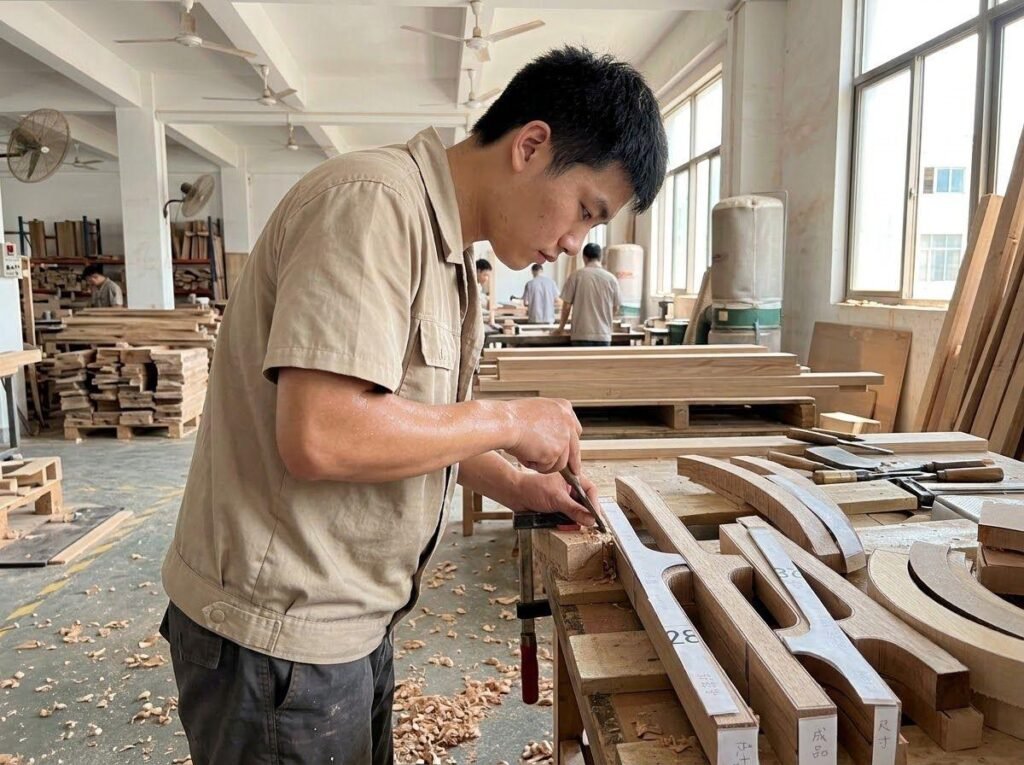
Now picture a Foshan workshop at six in the morning. The sample carpenter picks up your PDF. Three views, a material note, a few callouts. What’s missing? Grain direction. Joint tolerance. The fact that your “walnut” has to match a specific Italian supplier’s current batch. The factory will make choices. Logical ones. Efficient ones. And completely wrong for your market.
I watched a boutique hotel headboard go sideways at $4,200. The brief said “tufted leather.” Didn’t specify tufting depth. The factory went deep. Dramatically deep. Like a Chesterfield had a baby with a mattress. Was it wrong? Technically, no. Was it usable? Not a chance.
And here’s what most procurement directors miss. The factory isn’t trying to scam you. They’re trying to satisfy you with what they’ve got. Which is never enough.
What happens is this. Buyers assume shared visual literacy. Factories assume shared commercial priorities. Both are wrong. The factory wants to move fast and lock the PO. You want pixel-perfect replication. Those two agendas don’t even speak the same language.
The Communication Gap Nobody Talks About
What does “high quality” even mean in Dongguan?
If I had a dollar for every buyer who told a factory “we need top quality” then choked on the quote, I’d own a workshop in Longjiang by now.
It’s like playing telephone with someone who learned English from IKEA assembly leaflets. The words are there. The meaning ghosted you. In certain Dongguan shops, “high quality” means “this board won’t warp in humid weather.” To a buyer in Manhattan, it means “every edge hand-sanded to 600 grit, zero orange peel in the finish.” Those standards aren’t even in the same galaxy. (Not even close.)
The pattern in the field is this: factories grade by what won’t come back as a complaint. Buyers grade by what justifies a retail price. Two scorecards. Zero overlap.
(I learned this the hard way. Standing in a spray booth in Dongguan at 11 p.m. while the finishing supervisor explained that my “matte black” was actually their “semi-gloss with 30% sheen knocked off.”) He wasn’t wrong. He was consistent. I’d just never asked for the sheen percentage. Because I didn’t know I needed to.
But the real killer isn’t the vocabulary mismatch. It’s the silence. Factories won’t ask clarifying questions if they think it makes them look unsure. Face matters. Competence is demonstrated by doing, not by interrogating. So they build. They ship. They roll the dice.
And you get a sample that looks like it was made for a parallel universe where your design brief made perfect sense.
The Real Cost of Getting It Right
How many rounds before you call it?
There’s a toxic myth floating around rookie buyers: that a good factory should nail it first try. Needing revisions means something’s broken.
Wait. That’s backwards. What most buyers miss is that revisions aren’t a failure signal. Revisions are the process. The question isn’t whether you’ll need them. It’s how many your wallet can survive.
It’s like test-driving cars and refusing to buy because none felt perfect on the first turn. At some point, you’re not being discerning. You’re just being expensive.
From what I’ve tracked, roughly seven out of ten successful hotel projects needed at least two full prototype rounds before factory and buyer truly synced. The ones that tanked? Usually buyers who pulled the plug after sample one, convinced the factory “didn’t get it.” The factory got it fine. They just hadn’t been paid enough iterations to prove it.
This is where it gets interesting. Some buyers swear by the mega-factories in Foshan — thousands of workers, showrooms the size of football pitches. Others find that mid-sized specialists — operations like Interi Furniture, which focuses on custom hospitality and residential casegoods — offer a completely different risk-reward equation. Their prototyping teams tend to be more agile, though their capacity for massive runs might be narrower. For buyers who need flexibility over volume, that trade-off can be worth it.
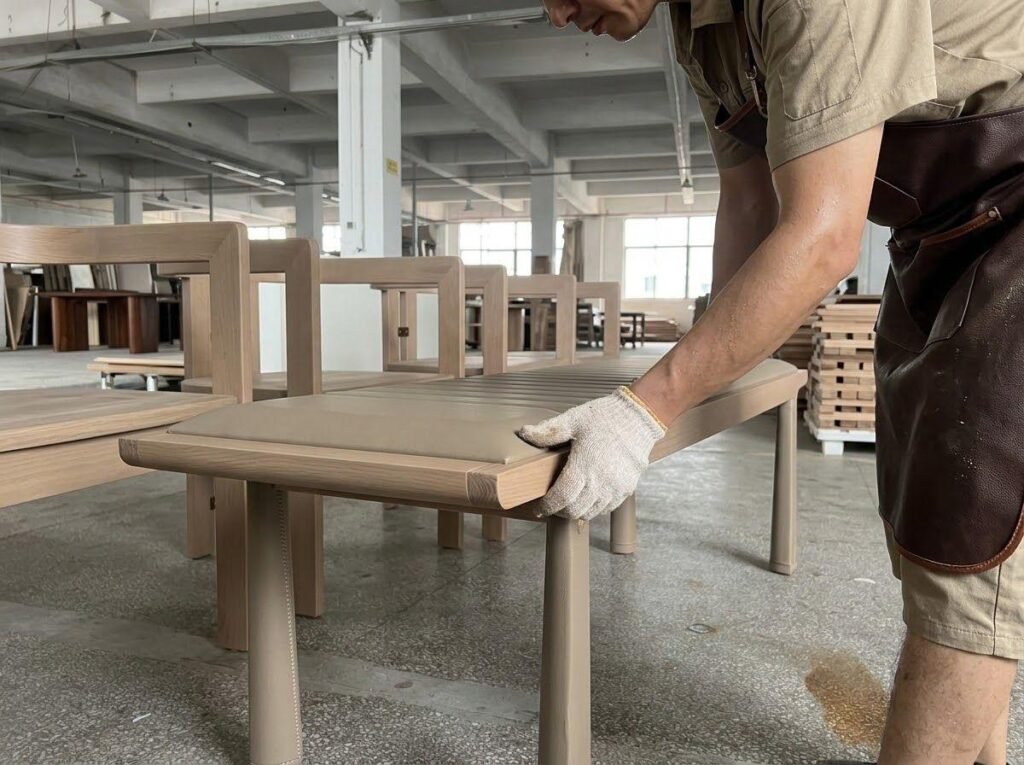
The cost structure is brutal if you walk in blind. One prototype might run $800 to $3,500 depending on complexity. Two or three iterations, plus shipping, plus your time, plus the hit to your launch calendar. The general pattern? Buyers who earmark $5,000 to $8,000 for prototype development end up with better final products and fewer nasty surprises at container inspection. The ones who budget $1,500 and pray? They usually pray again when the bulk order lands.
The sample is your ceiling, not your floor. Mass production quality only goes down from here. If the prototype feels cheap, the bulk order will feel cheaper. This is the hardest pill for new buyers to swallow.
A Framework That Actually Works
Forget the LinkedIn wisdom. Here’s what to do.
Before you ever contact a factory:
Build a tech pack with tolerances, not just dimensions. “Leg height: 18 inches ± 1/16 inch.” If you don’t specify tolerance, the factory assumes ± 1/4 inch. And they won’t tell you.
Send a physical swatch. Not a photo. A real piece of material. Mail it. Yeah, it takes two weeks. It’s cheaper than a wrong prototype.
Define “acceptable variation” in writing. If the wood grain doesn’t match your mood board exactly, what range is okay? Put it on paper.
During prototype development:
Demand progress shots at three stages: raw frame, unfinished/upholstered, and final. Not because you don’t trust them. Because catching a deviation at frame stage costs fifty bucks to fix. At final stage, it costs the whole prototype.
Red flag: If a factory quotes your sample way below everyone else and promises delivery in half the time — run. This isn’t a negotiation win. It’s either a factory that didn’t understand the scope, or one planning to cut corners you won’t find until sample two. (And yeah, this happens more than anyone wants to admit.)
Insist on a live video call before shipment. Not photos. Live. Ask them to rotate the piece, show the underside, knock on the joints. You’d be stunned what a factory considers “finished” that you’d call rough.
After the sample arrives:
Test it like your end customer will. Sit in it. Move it. Load it. I’ve seen buyers approve a dining chair prototype after sitting in it for thirty seconds. Then they wonder why the bulk order gets returned.
Document deviations with photos and precise descriptions. “Armrest: 1/8 inch higher than spec, see photo 3.” Vague feedback gets vague corrections.
| Approach | Best For | Typical Sample Cost | Risk Level |
|---|---|---|---|
| Factory direct, minimal oversight | Simple, catalog-based items | $800–$1,500 | High |
| Factory direct + inspector on site | Custom designs, new relationships | $1,200–$2,500 | Medium |
| Agent-managed process | Complex pieces, tight timelines | $2,000–$4,000+ | Lower |
There’s no universal “right” way. Only the way that matches your risk appetite and your actual budget.

FAQ: What Buyers Actually Ask
Q: My factory said the first sample is free if I place an order. Good deal?
A: No. It’s a debt wearing a discount costume. The factory will recover that “free” sample in your unit price, and because they rushed it to lock your commitment, the sample quality will show that urgency. Pay for your prototypes separately. Keeps the incentives honest.
Q: How do I know if a factory can actually build my design before I burn cash on a prototype?
A: Ask for photos of their current sample room, not their catalog. Then ask for a video walkthrough. If they hesitate, they either don’t have a sample room (red flag) or they’re not proud of what’s in it (bigger red flag). Capable factories show off their samples. The smoke-and-mirrors ones hide them.
Q: The sample looks okay but feels cheap. Is that because it’s one-off, or will the bulk order feel the same?
A: Same or worse. Never assume mass production improves quality. If the prototype feels cheap, the bulk order will feel cheaper. The sample is the ceiling, not the floor. Hardest lesson. Most important one.
Q: Can I skip the prototype and go straight to a small trial order to save time?
A: Only if you’re comfortable lighting money on fire. A trial order without an approved prototype is just an expensive way to discover problems you could have found with one unit. Exception: you’re buying a catalog item with zero modifications. But if you’re reading this, that’s probably not your situation.
Q: Should I hire a third-party inspector to check the prototype before it ships?
A: Yes — if the prototype cost tops $2,000 or if the design has critical dimensions. For simpler pieces, a detailed video call is usually enough. But anything with integrated lighting, moving parts, or mixed materials? An inspector on-site is cheaper than a nasty surprise in your warehouse. Depends on your product complexity and how much error you can absorb.
The Hard Question at the End
So here it is. You can read every article, hit every trade show, vet every factory. But the prototype phase is where you find out whether you actually understand product, or you just know how to place purchase orders.
The factories aren’t your enemy. Misaligned expectations are. And the only way to align them is to pay for the conversation — in dollars, in time, in patience, and in the humility to admit your first brief was probably half-baked.
What’s your prototype budget really buying you? Not a chair. Not a table. A translation. Between what you imagined, and what forty workers on a workshop floor in Guangdong think you meant.
Pay enough to get the words right.