

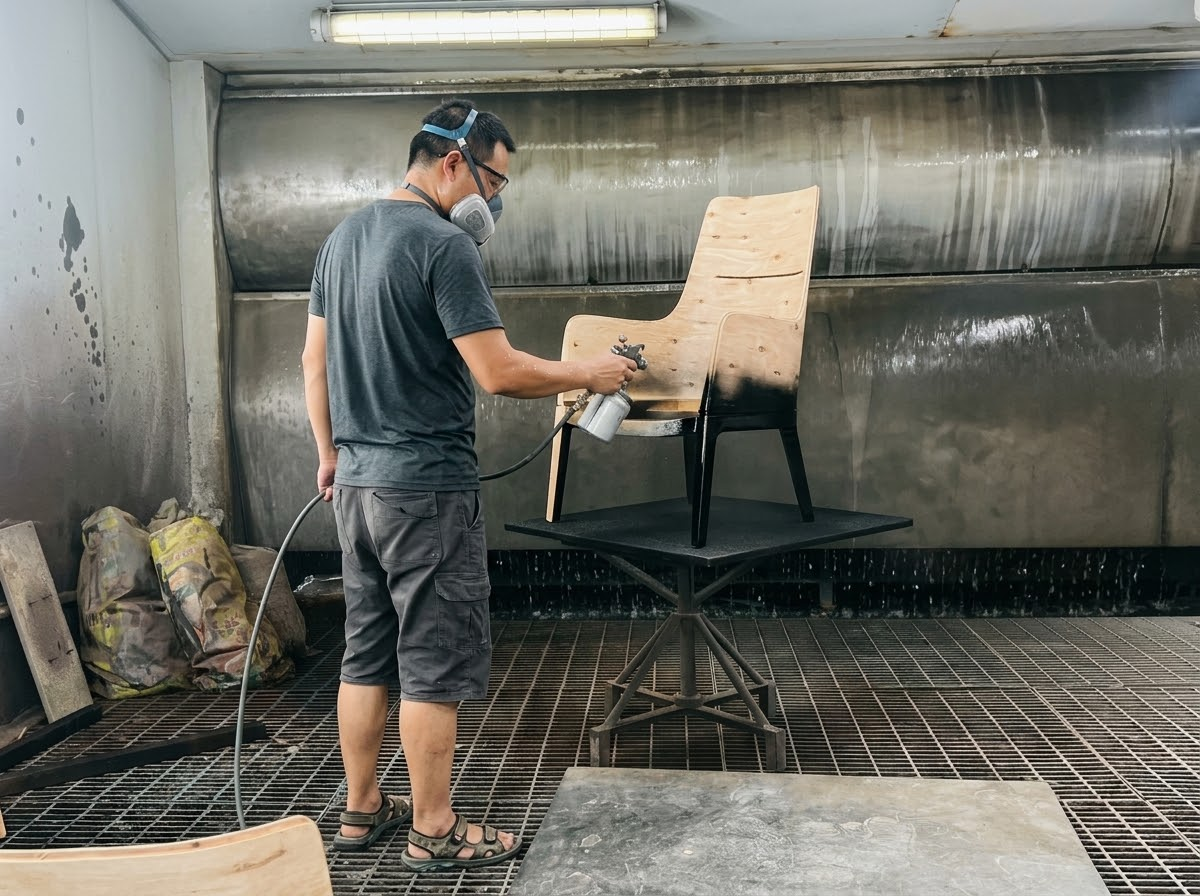
Last November, I was in a solid-wood custom factory in Longjiang, Foshan. The air was thick. A buyer — let’s call him Mike — stood at the spray booth entrance and pulled down his mask. “That smell’s wrong,” he said.
The factory manager smiled, pointing at a framed test report on the wall. “All compliant,” he said. “Water-based primer, PU topcoat, VOC below national standard.”
Mike picked up a freshly sprayed oak headboard and sniffed it. Then he opened a drum labeled “water-based primer” and took another whiff.
“That’s NC lacquer,” he said. “Forty percent thinner, minimum. I’ve been smelling this for twenty years. You don’t fool a nose that old.”
The manager’s smile froze. We were escorted to a secondary warehouse. There sat the real water-based coatings. Just one problem: the price tag was roughly double what was being used in the active spray booth.
This is the daily reality of China furniture coatings sourcing. You arrive with test reports. You leave with your senses. And more often than not, your senses are the more honest document.
China furniture coatings sourcing is the process of procuring surface finishes for wood products manufactured in Chinese workshops — a task where the gap between laboratory compliance and spray-booth reality can stretch across years.
The Brutal Truth: Most “Eco” Labels in Chinese Wood Workshops Are Theater
Buyers don’t want to hear this. But here it is.
That GB 30981.2-2025 compliance certificate on the wall? It probably represents the single drum that was submitted for testing. Not the drum being pumped into the spray gun right now. Not the drum that got an extra thirty percent thinner added last night. And definitely not the emergency stock borrowed from the neighboring workshop because this order is running three days late.
Coatings sourcing in Chinese wood workshops is an information-asymmetry casino. And the house — in case you’re wondering — never loses.
Here’s a rule of thumb I earned the hard way, across maybe two hundred factory visits: if a spray booth smells like banana water or thinner, no matter how many green certifications hang on the wall, the emissions are not compliant. No exceptions. Banana water is banana water. Your lungs don’t read Chinese labels.
But here’s the twist. The most dangerous lacquer? Sometimes it doesn’t smell like much at all.
Key Takeaways
- China furniture coatings compliance is a moving target: GB 30981.2-2025 replaces older standards in June 2026, but factory-floor reality often lags behind paperwork by years, not months.
- The most dangerous lacquer in Chinese wood workshops isn’t always the one that reeks — it’s frequently the one with the most convincing documentation.
- Your senses, combined with spot-checking raw material labels, remain more reliable than certificates you didn’t witness.
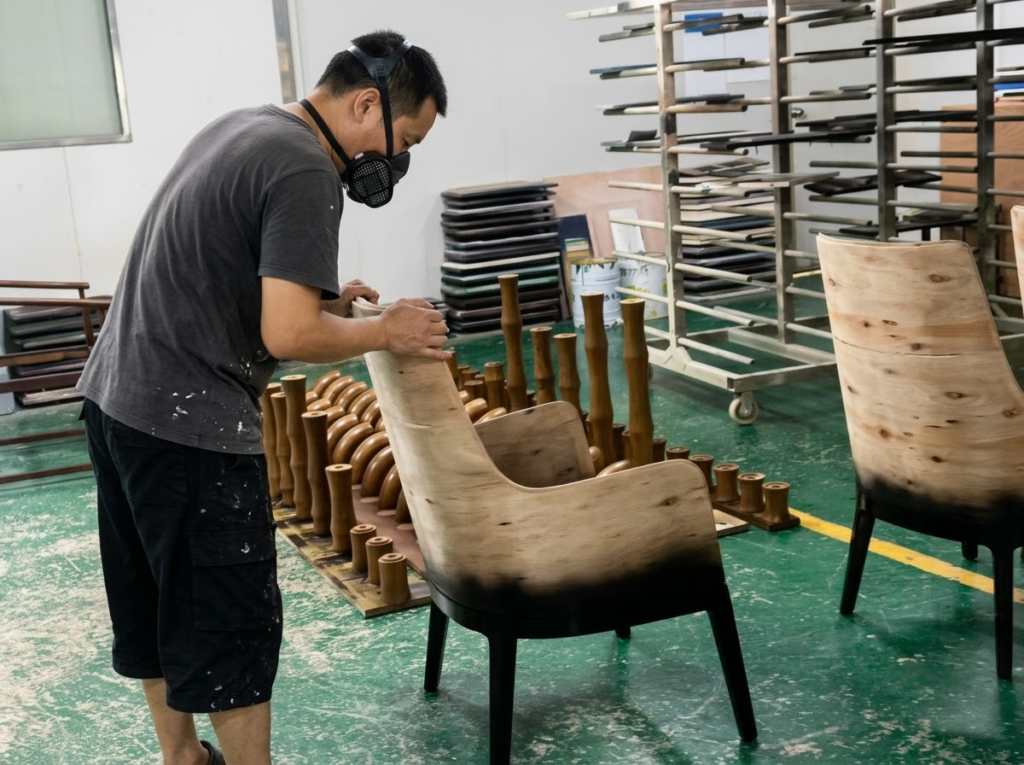
Why Your Nose Is Smarter Than the Lab Report
Buying coatings is a lot like buying a used car. The inspection report says the engine’s fine. But you slide into the driver’s seat, catch a whiff of something sweet and syrupy, and you know the coolant’s leaking somewhere. Paint works the same way.
What Are You Actually Smelling?
Solvent-borne coatings — PU, NC nitrocellulose, PE polyester — cure by evaporation. Each solvent carries a signature. Toluene hits sharp. Xylene is sweeter, heavier. Butyl acetate carries a faint fruity note. Mix them, and you get that perfume of a furniture factory at full tilt.
Water-based coatings are supposed to use water as the primary diluent. But “water-based” is a phrase that’s been abused into meaninglessness. Plenty of so-called waterborne coatings contain fifty percent water — and the rest is glycol ether co-solvents. You won’t smell banana water anymore. What you get is a denser, suffocating chemical note. Like wet newspaper soaked in rubbing alcohol. Not better. Just different.
Actually, that’s not quite right. A properly formulated water-based coating, once cured, should smell like almost nothing. UV-cured coatings take this further — photoinitiators react in seconds, leaving almost zero residual monomers. But UV lines demand expensive equipment and dust-free environments. Small workshops can’t afford the ticket price. So they don’t play.
When you walk into a factory, then, what should your nose tell you?
If it’s a sharp banana-water punch, you’re looking at solvent-borne coatings running naked. No excuses. If it’s that dense, chemical mustiness, you’re probably dealing with “fake water-based.” And if you smell almost nothing? Either they’re running genuinely clean coatings. Or you’re looking at stock curing for three weeks, and the current production line is hidden elsewhere.
The Certification Mirage
Certificates in the China furniture coatings industry are a magic show. And most buyers are willing spectators.
Who Paid for That Test?
Here’s an open secret: coating suppliers provide factories with test reports for “compliant” products. But the sample that went to the lab and the formulation that ships in bulk? They can be two different animals. The lab sample used imported hardener. The bulk shipment uses a domestic substitute. The lab sample held VOC at three hundred grams per liter. The bulk version might be pushing four-fifty. And the factory either doesn’t know, or knows enough not to ask.
The testing methodology itself is another layer of smoke and mirrors. GB standards use chamber or bag methods to measure the coating’s inherent VOC content. But on the factory floor, painters add thinners, hardeners, retarders. Many of these ancillaries fall outside the scope of the original test. A compliant primer, once cut with thirty percent off-brand thinner, becomes a VOC bomb. The test report still says “pass.”
I saw the most egregious case in Dongguan. A factory supplying cross-border e-commerce ran compliant coatings during daylight hours, when inspections might happen. After ten p.m., they switched to cheap solvent-borne stock to hit quotas. Their logic: inspectors don’t work nights. And buyers never stay past dinner.
Water-Based Isn’t Always the Hero
Water-based coatings are the white knight of the eco-narrative. But in this industry, the knight is sometimes wearing rented armor.
When “Eco” Backfires
Waterborne wood coatings have been pushed in China for over a decade. The problem was never the technology. It was the execution. A quality water-based system demands careful resin selection and controlled co-solvent ratios. It costs thirty to fifty percent more than solvent-borne. And the “economy-grade” products that flood the market? They achieve their price point by cutting corners you can’t see.
The most common trick: cranking up glycol ether co-solvents. These chemicals let the coating film properly in cool, humid conditions. But they’re still VOCs. And some variants — ethylene glycol butyl ether, for instance — carry their own health baggage, with liver toxicity concerns that don’t show up on a standard sniff test. The factory proudly announces “no thinner used.” What they don’t mention is what replaced it.
And then there’s the drying problem. During the southern monsoon season, water-based coatings cure slowly. Factories can’t afford the downtime. So they add accelerators, or they crank up the heat in forced-drying rooms. Higher temperatures drive faster volatilization of those hidden co-solvents. The result? Concentration spikes in the workshop air that can exceed what you’d see with a well-ventilated solvent system. Eco-friendly? Only on the paperwork.
UV-cured coatings sit at the opposite extreme. Instant cure, near-zero emissions. But the equipment investment runs into millions of RMB. Small workshops can’t touch it. Plus, UV demands tight control over wood moisture content and sanding precision. One slip, and adhesion fails. So UV has conquered the panel-furniture giants. In solid-wood custom workshops? Still a rarity.
| Coating Type | Typical VOC Content | Curing Time | Common “Cheating” Method |
|---|---|---|---|
| Solvent-borne PU/NC | High (300–500 g/L) | 4–6 hours | Excess thinner, night-shift switchovers |
| “Economy” water-based | Medium (150–300 g/L) | 12–24 hours | Hidden glycol ethers, forced-heat drying |
| UV-cured | Very low (<50 g/L) | Seconds | High capital cost limits adoption to large factories |
The Factory Floor Ecosystem: Who’s Playing What Game
The chaos around China furniture coatings isn’t fundamentally about technology. It’s about industrial structure. Guangdong, Zhejiang, Jiangxi, Fujian — these four provinces account for the bulk of China’s wooden furniture output. And within them, the production pyramid is inverted: a handful of listed giants at the top, a few hundred mid-sized exporters in the middle, and thousands of tiny workshops forming the base.
The giants have both incentive and capital to invest in UV lines, water-based systems, and RTO exhaust-treatment units. Their test reports are generally trustworthy. The cost of getting caught — lost export licenses, brand reputation collapse — is too high.
The mid-tier is where things get messy. These factories serve overseas mid-market brands, domestic project contractors, and cross-border e-commerce. Thin margins. Volatile order books. Environmental equipment that might be obsolete before it’s paid off. And yet, without it, they fail the audit and lose the client.
Within this mid-tier, the fault line runs between factories that buy paint by the price per kilo and factories that buy it by the audit trail it leaves behind. The second group isn’t necessarily bigger or more famous. They’re just serving buyers who can’t afford a surprise. Interi Furniture falls into this category — a mid-sized operation doing commercial and project-grade woodwork where a single failed emissions test doesn’t just cost a container; it costs a relationship that took three years to build. Their workaround isn’t revolutionary. They photograph every drum label on arrival, cross-check batch numbers against supplier certificates, and run spot tests on cured panels before they reach the packing line. Boring. Expensive. And exactly why their buyers keep coming back.
At the bottom, small workshops are the most agile variable. No brand baggage. No export-license pressure. Their customers are domestic e-commerce sellers, budget guesthouses, or “export-rejected” clearance traders. When they choose coatings, price comes first, smell comes second, and certificates come a distant third. The “eco-lacquer” you see here might have no relationship with ecology whatsoever.
A Buyer’s Field Guide: Spotting the Red Flags
You can’t carry a GC-MS into a factory visit. But you don’t need to. Below is the field checklist I’ve refined across fifteen years and maybe two hundred workshops.
Step one: Smell.
- The spray booth and drying area should be physically separated. Combined spaces mean stacked VOC concentrations.
- Solvent-borne banana-water odor is unmistakable. If the manager says “water-based” and your nose says thinner, ask to see the diluent drums immediately.
- A dense, musty alcohol note from “water-based” coatings isn’t innocent. Ask what film-forming aids are in the system.
Step two: Read the drum labels, not the wall certificates.
- Demand to see original drum labels for coatings being used that day. Photograph them. Record product codes and VOC-content declarations.
- Cross-check against the certificate’s product model. Mismatch is your first red flag.
- Check thinner and hardener labels too. The primer may be compliant while ancillaries come from another regulatory planet.
Step three: Pressure-test the timeline.
- Ask how long a freshly sprayed part sits before packing. Solvent-borne PU needs four to six hours. Water-based can need twelve to twenty-four. If a factory claims two-hour pack time for water-based, they’re lying or cutting corners.
- Look at drying-rack inventory depth. Only two or three days of stock means turnover is too fast. Parts aren’t getting adequate cure time.
Step four: Verify exhaust treatment.
- RTO thermal oxidizers or activated-carbon plus catalytic combustion are mainstream VOC treatments. Ask if they have one. Ask to see it.
- But here’s the counterintuitive red flag: if a small factory claims it invested in RTO equipment while producing less than fifty million RMB annually, that RTO is probably decorative. Running costs are brutal. Small factories often install the hardware to pass audits, then can’t afford to fire it up. The equipment is real. The flame inside? Not always.
Step five: Take a sample with you.
- Have the factory spray a test panel using the exact coating in production. Seal it in a bag. Take it back to your hotel.
- Open it after twenty-four hours. If it still carries a noticeable odor, your end customer will smell it too. And hotel rooms, unlike factory floors, don’t have industrial ventilation.

FAQ: The Questions Buyers Actually Ask
Q: “The factory showed me a GB 30981.2-2025 test report. Does that mean we’re safe?”
A: Not necessarily. GB 30981.2-2025 takes effect on June 1, 2026, replacing standards like GB 18581-2020. But a test report only covers the submitted sample. Bulk coatings, on-site thinner additions, and spray practices can push finished-product VOC emissions far beyond reported values. The certificate is a starting point, not a guarantee.
Q: “Are water-based coatings always greener than solvent-based ones?”
A: Not automatically. Genuine water-based systems carry lower VOC profiles, but the market is flooded with “pseudo-waterborne” products relying on high co-solvent loads. Factories under pressure may resort to high-heat forced drying or accelerators, spiking emissions. Green credentials depend on formulation integrity and factory honesty — not merely the word “water” on the label.
Q: “Can I just specify imported European or Italian wood coatings to eliminate risk?”
A: You can, but verify two things. First, whether the imported product was reformulated during local repackaging in China. Second, whether the factory adds “performance enhancers” to adapt to southern China’s high-humidity environment. An imported label does not automatically equal imported compliance.
Q: “Are small workshops definitely riskier than large factories?”
A: Statistically, yes, but not universally. Large factories face brand and export-license consequences that dwarf short-term savings from cheating. Small workshops operate with weaker oversight, yet some family-run shops have survived for decades on local reputation alone. What matters is what you observe during the audit, not the size of the signboard.
Q: “Can you actually spot toxic lacquer in a Chinese wood workshop?”
A: Yes, but with limits. Sharp banana-water odors, unlabeled thinner drums, and impossibly short curing times are all observable warning signs. However, certain lower-toxicity VOCs — specific glycol ether variants, for example — are effectively odorless and invisible to casual inspection. Ultimate safety depends on third-party random testing and long-term supply-chain auditing, not a single factory walkthrough.
The Hard Question
So the next time you step into a furniture factory in Foshan or Dongguan, and you catch that familiar chemical note in the air, ask yourself: Are you here to buy furniture, or are you here to buy peace of mind?
If it’s peace of mind you need, the test report will do just fine. It’s clean, official, and forwards beautifully to headquarters. But if what you’re after is genuine safety — hotel guests who don’t cough at 2 a.m., homeowners who don’t get headaches in their sealed bedrooms — then your nose, your fingertips, and your willingness to stay two hours longer matter more than any certificate ever will.
This industry won’t clean itself up. It will only get better at packaging. Your job is to learn how to unwrap the box.