

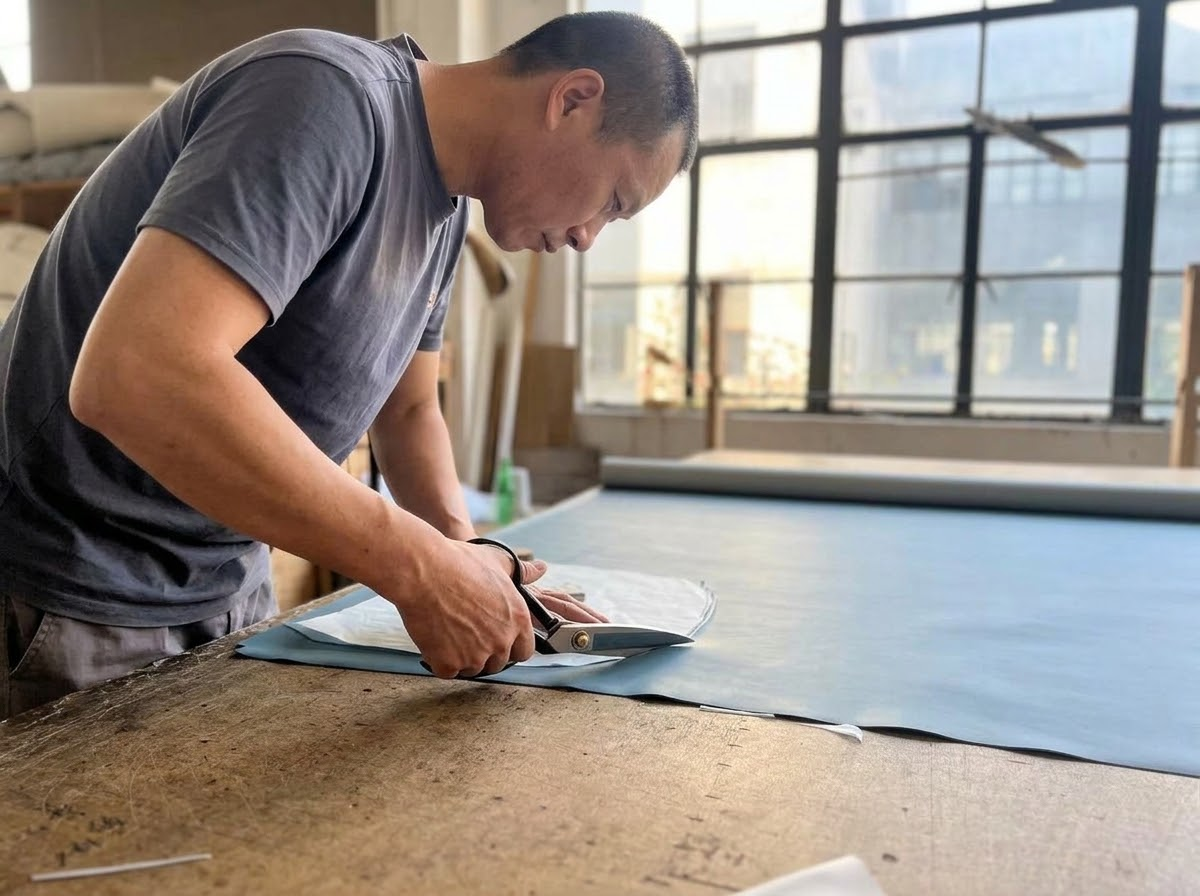
China furniture hubs aren’t what you see on Instagram. I learned that last October, stepping off a bus in Anji at 6:47 a.m., when the air smelled like steamed buns and MDF dust. A factory owner named Lao Chen met me holding a Styrofoam cup of tea that had gone cold. He didn’t want to show me his showroom. He wanted to show me his testing lab. Inside, a $2,800 ergonomic chair was being dropped from 1.2 meters onto concrete for the 47th time. The sound — a hollow plastic crack echoing off corrugated metal walls — is what changed how I think about sourcing.
In the context of manufacturing, a China furniture hub refers to a city or industrial cluster where the entire supply chain for a specific furniture category — from raw material to finished goods — is compressed into a tight geographic radius, creating cost and speed advantages impossible to replicate by scattered suppliers.
• Anji produces roughly one-third of China’s chairs at 25-35% below Guangdong pricing
• Nankang imports 4 million cubic meters of timber yearly, about 40% of national rubber wood imports
• Shengfang’s metal-glass cluster ships 10-day lead times to European buyers
• Dalingshan contract factories run stricter AQL standards — but you need to know which door to walk through
Anji: The Chair Kingdom, But Not All Chairs
This small county in northern Zhejiang produces roughly one-third of domestic office chairs and about half of China’s chair exports. Over 1,700 enterprises crowd a county smaller than most American suburbs. Based on export data patterns, Anji’s mid-range seating runs 25-35% below equivalent Guangdong products.
I visited three factories in one day. The first was a 50-person operation making mesh-back task chairs. The owner, a woman in her sixties who chain-smoked Parliaments, tapped a gray foam block. “Same density as the $400 chair in Shenzhen,” she said. “We just don’t pay Shenzhen rent.” The second factory shipped 800 gaming chairs a day to a single German distributor. “One SKU, twelve months, no changes.” The third made engineered cross-laminated bamboo panels — CNC-routed, water-based lacquer finish. Anji’s total industry value hit roughly 50 billion yuan in recent years. Bamboo is the quiet edge.
The rule of thumb: Anji is for seating at scale. If your project needs more than fifty chairs of the same spec, you’re probably overpaying by sourcing elsewhere.
Nankang: The Forestless Wood Kingdom
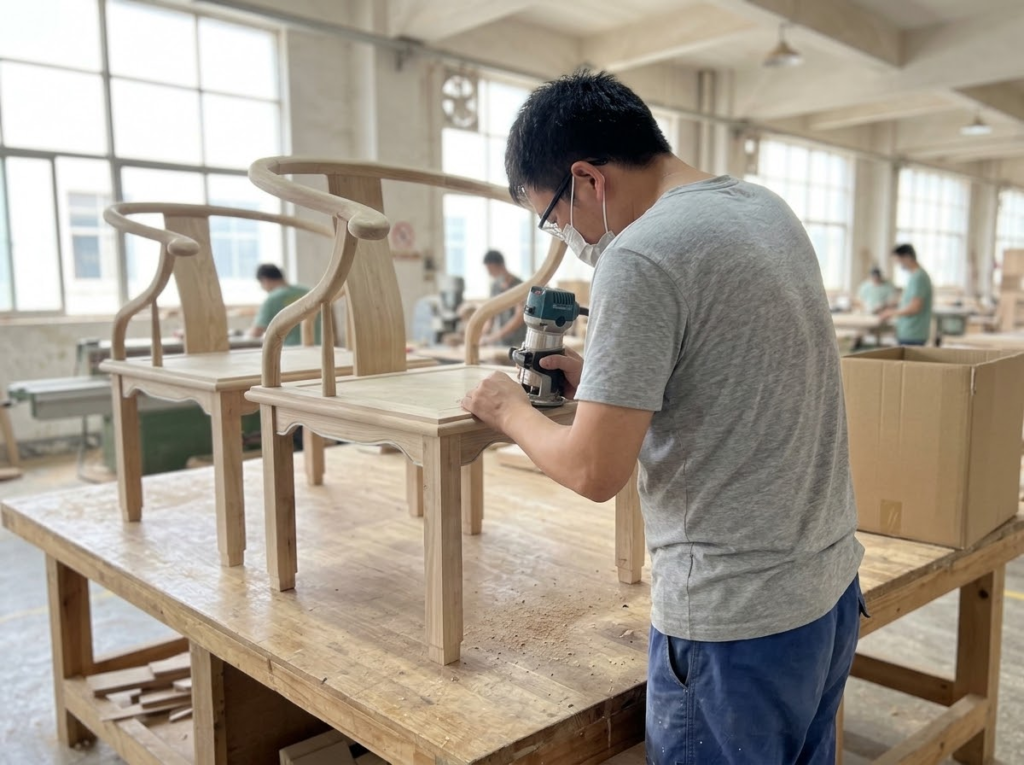
This inland county in Jiangxi Province has almost no native forest capable of supporting furniture production. Yet it consumes what public reports cite as more than 4 million cubic meters of imported timber annually and produces over 20% of China’s total solid-wood furniture output. The general pattern suggests Nankang’s cluster output exceeded RMB 284 billion in 2024.
Ganzhou Port, a rail-logistics hub, feeds timber directly into the district. The port lowered import costs by roughly 10%, saving local factories what public data cites as about RMB 3 billion a year. The magic is shared prep centers — centralized cutting and drying facilities where small factories buy standardized prepared boards by the truckload instead of each buying a $200,000 CNC panel saw.
But Nankang’s grassroots factory base is huge — thousands of SMEs — and quality varies wildly. More often than not, a first-time visitor gets quoted a price that seems too good because it is. I’ve seen Nankang dining chairs that wobbled like a carnival ride because the tenons were glued, not wedged.
The rule of thumb: Nankang rewards buyers who audit the shared prep center, not just the final assembly line. If you can’t visit, don’t buy solid wood here.
Shengfang: Where Metal Meets Glass at Factory-Floor Speed
This town in Bazhou, Hebei Province, sits roughly an hour from Tianjin Port and hosts what local sources describe as the world’s largest single metal-and-glass furniture marketplace. The expo city covers 650 acres. Inside, you can buy a frame, a tempered-glass tabletop, the powder-coating service, and the export crate — all without leaving the building.
The real kicker is lead time. I timed it. A factory owner sketched a bar stool on a napkin at 9:00 a.m. By 6:00 p.m., the powder-coat line had baked on a matte black finish. Nine hours for a new SKU. A 10,000-unit order for a Danish chain loads with an average 10-day lead time to European ports. Compare that to the 25-35 days I typically see in Guangdong. The difference isn’t craftsmanship. It’s cluster density — every supplier lives within 15 kilometers.
The limitation is category. Shengfang does metal, glass, and combinations thereof. If you need solid wood or complex upholstery, you’re in the wrong province. And the export paperwork here can be… creative. I’ve seen CE marks applied with the same enthusiasm as a tourist applying sunscreen.
The rule of thumb: Shengfang is for metal-glass furniture at speed. If your project has a hard deadline and a modern aesthetic, this is your town.
Xianyou: The Rosewood Secret Hiding in Plain Sight
Located in Putian, Fujian Province, this county produces what public reports cite as over 70% of China’s high-end classical craft furniture. We’re talking mortise-and-tenon joinery using 28 traditional techniques — miter tenons, pyramid tenons — executed by craftsmen trained in a master-apprentice lineage that dates back to the Ming Dynasty. The craft is literally national intangible cultural heritage.
Xianyou’s annual arts-and-crafts output hit roughly RMB 70 billion in 2023, with over 2,200 craft enterprises and nearly 200,000 employed. The China-Xianyou Rosewood Shared Trading Center consolidates tens of thousands of products from 220+ enterprises under one roof. In recent years, workshops have developed “New Chinese Style” lines — cleaner silhouettes, modern upholstery paired with traditional frames — aimed at boutique hospitality projects.
The risk is raw material. Rosewood prices swing wildly. International trade controls on endangered hardwoods can freeze a container mid-production. I watched a factory owner argue with a supplier over a shipment of Burmese teak held at customs for three weeks. Twelve craftsmen sat idle. Payroll doesn’t pause for paperwork.
The rule of thumb: Xianyou is for statement pieces where craftsmanship is the selling point. Budget 30-45% more than mass-market alternatives, but the pieces will outlast your hotel’s brand identity.
Dalingshan: The Upholstery Discipline Foshan Lacks
This district, tucked into Dongguan’s western edge, is where contract upholstery factories live — the ones that supply hotel chains, cruise lines, and senior living developments with sofas that must survive ten years of abuse. The difference between Dalingshan and Foshan’s Longjiang is subtle on a map but massive on a factory floor.
I audited a Dalingshan plant in March. The temperature inside was 34°C. No air conditioning. Workers wore cotton gloves and blue caps. The floor was painted with yellow lines marking every workflow stage. A quality chart hung above each station with defect counts from the previous week. Red circles marked problems. There were almost none.
The factory manager told me their AQL standard was 1.0 for major defects. “Foshan residential lines run 2.5, sometimes 4.0,” he said, shrugging. “We can’t. One failed sofa on a cruise ship costs more than this whole line.” But Dalingshan factories are built for volume contract runs — 500 identical sofas, not four custom sectionals. Minimums are real. Timelines are rigid.
The rule of thumb: Dalingshan is for hospitality upholstery at volume. If your spec sheet has more than fifty units per SKU and a 5-year warranty requirement, this is your floor.
The Brutal Truth About Hub Hopping
Here’s the thing: knowing these hubs exist doesn’t make you money. Acting on the wrong hub does.
These hubs don’t compete with each other. They complement each other. The smartest hotel project I’ve seen in years sourced seating from Anji, case goods from Nankang, lobby statement pieces from Xianyou, and bar furniture from Shengfang. Total savings against an all-Foshan quote: roughly 28%. But that buyer spent six weeks on the ground, spoke passable Mandarin, and hired a third-party inspector who actually knew what a mortise tenon should look like.
If you’re still figuring out your OEM strategy, read this first. Hub hopping without category clarity is just expensive tourism.
5 Red Flags to Spot Before You Wire Money
The “Everything” Factory. A real hub factory makes one thing well. If a Shengfang supplier offers metal chairs, solid-wood tables, and upholstered sofas, you’re talking to a trading company. Walk away.
The Showroom-Only Video Call. They refuse a video call from the production floor. Not the showroom. The floor. If the camera can’t show you welding sparks or sawdust, they don’t own the equipment.
The 40% Discount Mirage. The quote is more than 40% below Foshan equivalents for the same spec. Sometimes that’s real efficiency. More often, it’s a specification downgrade they didn’t mention. Ask for the material list. In writing.
The Deposit Panic. They demand more than 30% deposit without a verified factory audit. Industry standard is 30% T/T. If they want 50% or full payment upfront, that’s not confidence. It’s cash-flow desperation.
The Port Amnesia. They can’t name the port they normally ship from. Anji ships from Ningbo or Shanghai. Nankang uses Ganzhou Port or trucks to Shenzhen. Shengfang uses Tianjin. Xianyou uses Xiamen. Dalingshan uses Shenzhen or Hong Kong. If they hesitate, they haven’t shipped before. Or they’re not the factory.
How Mid-Tier Specialists Actually Work
While some buyers gravitate toward massive Foshan manufacturers, others find that mid-tier specialists — like Interi Furniture, which focuses on project and hospitality-grade upholstery with export-level QC — offer a different risk-reward equation when you need consistency without the bureaucracy of a 2,000-person plant. These factories typically run 150-400 workers, have direct export experience, and can adapt specs without routing every change through a committee. Not cheaper. Just more navigable.
Your Go/No-Go Hub Checklist
| Your Need | Go To | Avoid If |
|---|---|---|
| 50+ identical office/gaming chairs, tight budget | Anji | You need custom design or white-glove export packing |
| Solid-wood dining/bedroom, value tier, fast turnaround | Nankang | You can’t audit the shared prep center or verify wood grade |
| Metal-glass bar/dining furniture, hard deadline | Shengfang | You need complex upholstery or hand-finished wood |
| Statement classical pieces, luxury hospitality | Xianyou | Your timeline is under 60 days or your budget is fixed |
| 100+ contract sofas, strict AQL, hospitality spec | Dalingshan | You need custom frames or low MOQ flexibility |

FAQ
Q: Are these China furniture hubs safe for first-time buyers who don’t speak Mandarin?
A: It depends. Anji and Shengfang have limited English support. Nankang is improving but still challenging. Dalingshan, because it serves export markets, has better English documentation. Xianyou is the hardest — classical craft terminology doesn’t translate well. For all five, a bilingual sourcing agent with technical vocabulary is strongly recommended, not optional.
Q: How do MOQs compare to Foshan?
A: Generally lower in Nankang and Shengfang for standard designs, because the factory ecosystem is hungrier for export volume. Anji’s MOQs are medium — 50-100 units for seating. Dalingshan runs higher — 100-300 units for upholstery. Xianyou is variable; standard New Chinese Style pieces might start at 10 units, but true custom classical work is effectively single-piece pricing.
Q: Can I mix hubs in one container?
A: Yes, but logistics get complex. Anji to Ningbo port is straightforward. Nankang to Shenzhen requires trucking. Shengfang to Tianjin is easy. Xianyou to Xiamen is close. Dalingshan to Shenzhen is simple. If you want one consolidated FCL, you’ll need a freight forwarder who coordinates inland trucking between provinces. Based on my experience, add 5-7 days and roughly $800-1,200 in coordination fees compared to a single-hub load.
Q: Is quality control really better outside Foshan?
A: Not automatically. Foshan has world-class factories and terrible ones. So do these hubs. The advantage is category specialization. A Nankang factory that only makes solid-wood beds for fifteen years knows more about wood movement than a Foshan generalist. A Dalingshan contract upholsterer knows fire-retardant standards better than a Foshan residential sofa maker. Specialization beats geography every time.
Q: What’s the biggest hidden cost when sourcing from these hubs?
A: Inspector travel. Foshan has dozens of third-party QC firms with local staff. Anji has maybe three. Nankang has local associations but fewer independent auditors. If you plan to do pre-shipment inspection — and you should — budget for flying your inspector to the hub, or find a firm with regional coverage. See our guide on pre-shipment inspection timing for a full cost breakdown.
So here’s my question: are you still flying to Foshan because it’s familiar, or because it’s actually the right fit for every piece in your project? The map is bigger than you think. The savings are real. But only if you walk past the showroom and into the factory where the welding sparks actually fly.