

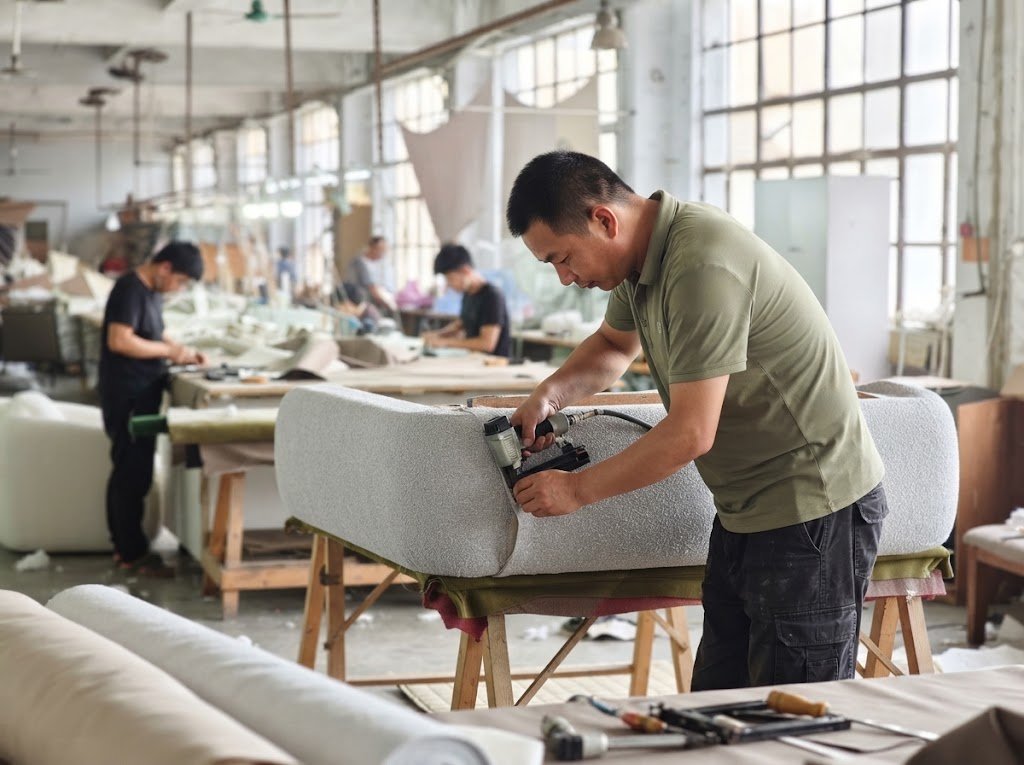
Foshan in late August feels like breathing through a wet wool blanket. The broken AC unit rattling above this Shunde showroom isn’t doing a damn thing for the sweat pooling at the base of your neck. You’re staring down the barrel of a Vegas boutique hotel opening in exactly 22 days. Sitting right in front of you, soaking up the glare of cheap fluorescent tubes, is forty-five grand worth of custom lobby seating. You just flew fifteen hours and survived the Baiyun airport taxi line, all to inspect this final batch before the crew stuffs it into a 40HQ container. The purchase order in your sweaty hand explicitly demanded “Top Grain Italian Leather.”
But push your thumb hard into that armrest seam. Keep pushing. Notice the unnatural drag? It doesn’t warm up to your skin heat. It bites back, squeaking like a restored 1980s diner booth. Over in the corner by the tea tray, the factory boss is chain-smoking Zhonghuas, aggressively waving off your visibly panicked translator. He keeps barking that “new technology leather” is the accepted standard for this market.
Your chest gets tight. Refuse the goods right now? The Vegas client opens their flagship property with a totally empty lobby and blacklists you forever. Authorize the shipment? The lead interior designer will personally hunt you down the minute a VIP guest’s bare leg sticks to a chair. This isn’t some rare, cautionary tale reserved for naive rookies trying to buy Chinese leather furniture. It’s just a typical Tuesday afternoon on the sourcing trail.
The “Slight Modification” Trap
Buyers land in Guangdong assuming a signed, chopped contract acts as a magical forcefield. It absolutely doesn’t. Out here on the industrial fringes, your signature is just the opening gambit in an exhausting, multi-month game of margin chess.
Let’s get one thing straight: you aren’t being scammed in a malicious, movie-villain sort of way. You’re just being aggressively managed by people who understand the math better than you do. The factory boss assumes your ultimate, uncrossable red line is the budget—even while you’re standing in his office banging the table about luxury quality standards. So, they smile. They nod at your spec sheet. They pound their official red chop onto the paper.
Then, the exact second your Didi pulls away to take you to the airport, they quietly instruct the floor manager to swap the hidden back and side panels to polyurethane. All before a single actual cowhide gets unrolled.
Why? Because nobody touches the back of a lobby sofa. It immediately saves the factory fifteen percent on raw materials, padding their razor-thin margin. And frankly? They figure you’ll never, ever notice. (And yes, I’ve watched them pull this exact maneuver on twenty-year sourcing veterans who simply got too comfortable).
Look at the brutal economics of the cutting room floor. If your quoted FOB price sits below the current global commodity rate for the raw Brazilian cowhide required to wrap the frame, you aren’t buying leather. Factories aren’t running charities. You are buying a highly engineered plastic illusion.
Key Takeaways: The Realities of Chinese Leather Furniture
- China furniture sourcing is the process of navigating a hyper-competitive supply chain where “genuine” is an insanely elastic term used to justify synthetics.
- “Top Grain” on a proforma invoice usually equals bonded leather or PU unless it’s backed by a verifiable, traceable tannery certificate.
- The real danger with China sofa materials isn’t outright theft—it’s the sneaky, unauthorized substitution of split hides on non-facing surfaces to pad margins.
- Getting actual full-grain leather demands lighter-fluid burn tests and hide origin tracking, not blind trust in a slick showroom swatch book.
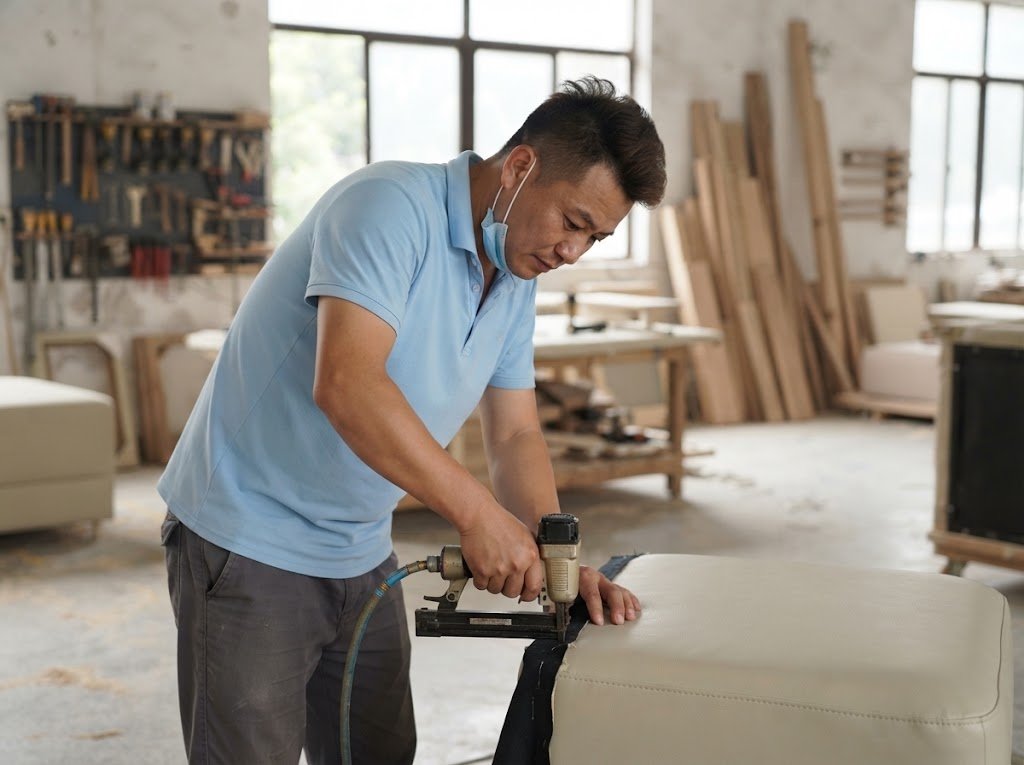
Digging into the Chemical Smoke and Mirrors
Mechanism: The Tannery Shuffle
Buying raw material in the Longjiang upholstery belt is basically like ordering a prime dry-aged steak at a highway truck stop. You see the word on the menu, sure. But the kitchen in the back is cooking something else entirely.
Actually, I need to be fair here—sometimes the assembly workshop you hired is actually as clueless as you are. They order genuine hides from a massive tannery up north in Hebei. What rolls off the delivery truck three days later? A hyper-processed split hide.
The tannery takes the absolute garbage bottom layer of the cow. The fibrous part near the muscle that nobody wants. They sand it to death with industrial grinders to erase the tick bites and fence scars. Then they stamp it with a fake, perfectly uniform pebble grain using a heated 5-ton steel roller. Finally, they spray it thick with an industrial colorant.
Technically, animal skin is in there somewhere. Functionally? You are sitting on a painted raincoat.
Variable: The “Half-Leather” Standard and Cow Geometry
Walk the chaotic, dusty floor space of any mid-tier workshop in Dongguan. Notice how they sort the raw hides. They map them strictly by touch zones.
The domestic Chinese market normalized this years ago. Seat cushions get the real stuff. The back, the lower valence, the hidden structural spots? Color-matched PU. Factories do this out of pure muscle memory, but there’s a deeper operational reason driving it: yield.
A cow is not a perfect square. Hides have weird edges, neck wrinkles, and belly stretch marks. Cutting them requires expensive human skill and creates massive waste on the floor. PU, on the other hand, comes on a flawless 50-meter roll. You can stack it ten layers deep and blast through it with an automated CNC fabric cutter. The factory saves on the material cost and the labor cost simultaneously.
Snapping them out of that habit takes brutal, on-the-ground micromanagement. This dynamic is exactly why serious OEM players—take Interi Furniture as a prime example—physically wall off their production lines when executing premium hospitality contracts. Because if you let the five-star full-hide teams mix with the commercial synthetic crews on the exact same factory floor, human nature takes over. When piece-rate workers run short on a difficult natural bend, they will inevitably grab the cheaper, stretchier PU roll sitting ten feet away. Cross-contamination is basically guaranteed unless you build literal walls between the lines.
Benchmark: The Needle Test and Thread Tension
Real leather fights back differently than coated PU. It just does.
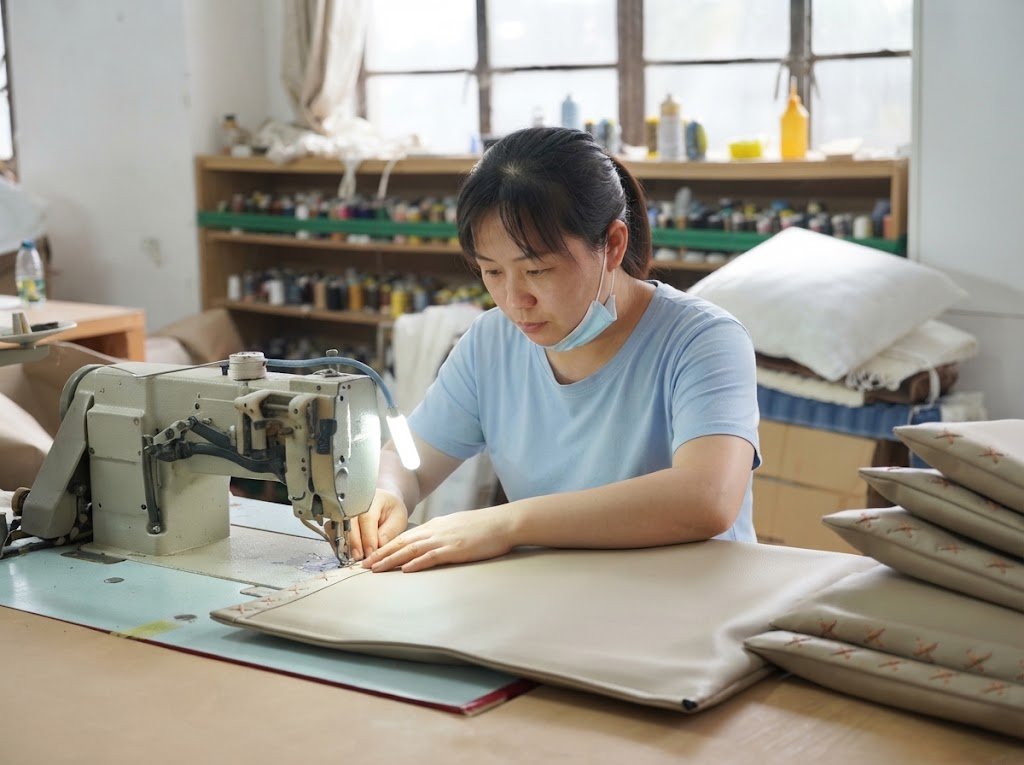
Genuine hides compress under the heavy pressure of a walking-foot sewing machine. Coated PU just folds inward. When an industrial needle punches real leather, the hole cuts clean. The natural fibers tighten right back around the bonded nylon thread. With cheap PU, that needle leaves a micro-jagged tear.
Think about a heavy hotel guest dropping onto that sofa after a few drinks. That tiny tear takes the kinetic load. It eventually widens, the thread pulls through, and the seam utterly fails under human weight. The internal wood frame is totally fine. The high-density foam is fine. But the skin tears open like wet paper.
Case Study: The Dubai Lounge Debacle
Let’s look at a mid-sized workshop in Houjie back in late 2023. An independent buyer needed 80 massive Chesterfield sofas for a VIP airport lounge, quoted FOB at an unbelievable $650 per unit. The guy thought he stole top-grain aniline. He completely failed to verify the back panels.
Six months of brutal Dubai AC cycles later, the hidden PVC side panels reacted violently to the dry air. The plasticizers broke down. They off-gassed, peeled, and crumbled right onto the expensive marble floor like bad dandruff. The real leather seats survived perfectly fine. A $52,000 initial spend morphed into an $80,000 air-freight replacement nightmare.
The factory boss just shrugged over WeChat. Through their lawyer, they argued that $650 obviously couldn’t cover 180 square feet of pure aniline hide. You got exactly what you paid for, buddy.
| Material | Factory Floor Slang | What It Actually Is | The Tell-Tale Sign |
| Full Grain | 头层牛皮 (Top Layer) | Raw hide. Bug bites, fat wrinkles, and neck scars fully included. | Absorbs a water drop fast. Feels warm to the touch. |
| Corrected Grain | 二层皮 (Second Layer) | Bottom layer sanded down aggressively and painted heavily. | Grain pattern repeats flawlessly across the entire sofa. |
| Bonded Leather | 再生皮 (Recycled Skin) | Leather dust from the factory floor glued together with plastic resin. | Smells distinctively like a chemical plant or rubber. |
| Leathaire / PU | 科技布 / 仿皮 (Tech Cloth) | 100% synthetic microfiber or plastic. No cow DNA at all. | Woven fabric backing visible underneath. Squeaks under pressure. |
The Risk Matrix
Putting real cash on the table? You need to know exactly where the trap doors are located.
The Flawless Hide Trap
Cows are living, breathing animals. They hit fences. They get bug bites. They get fat and have stretch marks.
— If a massive, four-seat modular sectional lacks a single surface flaw anywhere on the chassis, run away.
— Mechanical, repeating pores mean a heated roller was used to stamp a fake texture onto garbage-tier material.
— If it feels slick like a glossy photograph, it’s plastic. Stop trying to convince yourself otherwise just because the price is good.
The Edge-Paint Coverup
Cut edges tell the absolute truth. Factories hide cheap, layered synthetics by painting the exposed cuts with thick, rubbery edge dye. They apply it by hand with little rollers on the armrests and zipper flaps.
— Look under the cushion zipper. The line workers usually get lazy there and skip the paint.
— Unfinished edges should reveal a fibrous, suede-like truth.
— Thick edge paint almost always hides woven white PU backings or glued leather dust trying to masquerade as the real thing.
The Counter-Indicator: Board-Stiff Hides
Most rookies assume heavy, thick leather equals luxury. “Look how thick this is!” they say, slapping the cushion. Huge mistake.
Thick, board-stiff leather in the Chinese market is almost universally a cheap split hide. It’s coated in literal millimeters of plastic paint to give it fake rigidity and cover up the terrible sanding job underneath. Real premium full-grain is shockingly thin. It drapes beautifully over foam. It’s incredibly supple. Buying by thickness alone guarantees you’re just paying a massive premium for sprayed-on PU.
Segmented Sourcing Playbook
Don’t use a generic checklist downloaded from a random sourcing blog. Protect your spec based on your actual operational reality.
Hotel Procurement Directors
Volume, delivery timeline, and fire compliance beat museum quality for you every single time.
— Contract for the “Half-Leather” split openly. Frame the BOM (Bill of Materials) pricing around top-grain touch surfaces and high-grade PU backs. Don’t let it be a nasty surprise at the loading dock. Control the narrative.
— Demand physical swatches signed and dated in permanent ink by the factory boss himself. Not the junior sales rep who will quit in three months. Keep the master swatch locked in your office desk.
— Mandate third-party SGS testing for Martindale abrasion and CA117 fire compliance before they cut a single hide. PU reacts very differently to fire codes than real leather, and that will fail your occupancy inspection.
Interior Designers
Finish-matching is life or death for your aesthetic. You absolutely can’t have a lounge chair come in three shades darker than the 3D render.
— Write the raw hide origin directly into the PO. “Italian imported raw hide, tanned locally in Guangdong.”
— Spec aniline finishes. Why? Because factories literally can’t hide deep scars under semi-translucent aniline dye. It forces them to use better raw hides from the start, automatically filtering out the garbage.
— Fly in for the “white wood” inspection. See the physical hides sitting on the cutting table yourself before they start stretching them over the frames.
High-End Residential Buyers / Independent Importers
You need margin, but you can’t absorb a bad container. One bad shipment wipes out your entire yearly profit.
— Slice the lining open. Literally take a box cutter to it. Ask the factory to FedEx you a cutaway block sample showing foam density and the leather cross-section.
— Never trust an Alibaba render. The factory with the slickest Photoshop team usually runs the worst, dirtiest upholstery lines.
— Pay an independent inspector to do a literal lighter-fluid burn test during PSI. Real leather chars and smells like burnt human hair. PU melts, bubbles, and smells like a tire fire on the side of the highway.

Procurement FAQ: The Ugly Questions
Q: Why does the factory swear blind it’s real leather when I can literally scrape the plastic off with my thumbnail?
A: Because in local factory slang, the word “leather” (皮) covers a vast multitude of sins. It covers bonded dust. It covers polyurethane-coated splits. If the roll has 5% cow DNA mixed into the chemical glue, they feel legally and morally safe calling it leather. You have to explicitly specify “Top Grain” (头层牛皮) in the contract to stop the nonsense.
Q: Should I just buy raw Italian hides in Europe and ship them to China to be upholstered?
A: Ninety percent of the time, absolutely not. It’s a logistical nightmare. The import VAT, the customs friction at the port, and the shipping costs completely nuke whatever labor savings you get from the Chinese workshop. Plus, if the Chinese factory ruins an imported hide during cutting, they can’t easily replace it. Just buy Chinese-tanned hides made from imported Brazilian or Australian cattle. It’s infinitely safer.
Q: Can I take the factory’s beautiful showroom swatch book to the bank?
A: No. A swatch book is a marketing prop. It’s pure fiction. They will hand you premium top-grain in the meeting room to close the deal, then order a visually identical roll of PU for your production line to claw back the margin. Always, always keep a physical piece of the master swatch you agreed upon.
Q: If I squeeze them hard enough on the FOB price during negotiations, will they eventually capitulate and give me real leather at a loss just to win the volume?
A: Not a chance. Factories are not venture capital startups; they do not acquire customers at a loss. It depends entirely on the raw material floor price. If your target price drops below the actual cost of the cowhide, they won’t magically say no and walk away. They will just smile, pour you more tea, accept the order, and swap the material to hit your number.
Q: So, is it actually possible to get genuine, world-class leather upholstery out of China?
A: Yes. Absolutely. But it depends entirely on your willingness to verify the raw materials before assembly begins, rather than just inspecting the finished product when it’s entirely too late to fix anything.
Forward Query
Next time you’re sweating through a marathon negotiation in a massive Lecong furniture mall, haggling over thirty bucks on a chesterfield sofa, pause for a second. Look around the chaotic room. Are you actually eating into the factory’s profit margin? Or are you just negotiating which layer of the cow you’re going to receive?
The Chinese supply chain is basically a giant mirror. It reflects exactly what you demand and how closely you are willing to watch them. They can build heirloom pieces that easily rival Milan, or they can build landfill fodder that peels in six months. The difference isn’t their skill level. It’s your paranoia. You get exactly what you verify.
So, before wiring that 30% deposit to an offshore account, figure out if you’re buying a durable piece of commercial furniture or just a very expensive chemical illusion. What did you find hiding in your last container?