

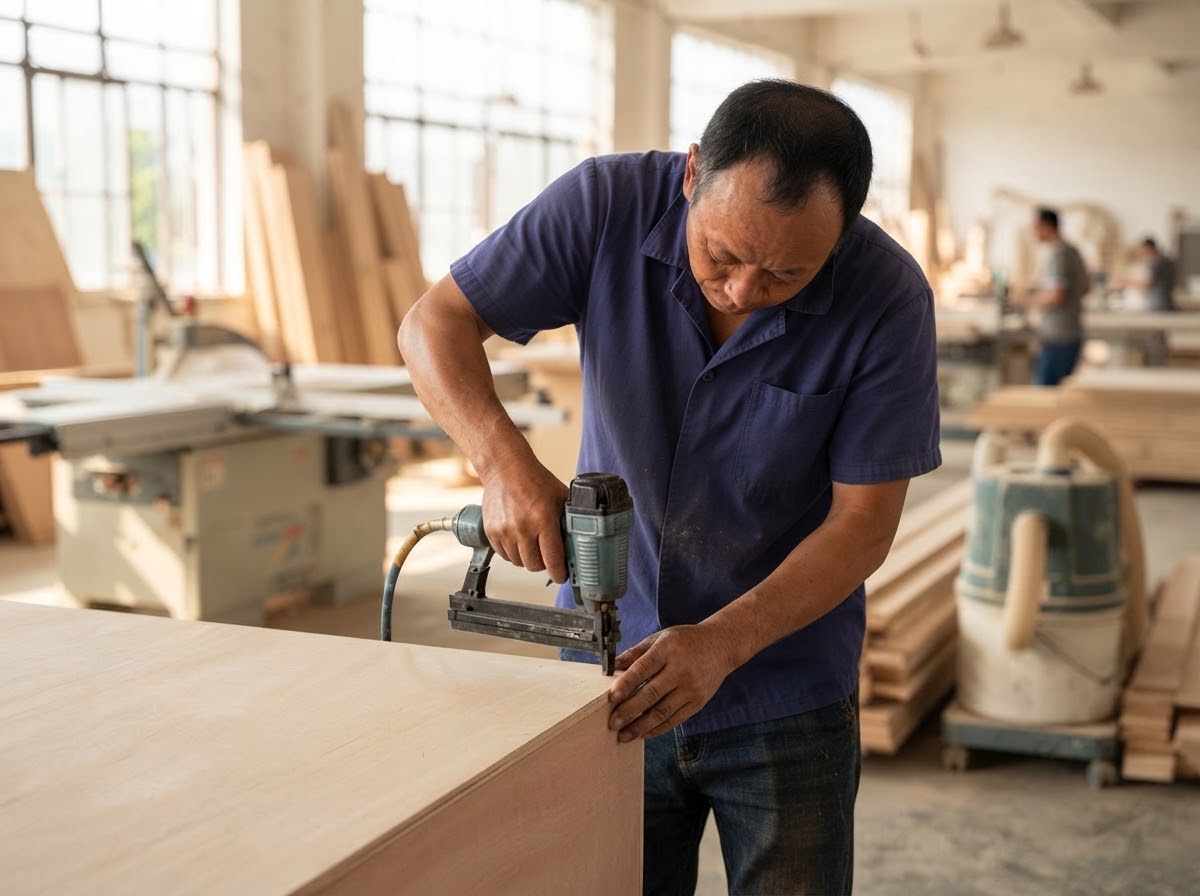
It was mid-November in Dongguan, which means the factory showroom was actually colder than the street outside. I was standing with a frustrated hotel procurement director from Chicago, staring at a stunning walnut-veneered hospitality credenza. The factory sales rep, smiling broadly while pouring us tiny cups of lukewarm tieguanyin tea, looked me dead in the eye and swore up and down the core was premium, multi-layer solid wood plywood. “Top grade, zero formaldehyde,” he promised.
I asked for an unpainted cross-section sample. He stalled. He offered us lunch. He offered to show us a different product line. When we finally dragged ourselves out to the production line and pulled a piece straight from the edge-bander, the truth was right there in the dusty, beige cross-cut. It was MDF. Medium-density fiberboard. And not even the good, high-density green moisture-resistant stuff. It was the flaky, cardboard-colored variety that swells up like a kitchen sponge if someone so much as sneezes near it with a glass of water.
This happens every single day. Buyers fly 7,000 miles, sit in these freezing showrooms, and nod along to material spec sheets that belong in the fiction aisle.
The Brutal Truth About Factory Floor Materials
Let’s get the ugly part out of the way first. When Chinese suppliers tell you a piece of furniture is made of plywood, they are often guessing what you want to hear, not stating a manufacturing fact.
They aren’t necessarily trying to scam you. Actually, that’s not quite right — what most buyers miss is that the factory often outsources the core panels to a sub-supplier in the next village over. The sales rep you are talking to in the front office might genuinely not know the difference until the boards actually arrive on the cutting floor.
Or rather, the problem isn’t the factory, it’s the expectation. You push for a 30% price cut to satisfy your finance department. The factory nods, smiles, and quietly swaps plywood for MDF to make the margin work. They won’t tell you. They assume you know how the game is played.
Here is your golden rule of thumb: If a supplier agrees to your aggressive target price without a fight, your plywood just became MDF.
It’s that simple.
Key Takeaways: The Reality of Chinese Wood Cores
- China furniture sourcing is the intricate process of balancing your aesthetic vision with the harsh realities of factory-level material substitutions.
- MDF is the default cost-saving fallback; if margins get squeezed, your plywood spec is the first thing to vanish.
- “E0 standard” claims are frequently thrown around but rarely backed by batch-specific testing without third-party intervention.
- Relying entirely on showroom samples is a fool’s errand. The real truth is found on the active production line.
The “Wood Standard” Smoke and Mirrors
What exactly are they testing?
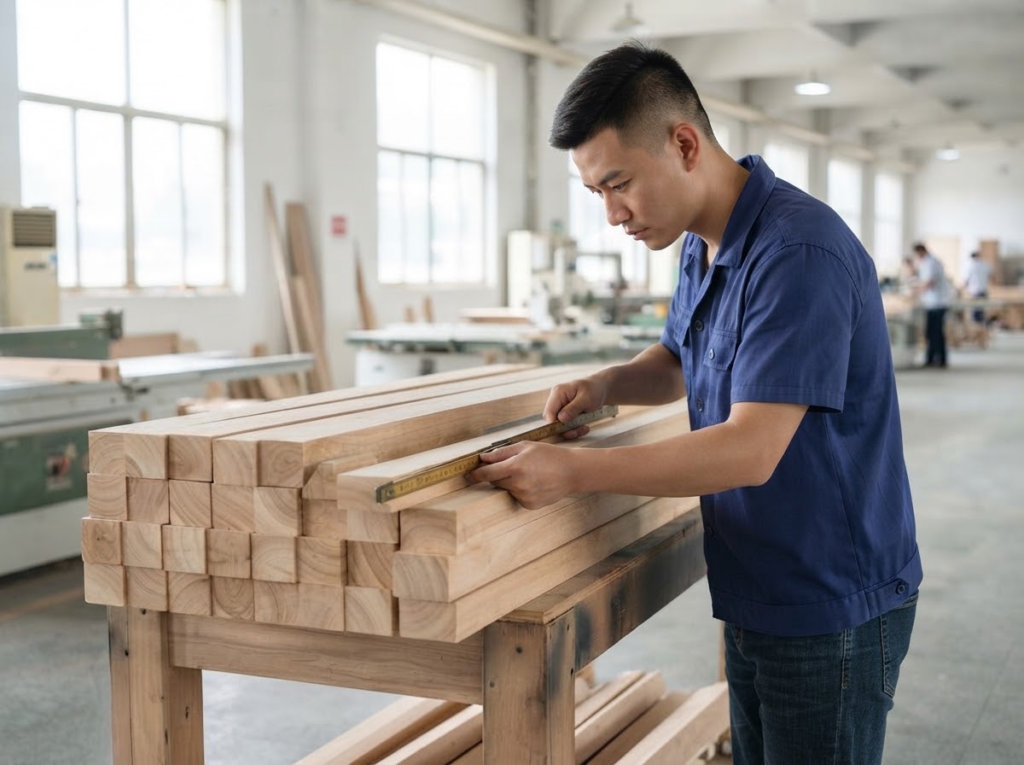
Understanding China wood standards is a lot like ordering from a secret menu at an American fast-food joint. You need to know the exact terminology, or you end up with something completely different from what you thought you asked for. When a factory claims their Chinese furniture materials meet “E0” or “CARB Phase 2” emissions standards, they usually just mean they can buy that material from the local market. Not that they are using it for your specific order.
The certification a factory shows you in the showroom belongs to a premium board they bought three years ago, not the stack sitting on their cutting floor today.
Smoke and mirrors.
I saw this firsthand at a massive casegoods facility in Longjiang. They had beautifully framed SGS and TÜV certificates proudly displayed in the marble lobby. But when I walked out to the raw materials staging area, the bundles of MDF had no stamps, no moisture-resistant green dye, and reeked of cheap urea-formaldehyde glue. When confronted, the production manager just shrugged. He told me the certified boards were for “Japan export only” because Japanese buyers actually pay for them. If you don’t write the specific standard into the penalty clause of your purchase order, those lobby certificates are just expensive wallpaper.
Plywood’s Disappearing Act
Where does the multi-layer go?
But why the constant bait and switch? Plywood is inherently more volatile to source. Making good plywood requires decent veneers, balanced moisture content, and high-quality pressing. If the local supplier rushes the drying process, the boards warp.
MDF is a known commodity. It’s stable, cheap, and machines beautifully.
Think of MDF as the processed American cheese of the woodworking world. It melts perfectly, it’s uniform, it has no grain direction to fight, and it’s dirt cheap. Plywood is like a wheel of aged cheddar. It has natural variations, it can misbehave if not cured right, and it costs a premium.
Factories love MDF because it eliminates the headache of natural wood movement. If a factory can quietly substitute MDF for plywood in a hidden structural component without you noticing, they will do it every single time. They view it as a victimless crime that pads their bottom line. (And yes, this happens more than anyone admits, even on luxury residential projects).
| Material | Factory Cost (Relative) | Water Resistance | Machinability for Factory | Likelihood of Bait-and-Switch |
| Standard MDF | Low ($) | Terrible | Excellent | Very High (The ultimate fallback) |
| HDF / Green MDF | Medium ($$) | Moderate | Excellent | Moderate |
| Commercial Plywood | High ($$$) | Good | Fair | Low (Usually swapped OUT) |
The Geography of Deception
Does location dictate the lie?
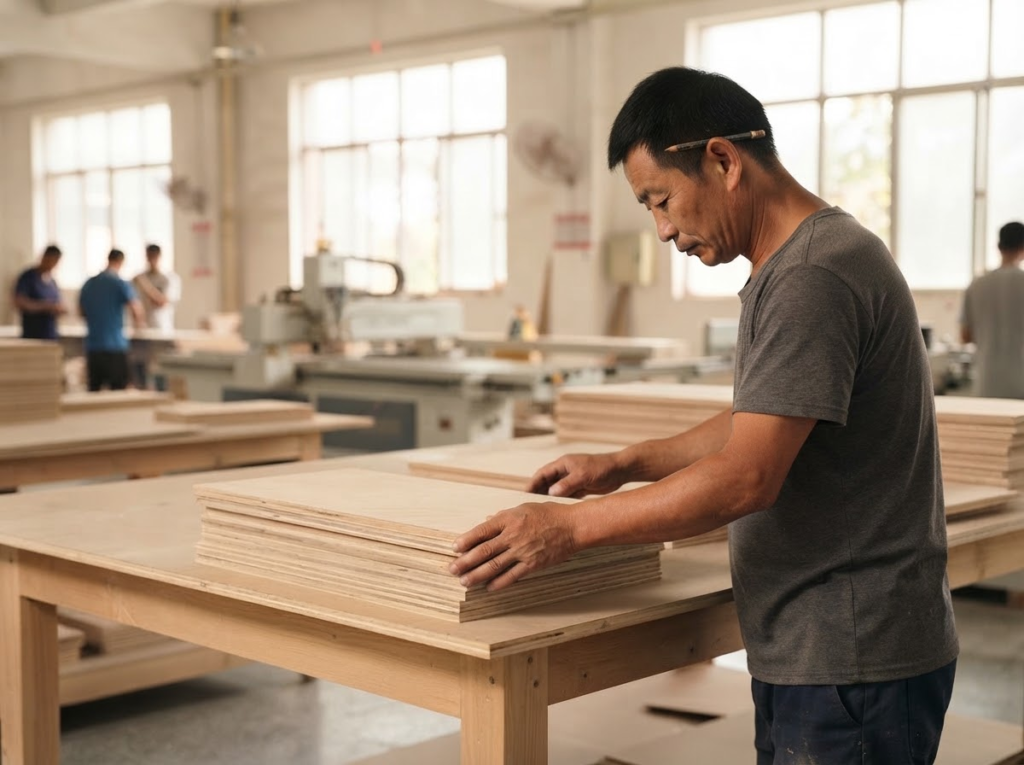
The materials you end up with are heavily dictated by the specific industrial cluster you are buying from. Industry observers estimate that over 60% of unexpected material downgrades happen simply because factories don’t want to source outside their local 20-kilometer radius.
If you are buying dining chairs in Anji, the metal and foam supply chains are world-class, but high-grade architectural plywood is harder to come by locally. If you are in Nankang, they want to use solid rubberwood for everything because it’s subsidized and abundant. Foshan has everything, but the sheer volume of cheap, domestic-market MDF flooding the local Shunde timber markets makes it incredibly tempting for factories to cut corners.
You cannot fight the local supply chain gravity; you either adapt your specs to what the region does best, or you pay a massive premium to import the right materials.
I once audited a factory in Zhejiang that was producing high-end hotel vanities. The spec clearly called for marine-grade plywood due to bathroom humidity. The factory was using standard MDF. Why? Because the owner’s brother-in-law ran the MDF pressing plant down the street. It was a relationship decision, not an engineering one.
Ecosystems and the Mid-Sized Advantage
The Chinese furniture manufacturing landscape isn’t a monolith. You have your massive, vertically integrated behemoths in Foshan that own their own board-pressing facilities, and you have tiny, gritty assembly shops in Dongguan that buy everything piece-meal on the spot market.
And here’s the thing. Your experience with material honesty depends entirely on where your supplier sits in this ecosystem. While some buyers gravitate toward large-scale manufacturers in Foshan to squeeze every last penny out of a volume order, others find that mid-sized specialists — operations like Interi Furniture, which typically focuses on tailored project and hospitality segments. Because factories at that mid-tier level rely heavily on repeat, spec-heavy export business rather than churning out disposable one-off retail volume, their incentive to secretly swap plywood for MDF is substantially lower.
They actually have a brand reputation and long-term client relationships to protect.
A mid-sized supplier with a focused export niche is your best defense against the systemic material downgrades common in mass-market factories.
You just have to know how to vet them, look past the glossy Alibaba pages, and see how they actually manage their supply chain on the ground.
The Material Defense Framework
How do you protect yourself? You stop trusting and start verifying. Here is the framework I use when auditing Chinese furniture materials on the factory floor.
- Demand un-veneered, raw samples. Never evaluate a core material when it’s wrapped in a beautiful oak veneer and sealed with six coats of heavy PU lacquer. Have them cut the panel in half right in front of you on the table saw.
- Weigh the damn thing: MDF is significantly heavier and denser than plywood. If a relatively small dining chair or nightstand feels like it’s filled with lead, you’re holding compressed wood dust and glue, not layered timber.
- The “Screw Test” Protocol: Drive a standard wood screw into the raw edge of the board. Unscrew it. Drive it in again in the exact same spot. If the hole strips out into a powdery mess on the second try, it’s low-density MDF. Real plywood will hold that thread tight, time after time.
- RED FLAG:They eagerly offer a “lifetime warranty” on the core materials. This contradicts everything you’re taught about buying quality goods. But in China sourcing, a factory throwing around impossible, un-enforceable warranties is usually covering up a material downgrade. They know you won’t ship a warped desk back from Los Angeles to Shenzhen in three years. The warranty is a distraction from the MDF they just snuck into your table base.
The most effective quality control happens during raw material staging, not final packing. By the time the furniture is boxed, the evidence is buried under paint.

Real Buyer FAQs (From the Factory Floor)
Q: Why does my factory keep telling me MDF is actually better for my specific climate?
A: They are selling you convenience, not durability. Factories prefer MDF because it won’t warp or twist during production, making their assembly job infinitely easier. Unless you live in a perfectly climate-controlled museum, high-quality plywood will always outperform standard MDF in longevity, screw-holding power, and moisture resistance.
Q: Can I trust the CARB Phase 2 stamps I see printed on the back of the boards?
A: Only if you literally watch them unloading the truck from the board manufacturer. Stamps are easily faked, or applied only to the top board of a stack while the rest are cheap, local market grade. A stamp is a suggestion; a third-party lab test is proof.
Q: Is it ever okay to let them use MDF?
A: Yes. For non-structural, flat-paneled case goods (like wardrobe doors or side panels) in dry environments, a high-density MDF is perfectly acceptable and actually prevents veneer cracking better than plywood. Just make sure you are paying MDF prices for it, not getting billed for premium ply.
Q: Ultimately, can I stop my Chinese supplier from swapping plywood to MDF behind my back?
A: Yes. But only if you explicitly tie your final payment to an unannounced mid-production inspection of the raw, un-painted frames.
At the end of the day, the wood you get is the wood you aggressively manage. You can’t negotiate the price down to the absolute bone, squeeze the factory for free shipping, and then act shocked when the supplier quietly engineers the cost out of the product to survive. The factory is a business, not a charity.
If you find yourself constantly fighting material swaps, ask yourself: Are you buying from a capable manufacturer, or are you just buying a fantasy price tag?
Next time you’re sitting on that leather sofa in the showroom, sipping lukewarm tea and listening to promises about European wood standards, don’t look at the glossy finish. Excuse yourself. Walk out back to the cutting room. Look at the sawdust on the floor.