

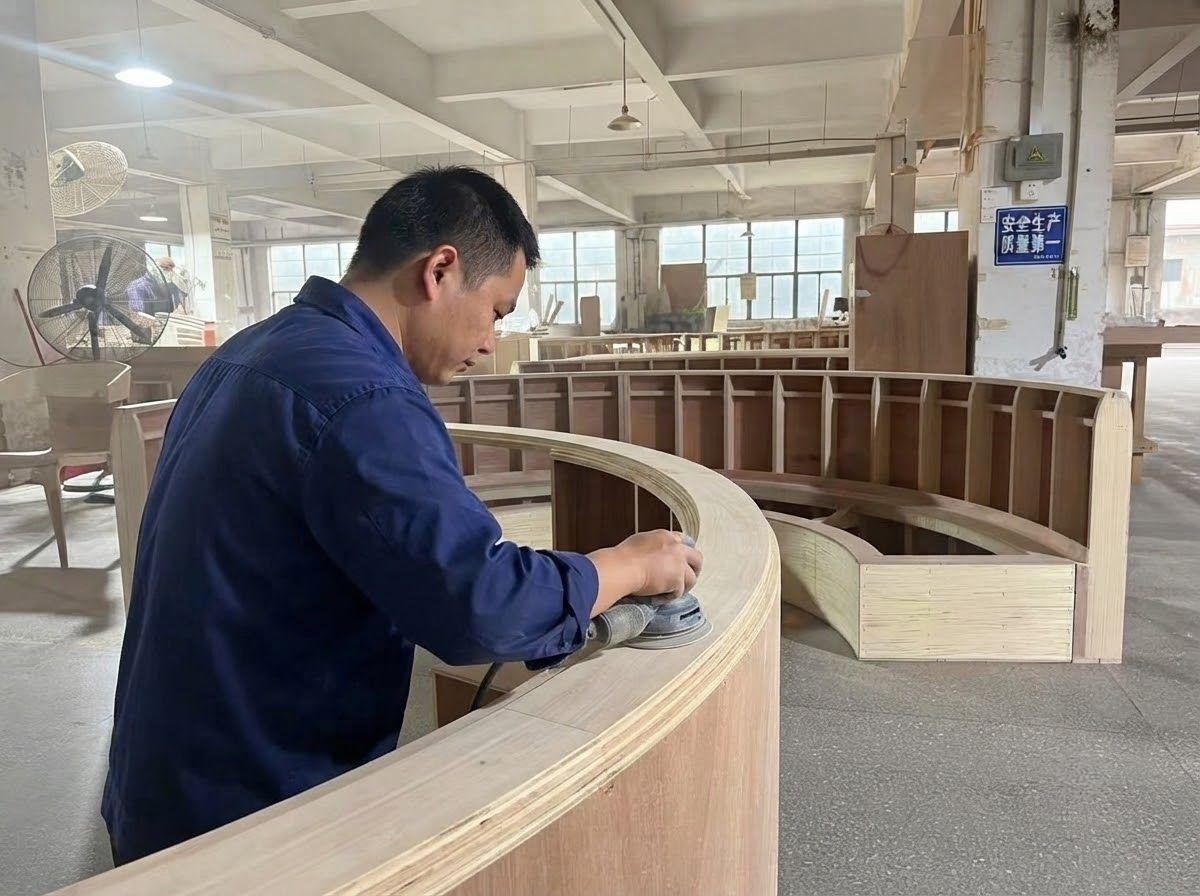
Last March. Longjiang. 6:30 a.m. and already humid enough to ruin a shirt. I’m standing in a factory that could swallow three Costco warehouses — 180,000 square feet, Lao Chen tells me, though I’ve learned never to trust a Chinese factory owner’s square footage claim. They’re hand-tacking upholstery on a sectional. Eight guys. One guy’s job is literally just pressing the staple gun. Another guy smooths the foam. Lao Chen’s been running this floor since ’98. Offers me a cigarette. I don’t smoke, but I take it. You learn that.
“Outbound to Atlanta,” he says. “$1,180. FOB Shenzhen.”
I do the math while the smoke drifts between us. That same sectional? $8,200 in a Georgia showroom. Not a typo. Eight thousand two hundred. And people still ask me why sourcing from China is worth the headache. The gap isn’t a markup. It’s a canyon. With a river at the bottom. And crocodiles.
But here’s the thing — and I say this to every buyer who slides into my DMs thinking they’ve found the cheat code — you’re not comparing apples to apples when you pit a Chinese furniture market quote against your local vendor’s price sheet. You’re comparing a tangerine to a tangerine that’s been passed through twelve pairs of hands, three showrooms, and a financing plan that somehow adds 18% without anyone explaining why. That 70% number? It’s real. I’ve seen it. I’ve also seen it evaporate because someone didn’t understand what “landed cost” actually means. More on that. But first.
The Part Nobody Wants to Hear
Local vendors aren’t evil. Let’s get that straight. They’re just playing a game where everyone grabs a slice, and most of those slices get cut before the furniture ever sniffs American soil.
My rule of thumb — and I’ve got the bad knees and worse Mandarin to back it up — is this: trace the chain from sawdust to your warehouse. More than two hands touching it? You’re bleeding 40% minimum. Two. That’s it. Most domestic supply chains? Four. Sometimes seven. By the time that sofa hits your client’s lobby, it’s been marked up by the factory agent, the export consolidator, the U.S. importer, the regional distributor, and finally some “design consultant” who slapped on 35% because they “curated” it. Curated what? A phone call?
The Chinese furniture market doesn’t run on secrets. These factories know exactly what their stuff sells for in Dallas. They just don’t care. Their money is made at volume, not markup. A plant in Anji cranking out 400 hotel headboards a week isn’t trying to squeeze an extra $200 out of you. They’re trying to keep the line from going cold. Your local guy? He’s trying to cover rent in a design district where the coffee costs $7 and the parking validation doesn’t work. Different math. Different planet.
Actually, wait. That’s not quite right. The problem isn’t the local vendor. It’s the architecture. The layers. The hands.
Where the Money Goes (And Why It Disappears)
Think fish. You want fish. You can go to the dock at 5 a.m. and buy from a guy with a cooler who wants to get home before his wife calls. Or you can go to the restaurant with the tasting menu, the sommelier, the linen service, and the sous chef who needs health insurance. Same fish. Same ocean. One costs $8 a pound. The other costs $48 and comes with a story about sustainable harvesting that nobody asked for. Sourcing from China is the dock at 5 a.m. Your local vendor is the restaurant with the amuse-bouche you didn’t order.
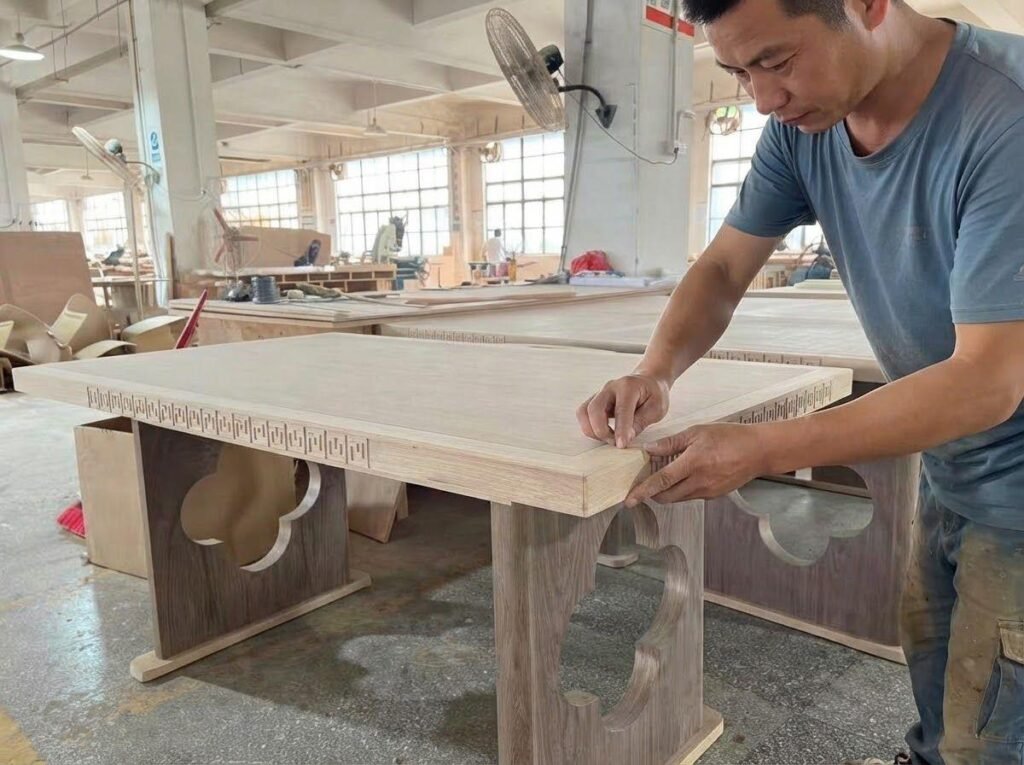
I was in a metalworking shop in Dongguan in ’23. Small place. Maybe forty workers. Guy shows me the invoice for dining table bases. His price to the trading company: $47 a pop. Trading company flips it to a U.S. brand for $118. Brand slaps it under a glass top, calls it “curated,” and retails the whole piece at $1,850. The base — just the metal — is maybe 8% of that final number. The factory sees less than 3%.
And here’s the part that stings. The factory wasn’t getting screwed. They were fine with it. $47 was their number. They’d baked in labor, powder coat, electricity, and a 12% margin that kept the lights on and the workers fed. The explosion happened upstream. It always does. Always.
The real kicker? That same factory would have sold to me direct at $52 per base if I ordered 200 units. Fifty-two dollars. Not $118. Not $1,850. The gap between $52 and $1,850 isn’t quality. It’s architecture. People who add “value” by adding cost. By the time you’re done, you’ve got a $52 base wearing a $1,798 tuxedo.
But hold on. You can’t just fly to Guangzhou and start knocking on doors. I’ve watched buyers try this. Ends with them in a taxi to a “factory” that’s actually a trading company’s rented showroom, signing a deposit check that disappears into the Pearl River Delta. I’ve seen the WhatsApp messages. “Mike, I think I got scammed.” Yeah, Mike. You did.
The 70% Number: Real Gun, Real Bullets
It’s real. But it’s loaded.
Based on export data patterns and fifteen years of comparing landed costs against domestic wholesale, the 70% figure holds up when three things line up. Three. And if you miss one, your savings evaporate faster than morning fog over the Delta. The three: direct factory engagement, consolidated container shipping, and realistic quality expectations. That’s it. No magic. No secret handshake.
This is where buyers get lost. They see a factory quote for a dining chair at $85 and compare it to a $400 U.S. wholesale price. Great. Then they forget customs duties — could be zero, could be 25%, depends on your HTS code and whether customs is having a bad day — ocean freight, which is running roughly $3,500 to $6,000 for a 40-foot container from Yantian to L.A., inland trucking, customs brokerage, and the inevitable “crap, we need to fix this before delivery” costs. The “oh no” costs. Every project has them.
Let me break it down without the pretty table, because tables are for people who haven’t lived through a customs hold.
You buy that dining chair factory-direct. $85. Good. Shipping? If you’re smart and fill a 40-footer — holds about 150 to 200 standard dining chairs, maybe 80 upholstered armchairs, maybe 40 sofas if you’re packing tight — you’re looking at maybe $22 per chair in ocean freight. Duties? Depends. Could be $12. Brokerage? $8. So you’re landed at around $140. Domestic wholesale on the same chair? $320, maybe $350 if they know you’re desperate. Your local showroom? $630 after they add the “design fee” that nobody asked for.
Seventy percent against retail. Fifty-five to sixty against wholesale. The math checks out. But only because that showroom markup is doing the heavy lifting. If you’re buying from a sharp domestic wholesaler who buys containers themselves and keeps overhead low? You’re looking at 45-55%. Still significant. Still worth the plane ticket. Just not the fairy tale.
What tends to happen — and I’ve fixed this more times than I can count — is buyers anchor on the 70% number, then bleed it dry through sloppy logistics. They LCL ship because they only need 40 chairs. Less than container load. Suddenly per-unit freight jumps to $85. They get hit with a customs exam because their broker filed the wrong HTS code. They skip inspection, and 15% of the goods need rework in a Chicago warehouse at $45 an hour. I’ve seen it. I’ve fixed it. It’s expensive. And it’s avoidable. But only if you know it’s coming.
The Factory Map: Giants, Specialists, and the Guys in Between
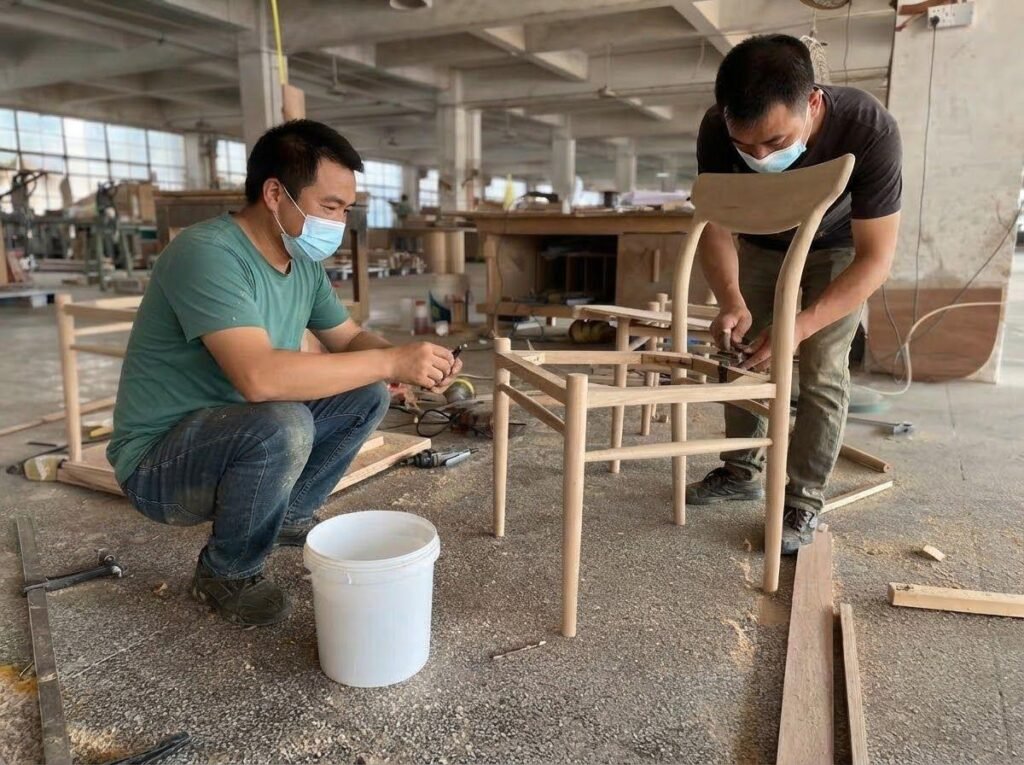
Foshan is the elephant. Shunde district alone claims thousands of manufacturers. Thousands. From massive operations with robotic spray lines — Homag edge banders, Biesse CNCs, the whole German machine park — to three-bay workshops run by a husband-and-wife team who subcontract everything but the final screw. If you’re sourcing hotel furniture at scale, you’ll end up here. The infrastructure is undeniable. Raw materials, hardware suppliers, finishing shops, all within a 20-minute drive. Gravity well. Hard to escape.
While some buyers gravitate toward those large-scale manufacturers in Foshan, others find that mid-sized specialists — operations like Interi Furniture, which focuses on custom hospitality and project-based casegoods — offer a different risk-reward equation. They’re big enough to handle compliance docs and container logistics without treating your paperwork like a favor, but small enough to pivot on finishes and dimensions without making you feel like you’re bothering them. In my experience, roughly 30% of project buyers who start in Foshan’s mega-factories end up migrating to these mid-tier players after their first quality control disaster. The mega-factories are fast. They’re also… impersonal. And impersonal factories make impersonal mistakes.
Nankang, down in Jiangxi, plays a different game. Solid wood. Mid-market residential. Prices that make Foshan look expensive, but lead times that stretch like taffy and quality consistency that wobbles depending on the season. I’ve seen Nankang oak that’s beautiful. I’ve seen Nankang oak with knots that look like a roadmap of Guangdong. You roll the dice.
Anji, up in Zhejiang, owns the office and soft seating categories. Mesh chairs. Ergonomic pieces. The stuff that fills WeWork knockoffs from Bangalore to Boston. You don’t go to Anji for a hand-carved four-poster. You go there when you need 300 task chairs that look decent and won’t collapse under a 200-pound tenant who’s been eating too much airport food.
When to Go, When to Stay Home
Don’t source from China because it’s cheaper. Source from China because your project timeline, volume, and quality tolerance align with what the market actually delivers. Here’s how I separate the smart money from the soon-to-be-disappointed.
Go if your order justifies at least half a 40-foot container, or you’re willing to wait for consolidation. Anything less and the freight math gets ugly. Fast. Like, “why did I even do this” fast.
Go if you’ve got 10 to 14 weeks before install. Not “we need it Tuesday.” China doesn’t do Tuesday. China does “maybe next month, depending on the holiday schedule and whether the paint shop has power this week.”
Go if you’ve budgeted for third-party inspection. Foshan has dozens of reputable QC firms. Use one. This isn’t optional. It’s insurance. Cheap insurance.
Go if you’re okay with slight variations. Wood grain. Leather texture. Fabric dye lots. “Exactly identical” is a fantasy invented by people who’ve never watched veneer being matched by hand in 90-degree heat.
Stop if the factory offers you a glossy catalog with 200 styles and claims they make everything in-house. They don’t. That’s a trading company with Photoshop skills. Run.
Stop if they demand 50% deposit upfront and 50% before shipment with no inspection milestone. Standard terms are 30% deposit, 70% against copy of B/L or after QC release. Anything else is a cash flow problem wearing a policy costume.
Stop if they can’t produce a valid Business License, VAT invoice, or export registration within 24 hours of asking. Real factories have these ready. Fakes stall. And stall. And stall.
And here’s the one that contradicts everything the LinkedIn gurus tell you: conventional wisdom says visit the factory before placing an order. I used to preach this. Now I don’t. If your first order is under $30,000, fly to China only if you want the dim sum. A good agent, a video call with the production manager, and a paid third-party inspection will tell you more than a staged factory tour where they cleaned the one bathroom you’ll see and cranked up the lights in the sample room. The real factory floor is messy. The real factory floor is loud. And the real factory floor doesn’t need you there to produce good work. It needs clear specs, a deposit, and someone checking the goods before they seal the container. That’s it.

The Questions Buyers Actually Ask Me
“Is the 70% thing real, or did you make it up?”
It’s real, but it’s a ceiling, not a floor. Based on export data patterns and my own landed cost tracking across 40-plus projects, savings of 60-75% are achievable when you buy factory-direct, ship full containers, and avoid the showroom markup trap. Drop any one of those three conditions and you’re looking at 40-50%. Still meaningful. Just not 70%.
“What about shipping? Freightos quoted me and it looked like the container would eat everything.”
It will — if you’re shipping 20 dining chairs. A 40-foot high-cube from Yantian to Los Angeles runs roughly $3,800 to $5,500 depending on the month, and it holds 180 to 220 standard dining chairs. Do the math: $4,500 divided by 200 units is $22.50 per chair. Your domestic wholesaler is already baking in freight from their U.S. warehouse to your job site, plus their own inbound container cost. The container doesn’t eat your margin. Small thinking does.
“How do I know I’m talking to a real factory and not some guy in an apartment with a WeChat account?”
Ask for a video call on the factory floor. Not the showroom. The floor. Ask for their Business License number and cross-check it. Ask what machine they use for edge banding. A real factory will say “Homag” or “Biesse” without blinking. A trader will say “German machine” and change the subject. And here’s the real test: ask them to modify a dimension by 15mm. A factory will calculate material waste and give you a revised quote in hours. A trader will disappear for three days while they scramble to find out if their actual factory — the one they don’t own — can even accommodate it.
“Will my hotel client care that it’s made in China?”
They will if you tell them. They won’t if you don’t. End users care about aesthetics, durability, and delivery date. Not origin. The “made in China” stigma lives in the minds of people who’ve never stepped onto a factory floor in Guangdong. I’ve seen $4,000-a-night hotel suites filled with Nankang oak and Foshan upholstery. The guests didn’t ask for passports. They asked if the WiFi worked and whether the minibar was complimentary.
“Do I actually need to fly over?”
You can do 80% of it from your laptop if you have the right partner on the ground. The other 20% — resolving a color mismatch, approving a production sample, or fire-testing a finish — requires someone with eyes and authority in the factory. That someone doesn’t have to be you. It can be a QC agent, a sourcing partner, or that one aggressive project manager you trust with your Amex. Flying to China is romantic. It’s also 16 hours in economy and a hotel in Shunde that smells like lacquer thinner. Pick your battles.
“So does sourcing from China actually beat local vendors by 70%, or not?”
It depends on who you’re calling “local.” Against showroom retail with design fees? Yes. 70% is achievable. I’ve seen higher. Against a sharp domestic wholesaler who buys containers themselves and keeps overhead low? You’re looking at 45-55%. The honest answer: it depends on how many hands touched the goods before they touched yours.
What Fifteen Years Actually Teaches You
I still see smart people make dumb mistakes because they chased a percentage instead of understanding a process. The Chinese furniture market isn’t a vending machine where you insert a purchase order and receive 70% savings. It’s a relationship economy wearing a manufacturing costume. The buyers who win are the ones who learn the rhythm — who know that Lao Chen’s cigarette break is when you ask the real questions, who understand that a factory going silent for two days usually means they’re solving your problem, not ignoring you, who accept that perfection is a moving target and consistency is the only metric that actually pays rent.
The math works. It always has. But math without context is just numbers on a page. And numbers on a page don’t survive a customs hold in Long Beach or a fabric lot that arrived three shades off because the dye house was rushing to beat the holiday.
So here’s what I leave you with: Are you looking for cheaper furniture, or are you looking to be a smarter buyer? Because only one of those questions has a 70% answer. And it isn’t the first one.