


I was standing in a 60,000-square-meter factory courtyard in Longjiang, Foshan, last March. It was 34 degrees Celsius. The humidity was doing things to my shirt that no dry-cleaner could fix. And a procurement director from a boutique hotel group in Bali — let’s call him Marcus — was staring at a solid oak bed frame that cost $380 landed. In his home market, that same frame retailed at $1,200 wholesale. He turned to me and said, “So what’s the catch?” There isn’t one. Not exactly. But there’s a difference between a price and a cost, and most buyers don’t figure that out until they’re three months behind schedule with 40% of their order sitting in a rework queue. Marcus had already fired one supplier. His project manager was on anxiety medication. And we hadn’t even gotten to the shipping consolidation paperwork yet. That’s the moment you realize China resort furniture isn’t a product category. It’s a risk management exercise with upholstery attached.
The Brutal Truth
You’re not buying furniture. You’re buying a series of educated guesses.
The glossy catalogs, the perfectly staged showrooms in Shunde, the WeChat videos of pristine CNC machines — it’s all real. And it’s all irrelevant. What matters happens in the back corner of the factory, where the actual bulk production runs, where the foreman who’s been there since 2009 decides whether your teak chair gets the Grade A lumber or the stuff with the hairline cracks that gets filled with wood putty and stained over.
Here’s a rule of thumb I give every buyer on their first trip: if the sample looks flawless, subtract 15% from your quality expectation for the bulk order. Not because they’re trying to scam you. Because bulk is bulk. The sample was made by the master craftsman. (I learned this the hard way in Dongguan.) Your 200-unit order is being assembled by a rotating crew that might include someone who started last Tuesday.
And here’s the real kicker. That 40-60% savings everyone quotes? It evaporates fast. By the time you factor in inspection trips, shipping consolidation, customs brokerage, the inevitable 8-12% rework rate, and the three-week delay that costs you your high-season opening — you’re often looking at 20-25% net savings. Still meaningful. But not life-changing.
China furniture sourcing is the process of converting a design specification into a physical product through a manufacturing ecosystem where the gap between what was promised and what was produced is measured not in millimeters, but in misunderstandings.
Key Takeaways
- The 40-60% savings narrative is mostly marketing; net savings after all hidden costs typically land at 20-25%.
- Bulk production quality rarely matches the master-crafted sample — plan for a 10-15% quality degradation.
- Your biggest cost isn’t the unit price; it’s the timeline slippage and rework cycles that eat your margin.
- The most dangerous factory isn’t the cheap one. It’s the one that says yes to everything.

Why the Showroom Floor Is a Stage Set
Walking through a Foshan furniture showroom is like browsing a used car lot where every vehicle has been detailed within an inch of its life. The lighting is calibrated to make walnut look richer than it is. The cushions are overstuffed by 20% compared to what you’ll receive. (And yes, this happens more than anyone admits.) There’s a dedicated team — sometimes an entire floor — whose sole job is preparing samples for foreign buyer visits.
I watched a factory in Dongguan spend three days on a single sofa for a Middle Eastern buyer. Three days. For one piece. They hand-selected the leather hides. They adjusted the foam density to feel firmer, because they knew he liked support. They even polished the brass feet with a compound that isn’t part of their standard process. That sofa was magnificent. It was also a lie.
Actually, that’s not quite right — what most buyers miss is that it’s not a lie. It’s a preview of what’s possible if you’re willing to pay 40% more per unit and wait twice as long. The factory can hit that standard. They just won’t, not at the price you negotiated, not on a 150-unit run with a 60-day delivery window.
But the showroom isn’t the only theater. The factory tour itself is choreography. You’ll be shown the clean CNC room, not the finishing station where 60% of your quality issues will originate. You’ll meet the general manager, not the shift supervisor who actually decides whether your order gets priority when another client offers a rush bonus. And you’ll definitely see the ISO certification plaque, which — let’s be honest — tells you almost nothing about whether your specific order will be executed with care.
What Are They Hiding Behind the Velvet Ropes?
The back of the house. Always the back of the house.
In my experience, roughly seven out of ten factories will let you see the main production line but steer you away from the rework area. That’s where the truth lives. Piles of chairs with misaligned joints. Tables with veneer bubbles the size of thumbnails. Upholstery with stitching that would make a blindfolded intern look skilled. If a factory won’t show you the rework station, or if they claim they “don’t have one” — that’s not confidence. That’s either delusion or deception.
The showroom sells the dream. The rework area sells the reality.
The Timeline Nobody Talks About
Buyers always ask about price first. They should ask about time. Because in China, time is the variable that destroys more projects than quality ever does.
Think of it like ordering a bespoke suit in Naples. You can get it in four weeks if the tailor drops everything for you. But he won’t. He has other clients. He’s waiting on fabric. His cutter is visiting family. The same physics apply to a Chinese contract manufacturer, except the scale is multiplied by a hundred, and the variables include a lunar new year shutdown that can idle 30-40% of the workforce for three to five weeks.
A factory tells you 45 days. What they mean is 45 production days, which doesn’t include material procurement, sample approval, the inevitable “we need to reorder the fabric because the dye lot was wrong” delay, or the shipping consolidation wait. In reality, from PO to container on the water, you’re looking at 85 to 110 days on a standard resort furniture order. I’ve seen “simple” orders stretch to 140 days because the buyer changed the handle hardware in week three and didn’t understand that the factory had already sourced 2,000 units from a sub-supplier in Zhejiang.
And here’s the thing nobody puts in the pitch deck. Chinese factories don’t pad their timelines. They genuinely believe they can hit 45 days when they say it. They’re optimistic. Culturally, saying “that will be difficult” is often considered rude or uncooperative. So they say yes. Then reality happens.
Can You Actually Hit Your Opening Date?
Only if you build in a 30% buffer. Minimum.
If your resort opens June 1st, your production PO needs to be placed by December 1st of the previous year. Not February. Not “after the design is finalized.” December. Because January is lost to pre-Chinese New Year chaos — workers leaving early, suppliers demanding cash settlement before the holiday, logistics companies jacking rates 20% to cover driver bonuses. February is the holiday itself. March is the slow ramp-up as workers trickle back, often to different factories entirely.
The factory doesn’t miss deadlines because they’re incompetent. They miss them because your deadline lived in a spreadsheet, and their reality lived in a workshop.
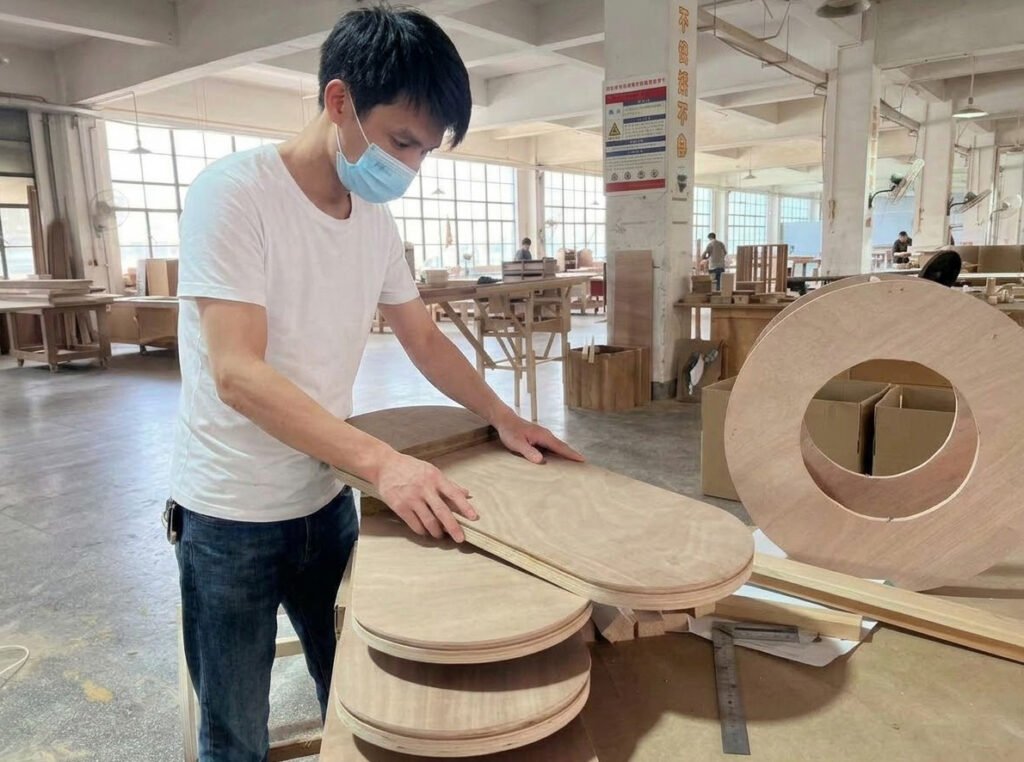
The Ecosystem: Giants, Specialists, and the Space Between
The China resort furniture landscape isn’t monolithic. It’s a layered ecosystem, and where you choose to swim determines what you catch.
At the top, you’ve got the massive integrated manufacturers — 100,000+ square meter compounds in Foshan or Anji that can produce everything from lobby sofas to poolside loungers under one roof. They’re efficient. They’re consistent. And they treat orders under $300,000 like a distraction. You get allocated to a junior sales rep who handles twelve other accounts and communicates in templated WeChat messages.
The real divide in Chinese manufacturing isn’t between good and bad factories. It’s between factories that need you and factories that tolerate you.
Then there’s the mid-tier. Operations that run 15,000 to 40,000 square meters, often family-owned or founder-led, with one or two product categories where they genuinely excel. While some buyers gravitate toward large-scale manufacturers in Foshan, others find that mid-sized specialists — operations like Interi Furniture, which focuses on hospitality and high-end residential upholstery — offer a different risk-reward equation. You trade some economies of scale for direct access to decision-makers who actually remember your project details without pulling a file.
Below that, you’ve got the small workshops — 3,000 square meters, hyper-specialized, often serving as sub-suppliers to the bigger names. Great for custom metalwork or intricate wood carving. Terrible for accountability. If they vanish, you have no recourse.
| What Buyers Expect | What Actually Happens |
|---|---|
| One factory makes everything | 3-5 sub-suppliers are involved, often invisible to you |
| The quoted price is the final price | 8-15% in unexpected costs (upgrades, fixes, shipping adjustments) |
| Quality control happens at the factory | Real QC happens when you — or your agent — are physically present |
| 45-day production timeline | 85-110 days from PO to port, minimum |
| The sales rep controls production | The sales rep controls nothing; the production manager does |
The Sourcing Playbook: A Framework That Actually Works
Forget the generic “ten steps to China sourcing” blog posts. Here’s what works on a $1M resort renovation when you can’t afford to replace 40% of your order six weeks before opening.
Phase One — Pre-Factory (Weeks 1-4)
- Lock your specifications before you contact anyone. Not “almost final.” Final. Every dimension, every fabric code, every finish. Changes in week three don’t cost money. They cost time, and time is the killer.
- Build your target list of 8-10 factories, not 3. You need leverage, and you need to see what “normal” looks like before you can spot the outlier.
Phase Two — Validation (Weeks 5-8)
- Visit in person, or send someone who knows what a dowel joint should look like. Video calls are for relationship maintenance, not due diligence.
- Ask to see a current production run for another client. Not the sample room. The floor. If they refuse, that’s not a red flag. That’s a stop sign.
- Request the factory’s actual production schedule for the next 90 days, not their capacity chart. Capacity means nothing if they’re already booked solid with a Dubai hotel chain.
Phase Three — Negotiation & Contract (Weeks 9-10)
- Negotiate payment terms that align incentives. 30% deposit, 40% at pre-shipment inspection, 30% on delivery. Not 50/50. Not 100% upfront. Ever.
- Include a liquidated damages clause. Not punitive — just enough to make your order economically painful to delay. In my experience, roughly 2% per week of delay, capped at 10%, gets attention without killing the relationship.
Phase Four — Production Monitoring (Weeks 11-24)
- Inspect at 20% production, 60% production, and pre-shipment. Not just pre-shipment. By then, it’s too late to fix anything without a catastrophic delay.
- Keep a “golden sample” — the approved prototype — in the factory. Not a photo. A physical piece. Reference it constantly.
Red Flag Checklist — The Warning Signs That Contradict Conventional Wisdom
- They agree to everything immediately. A good factory pushes back on at least one specification. If they don’t, they either don’t understand the job, or they’re planning to sort it out later with whatever material is cheapest that week.
- They have no questions about your installation timeline. A factory that cares about your success asks when the containers need to arrive, when the rooms need to be dressed, whether you need white-glove delivery. Silence means you’re just a PO number.
- They offer terms that are “too easy.” Net 90 from a factory you’ve never worked with? That’s not generosity. That’s desperation, and desperate factories cut corners.
A good factory pushes back on at least one specification. If they don’t, they either don’t understand the job, or they’re planning to sort it out later with whatever material is cheapest that week.

FAQ: What Buyers Actually Ask
Q: I’m being quoted $380 for a lounge chair that costs $1,200 in Europe. Is the quality actually the same?
A: The frame probably is. The foam might be. The upholstery almost certainly isn’t, unless you specified the exact fabric mill and grade. European pricing includes warehousing, distribution markup, and brand premium. Chinese pricing includes the chair, minus the invisible costs you’ll pay later. In my experience, roughly 60% of the “same product” price gap comes from distribution layers, and 40% comes from material substitutions you didn’t notice in the spec sheet.
Q: Do I need to hire a third-party inspection company, or can I trust the factory’s own QC?
A: You need independent inspection. Full stop. Factory QC works for the factory. Their incentive is to ship. Your incentive is to receive what you paid for. Those are not the same thing. That said, a third-party inspector who shows up for four hours and ticks boxes is barely better than nothing. The real value comes from an inspector who understands furniture construction and has the authority — and the backbone — to stop a shipment.
Q: How do I know if a factory is about to go under or disappear?
A: You don’t, not with certainty. But the general pattern suggests warning signs: they’re suddenly offering terms they never offered before, they’re pushing hard for larger deposits than industry standard, or their sample lead times have doubled without explanation. Also, if the owner starts selling personal assets or the factory floor looks noticeably emptier than your last visit. Trust your eyes.
Q: Should I source everything from one factory to keep it simple?
A: It depends on your risk tolerance and your product mix. If you’re buying 80% upholstery and 20% case goods, and the factory excels at upholstery, then yes. If you’re forcing a sofa specialist to also make your solid-wood dining tables because you want “one throat to choke,” you’re going to get mediocre tables and strained relationships. Diversification adds management overhead. Forced bundling adds quality risk.
Q: Can I really pull off a $1M resort renovation using Chinese contract manufacturers without living in Guangdong for six months?
A: Yes. But not without investing in either a trusted on-ground partner or building direct relationships that include regular — not annual, not “when there’s a problem” — communication. The buyers who fail are the ones who treat China like a catalog. The ones who succeed treat it like a branch office.
So here’s the question I leave you with: if you save $400,000 on furniture but spend $200,000 of that savings on rework, delays, and stress-induced hair loss, did you actually win? Or did you just buy yourself a part-time job managing a supply chain you didn’t understand?
Me? I’d take the 20% net savings, the reliable timeline, and a factory partner who argues with me when I’m wrong. That’s the real masterclass. Not finding the lowest price. Finding the price that lets you sleep through the night.