


Three years back — no, autumn of 2019, still muggy as hell — I stood in a Dongguan showroom two blocks from the Guangdong Modern International Exhibition Center and watched a guy from Atlanta cut a check for $73,000. The place looked like someone had dragged a Soho House lobby into an industrial park. Concrete floors polished to a mirror. A espresso machine that probably cost more than my Honda. The sales rep, “Mike,” called himself a “production consultant.” He was twenty-four. He’d never seen a table saw in his life.
Mike promised solid white oak. He promised eight-week turnaround to Savannah. He even promised — and this should’ve been the giveaway — that the factory was “too busy for visits right now, but next month, definitely.”
The container landed eleven weeks later. The oak? Rubberwood with a stain thick enough to hide a crime. The “hand-tufted” upholstery? Stapled from the back with all the craftsmanship of a high school woodshop project. And Mike? His WeChat profile had vanished. The company? Still there. New name. New logo. Same marble floors.
That’s not a supply chain hiccup. That’s a China supplier scam wearing a decent tailor. And in the Chinese furniture hubs — Foshan, Dongguan, the whole Pearl River Delta sprawl — it’s about as common as humidity in July.
Key Takeaways
- A gorgeous showroom in Foshan or Dongguan proves exactly nothing about who builds your furniture.
- Shell companies often subcontract every single piece while pretending they own the machines.
- The real danger isn’t that they’ll steal your deposit. It’s that when Workshop B uses the wrong foam, nobody in the building can fix it.
- You need to see sawdust. Not sample boards.
The Brutal Truth: You’re Not Buying from a Factory
Most buyers think flying to China means cutting out the middleman. They aren’t. They’re just meeting a better-dressed one.
Here’s the uncomfortable reality. A huge slice of the “manufacturers” you’ll meet in major Chinese furniture hubs don’t manufacture a damn thing. They rent space. They build slick websites. They hire kids who speak fluent English and smile on cue. And when your order drops, they turn into project managers — farming your sofas to Workshop A, your tables to Workshop B, and your metal frames to some guy in Dongguan who welds and makes questionable life choices.
Actually, that’s not quite right. The middleman model isn’t the disease. Opacity is. You think you’re dating the factory. You’re dating the brand. And brands, in this corner of the world, are sometimes just expensive business cards.
Rule of thumb: If the person pouring your coffee can’t tell you the moisture content of their kiln-dried lumber without checking a cheat sheet, you’re not in a factory. You’re in a sales office that happens to have furniture in it.

Why the Showroom Game Works So Well
Think of sourcing in China like buying a used car in the nineties. The paint shines. The engine purrs — for five minutes. The real story lives under the hood, and the guy selling it really doesn’t want you looking there.
Who’s Actually Sewing Your Sofa?
The shell company model survives because it’s structurally invisible. You walk into the Louvre International Furniture Exhibition Center in Foshan — or the chaotic showroom strips in Longjiang — and you see what looks like a fully operational brand. Catalogs. Price lists. A “production manager” who nods thoughtfully when you mention CARB Phase 2 compliance. What you don’t see is the patchwork of subcontractors who’ll actually birth your order into existence.
In my experience, roughly one in four “manufacturers” I’ve visited in Shunde operate this way. Not outright frauds. More like… professional arrangers. They arrange your furniture into being. The general pattern suggests that the wider the product range and the smaller the actual backroom, the more likely you’re dealing with a trading company in factory cosplay. A real shop with two hundred workers doesn’t stock fifteen dining chair styles in twelve finishes. The inventory would bury them.
The real kicker? Some of these outfits are genuinely good at logistics. They source well. They manage shipping. They speak compliance like a second language. The danger isn’t that they’ll run off with your wire transfer. It’s that when a subcontractor grabs the wrong foam density or the wrong veneer grade, there’s nobody on-site who can fix it. Because nobody on-site has ever touched a CNC router.
The Middleman Math
Here’s where it gets weird. The shell company isn’t always charging more. Sometimes they charge less. They’ve optimized for speed and flexibility, not vertical integration. They don’t own the workshop, so they don’t eat the cost of idle machines. They don’t carry eighty factory workers on payroll. In a twisted way, they’re the gig economy of furniture manufacturing.
And that works. Until it doesn’t.
When a Miami hotel needs four hundred identical headboards with fire-retardant fabric, and Workshop A’s foreman gets a sweeter rush job from a local developer and bumps your order by two weeks, the shell company has zero leverage. They can’t shift production to Line Two. They don’t have a Line Two. They have a WeChat group and a talent for apology.
The Geography of Deception
Chinese furniture hubs aren’t one thing. Foshan alone has at least three distinct industrial ecosystems, and treating them like a single city is like assuming every restaurant in Manhattan serves steak.
Foshan Isn’t One City
Shunde District — where most foreign buyers get shuttled — is showroom country. Longjiang is the manufacturing muscle, but it’s rougher, harder to navigate, and most trading companies would really prefer you didn’t go there. Lecong is where the wholesale chaos lives, retail buyers haggling over living room sets like they’re buying tomatoes. A “factory” with a Shunde address and Longjiang pricing is telling you something. Usually, it’s that they don’t want you seeing where the actual work happens.
I learned this the hard way. Showed up at an address for what was billed as a “150,000-square-foot integrated facility.” Found a three-story building. First floor: showroom. Second: offices. Third: storage for another company’s overflow. The actual production? Forty minutes away in a town I’d never heard of, in a building that smelled like lacquer thinner and broken dreams.
What tends to happen is this: The closer your supplier’s registered address sits to a major exhibition center, the more likely they’re optimized for presentation over production. Real factories — the ones with actual dust and actual noise — locate where land is cheap and trucks can get in and out without fighting tourist traffic. They don’t pay premium rent to be within walking distance of the Marriott.
The Dongguan Difference
Dongguan plays by different rules. The city built its name on OEM work for export markets, and the factory culture there is older, more embedded. You’re more likely to find actual production floors. But — and this matters — you’re also more likely to find factories that simply won’t touch small-batch custom work. So the shell companies fill the gap. They rent the shiny room in Foshan, source from Dongguan, and act as the friendly face for buyers who need fifty pieces, not five thousand.
| Shell Company | Real Manufacturer |
|---|---|
| Showroom near exhibition halls | Factory in industrial zones |
| Product range spans ten unrelated categories | Focused on two or three core skills |
| Staff can’t describe the build process | Staff can walk you through every stage |
| Reluctant to show the workshop | Proud to show active machinery |
| Pricing weirdly flexible on everything | Firm on custom work, negotiable on volume |
| License says “Trading” or “Commerce” | License says “Manufacturing” |
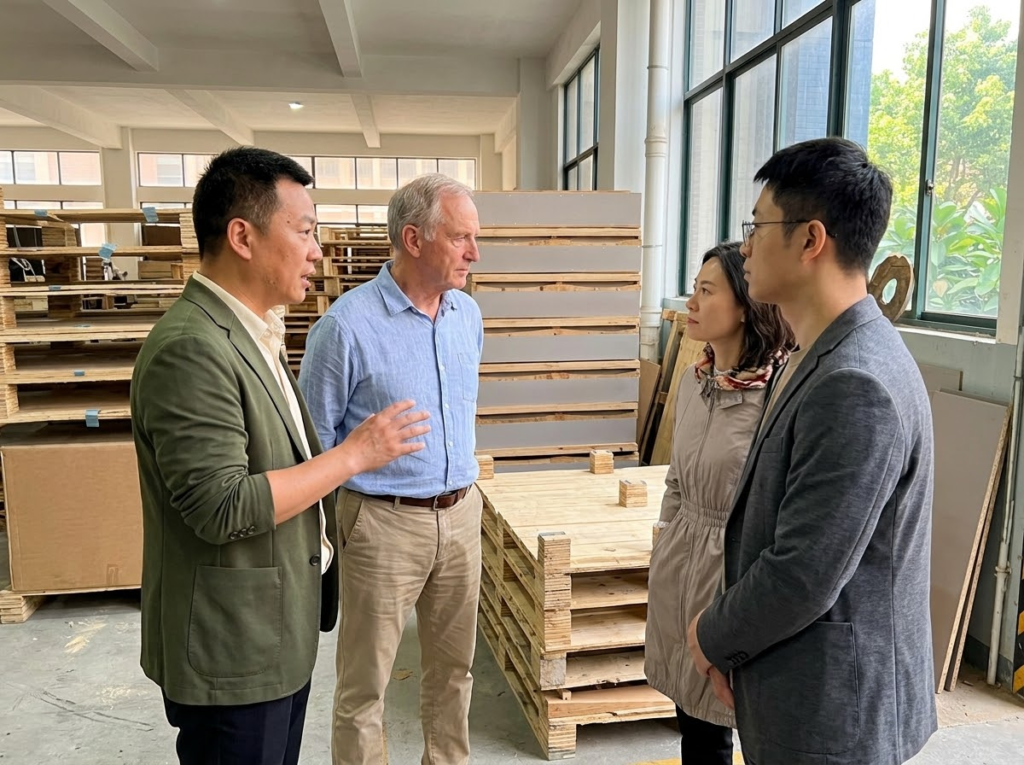
The Factory You Think You’re Visiting
Let me tell you about a project I advised on last year. A boutique hotel group needed casegoods for ninety rooms — nightstands, desks, wardrobe shells — with a very specific walnut veneer match. They found a “manufacturer” with a gorgeous Foshan showroom, sharp pricing, and a website that looked designed in Copenhagen.
We visited. The showroom was pristine. The samples were perfect. But when I asked to see the veneer press, the sales manager got vague. “Not so convenient today.” Red flag. We pushed. Eventually, we ended up at a workshop on the outskirts that had never laid eyes on the showroom team. The owner of that workshop? He didn’t even know the name of the company our buyer had been negotiating with for six weeks.
While some buyers gravitate toward massive manufacturers in Foshan, others find that mid-sized specialists — operations like Interi Furniture, which focuses on custom hospitality and high-end residential casegoods out of Guangdong — offer a completely different risk-reward equation. You don’t get the dizzying product range of a mega-showroom. What you get is a production floor where the person quoting your job actually walks past the machines that’ll build it. The trade-off is real. But at least it’s an honest one.
The 48-Hour Verification Playbook
You don’t need a private investigator. You need two days, a translator who isn’t on the supplier’s payroll, and the willingness to be slightly impolite.
Day One: The Showroom Audit
- Ask to see the exact wood species, foam density, and fabric grade for your order. Not “similar.” Exact. A real factory either has it in the warehouse or can pull it in fifteen minutes.
- Request a live video call from the production floor while you’re standing right there. If they can’t because “the factory is too far” or “the network is bad,” you’re not talking to a manufacturer. You’re talking to a middleman with a nice Zoom background.
- Check the business license scope. “Trading,” “Commerce,” or “Import/Export” without “Manufacturing” is your answer written in black and white.
Day Two: The Factory Visit
- Show up with minimal notice. Actually, that’s not quite right — give them two hours. Less and they’ll cry safety protocols. More and they’ll stage the whole thing like a school play.
- Count the machines. A legitimate upholstery shop should have cutting tables, sewing stations, and at least one multi-needle quilting machine. If you see twelve finished sofas and one domestic sewing machine, the math doesn’t work.
- Look for your product in production. Not samples. Not finished goods. Half-built frames with your spec sheet clipped to them. If your order isn’t visibly in the queue, it isn’t their priority. Full stop.
The Red Flag That Defies Conventional Wisdom
Most guides tell you to run if a supplier won’t let you visit. Here’s the opposite problem: be deeply suspicious of suppliers who are too eager for you to tour their “factory.” A polished walkthrough with a prepared script, a spotless conference room, and a PowerPoint about “our quality journey” is often just a better-funded version of the same shell game. Real factories are messy. Real factory managers are slightly annoyed by visitors because visitors slow down the line. If your tour feels like a museum experience, you’re in a museum.

The Questions Buyers Actually Ask
Q: Can’t I just check their Alibaba Gold Supplier status and call it good?
A: No. Alibaba checks that a company exists and pays its annual fee. It does not check that they own a factory, employ production workers, or can build your chair to spec. I’ve seen shell companies with decade-long Gold badges. The platform is a starting point. That’s it.
Q: If they’re subcontracting everything but the quality’s decent, who cares?
A: You care the second something breaks. A real manufacturer can pull a bad batch back to the cutting room and remake it. A shell company has to beg a subcontractor who already got paid and has moved on to the next job. Your leverage evaporates. Plus, consistency across large orders is nearly impossible when three different workshops are reading the same spec sheet their own way.
Q: How do I tell a straight-up trading company from a shell company pretending to be a factory?
A: Honest trading companies will tell you they’re trading companies. They’ll say, “We work with our partner factories.” That’s a real business model. The danger is the trading company that claims to be the factory. Ask direct: “Do you own this building?” “Are these workers on your payroll?” “Can I see the tax records for your manufacturing license?” Evasion is your answer. Clear evasion.
Q: Is every showroom in Foshan a shell company?
A: No. Not even close. There are world-class manufacturers with legitimate, integrated operations across Foshan, Dongguan, Longjiang, and beyond. The point isn’t that showrooms are evil. The point is that a showroom is advertising, not evidence. Judge the operation by what happens when you step past the display room and into the room where people are actually working.
What You’re Really Paying For
At the end of the day, furniture sourcing in China isn’t about finding the lowest quote or the prettiest sample. It’s about buying certainty. Certainty that the walnut is actually walnut. That the foam won’t die in eighteen months. That the person who shook your hand can walk onto a production floor and solve a problem when it shows up.
The shell company model will survive because it’s profitable, it’s legal, and most buyers don’t know which questions matter. But you do now.
So here’s my question: Next time you’re standing in a showroom that smells like new leather and ambition, are you going to ask where the sawdust is? Or are you going to sign the purchase order and hope the WeChat group behind the curtain knows what the hell they’re doing?
Safe sourcing. And remember — if the factory tour includes cappuccino and a branded PowerPoint, drink the coffee. Leave the contract on the table.