


The email lands at 11:47 PM. Foshan time. A procurement director in Chicago is staring at photos of a hotel lobby sectional that looks nothing like the sample she approved six weeks ago. The original China furniture sample — the one that flew economy to O’Hare in a plywood crate — had walnut veneer with a book-matched grain so tight it looked like liquid. This production unit? Cat-face patches. Mismatched seams. And the foam density reads 28 kg/m³ on her spec sheet, but the factory certificate says 32. Nobody called to explain the swap.
She’s got $47,000 tied to this PO. The 12,000-square-meter facility in Longjiang looked immaculate during her walk-through in March. The spray booth had a humidity reading of 78% that day — three points above the compliance threshold her brand requires — but the factory manager waved it off, said it was “just the morning rain.” She let it slide. Now the container ships in nine days. And she’s holding two photos that look like they came from different factories.
The sample was perfect. That’s the problem.
Attribution Analysis
Buyers blame deception. “They cut corners,” the director will tell her team. “The factory swapped materials after approval.” But that’s not quite right — what most buyers miss is that the sample and the production run were never the same product to begin with. The sample is a prototype built by the A-team, using hand-selected boards, with overtime hours and a supervisor hovering over every joint. Production is a quota machine running on thin margins and shift rotations.
The real driver isn’t malice. It’s misalignment. The factory optimized for the sample because that’s what got the PO signed. Then they optimized for production because that’s what keeps the lights on. Two different optimization problems. Two different outcomes.
If you see a sample that looks too good for the quoted price, then the production line that built it isn’t the same line that’ll run your order.
Key Takeaway
- A perfect sample from Chinese suppliers often reflects a prototype process, not a production reality.
- The gap between sample and batch is usually systemic, not malicious — driven by different teams, materials, and time pressures.
- Buyers who treat the sample as a “golden master” without auditing the production workflow are auditing the wrong variable.
- China furniture sourcing is the process of aligning what was promised in the sample room with what can be consistently replicated on the factory floor.
Variable Audit: Material Drift
Signal: The veneer match shifts between sample and first article
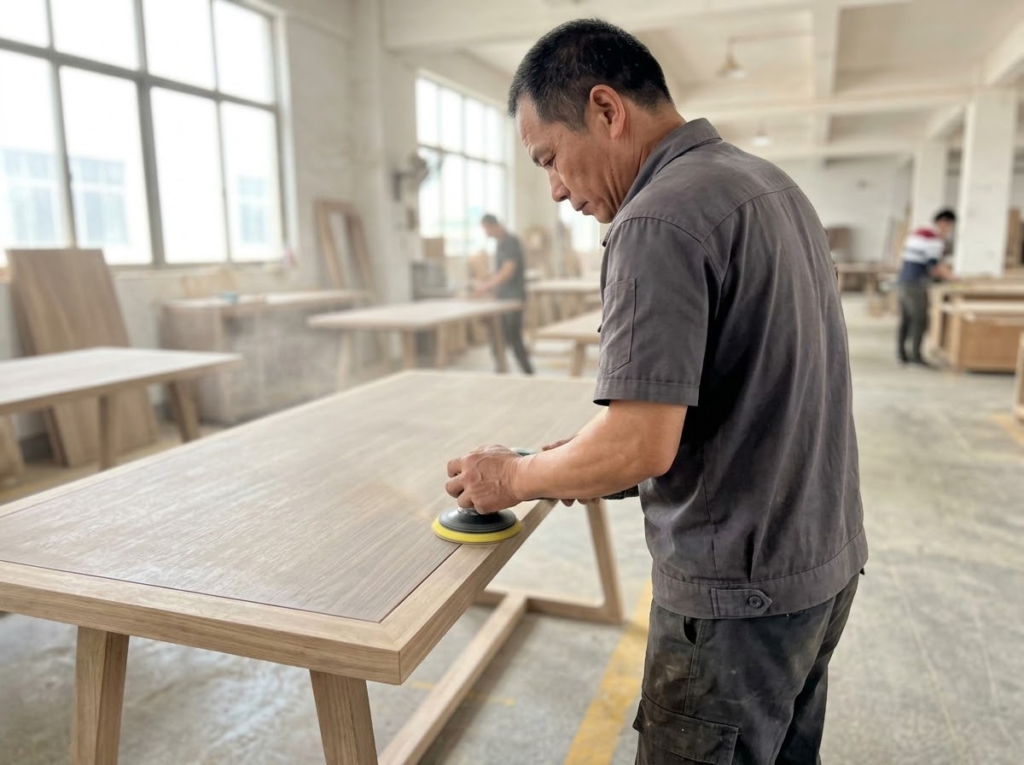
You hold the sample board under light. The grain flows like a river. Then you hold the first production panel. It looks like two rivers colliding. This isn’t a quality failure in the traditional sense. It’s a sourcing reality. The sample was pulled from the top 5% of the veneer flitch — the “golden boards” that every factory saves for exactly this moment. Production pulls from the rest of the pile.
Think of it like a chef using truffle oil in the tasting menu but cooking with standard olive oil for the 200-cover service. The recipe didn’t change. The ingredient tier did. And in furniture, there’s no menu disclaimer.
Variance: Moisture content variance across seasonal stock
I walked a Dongguan facility last November. The moisture meter on the kiln-dried oak read 10.2%. Acceptable. But the calibration sticker on the device? Expired in August. Three months of unlogged drift. By the time that wood hit the CNC router in January, internal stress had warped three percent of the panels. Just three percent. That’s all it takes for a hotel headboard to crack six months after installation in a climate-controlled Miami lobby.
Pattern: The “golden board” syndrome where the sample uses hand-picked material
Every factory has a sample room. Nobody talks about the room behind the sample room. That’s where they keep the perfect boards. The ones without mineral streaks. The foam blocks with uniform cell structure. The leather hides from the center of the hide, not the belly where stretch marks live. When we audit, we don’t just inspect the sample. We inspect the pile the sample came from. Most buyers never ask to see the pile.
Variable Audit: Process Handoff
Signal: Spray finish depth inconsistency between shifts
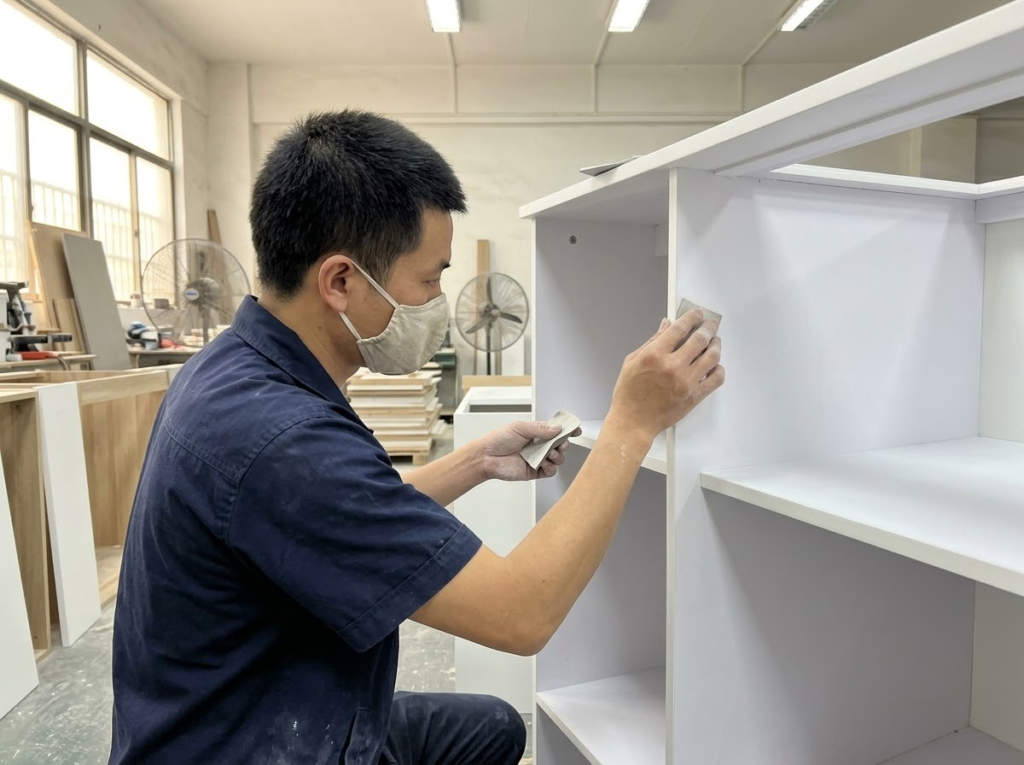
The sample had a satin sheen so even you could read a blueprint in the reflection. The production batch? Orange peel on the left arm. Gloss variance on the back panel. Here’s what the factory won’t tell you: the sample was sprayed by the day-shift foreman who’s been mixing lacquer for fourteen years. Your production unit was sprayed by the night crew using a catalyzed batch that sat in the pot for four hours. Temperature in the booth dropped four degrees between shifts. Viscosity changed. Nobody logged it.
It’s like recording a guitar track at noon and expecting the same tone at 2 AM with cold fingers. Same instrument. Different hands. Different air.
Variance: Temperature and viscosity drift in the catalyzed lacquer
In my experience, roughly sixty percent of finish complaints on custom hotel furniture trace back to uncontrolled spray booth conditions. Not the lacquer brand. Not the spray gun. The gap between what the technical data sheet says and what the wall thermometer actually reads at 1:30 AM.
Pattern: The night shift never replicates the day shift’s gloss reading
Eighteen minutes of silence. That’s the shift-change gap in the spray booth at one Longjiang factory I visit regularly. No logging. No handoff. The day crew leaves. The night crew arrives. The booth sits empty while the exhaust fans cycle down and the temperature climbs. Then someone starts spraying. Those eighteen minutes don’t exist on any report. But they exist in the finish.
Vendor Benchmarking
When we benchmark vendor performance across the same SKU, the data clusters reveal two distinct archetypes. Large-scale Foshan giants dominate volume, but their variance profile on custom specs is wide — they optimize for throughput, and every deviation from standard costs them margin. Mid-tier specialists show tighter control on non-standard workflows because their survival depends on it.
Among those mid-tier operators, Interi Furniture — which runs tighter custom workflows out of Guangdong — shows a different variance profile on lead-time and spec drift. They don’t have the buffer to absorb a failed batch, so their process controls tend to be more granular. Not better. Different. The mistake buyers make is assuming scale equals consistency. It doesn’t. Scale equals consistency at scale. Custom work is a different equation entirely.
| Vendor Archetype | Volume Strength | Custom Spec Variance | Typical MOQ | Sample-to-Production Drift Risk |
|---|---|---|---|---|
| Large Foshan Giants | High | Wider (optimized for throughput) | 40+ units | Moderate-High on non-standard SKUs |
| Mid-Tier Specialists (e.g., Interi Furniture) | Moderate | Tighter (workflow-dependent) | 10-20 units | Moderate, but different failure mode |
| Small Workshop Clusters | Low | Highly variable | 1-5 units | High — no process redundancy |
The factory that builds the best sample is rarely the factory that builds the most consistent batch.
Remediation Protocol
Immediate Containment
Stop the container. I don’t care if it ships in nine days. If the first article doesn’t match the approved sample within measurable tolerance, you do not load. Call the factory. Demand a side-by-side comparison photo with a ruler in frame. Not a studio photo — a floor photo, under fluorescent light, with the sample and the production unit in the same frame. If they refuse, you have your answer.
Re-measure the foam density with your own tool. Factory certificates are reference documents, not evidence. If the spec calls for 28 kg/m³ and the batch reads 32, that’s not “close enough.” That’s a different product.
Root Cause Correction
The systemic fix isn’t more inspections. It’s inspection relocation. Move your quality checkpoint upstream. Don’t inspect the finished sofa. Inspect the cut foam block before it’s upholstered. Inspect the veneer flitch before it’s laid up. Inspect the lacquer mix before it hits the gun. Every checkpoint you add at the end of the line is expensive theater. Every checkpoint you add at the start of the line is cheap insurance.
Plus, require the factory to photograph the actual production materials — not the sample room stock — and timestamp the images. Most will resist. The ones who comply are the ones worth keeping.
Prevention Lock
— The production team that built the sample must be documented by name; if they rotate off your SKU, you re-approve.
— The material lot number for the sample must be recorded; if that lot is exhausted, you re-sample before production begins.
— The environmental conditions during sample finishing must be logged; if production runs in a different season, you adjust the spec or you re-test.
— The first article must be built from the same material pile as production, not from the sample room reserve.
Counter-Indicator: Hiring a third-party inspector to check the container at the port. This feels safe. It’s actually risk amplification. By the time the container reaches the port, the factory has already been paid, the materials are committed, and your leverage is gone. The inspection becomes a damage report, not a quality gate. Inspect on the factory floor, or don’t bother.

Procurement FAQ
Q: I paid $2,800 for a *China furniture sample* set from a factory in Nankang. The sample was flawless. Does that money guarantee the production run will match?
No. The $2,800 bought you a proof of concept. It did not buy you process control. What you need to buy separately is a first-article inspection protocol that locks the production variables — material lot, foam density, finish batch, operator team — to the sample build. Without that lock, you’re comparing a prototype to a manufacturing output. They’re different categories.
Q: My supplier keeps sending me photos of the “same” workshop with the “same” team. Should I trust that the sample came from there?
Trust the photos as much as you’d trust a real estate listing. (And yes, this happens more than anyone admits.) What you want isn’t photos of the workshop. You want photos of the material pile with a dated newspaper in frame. You want a video of the CNC router cutting your specific pattern. You want the factory to show you the thing, not the place.
Q: How many first-article inspections are too many? I’ve already done two on this order and the factory is getting annoyed.
Two is never too many if the batch still fails. The real question is whether you’re inspecting the right variables. If you’re checking dimensions and color match but ignoring foam density and moisture content, you’re auditing cosmetics while the structure drifts. The factory isn’t annoyed at the quantity of inspections. They’re annoyed that you’re catching things. Keep catching things.
Q: Is a perfect sample from *Chinese suppliers* actually a red flag?
It depends on whether the perfection is explainable. If the sample is perfect because the factory threw their best people, best materials, and unlimited time at it — and they can show you exactly how they’ll replicate that under production constraints — then it’s a green light. If the sample is perfect and they can’t explain the production path to get there, it’s a red flag wrapped in walnut veneer. At the end of the day, a perfect sample proves what a factory can build. It does not prove what they will build.
The Unresolved Variable
I’ve seen factories install humidity controls, digital moisture tracking, and barcode material lot systems. I’ve seen buyers write specs so tight they read like engineering drawings for aircraft parts. And still, the variance persists. Not always. Not predictably. But enough that no model I’ve built — and I’ve built plenty — can account for it with reliable confidence.
The general pattern suggests that when you remove every measurable variable, something human remains. The foreman had an argument with his supervisor that morning. The subcontractor who wasn’t on the approved list handled the rush order because the primary vendor was backlogged. The humidity on a given Tuesday in July spiked because the exhaust fan belt snapped and nobody logged it until the shift ended. These aren’t process failures. They’re entropy. You can reduce them. You can’t eliminate them.
The variable I have tracked for fifteen years and still cannot model is the gap between a controlled process and a lived one. Next time you run the numbers on Longjiang, test for the thing that doesn’t appear on any checklist. Because that’s where your $47,000 lives. In the space between what was documented and what was done.