

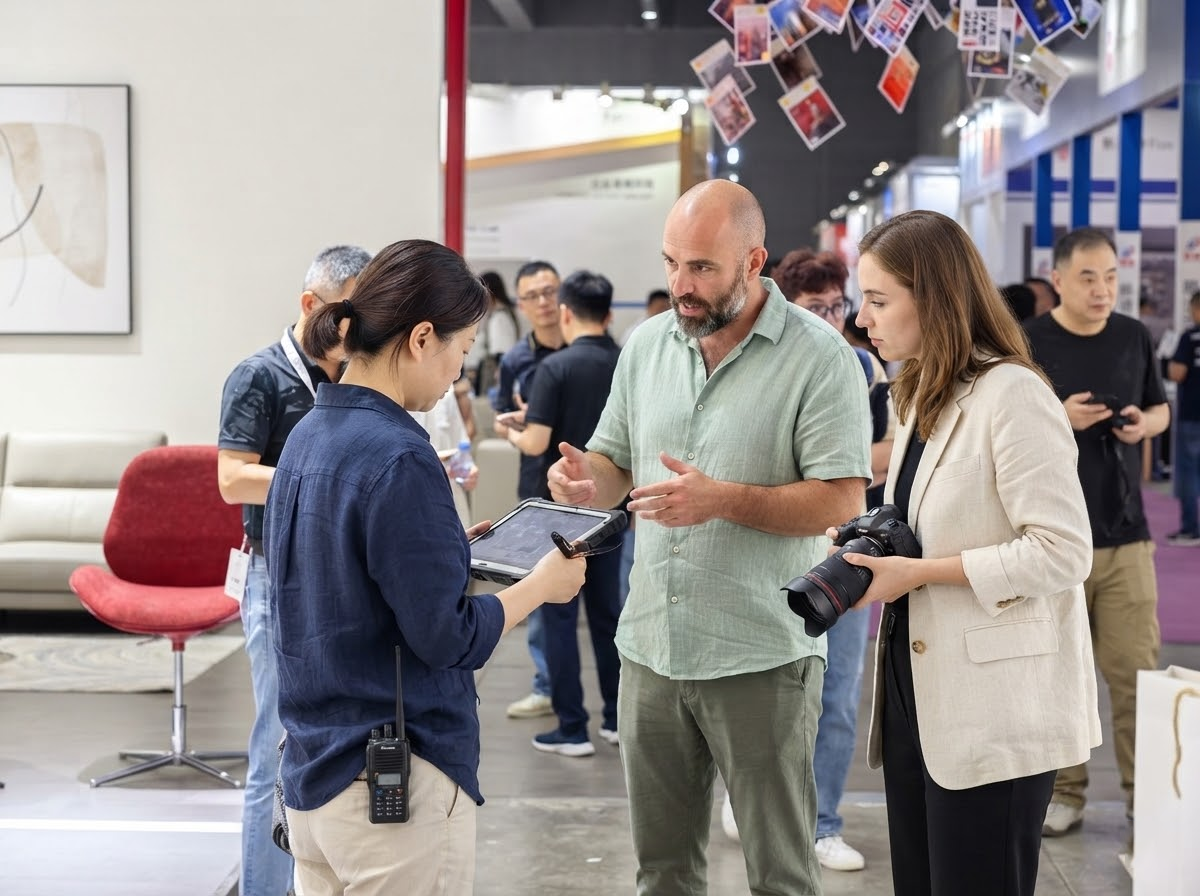
It was the third day of the March session, and my feet hurt. I’d already walked maybe six miles through the Guangzhou Pazhou Complex, past the usual suspects — the marble-clad “Italian design” booths, the LED-lit monstrosities with hostesses in qipaos, the guys handing out USB drives like they were candy. Then I spotted it. A 400-square-meter booth near Hall 17.2, all warm lighting and walnut veneer, showcasing what the banner called “2024 Exclusive Hotel Collection.” The sales girl, maybe twenty-four, handed me a catalog thick enough to stop a door. I flipped to page seven. There it was. The exact same wingback chair I’d seen in a Dongguan factory back in 2019. Same stitching pattern. Same awkwardly cropped product photo. Same spec sheet font. Only the price had gone up 40%. She smiled and said, “This is our newest project line. Very popular with Middle East buyers.” I smiled back. I’d just met the ghost again. (And yes, this happens more than anyone admits.)
The Brutal Truth
Here’s what nobody at the welcome desk tells you about the CIFF exhibitor scam. That glossy “new project” catalog? It’s often a Frankenstein job. Three-year-old frames. Five-year-old upholstery techniques. Photos shot in 2021 and relabeled with a 2024 date. The factory isn’t necessarily lying. They’re just playing a language game where “new” means “newly printed.”
The general pattern suggests that maybe 60% of project catalogs at any given CIFF session contain pieces the factory hasn’t produced in quantity for at least eighteen months. Some haven’t tooled up for them in three years. But the booth looks fresh. The lighting is new. The sales team has new name tags. So your brain connects the dots wrong.
Rule of thumb: If you can’t find sawdust under the catalog, you’re looking at a brochure, not a business.
Key Takeaway
- China furniture sourcing is the process of evaluating manufacturing capability through physical evidence, not printed promises — especially at trade shows where the visual layer is engineered to sell an illusion.
- An outdated portfolio doesn’t always mean a scam, but a “new project” label on old products is a deliberate opacity tactic that shifts risk entirely onto the buyer.
- The most dangerous booths aren’t the obviously cheap ones; they’re the polished operations that know exactly how close to the line they can dance without technically crossing it.
- Your job at CIFF isn’t to fall in love with a product. It’s to find the gap between what you’re shown and what actually gets built.

Why Do Factories Keep Three-Year-Old Samples on Display?
The Catalog Is a Costume, Not a Wardrobe
Think of it like a Hollywood backlot. From the front, you’ve got a bustling street — cafés, shops, pedestrians. Walk around the back, and it’s plywood held up with two-by-fours. That’s your average “new project” booth at CIFF. The factory isn’t trying to fool you because they’re evil. They’re trying to fool you because it works. Most buyers spend eleven seconds looking at a chair before they ask the price.
Eleven seconds. You can’t inspect a joint in eleven seconds. You can’t tell if the foam density matches the spec sheet. You can only tell if it photographs well.
And here’s the thing. The factory with the outdated portfolio isn’t always a bad factory. Sometimes they’re a solid manufacturer who got stuck with 200 units of a hotel line that got canceled in 2022. The samples still look good. The tooling still exists, technically. So they wheel it out, print a new catalog, and hope nobody asks too many questions about the production date. Worse still, some of them don’t even have the original tooling anymore. They outsourced that wingback to a subcontractor in Nankang who closed shop last year. But the sample remains, gleaming under LED spots, waiting for a buyer who trusts their eyes more than their due diligence.
The real kicker? The sales team believes it. They weren’t around in 2019. They genuinely think this is the new collection.
Who Actually Made That Sofa?
Walk into any mid-sized booth in Foshan and ask who designed a particular piece in their Chinese factory portfolio. Watch the hesitation. “Our R&D team,” they’ll say. Or “Italian designer cooperation.” What tends to happen is something messier. The factory bought a catalog from a defunct trading company. Or they reverse-engineered a piece they saw at Salone del Mobile in 2018 and have been tweaking the legs ever since. The “new project” label gets slapped on because, to this specific sales channel, it is new — they just started showing it to hotel buyers last quarter.
Actually, that’s not quite right — what most buyers miss is that the problem isn’t the origin story. It’s the capability gap. A factory showing you a sofa they haven’t built since the pandemic might still be able to build it. But the leather supplier they used is gone. The master upholsterer retired. The fire-retardant foam they quoted was a special run that’s now three times the price. So the quote you get on the show floor is built on quicksand.
The catalog photo is a promise. The factory floor is the only contract that matters.
When “New” Means “New to You”
The Translation Trap
This part cuts both ways. These China trade show tricks aren’t even hidden — they’re baked into the language. In Chinese trade show parlance, “new project” (新项目) doesn’t necessarily mean “newly developed.” It often means “newly assigned to this sales team” or “newly targeted at your market segment.” A collection that’s been sitting in a Longjiang warehouse since 2020 becomes a “2024 New Project” when the factory finally decides to push it to North American boutique hotel buyers instead of Middle East contractors. The product hasn’t changed. The label has.
The product hasn’t changed. The label has.
It’s like going to a concert and discovering your favorite band is actually a cover group. The songs sound right. The lights look right. But the bassist is learning the chords as he goes. Some buyers don’t care. They just want the hit single at a reasonable price. Others get burned when the “original design” they thought they were sourcing turns out to be a widely available catalog piece that three other factories in Dongguan are also pitching as “exclusive.”
And the factory isn’t even hiding it, not really. If you ask to see the design patent certificate, the conversation shifts fast. “Oh, this is open design.” Or “The client changed some details, so patent is not necessary.” Smoke and mirrors. But convincing smoke and mirrors.
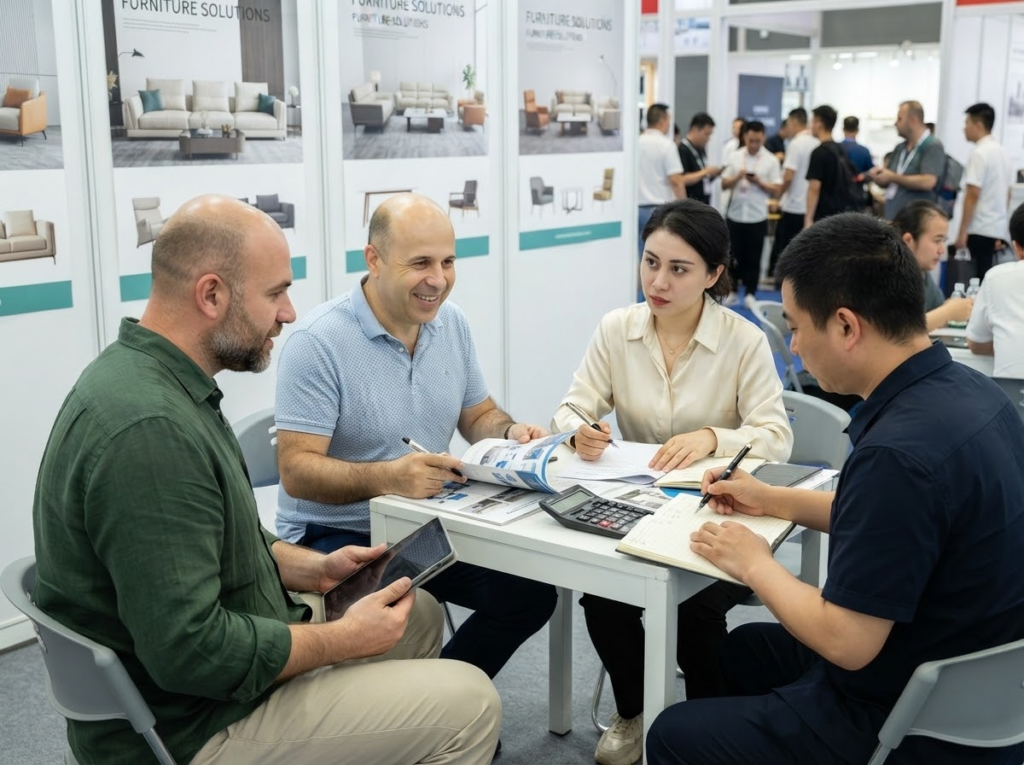
The Ecosystem: Who’s Real and Who’s Renting a Reputation
Let’s talk about booth economics. A 200-square-meter CIFF booth in a prime hall runs about what a small apartment in Shenzhen costs per year. Not every factory can swing that. So what do they do? They partner. They share. They rent space under a bigger name. You think you’re talking to the manufacturer, but you’re talking to a trading company that has a loose arrangement with three workshops. One of those workshops might be solid. The other two might be disasters. You won’t know which one gets your PO.
While some buyers gravitate toward large-scale manufacturers in Foshan, others find that mid-sized specialists — operations like Interi Furniture, which focuses on custom hospitality and project-based upholstery — offer a different risk-reward equation. You don’t get the dizzying scale of a 500,000-square-meter plant, but you might get a sales director who actually visited your hotel site and remembers your room count. That’s not an endorsement. It’s a category distinction. The furniture landscape in China isn’t binary between “giant factory” and “back-alley scam.” There’s a vast middle where competence and opacity overlap, and that’s where most buyers actually live.
The most honest factory in China might have the most boring booth. That’s not a bug. It’s a feature they haven’t learned to market.
Your CIFF Survival Checklist
Don’t treat this like a treasure hunt. Treat it like a background check with furniture in it.
- Step one: Flip the catalog over. Look at the photo metadata if they’ll let you see the digital files. (They won’t. So ask for a process video instead.) A factory actively producing a “new” line should have thirty seconds of phone footage from last week. Not 2019.
- Step two: Ask for the production log. Not the sales sheet. The log. What shipped last month? To whom? Even a redacted client list tells you more than a render ever will. If they hesitate, that’s your answer.
- Step three: Check the sample weight. Old foam gets lighter. Leather samples left in a showroom for two years develop a specific patina — not the good kind. Pick up the chair. Does it feel like it’s been fondled by ten thousand hands? It probably has.
- Step four: Request a factory visit — but not to the main plant. Ask to see the specific workshop where your “new project” gets built. If they redirect you to the glossy headquarters tour, you’re being managed. The real work happens three buildings over, where the paint isn’t fresh.
- Step five: Cross-reference the city. A factory claiming project expertise but based in a district known only for raw timber? Possible, but unlikely. Geographic specialization in China is real. Upholstery clusters in Longjiang. Solid wood in Dongguan. Metal framing in Anji. If the product and the postcode don’t match, dig deeper.
- Step six: The “ghost shift” test. Ask if you can visit during production hours, unannounced. Not the scheduled tour. The real shift. Most will say no. The ones who say yes with conditions are worth remembering. The ones who say yes immediately might be too desperate. The ones who get offended were never going to be honest anyway.
- Step seven: Trust the red flag that sounds wrong. Here’s the one that contradicts conventional wisdom. If a booth is too organized, too consistent, too perfectly on-trend — be suspicious. Real factories are slightly messy. Their samples have minor variations. Their salespeople disagree with each other. A booth that feels like a museum is often a museum. You’re looking at history, not capability.
| What You’re Told | What to Verify | The Real Question |
|---|---|---|
| “This is our 2024 new project line” | Request shipping docs from Q1 2024 | Has this actually been produced at scale recently? |
| “We designed this in-house” | Ask for the original design file dates | Do they own the capability, or just the sample? |
| “Exclusive to your market” | Image-search the product on 1688.com | Is this a catalog piece dressed up as custom? |
| “Our factory is 50,000 sqm” | Check the address against satellite imagery | Are they showing you the real facility or a rented showroom? |
| “We supply five-star hotels globally” | Ask for a single verifiable reference | Can anyone confirm this claim without going through the factory? |

FAQ: The Questions Buyers Actually Ask
Q: I saw a chair at CIFF that looked exactly like a Minotti design. The factory said it was their “original new project.” Is that normal?
A: It’s normal. It’s also a liability. What you’re seeing is either a licensed reproduction (rare at this price point) or a reverse-engineered piece with enough details changed to avoid immediate legal trouble. The problem isn’t the look. The problem is that the factory showing it as “new” probably doesn’t have the engineering depth to replicate the comfort and durability of the original. You’ll get the silhouette. You won’t get the sit. And if you’re sourcing for a commercial project, that distinction matters more than the styling.
Q: The sales director told me they made the furniture for a luxury hotel in Dubai. How do I check if that’s true?
A: You probably can’t, not directly. Hotel FF&E supply chains are layered with NDAs, general contractors, and procurement agents. But you can ask for photos of the factory floor during production — dated, with the specific pieces visible. If they supplied a 200-room hotel, there should be hundreds of units in process at some point. No photos? No proof. Also, check LinkedIn. Real project managers at Chinese factories usually post shipment photos. It’s not forensic science, but it’s better than a verbal claim.
Q: Their catalog says “new collection 2025” but I swear I’ve seen these photos on Alibaba from 2021. Am I losing my mind?
A: No. You’re seeing the recycle. Factories frequently purchase stock photography from shared pools, reuse old shoots with new graphic design, or simply relabel existing products. The 2025 date refers to the catalog print run, not the design vintage. Your eyes are fine. Your instinct is better. Trust the déjà vu.
Q: Should I avoid the big flashy booths entirely? Are smaller ones safer?
A: It depends on what you’re buying. Large booths often belong to established groups with real capacity but bureaucratic sales layers. Small booths can be nimble specialists or trading companies one bad month from closing. The scam risk isn’t about size. It’s about information asymmetry. A small booth that answers your technical questions directly is safer than a cathedral booth that only wants your deposit.
Q: If I get burned by an outdated portfolio — say, the samples don’t match production — is there any recourse?
A: Legally, yes, if your contract specifies materials and dimensions precisely. Practically? Good luck. Cross-border enforcement against a Chinese factory is slow, expensive, and often futile unless your PO is large enough to justify legal fees. The better move is prevention. Get a third-party QC inspection at production start, not just before shipment. And never, ever pay 100% upfront for a “new project” line you’ve never seen in production. The deposit is your only leverage. Once it’s gone, so is your bargaining power.
Closing
So here’s the lesson, earned over fifteen years of factory floors and too many cups of instant coffee in Guangdong. The catalog isn’t the product. The booth isn’t the factory. The smile isn’t the relationship. You’re not at CIFF to be impressed. You’re there to find the one manufacturer out of a hundred who doesn’t need to impress you because their Tuesday production schedule is already full.
At the end of the day, the only “new project” that matters is the one they’ll actually build for you. Everything else is just expensive wallpaper.
What’s the oldest “new” sample you’ve ever been shown?