


Late January. Freezing rain pounding against the corrugated tin roof. I’m standing next to a massive German Homag edge-banding machine in Longjiang, watching a British procurement director undergo a full-blown existential crisis.
His name was Martin, and he had just realized his 1,200 beds for a Manchester student housing block weren’t being “crafted.” They were being spat out by a machine that didn’t care about his mood board.
We’re upstairs in the factory boss’s glass-walled office. The air smells like cheap Chungwa cigarettes, muddy Tieguanyin tea, and the sharp tang of industrial solvent. Down on the floor below? They’ve already punched, banded, and flat-packed enough faux-oak melamine board to outfit a medium-sized college campus. The Brit honestly thought his 14-day lead time meant he had secured VIP status. He pictured master carpenters wearing aprons, working overtime just for his specific project.
Nonsense. What most buyers completely miss is this: to a Guangdong mega-plant, a two-week dormitory blitz isn’t a scramble. It’s a regular Tuesday afternoon.
You aren’t buying speed. You are leasing a time slot on a very ruthless, highly optimized conveyor belt. Don’t understand how that ecosystem actually breathes? It will chew up your margins, ignore your emails, and spit out a 40HQ container full of peeling nightstands.
The Brutal Truth About “Fast” Furniture
Western buyers show up at Guangzhou Baiyun Airport clutching CAD files and a ton of romantic illusions. They think a dedicated engineering team is going to agonize over their joint details and veneer matches.
Reality check. Tapping the China supply chain for bulk contract furniture is a hardcore logistics play. It’s not woodworking.
If the contract says two weeks, that factory is touching your wood panels for exactly 48 hours. The other twelve days? They are waiting for a guy on a battered electric trike to deliver hardware from a wholesale market three streets away. Or they are arguing with a sub-vendor about a two-cent increase in laminate pricing. Or they are letting the glue dry because it’s raining and the humidity is messing with the curing time.
Here is my golden rule. If the factory boss can’t quote your standard panel gig within a 3% margin of error on a scrap of paper during a hotpot dinner, they aren’t the guys actually cutting the wood. Simple as that.
The guys who actually run the lines know the cost of a square meter of E1 MDF down to the decimal point on any given morning. If they have to “get back to you next week with a detailed breakdown,” they are just brokers. You’re talking to a middleman who is currently desperately calling around trying to find a real factory to take your order.
THE SURVIVAL SHEET: SECURING YOUR MARGINS
- Speed equals standard: A 14-day turnaround means purely off-the-shelf components. You want custom metal tooling? Add three months and a migraine.
- Cultural Contracts: A Chinese wholesale contract is a polite starting point for a conversation. It’s rarely a locked-in legal mandate.
- The Sub-Contracting Trap: If you push a factory too hard on price and speed simultaneously, they won’t say no. They will just secretly outsource your order to a literal sweatshop down the road.
- The Mid-Market Save: Giant plants ignore you. Boutiques can’t handle the volume. Mid-sized specialists usually hit the sweet spot for commercial bids.
- QC is your problem: If you refuse to pay a third-party inspector to watch them load the truck, you deserve whatever garbage shows up at your port.
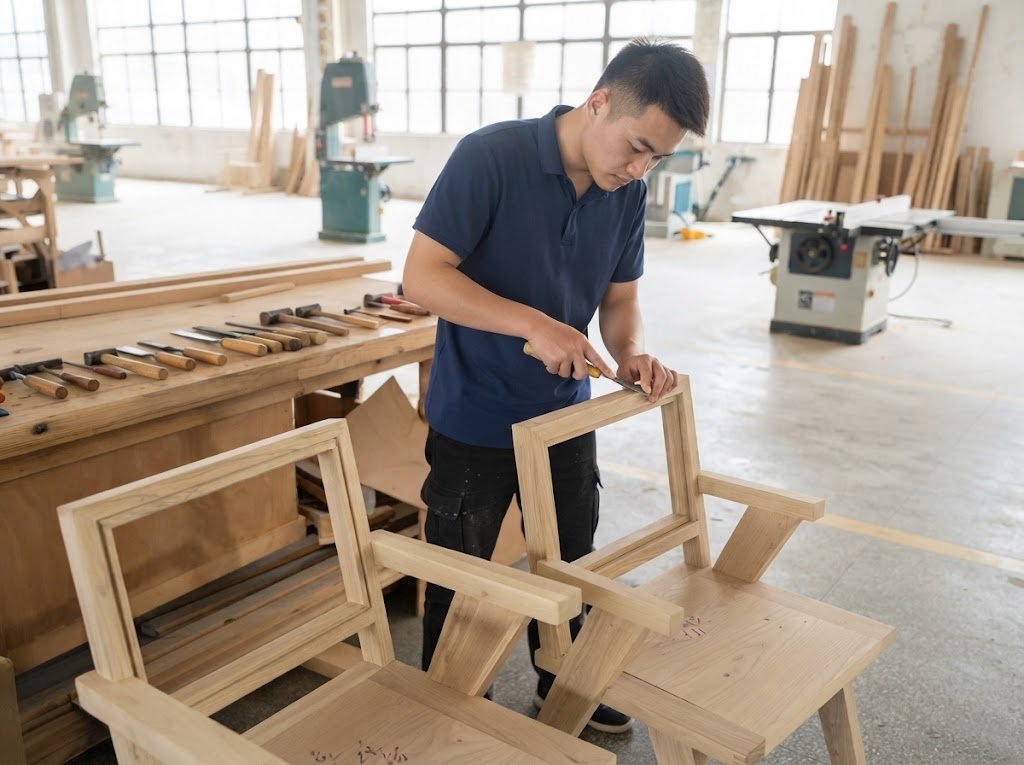
Anatomy of a 14-Day Miracle
Volume furniture sourcing here is about herding cats. You are dealing with hyper-local networks of raw material vendors slapping things together at terrifying speed.
Think of it like a Friday dinner rush in a massive commercial kitchen. You don’t walk in and ask the line cook to bake a bespoke artisanal potato. You order the steak frites. Why? The fryer is already hot, the meat is pre-portioned, and the kitchen is designed to move that exact plate to the window.
Walk a Dongguan panel floor in mid-July. It’s 100 degrees inside. MDF dust coats your teeth instantly. The chemical punch of curing contact adhesive literally makes your eyes water. Guys are driving forklifts like it’s Mario Kart, dodging twenty-foot towers of E1-grade board. To an outsider, it looks completely unhinged.
It isn’t. It’s highly orchestrated chaos. And every second is billed.
Where the clock actually bleeds
Procurement rookies obsess over the CNC routers. The cutting phase. But the saws are just the finish line. Total project timelines live and die by the weakest vendor in the chain. Usually? That’s the hardware.
Write down a standard, locally sourced DTC hinge in your spec sheet, and your desks finish on schedule. Demand a specific, out-of-stock German Blum soft-close hinge? Watch your 14-day window vaporize into thin air.
Will the factory boss warn you that the Blum hinges are delayed by a month? Of course not. They’ll just silently swap in a generic local hinge that looks identical to hit your deadline, crossing their fingers you won’t catch it on the final hotel install. (And yeah, this happens daily. I’ve literally caught workers scraping fake logos onto cheap drawer runners).
The phantom night shift
Here’s an insider reality you won’t read in a standard supply chain textbook. Let’s say you drop a massive order on a factory, but they are already at 90% capacity. They won’t reject your money.
Instead, at 11:00 PM, a fleet of unmarked trucks pulls up to the back dock. Your raw materials are loaded up, driven three villages over, and dumped at a “ghost factory”—a completely unregulated, un-audited facility operating out of a literal tin shed. They cut your boards, slap on the edge banding, and truck the parts back to the main factory by 6:00 AM for packaging.
You think you bought from an ISO-certified mega-facility. Actually, your nightstands were glued together by guys smoking cigarettes over an open bucket of adhesive. The only way to stop this is physical, unannounced night audits.
Paper Shields and Legal Fictions
Let’s talk about the paperwork delusion. Western directors love clutching a Chinese wholesale contract like it’s a Kevlar vest.
They fly in with their corporate lawyers. They draft fifty pages of indemnity clauses, non-competes, and strict liability delay penalties. The factory owner nods, smiles, tops off your tea, and hits the last page with the red company chop. He didn’t read past page two. And honestly, he didn’t need to.
Who holds the molds?
They sign because they understand the game better than you do. A piece of paper doesn’t enforce behavior here. The ongoing relationship enforces the contract. The promise of the next order is what keeps them honest on the current order.
If things blow up over a delayed container, your iron-clad contract is basically expensive origami. Go ahead, try suing a mid-tier Foshan plant in a local Guangdong court for a $50k delay penalty. Let me know how that works out for you. Best case scenario? You spend $30,000 in legal fees to win a judgment that the local police refuse to enforce.
They know damn well that if you walk away, those custom injection molds you paid $15,000 for are getting repurposed for a domestic client by next week. I once watched an American buyer try to demand his chair molds back after a dispute. The factory boss smiled, pointed to a mountain of rusting metal out back, and said, “Sure. Go find them.”
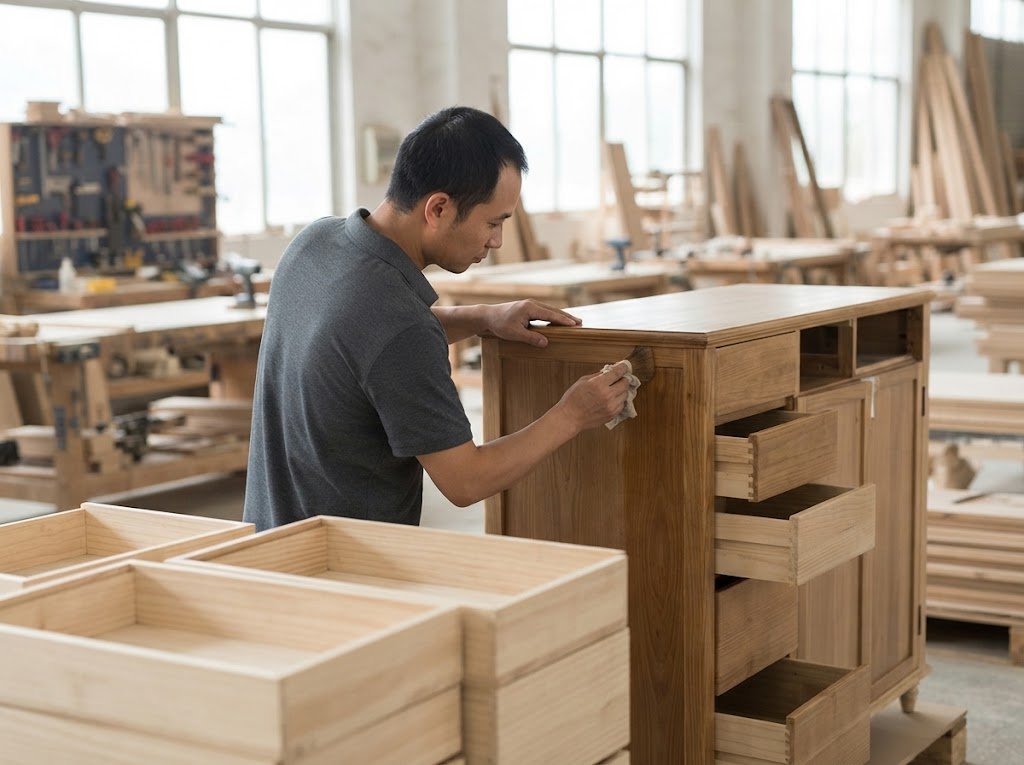
Finding the Middle Market Sweet Spot
When a buyer gets a massive dorm or hotel bid, the instinct is to run straight to the monoliths in Shunde or Nankang. The places pumping out 5,000 units before lunch. Facilities so big the workers ride bicycles from the cafeteria to the assembly line.
But to those giants, your $150,000 purchase order is a rounding error. A fly buzzing in the manager’s ear.
The problem isn’t the mega-factory. It’s your expectation of red-carpet treatment from a facility engineered to feed massive global retail chains. Plenty of buyers fight that battle, scream at their reps, and lose.
The smarter money usually shifts to mid-sized specialists. Operations like Interi Furniture, who actually dial in on tailored project solutions without the suffocating corporate overhead. They pack enough heavy machinery to nail a brutal timeline and hit the volume demands, sure. But more importantly? They possess enough operational flexibility that a real human being will actually reply to your WeChat at 11 PM when the architect suddenly decides to change the laminate spec from ‘Walnut’ to ‘Ash’.
You don’t need the biggest factory in the province. You need the factory whose scale matches your exact risk tolerance. Be a tiny fish in a massive pond, and your run gets bumped the second a multi-million-dollar regular needs the line capacity for Black Friday inventory.
The Site Manager’s Survival Guide
How do you get this done without getting fired? Stop acting like a desk-jockey buyer sitting in London or New York. Start operating like a paranoid site manager.
When a client drops 800 rooms on my desk with a ridiculous, impossible deadline, this is the exact playbook I use to keep things from detonating:
- Buy your own eyes: Factory photos are a complete joke. They take the one flawless “golden sample,” wipe the dust off, and shoot it in perfect lighting from twelve angles. Meanwhile, the other 799 units look like they were assembled in the dark. Hire an independent bulldog QC inspector to stand physically on the line during production. Pay them well. Make sure they know they work for you, not the factory.
- Spec the cardboard, not just the wood: I once watched $200,000 in gorgeous veneer work get trashed in transit. Why? The boss saved exactly three cents a carton by using single-wall boxes instead of double-wall. The moisture at sea turned the boxes to mush. Force them to use ISTA drop-test rated packaging and explicitly put the exact cardboard thickness specs in your purchase order.
- RED FLAG: A quiet floor. Buyers love touring a pristine, silent factory. Idiots. A spotless floor on a Wednesday afternoon means they are starving for orders. The highly skilled guys already bounced to a busier shop. They are absolutely going to use your 30% upfront deposit to pay off their angry material suppliers from a previous job. You want a facility that smells like sweat, sounds deafening, and looks a little chaotic. That means cash is flowing.
- The Tolerance Trap: Never write “acceptable tolerance” on a spec sheet. Specify exactly what that means. If you are ordering 500 headboards that need to fit between two existing electrical outlets in a hotel room, a “+/- 2cm tolerance” means your headboard is going to cover the light switches. Dictate the millimeter.
- Choke the cash: Control the wire transfers ruthlessly. Do not release the 70% balance until the goods are verified by your guy, packed securely, and locked inside the shipping container with the seal on. Once your USD crosses the ocean and hits their bank account, your leverage goes to absolute zero.

Uncomfortable Questions (Answered)
Q: “What happens if they swap my high-density foam for trash right before they load it?”
A: Classic move. The locals literally call it “fade before shipment.” The counter-move? Have your QC guy literally slash open a random seat cushion on the line ten minutes before they seal the container doors. Yes, you ruin one chair. But if you catch them doing it once, they will never try it on you again. It establishes dominance.
Q: “Do I actually need to sit on a plane to China for standard panel goods?”
A: For the first massive run with a brand-new supplier? 100%. A slick Zoom walkthrough of a nicely lit showroom tells you absolutely nothing about the actual production capacity out back. I’ve seen “factories” on Alibaba that were literally just a guy in an apartment with a really nice digital camera and a cousin who owned a van. Once you establish dominance in person, then you can rely on local agents.
Q: “Can my Western NDA protect my proprietary designs?”
A: It’s just theater, man. If your design is genuinely brilliant and easy to mass-produce, assume it’s getting knocked off the minute the CAD file hits their inbox. IP defense in this game isn’t a legal strategy. It’s speed to market. You beat the knock-offs by being on the retail shelf before they finish cutting the molds.
Q: “How do I know if the factory is actually producing my goods, or just farming them out?”
A: Look at the environmental compliance stickers on the machinery. If a factory claims they can produce 5,000 lacquered nightstands in ten days, but their paint-spraying booth is only rated (and legally permitted) to run 8 hours a day, the math doesn’t work. They are farming your order out to an unregulated shop.
Q: “What’s the real deal with payment terms? Everyone wants 30/70.”
A: 30% deposit upon order, 70% before shipment is the industry standard. Do not try to force Net-30 or Net-60 terms on a new Chinese factory. They will assume you are trying to scam them, or they will simply bake the risk into the unit price, essentially charging you 15% interest for the privilege. Stick to 30/70, but control the release of the 70.
Q: “Is delivering a 1,000-room blitz in two weeks actually possible?”
A: Sure. Provided you stick strictly to standard molds, off-the-shelf boards, and hardware that is currently sitting in a warehouse five minutes away. If you start asking for bespoke curved plywood, custom metal extrusions, or a highly specific fabric dye lot, your two-week deadline is a total hallucination.
The Bottom Line
Sourcing bulk furniture out of China isn’t a fairy tale about finding a magical, flawless partner who anticipates your every need. It’s about finding a highly competent machine and managing it with deep, unrelenting paranoia.
Fast, cheap, and good. You can almost never get all three at the exact same time—unless you are physically standing there, inhaling the MDF dust, drinking the terrible tea, and watching the edge-bander yourself.
Will this whole circus ever become the frictionless, automated SaaS utopia that tech bros keep pitching at supply chain conferences?
Maybe. Someday. But until that day actually arrives, you’d better figure out what a Chinese wholesale contract actually means on the ground in Guangdong.
And always, always check the damn hinges yourself.