


Hall 9.1 at Canton Fair Pazhou is a sensory nightmare. Blinding lights. Screaming crowds. And right now, it’s playing tricks on your wallet.
You are staring at a velvet lounge chair. The backrest pitch is flawless. Dead ringer for a $4,200 Italian spec your lead designer signed off on Tuesday. The rep hands you a lukewarm Evian. Smiles. Quotes $185 FOB Shenzhen.
You think you won. You didn’t.
My gut still twists remembering a Miami buyer who chased that exact same “bargain.” Two years ago, he unsealed a 40-foot container full of water-logged MDF carcasses. The second that cheap board hit Florida humidity, the veneer peeled back. Looked like a bad sunburn. That little trade-show victory cost his hospitality group $45,000 in liquidated damages. They missed a boutique hotel soft opening because of it.
So yeah, you’re sweating. You listen to this rep swear on a 25-day lead time. Meanwhile, you notice the piping on their prized floor sample fraying at the corners. The factory printing those glossy handouts isn’t the one firing the nail guns. You have eight hours before they kill the lights to separate the guys who own the machines from the guys who just own a really good printer.
The Floor Reality vs. The Export Illusion
Key Takeaways: Sweeping Pazhou’s Mega-Factories
- The 80/20 Rule: Roughly 80% of those massive, beautifully styled booths in the main aisles? Pure trading companies. Not direct factories.
- The Geographic Tell: Genuine mega-factories are physically bolted to dirt in specific industrial clusters like Shunde or Nankang. They don’t just exist as a brand name in a convention center.
- The One-Day Sweep: You don’t win by walking every aisle. You win by extracting 3-4 viable targets for immediate physical factory audits the next morning.
- The Pricing Trap: The cheapest FOB quote almost always guarantees brutal material substitutions the minute your deposit clears.
Here is the part most sourcing agents actively hide. China factory sourcing isn’t about locating one magical building where logs go in and sofas come out. That doesn’t exist anymore. It is about navigating a highly fragmented, chaotic web of hyper-specialized subcontractors.
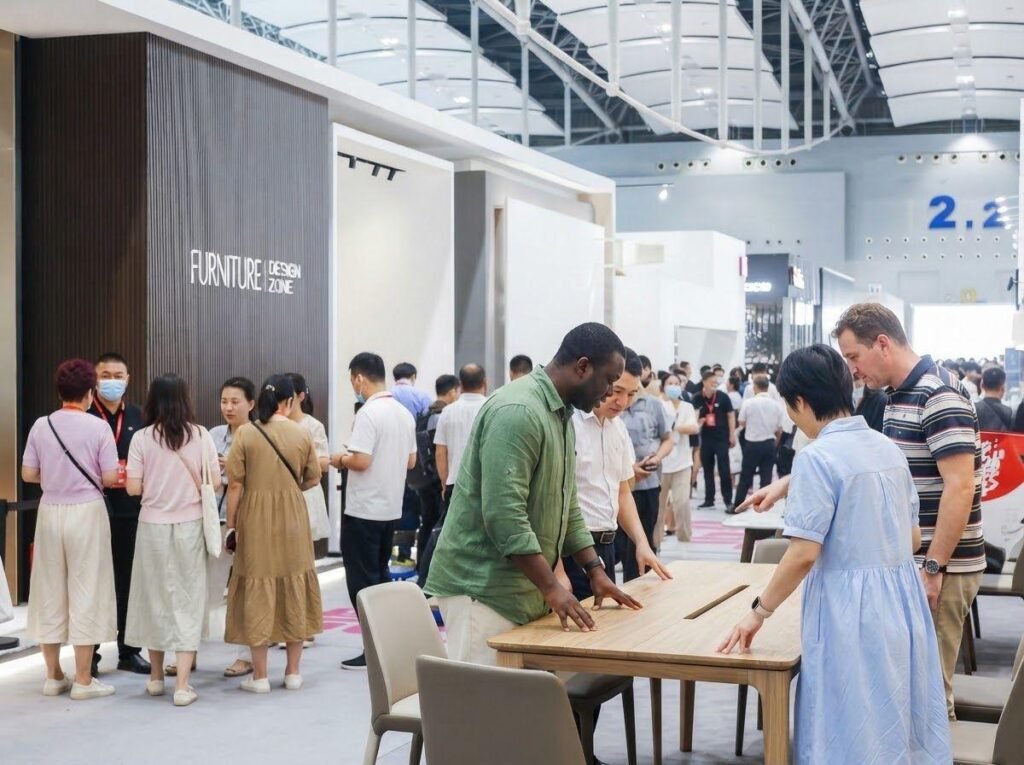
Step onto the floor at Pazhou, and you’re walking onto a soundstage. Pure theater.
Those vendors commanding massive square footage with slick Western branding? Mostly aggregators. They take your heavy-volume order, chop it into pieces, and farm it out to five different poorly lit workshops tucked away in the backstreets of Longjiang. Then they slap a 30% margin on your invoice.
Real factory bosses rarely care about wooing you with a barista in their booth. Their welding lines do the talking.
My rule of thumb for the floor is brutal but effective. If the guy writing up your quote can’t flip over a catalog and sketch the internal joinery of the chair frame, you are talking to a middleman. Buyers fly 7,000 miles to cut out the middleman, only to sign a contract with a better-dressed one.
The Operational Dissection
To sweep this fair efficiently, stop looking at the furniture. I mean it. Look at the supply chain. Because the problem isn’t usually the factory itself. It’s your broken expectation of how Chinese manufacturing actually operates.
Mechanism: The Sub-Assembly Hustle
Think of the Foshan furniture belt like a commercial kitchen operating during a permanent dinner rush. The executive chef isn’t chopping garlic. He is assembling plates using prep work delivered from a dozen specialized stations.
Down in the Shunde cluster, nobody makes everything. The raw wood frames get cut and routed in one alley. The high-resilience foam gets poured at a chemical facility an hour away. The brass foot-caps? Trucked in overnight from a metalworks up in Wenzhou.
Auditing a factory means interrogating their grip on those component suppliers. Not just staring at their final packing line.
I dragged a client through a mid-sized OEM in Longjiang last November. Walked past their sewing line and noticed a thick layer of fine sawdust on the needle plates. Dead giveaway. They were outsourcing the actual upholstery to a shadow workshop down the road just to hit their export quota. They entirely bypassed the QC protocols we had just spent three days negotiating.
Benchmark: Spotting the Genuine Mega-Factory
How do you weed out the traders on the floor? Start asking incredibly boring, highly technical questions.
| Indicator | Trading Company Booth | Genuine Mega-Factory Booth |
|---|---|---|
| Product Range | Sells everything. Rattan loungers next to tufted velvet beds. | Stubbornly narrow. (e.g., Only metal-framed banquet seating). |
| Technical Specs | Deflects constantly. “I will ask our chief engineer tonight.” | Can instantly quote the seat sponge density (e.g., 45kg/m³). |
| Custom Prototypes | “Yes my friend, any design you want!” | “That requires a $1,500 mold fee. Takes 15 days minimum.” |
| Factory Location | Evasive. “We are based in Guangdong province.” | Hyper-specific. “Jiujiang Town, Foshan.” |
Look at a setup like Interi Furniture as a baseline. When you analyze their footprint out of the Guangdong hub, they aren’t pretending they can manufacture cheap plastic patio chairs on the side. They have a strictly defined material competency geared toward high-volume project and residential work, backed by a verifiable production floor. That is the exact discipline you need in your head when scanning a vendor’s credentials. If a booth lacks that focus, walk.
Variable: The Material Shell Game
This is where your budget bleeds out. That gorgeous dining table you are staring at under the stadium lights? That is a “golden sample.” Hand-crafted over three weeks by their top engineers specifically to separate you from your deposit.
Case Study: The Dongguan Discrepancy
Back in 2022, a procurement director for a boutique hotel chain ordered 300 solid ash dining chairs from a beautifully styled booth in Hall 11.2. The floor sample was structural perfection. The quoted price was a steal at $110 per chair. Total order value: $33,000. When that container cracked open in Los Angeles, the “solid ash” had miraculously transformed into cheap ash veneer glued over rubberwood. Worse? The joints were just glued and screwed. No dowels. The buyer burned $12,000 retrofitting wobbly frames just to pass a local safety inspection.
Why did it happen? He didn’t explicitly demand the material grade on the stamped Purchase Order. He relied on a verbal promise made by a smiling sales rep. If it isn’t documented on paper, it does not exist on the production line.
The Pazhou Red-Line Risk Matrix
You are running a one-day commando sweep. You do not have the luxury of time. Disqualify bad actors in the first three minutes.
The “Yes, we can do it” trap.
If a vendor enthusiastically agrees to every single design tweak, material swap, and aggressive price cut you throw at them without once touching a calculator. Run. Real factory bosses fight back. They will bluntly tell you when shaving off a millimeter of steel compromises the frame’s integrity.
The phantom certifications.
You ask for CAL 117 fire retardancy paperwork. They hand you a blurry, fourth-generation photocopy from 2018. If the compliance isn’t current, it’s garbage. Never load a container based on expired paperwork.
The deposit pressure cooker.
“This special price is only valid while the fair is open.” Total nonsense. Commodity prices shift, but not in 48 hours. They just desperately want your 30% T/T advance before you realize you need to book a third-party inspection of their actual facility in Nankang.
Watch out for these specific tells:
— Total refusal to do a live WeChat video tour of the factory floor right then and there.
— Booths displaying wildly different brands of hardware (Blum hinges sitting right next to no-name knockoffs) on the exact same line.
— Reps who dodge giving you their real factory address, insisting they will “pick you up at your hotel” instead.
The Counter-Indicator:
Actually, what most buyers miss entirely is the danger of the “perfectly fluent English speaker.” Naive buyers naturally flock to the booth with the slickest Western communication style because it feels safe. In reality? Highly polished foreign sales teams are a massive hallmark of a trading company. A genuine factory boss running a tight ship in Dongguan might speak exactly zero English. He relies on a terrified junior translator. But that boss knows exactly how to redesign a hidden bracket to save you 12% without ruining the chair.
Never confuse smooth talking with manufacturing competence.
The Segmented Playbook
Don’t walk the fair with a generic checklist. Your interrogation strategy has to match your specific liability.
Hotel Procurement Directors
You only care about volume, strict compliance, and protecting that grand opening timeline.
— Ignore the pretty aesthetic tweaks. Hammer them on daily output capacity.
— Demand physical proof of their commercial packing standards (ISTA 3A drop test protocols). If they try to fob you off with bubble wrap and thin cardboard boxes, your transit attrition rate is going to be a nightmare.
— If they cannot prove—with redacted shipping documents—that they have exported to your specific country in the last six months, they are a massive risk to your timeline.
Interior Designers
You care about proportions, custom specs, and getting the finish matched perfectly. You aren’t buying 1,000 units. You need 20 flawless ones.
— Hunt for booths showcasing complex joinery or mixed materials. Metal, wood, and stone integrating seamlessly in a single piece is a great sign of technical chops.
— Ask for their MOQ (Minimum Order Quantity) in the first breath. If they say 100 pieces, walk away. Do not waste an hour begging them to do 10. Their line isn’t built for it. They’ll just cut corners to shove your tiny order out the door.
— Grab physical material swatches at the booth. Never approve a finish based on a compressed PDF sent over WeChat.
High-End Residential Buyers / Independent Importers
You care about fat margins, MOQ flexibility, and getting direct to the owner.
— Skip the massive, flashy center-aisle booths. Walk the perimeter walls of the halls. That’s where the smaller, hungrier direct-manufacturers get shoved.
— Ask to see a photo of a raw frame before it gets upholstered. A factory making its own frames is ten times more flexible on custom dimensions than one buying pre-made carcasses.
— Negotiate terms based on container volume. “How many CBM (Cubic Meters) does this chair pack down to?” is the only math that matters.

Ground-Level Procurement FAQ
Q: Can I just skip the flight, avoid the jet lag, and find these exact factories on Alibaba?
A: Alibaba is a highly optimized search engine built for marketers, but the Canton Fair is a physical gauntlet built for interrogators. Sure, you can find them online. But you can’t test a chair’s pitch. You can’t dig your thumb into the foam density. You can’t read the nervous body language of a rep over a chat window. The fair compresses six brutal months of due diligence into a single afternoon.
Q: Why does every single factory tell me their lead time is 30 days when it actually always takes 60?
A: Because 30 days is the standard industry lie required to secure your deposit. What they conveniently leave out is that the 30-day clock doesn’t start until they order raw materials. And they won’t order a single piece of wood until your wire transfer actually clears the Chinese banking system. Add 20 days to literally any verbal timeline they give you on the floor.
Q: The booth rep swears up and down they are the factory, but their business card says “Guangzhou Import/Export Co.” What gives?
A: You’re talking to a trading company. Or, best-case scenario, the legally separate export arm of a domestic manufacturer. Genuine factories are usually registered as “[City Name] [Company Name] Furniture Co., Ltd.” If the card screams trading company, you’re paying a premium for a middleman.
Q: Bottom line: Is it actually possible to sweep Pazhou’s hidden mega-factories in one single day?
A: It depends entirely on your discipline. If you stop to drink tea and admire every shiny velvet sofa you pass, absolutely not. But if you walk in with a ruthless matrix—pre-qualifying booths by asking three hard questions about capacity, MOQs, and component sourcing—you can extract the 4 to 5 genuine manufacturing partners actually worth visiting in Foshan the next morning.
The Forward Query
The harsh reality of sourcing in China is that the container of furniture you ultimately receive is only as good as the systems you put in place to verify it. You can easily blow a week getting lost in the sensory overload of Pazhou, dragging around hundreds of glossy catalogs that will just end up in the trash bin at the Westin. Or, you can treat the exhibition floor like an interrogation room, cutting straight through the marketing noise to find the people actually building things.
Next time you’re sitting in a cramped office in Dongguan, running your hand over a beautiful walnut veneer sample, ask yourself this: Are you just buying the furniture, or are you actually buying the quality control process that guarantees the furniture won’t warp in transit?
Because at the end of the day, a cheap quote isn’t a victory. It’s usually a warning. How much of your margin are you really willing to risk just to find out the hard way?