

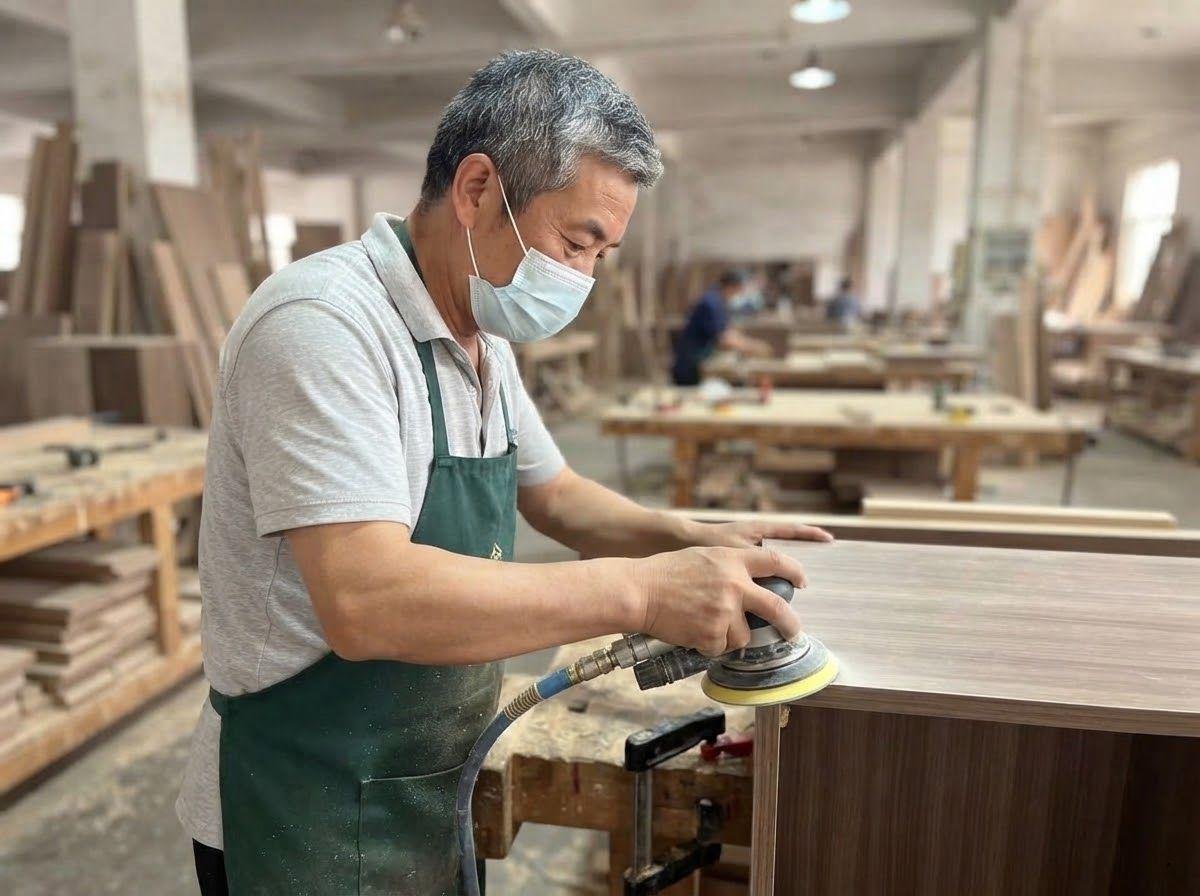
I remember this one specific Tuesday back in August 2018. We were out in Longjiang. If you’ve never been, the humidity there doesn’t just make you sweat—it physically sits on your chest. The air inside this massive metal shed smelled violently of industrial contact adhesive, MDF dust, and cheap cigarettes.
Standing right next to me is this procurement director from a major US hotel group. His dress shirt is completely glued to his back. But the guy is grinning. Ear to ear. He’d just signed off on a killer solid-ash lounge chair prototype, and the factory boss had agreed to a miraculously low $145 per unit FOB Shenzhen.
He honestly thinks he’s the smartest guy in the Pearl River Delta that day.
I looked down at the chair. Then I glanced over his shoulder at the poorly lit assembly line about fifty feet away. Exhausted workers were frantically stapling together these generic, mystery-wood frames over bare concrete. I didn’t have the heart to tell him yet, but my guy was almost certainly going to be out of a job by Christmas.
That flawless chair sitting between us? A total load of smoke. The finish was meticulously hand-rubbed. The foam felt perfectly crowned. Butter-soft top-grain leather. But the actual mass-production units they were gearing up to stuff into his 40-foot containers next month? Slapped together using green, high-moisture rubberwood wrapped in paper-thin veneer. Those cushions would be stuffed with recycled scrap foam that flattens into a concrete slab after maybe three months of hotel guests sitting on them.
Welcome to the oldest Chinese supplier trick in the book. If you’re buying commercial volumes in Guangdong or Zhejiang without a hyper-paranoid verification system in place, you are exactly the kind of prey they look for.
The Brutal Truth About Your “Golden” Prototype
Let’s just toss the corporate procurement handbook in the trash for a minute. Because the hardest pill to swallow in overseas manufacturing is a simple one. That breathtaking prototype you just eagerly slapped your signature on? The factory you’re currently standing in probably didn’t even build it.
I’ve watched this exact scenario play out more times than I can count. That perfect item was likely bought off a high-end retail showroom floor in Shenzhen the day before your flight landed. Or maybe they hired a 60-year-old master carpenter. You know, a guy who works in a locked, air-conditioned back room and never goes anywhere near the actual mass-production assembly line. They roll this masterpiece out into the lobby. They dazzle you. You wire that sweet 30% T/T deposit to their Hong Kong bank account.
And then the real math begins.
To them, it’s not malicious lying. It’s simply how you secure a foreign contract in a cutthroat market. If a price tag feels totally disconnected from the physical quality sitting in front of you, you aren’t buying a finished product—you’re just funding a theater production.
The Survival Cheat Sheet: Dodging the Decoy
- Treat it like a movie prop: Assume any perfect pre-production model is a bespoke creation. Built by off-site specialists. It almost never reflects what their high-speed, piece-rate assembly line can actually pull off when the boss isn’t looking.
- The unseen downgrade: The absolute second your flight takes off from Baiyun Airport, factories quietly cannibalize the internal components. Foam density, inner framing, and hardware get instantly swapped for cheaper variants. Why? To claw back the profit margin you negotiated away from them yesterday.
- Paper contracts mean nothing: A bulletproof, lawyer-reviewed Purchase Order is completely useless if you don’t have someone standing on the factory floor doing white-wood inspections during the very first production run.
- Beware the easy “Yes”: If a supplier accepts every single one of your custom modifications without fighting you hard on unit price or delivery time, congratulations. You’re being played.
Dissecting the Anatomy of a Sourcing Illusion
To really grasp how you get taken to the cleaners, you have to understand the mechanics of the pitch. Getting your China furniture sample approved is basically just a high-stakes game of verifying that the beautiful object you okayed is actually the same object being loaded onto your cargo ship.
Think about shooting a fast-food commercial. You know how the burger on TV looks massive, juicy, and perfect? Food stylists use tweezers, hidden toothpicks, carefully glued sesame seeds, and cardboard inserts to make it look impossibly tall. But the actual burger shoved through your car window at 11 PM? Smashed. Grey. Totally depressing.
That is the exact DNA of a factory bait-and-switch. They painstakingly construct the television commercial. You pay for it. Then they hand you the sad drive-thru bag.
The Fake Factory Tour (Yes, It’s Real)
A few years back, I got hired to audit a sprawling facility out in Dongguan. The boss—a charismatic guy named Mr. Chen—welcomed me into a pristine, climate-controlled showroom. It was packed to the ceiling with stunning mid-century modern replicas. (And yes, the irony isn’t lost on me that the entire room was basically a shrine to stolen European intellectual property. But that happens daily.)
Here is where things went sideways. I didn’t want his expensive tea. I wanted to see the floor.
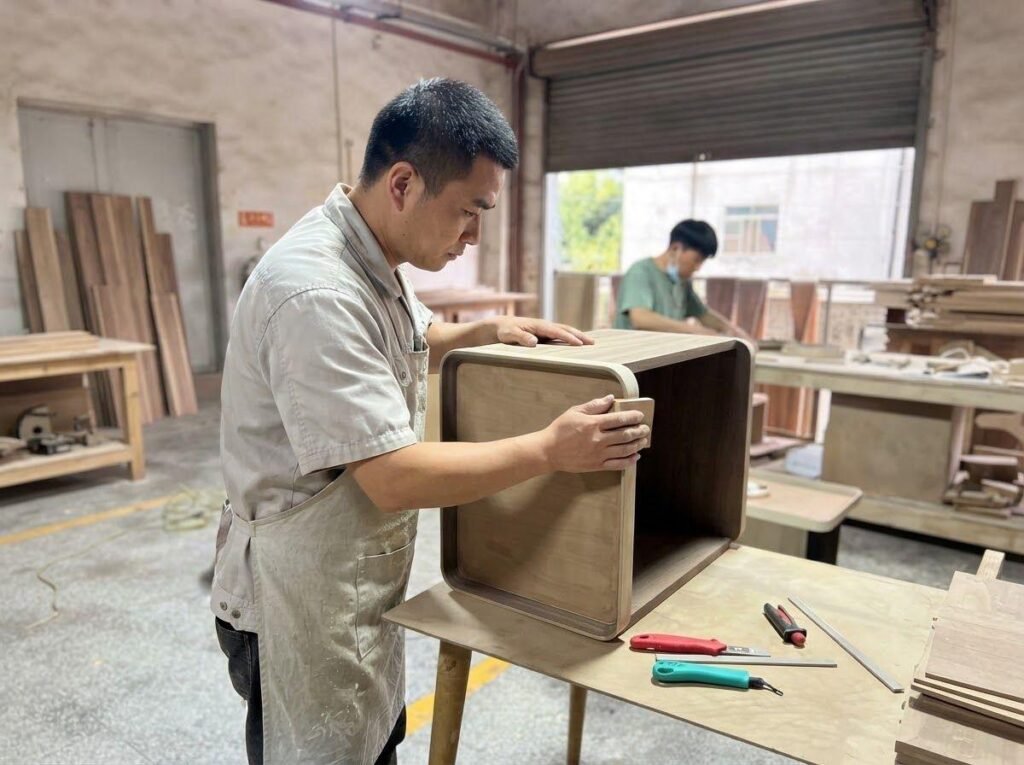
When I forced my way past the showroom and into the actual manufacturing sheds, the narrative collapsed instantly. The heavy machinery was just stamping out cheap, thin-gauge metal table bases for local noodle shops. There wasn’t a single commercial sewing machine or woodworker in sight. Caught red-handed. Mr. Chen had quietly bought fully finished, premium pieces from specialized boutique workshops just to populate his showroom. Passing them off as his own factory’s output to foreign buyers who didn’t know any better.
Brilliant, airtight illusion. Until someone actually looked behind the curtain.
The Dark Art of Material Alchemy
Approve that golden prototype. Wire the funds. Watch the material alchemy kick into overdrive.
This is where the factory systematically engineers the cost right out of your furniture. They aren’t stupid, obviously. They won’t change the exterior dimensions or the fabric color. That’s way too obvious to a casual inspector. Instead, they attack the dark spaces. The parts you can’t see.
Remember that 45-density, high-resilience polyurethane foam you tested? The one that bounced back perfectly? Gone. Swapped for a 30-density foam heavily mixed with calcium carbonate filler. The chalk dust makes the cushion feel heavy and firm on day one. So it passes a basic hand-press test. But it literally breaks down into powder after twelve months of heavy commercial use.
Imported DTC or Blum drawer slides? Swapped out for generic, unbranded pot-metal hardware that bends if you look at it wrong. Solid wood blocking inside the sofa chassis miraculously transforms into cheap MDF scrap. Or worse, raw pine with a moisture content sitting at 18%. That wet wood is going to warp, twist, and violently snap while baking inside a shipping container crossing the Pacific. The deadliest changes in this industry are always the ones hidden entirely beneath the upholstery.
The Chaotic Ecosystem of Subcontractors
Look, the reality isn’t totally black and white. What most angry Western buyers fail to realize is that the factory boss usually isn’t waking up trying to maliciously scam foreigners. Actually, scratch that. The root of the problem isn’t always inherent dishonesty. It’s the buyer’s completely delusional expectations.
When a procurement guy swaggers into a negotiation, bangs his fist on the table, and ruthlessly grinds the supplier down by 25% on the unit price, what do you think happens? The supplier doesn’t just absorb that massive loss out of the goodness of their heart. They smile. They pour you more tea. They sign the document. And then they immediately run back to the production floor to gut your bill of materials. You squeezed their margins to the bone; they squeezed your product. Basic physics.
Why the Mid-Market Sweet Spot Actually Works
If you want to dodge this mess, you have to read the manufacturing landscape correctly. It’s wildly fragmented out here.
Up in Nankang, you’ve got thousands of unregulated, dirt-floor sheds pumping out ultra-cheap, disposable goods for the domestic market. Over in Foshan, you have massive, glittering mega-factories that look like Silicon Valley tech campuses. But here’s the dirty secret about those giants. They often just act as assembly hubs. Farming out your components to the absolute lowest-bidding subcontractors in the region to maximize their own cut.
This is exactly why smart sourcing strategies are shifting. Instead of chasing the biggest building in Foshan, savvy buyers are looking for mid-sized specialists.
Take an operation like Interi Furniture, for instance. When you deal with a mid-scale facility that genuinely focuses on dedicated project manufacturing—and keeps actual, in-house framing and upholstery lines running under one roof—the risk equation shifts heavily in your favor. Because they control the internal machinery, they actually manufacture the samples they ship you.
Changes the entire psychological baseline. You are no longer praying that a massive factory can magically match a boutique workshop’s hand-carved sample. Instead, you are just verifying that their production line can successfully repeat what it literally did yesterday.
The Shadow Factory Network
But let’s say you do end up rolling the dice with one of those massive mega-factories. The real gut-punch is that the beautiful facility you spent three hours auditing might just be the “front door” for your order.
I’ve personally watched massive export factories accept a US buyer’s 10,000-piece hospitality order, show off a flawless pre-production sample made on their premium line, and then quietly farm out the entire mass production run to three different, sketchy, tier-3 factories in a cheaper neighboring province. The mega-factory just acts as a glorified trading company. Skimming 15% off the top for doing absolutely nothing but answering your emails in decent English.
When the goods finally hit your distribution center in Los Angeles, it’s a bloodbath. You open the boxes and find three completely different levels of quality mixed into the same PO. Leg stains don’t match. Fabric dye lots are wildly off. Hardware is misaligned. Total, unmitigated nightmare.

The Bait-and-Switch Survival Framework
So how do you actually fight back? You can’t just rely on a stamped Proforma Invoice and a polite WeChat message. You need to operate with a paranoid, highly aggressive verification framework.
If you are pulling commercial volume out of Asia, do not skip these steps. I’m serious.
The “Prove It” Protocol
- Demand the “Naked” Sample First: Never, ever approve a fully finished upholstered item as your first step. Demand to see the skeleton. I want the raw wood frame sitting in front of me. I need to physically inspect the wood species. Check if they are using dowels and glue or just blasting it with cheap air-gun staples. Test the webbing tension before a single yard of fabric hides the evidence.
- The Ironclad Cut-Sheet: Put every single invisible specification in writing. Do not just type “High density foam” on your PO. That means nothing. Write “45kg/m³ HR polyurethane foam, 0% calcium fillers, must pass independent lab density test.” Leaving any ambiguity in a Chinese manufacturing contract is essentially begging them to downgrade your materials.
- Literally, Buy a Reciprocating Saw: Have them cut the finished sample in half. I have personally taken a Dewalt saw to a $500 approved sofa sample right in the middle of a factory floor to verify that the internal framing matched the spec sheet. The look of sheer panic on the factory boss’s face when you ask for power tools? Priceless.
- In-Line Inspection or Bust: If you wait until the goods are 100% finished, wrapped in foam, and boxed up to send your QC inspector in, you’ve lost. You must inspect during the first 10% to 15% of the production run. It’s called a “white-wood inspection.” If the internal frame is garbage, you catch it and halt production before they manage to upholster two thousand units.
The Red Flags Everyone Misses
Conventional business wisdom tells you to watch out for factories that are slow to communicate or push back hard on changes. I think that’s completely backwards.
The Ultimate Red Flag: They approve your highly complex, custom changes way too quickly.
Think about it. You ask a supplier to completely change the leg profile from round to tapered, upgrade the upholstery to a heavy, high-rub-count bouclé, and swap out the foam core. They reply with “Yes friend, no problem!” without demanding a price hike or asking for a 14-day lead time extension. Run for the hills. Real manufacturing requires fresh costing, new raw material sourcing, and physical re-tooling. If they agree instantly, they are flat-out lying to you. They have zero intention of making those changes and will just ship whatever is sitting around the warehouse.
| The Component | The “Golden” Prototype Version | The Mass Production Reality |
| Framing | Kiln-dried solid Ash wood, smoothly sanded | Raw, wet Pine or cheap, off-gassing MDF scraps |
| Cushion Foam | Premium 45-density, high-resilience memory foam | Cheap 30-density foam packed with heavy chalk |
| Veneer | 0.6mm thickness, beautiful natural grain | 0.2mm engineered paper foil that peels right off |
| Metal Finishes | True PVD electroplated brass | Quick, cheap spray-paint powder coat |
| Hidden Joinery | Double-dowelled, heavily glued, corner blocked | Hundreds of air-gun staples and a lot of hope |

The Gritty FAQ: What Buyers Actually Ask Me
Whenever I’m grabbing a Tsingtao at a hotel bar in Guangzhou after a grueling 12-hour day of factory audits, frustrated buyers always corner me with the same questions. Here’s the unvarnished reality.
Q: Why the hell does my final shipment look so much worse than the sample?
A: Because the prototype was hand-crafted by an artisan to win your money. Your final shipment was blasted out by an assembly line heavily incentivized to save pennies on every single unit. The sample is a marketing expense. The production run is a margin-maximization exercise. Unless you rigidly audit the transition phase from prototype to mass production, a downgrade isn’t just possible. It’s basically a guarantee.
Q: Can’t I just enforce massive financial penalties in our contract if they mess up?
A: You can write whatever fantasy clauses you want into a Word document. Good luck enforcing it across borders. If your office is in Chicago and the factory owner is in Dongguan, threatening to sue him over foam density is an utterly empty threat. In this landscape, a signed contract is often viewed as the starting point of a negotiation, not the final word. Your only actual leverage is refusing to wire that final 70% balance until your QC guy passes the goods on the floor. Money leaves your account, you lose your power.
Q: If the unit price they quote is ridiculously low, is it definitely a scam?
A: Not necessarily a criminal scam. But it is a harsh reflection of math. There’s no magic wand in manufacturing. Raw materials—wood, steel, oil for foam—cost what they cost on the global commodity index. If a factory offers you a price magically 30% below the regional market average for a walnut dining chair, they are not taking a financial loss just to win your friendship. They are actively using inferior hardware, cheaper wet wood, or cutting massive corners on labor. You get exactly what you pay for.
Q: Will hiring a third-party QC inspection company actually fix this?
A: Only if you give the inspector teeth. Most lazy buyers just email a generic PDF spec sheet to a third-party QC guy. The inspector shows up, sees 500 chairs that generally resemble the photo, ticks a box, and goes home. If you want real protection, physically ship the actual, signed prototype back to the factory floor. Explicitly instruct your QC inspector to compare the mass production units side-by-side against it. Tear into the internals if necessary.
Q: With all this headache, is it even possible to get world-class furniture out of Asia anymore?
A: Absolutely. Despite the chaos, the infrastructure, engineering talent, and supply chain logistics are still some of the best on earth. But tapping into that top tier requires relentless vigilance. Boots on the ground. And a willingness to pay a fair, sustainable price for honest work.
The Final Word from the Factory Floor
Look, when all is said and done, you have to ask yourself a very blunt question. Are you actively managing a complex overseas supply chain, or are you just pointing at a shiny object in an email and crossing your fingers?
The factory bosses pulling this trick aren’t cartoon villains twirling their mustaches in smoky back rooms. They are hyper-rational, aggressive business operators trying to survive on razor-thin margins in a ruthless global market. You blindly squeeze them on price, they adapt. You look the other way during production, they optimize for their own financial survival.
Stop treating commercial sourcing like you’re casually adding items to a retail shopping cart. Get your hands dirty. Fly over there. Cut a chair in half. Demand uncomfortable transparency at every single stage of the assembly line. Because if you don’t aggressively control the bill of materials, I promise you, the bill of materials is going to control you.
Stay paranoid out there.