

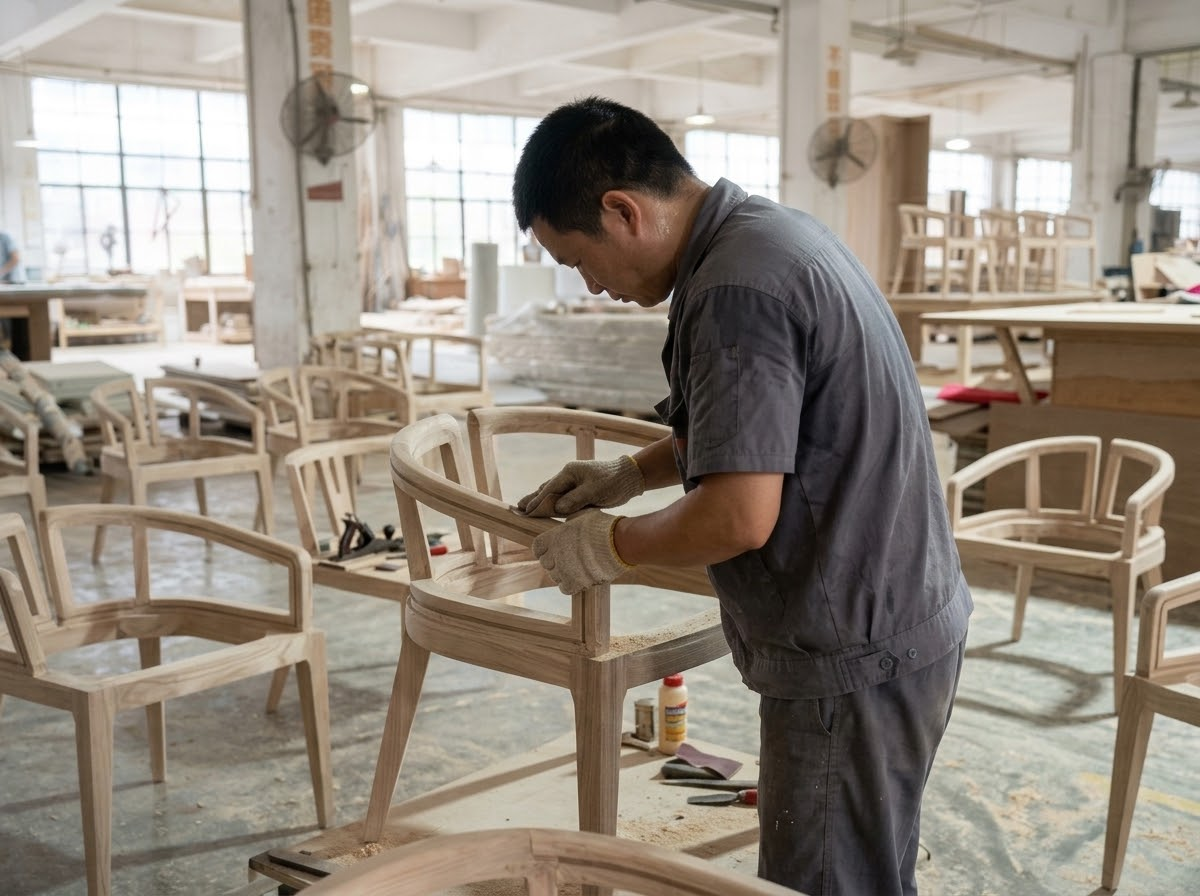
Marco V. didn’t open the email at first. Just stared at the subject line. “Re: Sheraton FF&E Batch 3 — Revised ETD.” It was 6:47 a.m. in Miami. His coffee was still too hot to drink. And he already knew. He’d been in this game twelve years. Sourcing China hotel furniture out of Guangdong, Zhejiang, anywhere they’ll pick up the phone. “Revised ETD” is just factory code for your container’s sitting in a yard near Yantian, probably has been for a week, and no — they don’t know when it’ll move.
The project? One forty-seven-room beachfront property in Fort Lauderdale. Hard opening in six weeks. He’d wired the deposit — $2.4 million — to a factory in Longjiang, Shunde District, back in February. February felt like a different lifetime. And now the lobby sofas. Those damn sofas. Custom rattan weave. Designer wouldn’t budge on the spec. “Awaiting final QC,” the email said. Translation: the foam blocks showed up wrong density. Again. The factory was too embarrassed to say so. Or maybe they didn’t even know yet. The foam shop was three blocks away, not even the same company. Someone forgot to check. Someone always forgets to check.
That’s the thing nobody tells you at the trade show. Your furniture isn’t late because of one disaster. It’s late because of twenty small failures, and the factory will only admit to the one you caught.
The Brutal Truth
Let’s not sugarcoat this. China hotel furniture sourcing — commissioning custom casegoods, seating, and fixtures from specialized factories in China’s industrial belts — sounds like a procurement function. It’s not. It’s risk management with a veneer of carpentry.
Most buyers think their Chinese contract manufacturer is a vendor with a funny time zone. Wrong. They’re a network of small workshops held together by WeChat voice messages, cash payments to material brokers, and guanxi older than your career. That shiny showroom in Lecong? Real. The actual floor making your headboards? Could be three separate buildings. Two you’ve never seen. One you couldn’t find if you tried.
Here’s the rule of thumb, and I don’t care how many ISO certificates are framed on the wall: If they say eight weeks, assume twelve. If they say twelve, assume eighteen. And if they smile and say “no problem, very fast”? Run. Don’t walk. Run.
Key Takeaway
- Lead times are systematically understated by 30–50% because factories quote “production time,” not real-world elapsed time. They don’t count material procurement. They don’t count CNY. They barely count weekends.
- The real chokepoint isn’t capacity. It’s coordination. A factory might own the CNC machines, but they don’t own the veneer shop, the foam cutter, or the hardware broker. One link breaks, everything stops.
- Rush orders get pushed to the back. Counterintuitive, but true. Factories protect their volume clients — the ones who placed orders six months ago and visit twice a year. You’re the one-off. You get whatever gaps are left.
- A container sitting in Shenzhen costs them less per day than expediting your production. Some factories use ocean freight delays as a free buffer. Not all. But enough.
Why the Timeline Is Always a Lie
Who Are You Really Buying From?
Look, buying custom hospitality furniture from China is like hiring a wedding planner who doesn’t own a kitchen. She knows a caterer. The caterer knows a guy with ovens. The ovens are in another county. Your cake comes together at 5 a.m. in a rented commissary while someone’s quinceañera is wrapping up in the next room. That’s not an insult. That’s the model. And 80% of the time, it works fine. Until it doesn’t.
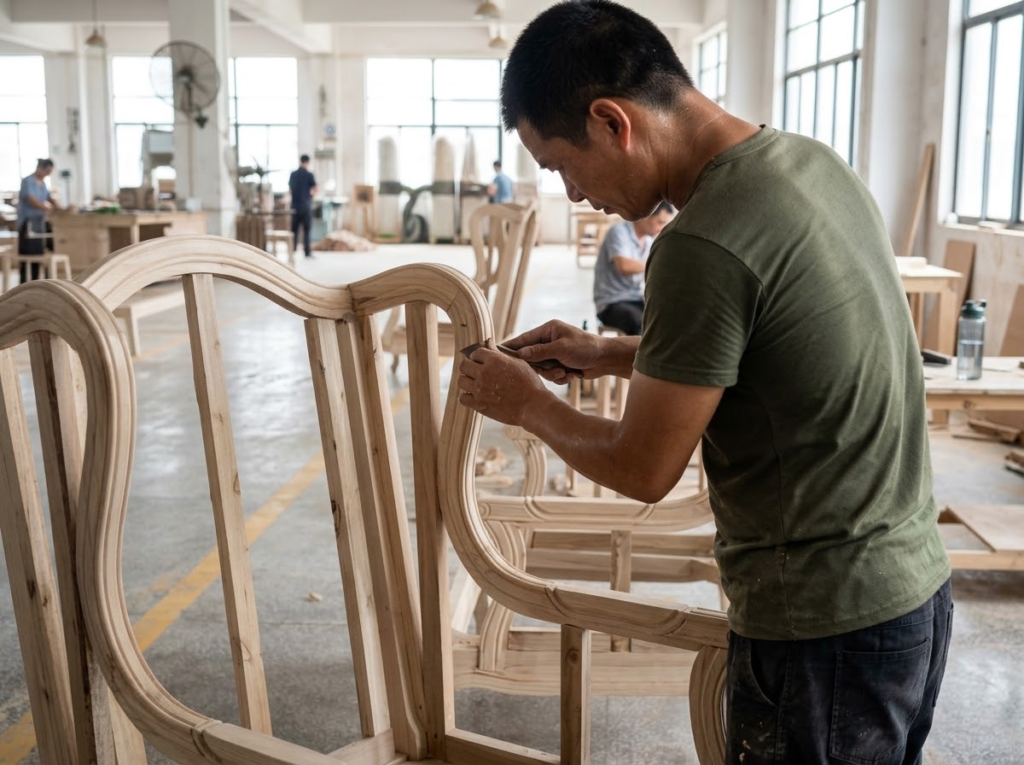
When a factory quotes 60 days, they’re counting from the moment all materials hit their loading bay. Not the day you sign. Not the day your deposit clears. Not the day they finally get around to calling the veneer guy. Just the pure, theoretical production window. And that veneer guy? He’s cutting for twelve other factories that week. Your order is a line item on a scrap of paper. If the Dubai hotel chain put in a bigger PO the same Tuesday, guess whose walnut gets sliced first?
Wait. Actually, that’s not quite right. The factory isn’t lying to you. They’re lying to themselves first. The sales rep — let’s call her Linda, they always seem to be called Linda — she genuinely believes the workshop can turn your 200-room set in eight weeks. She believes it because in 2023, under totally different conditions, with a simpler spec, they did it once. For one client. Who ordered in March, not the week before Golden Week. She’s selling you a memory. A ghost. Not a schedule.
And Chinese New Year. God, CNY. It doesn’t just disrupt January. It eats December, January, and half of February whole. The factory “shuts down” for two weeks officially. In reality? Workers start drifting home to Hunan, Henan, Sichuan by mid-January. Some don’t come back. Ever. The ones who do trickle in through late February. Material suppliers? Same story. But your contract says 60 days. You signed it in December. Nobody mentioned that the first three weeks of your timeline are essentially fictional.
The real kicker? They won’t tell you any of this until week five. Why? Because admitting delay in week one means admitting they took your deposit knowing the timeline was theater. Admitting it in week five means blaming the veneer supplier. Guess which one keeps the relationship alive?
Foshan Sells Dreams. Dongguan Makes the Mess.
Foshan is the Vegas of China hotel furniture. Bright lights. Massive showrooms. Sales reps who speak better English than your project manager and wear better suits than your CEO. You walk through Lecong or Longjiang and every factory looks ready for a 500-room Hilton rollout. Some are. Most aren’t. What Foshan sells is confidence. Pure, uncut confidence. What Dongguan sells is capacity — gritty, unglamorous, often hidden in industrial parks where the GPS thinks you’re in a rice paddy. And Nankang? Nankang sells price. Rock-bottom, how-is-this-even-possible price.
The problem isn’t the cities. It’s that buyers shop in Foshan, sign in Foshan, and then wonder why their goods are being made in a facility three hours away they’ve never laid eyes on.
I learned this the hard way. Dongguan, 2019. Factory looked perfect. Website, ISO, the works. English-speaking staff. Clean samples. Then I asked to see the workshop. “Oh, that building is being renovated. But we have another facility…” We drove twenty minutes to a concrete block with no sign. A guy in flip-flops was spray-painting bed frames next to — I swear — a chicken coop. (And yes, this happens more than anyone admits.) The quality? Honestly, not bad. But the timeline? They were running three shifts for a Saudi client who’d prepaid 100% upfront. My order? “In the queue.” Queue. Right.
Now, while some buyers gravitate toward those big Foshan players — the ones with 50,000-square-meter workshops and 350-plus workers on the books — others find that mid-sized specialists offer a different equation. Operations like Interi Furniture, which focuses on project-based hospitality and residential contract manufacturing, sit in that awkward middle ground. Tighter grip on their subcontractor network because they have to — they can’t afford a miss. But less buffer capacity when something goes sideways. They’re not safer. They’re differently risky. And a lot of buyers don’t know which bet they’re actually making.
Here’s what actually matters:
| Factor | Big Foshan Player | Mid-Sized Specialist (Interi Furniture type) | Small Workshop Cluster |
|---|---|---|---|
| Quoted Lead | 60–90 days | 45–75 days | 30–60 days |
| Realistic Time | 90–120 days | 75–100 days | Who knows |
| Materials | Centralized, but bulk-prioritized | Mixed — some direct, some brokered | All cash, all outsourced |
| QC | Good on standard; shaky on custom | Higher touch, fewer inspectors | A coin flip |
| Communication | Professional, but filtered | Direct, often owner-level | WeChat and prayer |
| Best For | Chain rollouts, repeat specs | Boutique hotels, mixed-use, custom resi | Budget jobs with no hard date |
The mistake isn’t picking the wrong tier. It’s expecting one tier to act like another. You can’t ask a small workshop for Marriott-level paperwork. And you can’t ask a mega-factory for boutique flexibility. They’ll say yes to both. That’s the trap.
What a Delay Actually Looks Like Up Close
Let’s get granular. You drop $400,000 on a 90-room limited-service property. Custom casegoods, upholstered seating, lobby pieces. The factory says ten weeks production, three weeks to LA. You pad it by two weeks because you’re not an idiot. Thirteen weeks total. You need it in sixteen. Comfortable, right? Wrong.
Week 1–2: “Preparing materials.” Translation: nothing. They’re finishing the job before yours. Your deposit is literally funding someone else’s wood. This is standard. Don’t act surprised.
Week 3: Veneer shows up. Wrong color. Not by much. But enough that your designer — the one who charges $300 an hour and has opinions about everything — will notice. The factory doesn’t tell you. They just reorder. Three days gone. Now six. You won’t find out until week seven.
Week 5: Foam arrives. Good foam, actually. But the upholstery workshop — separate business, three blocks away, not owned by the factory — is slammed. They took a rush job from a Macau casino. Your sofa frames sit wrapped in plastic for a week. The weekly update? Copy-pasted. “Production proceeding normally.”
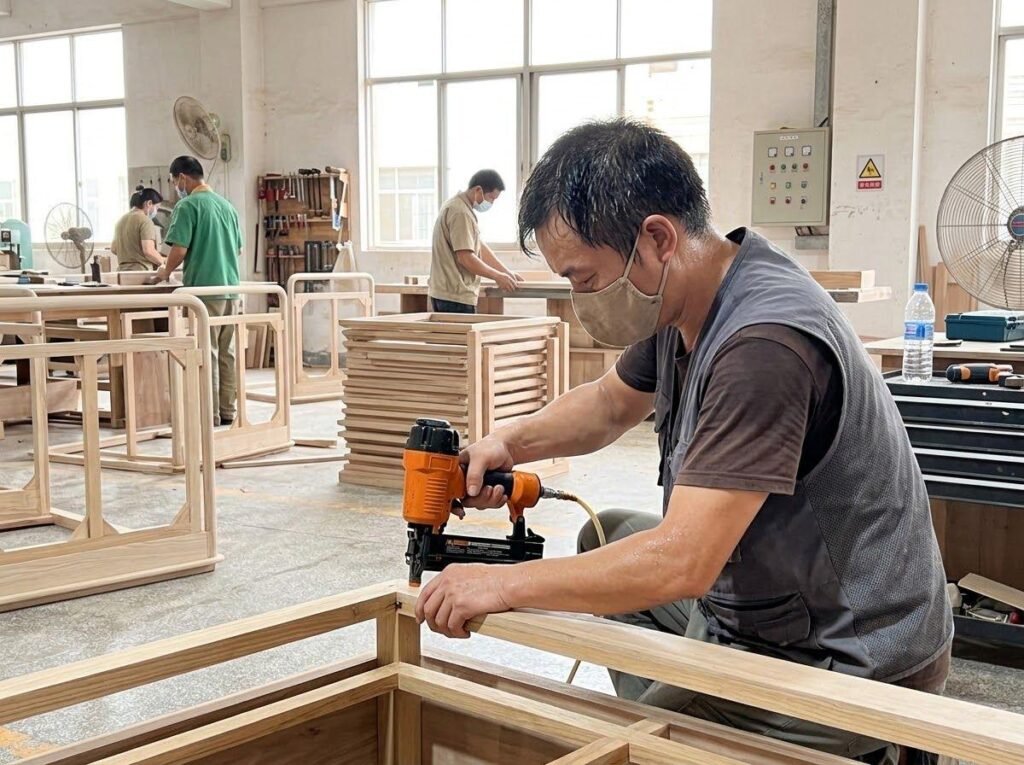
Week 7: Production “starts.” You get CNC photos. Looks great. What you don’t see: they’re running one shift, not two, because three workers never came back after CNY. The photos never show empty stations. I learned that in Dongguan. The hard way.
Week 9: Assembly. The soft-close hinges — the ones you specified in writing, twice — are backordered. European supplier missed their boat. Factory installs standard hinges “temporarily” to keep the line moving. Plan to swap later. Plan not to tell you.
Week 11: QC. Inspector finds finish issues on 40% of headboards. Rework. Five days. Minimum.
Week 12: “Ready for shipment.” Except the freight forwarder can’t get a booking because post-CNY demand just spiked. Your goods sit for ten days. Maybe two weeks.
Week 14: Container loads. Sails. You hit your sixteen-week window by the skin of your teeth. Zero margin. If Long Beach has a bad day, if customs wants to inspect, if the truck driver loses your paperwork — you’re eating into opening day.
This isn’t a worst-case scenario. This is the median. Industry observers estimate that 60–70% of China hotel furniture orders hit at least one material-related delay. The factories that call you proactively before it happens? Maybe one in five. If you’re lucky.
What to Actually Do About It
You can’t prevent delay. You can only move it to where it does the least damage. Here’s the playbook.
Before You Sign
- Demand a milestone schedule. Not “10 weeks.” Week 1: material lock. Week 2–3: cutting. Week 4–5: carcass assembly. Week 6: finishing. Week 7: upholstery. Week 8: QC and pack. If they can’t break it down, they haven’t thought it through. Don’t sign.
- Inspect the material warehouse. Not the showroom. The warehouse. Look at wood stock, foam blocks, hardware bins. Empty shelves plus big promises equals they’re buying your materials with your deposit. Not illegal. Just risky as hell.
- Book freight when you pay deposit. Not when they say “ready.” Cancellation fees are cheaper than goods sitting in a rented warehouse while you scramble for a container that doesn’t exist.
- Flip the penalty clause. Everyone punishes late delivery. Try this instead: reward early bad news. “Tell me about a material issue in Week 2 instead of Week 6, and we split expediting costs. Hide it, and you eat the full penalty.” Factories bury problems because they’re scared of you. Change the math.
During Production
- Video calls. Live. Not photos. Photos lie by omission. A 30-minute WeChat video walkthrough tells you more than fifty high-res images. Look for clutter. Idle workers. Whether the pieces on the floor actually match your PO.
- Approve the first production unit. Not the sample. The sample is made by the best guy, with the best wood, under zero pressure. The first production piece is reality. Inspect it like your job depends on it. It does.
- Pay in milestones. 30% deposit. 30% at mid-production, confirmed by your inspector. 30% post-QC, pre-shipment. 10% on delivery. If they balk at this, ask why. Their answer tells you everything.
The Buffer You Actually Need
- Standard casegoods? Add four weeks to the quote.
- Custom upholstery with imported fabric? Add six.
- Anything ordered between September and January? Add eight. CNY is coming. It’s not a surprise. It’s physics.
And here’s the thing procurement directors keep forgetting: the cheapest quote is usually the slowest delivery. Not because the factory is bad. Because they priced your job to fill gaps between bigger orders. You’re the filler. When the real client shifts their timeline, yours shifts too. The factory isn’t being evil. They’re being rational. Cut-rate pricing buys cut-rate priority. That’s not a bug. It’s the business model.

FAQ
Q: My factory said 45 days. We’re on day 50 and no ship date. Is this normal, or did I pick a bad apple?
A: Both. In my experience, about 70% of Chinese contract manufacturers miss their first delivery promise by at least two weeks. The question isn’t if delay happened. It’s whether they called you at day 30 to warn you. A supplier who flags trouble early is usually more reliable than one who hits the date perfectly but goes radio silent when things break.
Q: Should I just air freight everything and skip the ocean nightmare?
A: Only if you’re shipping samples or a single room set. For a full hotel FF&E package, air freight costs more than the furniture. The math collapses unless you’re doing a twelve-room boutique and opening next month. For 50+ rooms, build ocean time into your schedule on day one. There is no shortcut. Only earlier planning.
Q: How do I know if they’re actually making my stuff, or farming it out to some workshop I’ve never seen?
A: You don’t. Not for sure. But you can make hiding it expensive. Demand milestone photos with date stamps and your PO number visible on the factory floor. Insist on a third-party inspection at 30% completion — not just pre-shipment. Visit unannounced if you can. Or hire a local agent in Foshan to do it. Subcontracting itself isn’t evil. Some small shops do beautiful work. But secret subcontracting is a risk you didn’t sign up for.
Q: Is sourcing China hotel furniture just too risky for a property with a hard opening?
A: Depends when you started. Opening in 14 months and sourcing now? Manageable. Opening in five months and still picking fabrics? You’re gambling. The nightmare isn’t China. It’s China plus a compressed timeline. Give yourself 8–10 months from first contact to container delivery, and delay becomes an annoyance. Not a catastrophe.
Closing
I started with Marco because he’s not special. I’ve got a dozen Marcos in my phone. Some learned to pad every quote by three months. Some swallowed the 40% premium and went domestic. Some are still refreshing tracking pages at 3 a.m., praying a container in Yantian will teleport to Florida.
Here’s the hard lesson, and it took me fifteen years to really believe it: You don’t beat the delay by finding a better factory. You beat it by assuming the delay will happen, and building your whole project around that assumption. The factory in Longjiang isn’t your enemy. Your own optimism is.
Sleep tight. Your sofas are still “awaiting final QC.”