

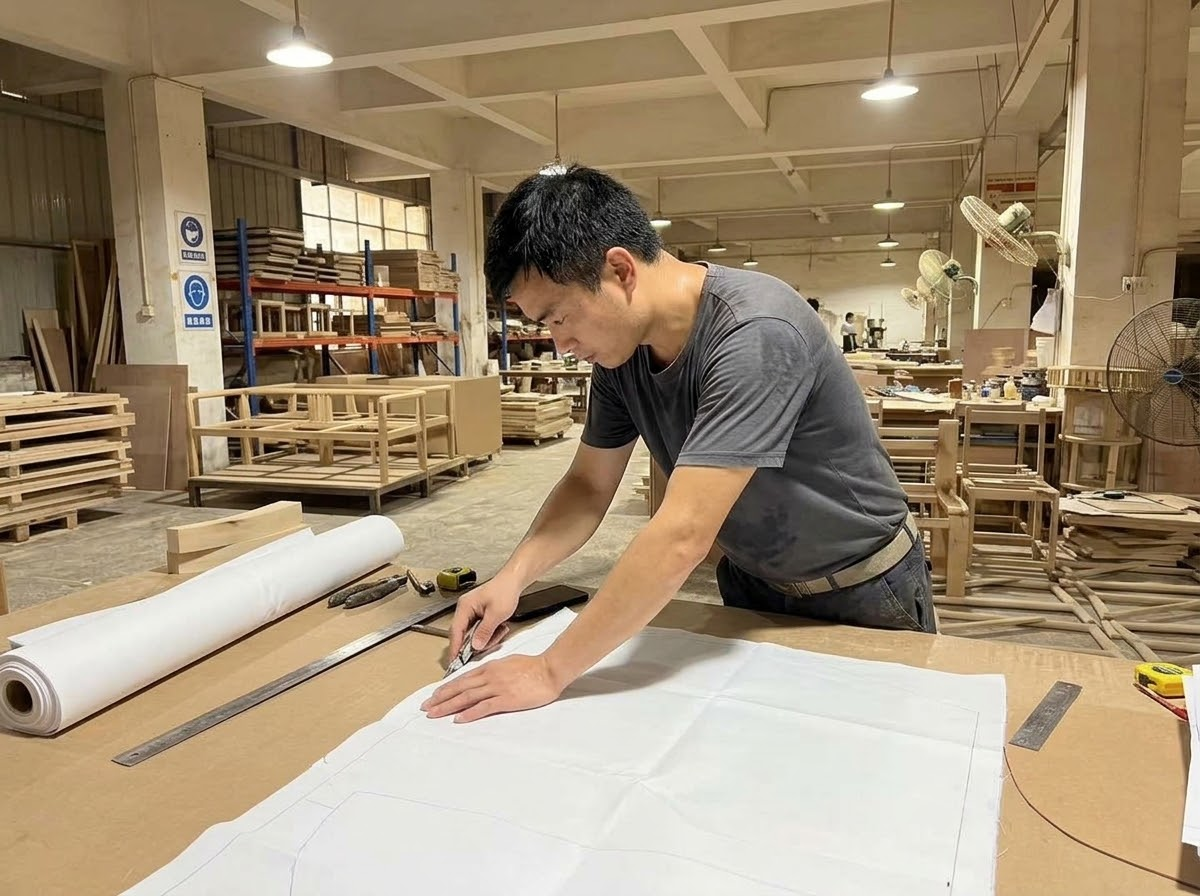
I was standing in a Longjiang warehouse last March, watching a buyer from Melbourne unwrap what was supposed to be his “production sample” — the exact piece his 200-unit hotel order would replicate. He’d flown in specifically for this. The oak veneer on the China furniture sample he’d approved back in November had a warm, honeyed grain with subtle figuring. What sat in front of him now looked like someone had laminated a photograph of wood onto particleboard. The color was off by two shades. The edge banding was peeling. And the weight — he picked up a chair and almost threw it across the room — was maybe sixty percent of what the sample had been.
“Same factory,” his agent kept saying. “Same factory, same specifications.” The buyer just stared at the chair. He’d already wired a 30% deposit. Forty thousand dollars. The real kicker? This wasn’t some back-alley operation. This was a mid-sized manufacturer with a decent Alibaba storefront, ISO paperwork, and a showroom that looked like it belonged in Milan.
That’s the thing about the China furniture sample game. The sample room is theater. The production floor is reality. And the gap between them? That’s where careers get buried.
The Brutal Truth Nobody Wants to Hear
Most buyers think they’ve stumbled into a Chinese factory scam. They haven’t.
The problem is that buyers treat the China furniture sample approval process like a wedding vow — something permanent and binding — when the factory treats it like a first date. A reference point. A starting bid.
Here’s the rule of thumb that took me a decade to internalize: If you haven’t seen the production line running your order, you don’t actually have an order. You have a hope. And hope, in the furniture business, is not a procurement strategy.
Factories don’t set out to scam you. Most don’t, anyway. What happens is simpler and more insidious. Material costs shift. A veneer supplier runs out of the A-grade stock and substitutes B-grade. A foreman decides the approved foam density is “too expensive for bulk” and dials it back. The China furniture sample was built by the owner’s nephew, who actually cares. Your production run was built by a Tuesday-morning shift that got yelled at for working too slowly.
And here’s what makes it worse: by the time you discover the bait-and-switch, you’re already emotionally and financially committed. Container’s loaded. Balance is due. Your hotel opening is in six weeks.
Why the Sample Room Is a Magic Show
How do factories build samples that production can’t replicate?
Think of it like dating apps. Everyone puts their best photo forward. The factory’s China furniture sample is their profile pic — filtered, lit from above, maybe three years old. The production floor is what shows up for coffee.
I’ve watched factories build “approval samples” using wood from a completely different supplier than the one they’ll use for bulk. Why? Because the sample supplier had a limited stock of premium-grade oak, enough for three chairs, not three hundred. The factory knows this. They also know that by the time you figure it out, you’re twelve time zones away and dealing with a different department entirely.
The general pattern suggests that roughly seven out of ten quality disputes I see trace back not to malice, but to what I’d call “specification drift.” The factory changes something — foam, veneer thickness, internal bracing — and convinces themselves it’s “basically the same.” To their eye, trained on thousands of units, it is. To your eye, trained on the single sample you approved, it’s a different product.
But the real issue isn’t even the materials. It’s the labor.
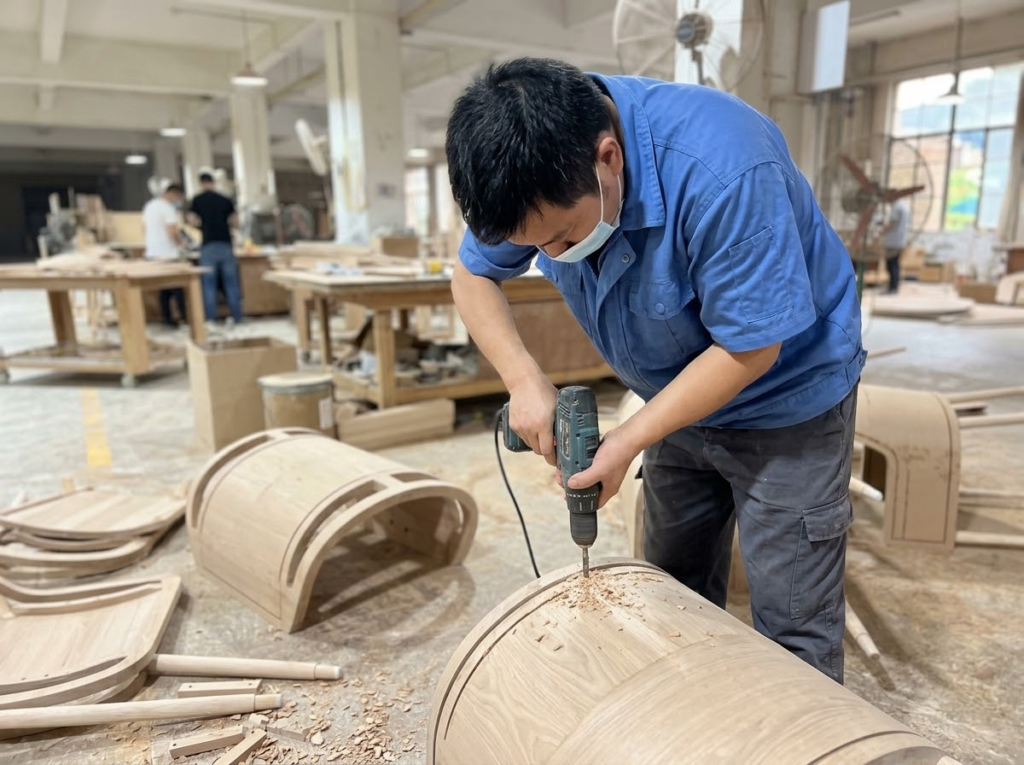
Your China furniture sample was likely built by the A-team. Senior carpenters. The guys who’ve been there eight years and get paid piece-rate premiums. Your bulk order? That’s getting built by whoever’s available. New hires. Temps. The Tuesday shift. And in a country where factory turnover can hit 30% annually, the “same factory” doesn’t mean the same hands.
Plus, and here’s the thing most procurement courses won’t tell you: Chinese factory culture rewards speed over precision when management isn’t watching. The sample had management watching. Your container won’t.
The Geography of Deception
Why does the bait-and-switch happen more in some regions than others?
Actually, that’s not quite right — what most buyers miss is that geography isn’t destiny, but it is a risk multiplier.
Foshan, in Guangdong province, is the elephant in the room. It’s where most international buyers land, and it’s where I spend probably sixty percent of my time. The scale is staggering. Showrooms the size of football stadiums. Entire districts devoted to a single category — Longjiang for sofas, Lecong for everything else. But that scale comes with a dark side. The sheer volume of transactions creates a “churn and burn” mentality in some corners of the market. A factory that can replace you with three new buyers next week has less incentive to protect its reputation with you.
Dongguan, an hour’s drive north, has a different flavor. More OEM-focused. More accustomed to Western brand standards because it’s been feeding the export machine since the 1990s. You pay more. You generally get more consistency. Not always — I got burned in Dongguan too — but the baseline is higher.
Then there’s the cluster most buyers never visit: Anji, in Zhejiang province, for bamboo and mid-market seating. Nankang, in Jiangxi, for solid wood. These aren’t on the standard buying tour. The factories there are hungrier, more willing to customize, and — in my experience — more likely to cut corners if they think you won’t notice. Not because they’re worse people. Because they’re operating on thinner margins and less international exposure.
While some buyers gravitate toward large-scale manufacturers in Foshan with their glossy showrooms and English-speaking sales staff, others find that mid-sized specialists — operations like Interi Furniture, which focuses on commercial and hospitality-grade case goods with a reputation for holding spec through production — offer a different risk-reward equation. They’re not immune to the pressures that affect everyone. But their business model depends on repeat project work, which means a bait-and-switch doesn’t just lose one order — it can poison an entire vertical. That changes incentives in ways a pure export trader never experiences.
The Real Cost of “Close Enough”
When does a minor spec deviation become a major disaster?
I learned this the hard way in Dongguan. A client of mine — a boutique hotel group out of Sydney — approved a walnut-veneer headboard with a specific oil finish. The production run came back with a lacquer finish instead. “Same color,” the factory said. “More durable. Better for hotel use.”
They weren’t wrong about durability. But the lacquer had a slight amber cast under incandescent light that the oil didn’t. In a room with 2700K bulbs, the headboards looked orange. Not walnut. Orange. We had to re-finish 86 units in a Sydney warehouse at $140 per piece. The factory offered a $2,000 credit. I laughed. Then I cried.
The general pattern suggests that the most expensive “minor” changes are the ones that affect how a piece lives in a space. A slightly softer foam? Your guests sink in too deep and can’t get out. A veneer substitution? It photographs differently for your marketing. A frame joint simplified to save labor? It fails at month fourteen, just outside warranty.
Here’s what tends to happen when buyers push back: the factory acts offended. “You don’t trust us?” they’ll say. Or: “This is standard in China market.” Both statements are negotiating tactics, not facts. The appropriate response is not to get angry. It’s to get specific.
Your Pre-Production Playbook
What actually works to prevent the bait-and-switch?
I’ve watched hundreds of buyers try to solve this problem. The ones who succeed don’t rely on contracts. They rely on presence. On verification. On making it harder to cheat than to comply.
Here’s the framework I use myself:
— The Golden Sample Lockdown
Don’t just approve a sample. Lock it. Physically seal it in a box with your signature, the factory manager’s signature, and a dated photo. Store one copy at the factory. Take one home. If possible, store a third with your third-party inspector. When production finishes, the inspector compares against the sealed sample, not a memory, not a photo on a phone.
— The Mid-Production Raid
Schedule an unannounced visit. Not the “we’ll be there Tuesday” visit that gives them three days to clean house. A real surprise. Walk the production line. Pick up a half-finished piece. Does the internal frame match what you were shown? Is the foam density stamped on the blocks? (It should be. If it isn’t, that’s a dead giveaway they’re winging it.)
— The Material Pre-Approval
For any order over $50,000, insist on approving raw materials before they become furniture. The actual veneer sheets. The actual fabric roll. The actual foam blocks. Label them. Photograph them. Make the factory certify in writing that these are the materials being used for your order. Yes, this is a pain. Yes, it works.
— The “Worst Piece” Clause
Here’s the red flag checklist item that contradicts conventional wisdom: Don’t ask to see the best piece from the production run. Ask to see the worst. Tell the factory you want to approve the piece they’re most embarrassed about. If the worst piece is acceptable, the run is probably fine. If they refuse to show you anything but perfect samples, you’re being managed.
— The Third-Party Inspection That Actually Inspects
Most buyers hire inspection companies and then don’t read the reports. Or they hire inspectors who walk in, count cartons, and leave. You want an inspector who knows furniture. Who will cut open a sofa and photograph the internal frame. Who will measure foam density with a durometer. Who works for you, not for the factory’s convenience. Companies like Asia Inspection or Bureau Veritas are fine, but the individual inspector matters more than the brand on their shirt.
— The Payment Structure as Leverage
Never — and I mean never — pay the full balance before the container leaves the factory. Hold 10% to 15% until after you’ve unwrapped and inspected a random sampling in your own warehouse. Yes, this is hard to negotiate. Do it anyway. The buyers who get stuck with garbage containers are almost always the ones who paid in full because “it was easier.”

FAQ: The Questions Buyers Actually Ask
Q: Can I trust a factory that won’t let me visit their production floor?
A: No. Full stop. I’ve heard every excuse — “too messy,” “workers don’t like foreigners,” “proprietary process.” All of them are smoke and mirrors. A factory with nothing to hide shows you everything. The ones that restrict access are restricting it for a reason. I’ve seen “factories” that were actually just showrooms with production subcontracted to a shed two towns over. This isn’t a Chinese factory scam in the classic sense — it’s opacity, and opacity is where problems breed. If you can’t walk the floor, you’re not buying from a manufacturer. You’re buying from a middleman with a nice brochure.
Q: How much more should I expect to pay if I want the sample quality in bulk?
A: It depends on what the sample actually cost to build. Here’s the uncomfortable truth: most approval samples are built at a loss. The factory absorbs the cost because they want the order. They plan to make it back on production efficiency — which is a polite way of saying they plan to cut corners. If your sample used $40 worth of foam and the factory’s standard spec uses $22 foam, expect to pay the difference. In my experience, roughly 15% to 25% above the factory’s first quote is what it actually takes to build the sample for real, at scale. If you’re not willing to pay that, you’re not willing to buy what you approved.
Q: Is the bait-and-switch illegal under Chinese contract law?
A: Technically yes. Practically, good luck. Chinese courts do enforce contracts, and the legal framework has improved dramatically in the past decade. But cross-border litigation is slow, expensive, and culturally complex. A factory in Foshan knows that a buyer in Denver is unlikely to sue over a $60,000 order. The math doesn’t work. Your real protection isn’t a contract. It’s making the factory believe that cheating you costs more than doing it right — through reputation risk, repeat business potential, or the credible threat of inspection and exposure.
Q: What if the sample was great but the bulk is just “slightly off”? Should I accept it?
A: Only if you can live with “slightly off” getting worse over time. Here’s the thing about specification drift: it doesn’t self-correct. If the factory cut a corner on this order and you accepted it, you’ve just trained them that you’re a soft target. The next order will be more off. And the one after that. I’ve seen relationships that started with a 5% deviation end with a 40% disaster eighteen months later. Draw the line early. Reject the first container that doesn’t match. Yes, it hurts. Yes, it costs. It’s cheaper than the alternative.
Q: Can you ever fully eliminate the risk of a bait-and-switch when sourcing furniture from China?
A: No. But you can compress it to a manageable margin. The buyers who sleep well at night aren’t the ones who found the “honest” factory — because that factory doesn’t exist as a permanent category. They’re the ones who built systems. Verification at multiple stages. Payment terms that maintain leverage. Relationships with multiple suppliers so no single factory holds them hostage. The goal isn’t perfect trust. It’s perfect verification.
The Hard-Earned Lesson
I started this business thinking the answer was finding the right factories. The good ones. The honest ones. Fifteen years in, I don’t believe in “good factories” anymore. I believe in good systems applied to factories run by humans who respond to incentives.
Your sample will always look better than your container. That’s gravity. The question is whether you built enough friction into the process to catch the drift before it becomes a disaster.
The buyers who thrive in China aren’t the optimists. They’re the ones who assume something will go wrong — and then make sure they catch it before the boat leaves Shenzhen.
So here’s my question for you: when your next container arrives, will you unwrap one piece and breathe a sigh of relief? Or will you cut one open, dig into the frame, and know for certain?
I know which one I’d bet my reputation on.