

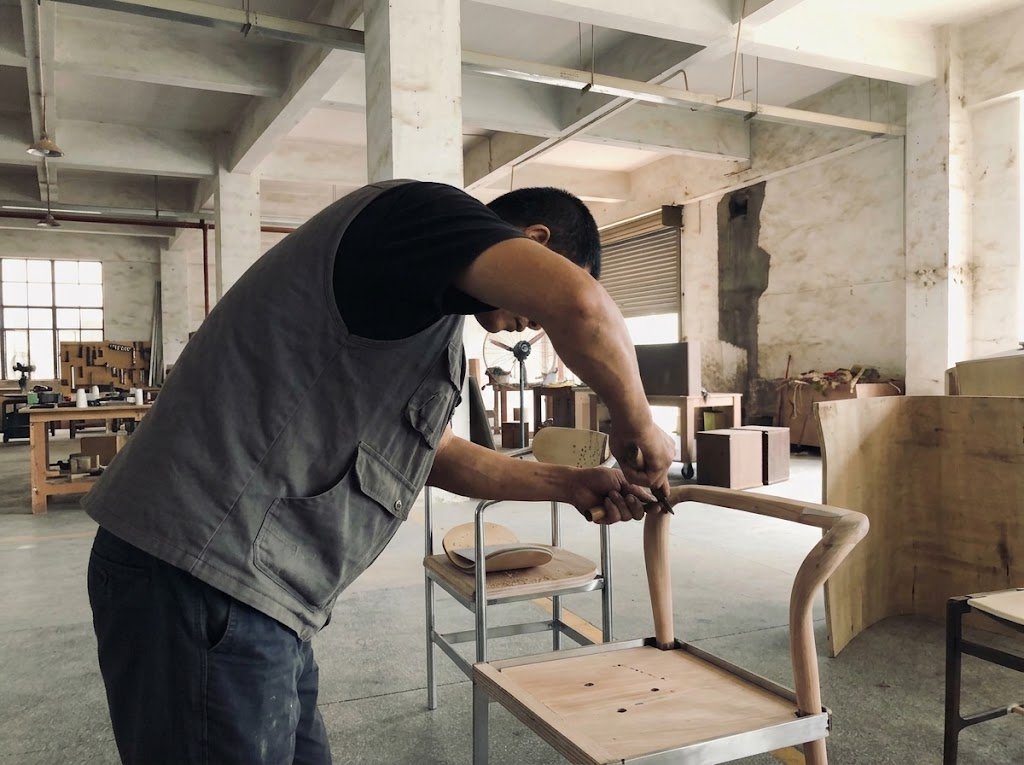
The call came at 11 PM from a warehouse in Long Beach. A $47,000 shipment of dining chairs — the ones a boutique hotel chain had spec’d for twelve properties — had just failed California’s Title 24 structural load test. Not by a little. By 40 percent. The seat pan cracked at 180 pounds when the contract called for 300. The buyer, a procurement director I’d known since her days sourcing in Dongguan, didn’t yell. She just sounded tired. “I walked the floor in Foshan,” she said. “I watched them stack the cartons. I thought I did everything right.”
She had. And she hadn’t. That’s the thing about Chinese contract chairs. The gap between what you see on a factory tour and what survives a UL or EN 1335 test isn’t a matter of dishonesty. It’s a structural mismatch between two entirely different production logics. One logic says: make it look right, ship it fast, price it to move. The other says: document every weld, every foam density, every plywood layer, because a lawsuit in Munich or Miami doesn’t care about your MOQ.
China furniture testing isn’t just about dropping weight on a seat and calling it done. It’s a completely different production philosophy.
I’ve spent fifteen years watching buyers learn this distinction the expensive way. The chairs that collapse aren’t the obvious junk. They’re the mid-grade pieces that photograph beautifully, quote competitively, and fall apart the moment a testing lab applies standardized pressure. The real kicker? Most factories making them aren’t trying to cheat anyone. They’re just building to a different set of assumptions.
The Brutal Truth
Here’s what nobody tells you at the Canton Fair: the majority of Chinese chair factories have never had a single product tested to BIFMA or EN standards. Not because they can’t. Because their entire customer base — domestic hotels, Southeast Asian developers, African trading companies — has never asked. China furniture testing infrastructure, at the mid-tier level, is basically nonexistent.
A factory in Longjiang that ships 8,000 chairs a month might have zero in-house testing equipment beyond a basic weight drop rig. No cyclic testing machine. No durability sled. Nothing that simulates five years of actual use.
The rule of thumb I give buyers? If the factory can’t show you a test report with a lab name you recognize — SGS, Intertek, TÜV, Bureau Veritas — assume the chair was engineered for a photography set, not a contract floor. Period.
And here’s the uncomfortable part. Even when a factory has tested a chair, they may have tested the prototype. Not the production unit. Not the one that left the line in a rush to hit a vessel date. The one you’re holding.
Why the Specs Don’t Travel
What “Contract Grade” Actually Means in China
China furniture sourcing is the process of identifying manufacturers whose production standards align with the regulatory and liability frameworks of your end market — a definition that sounds dry until you’re the one explaining to a general contractor why 200 chairs need to be destroyed.
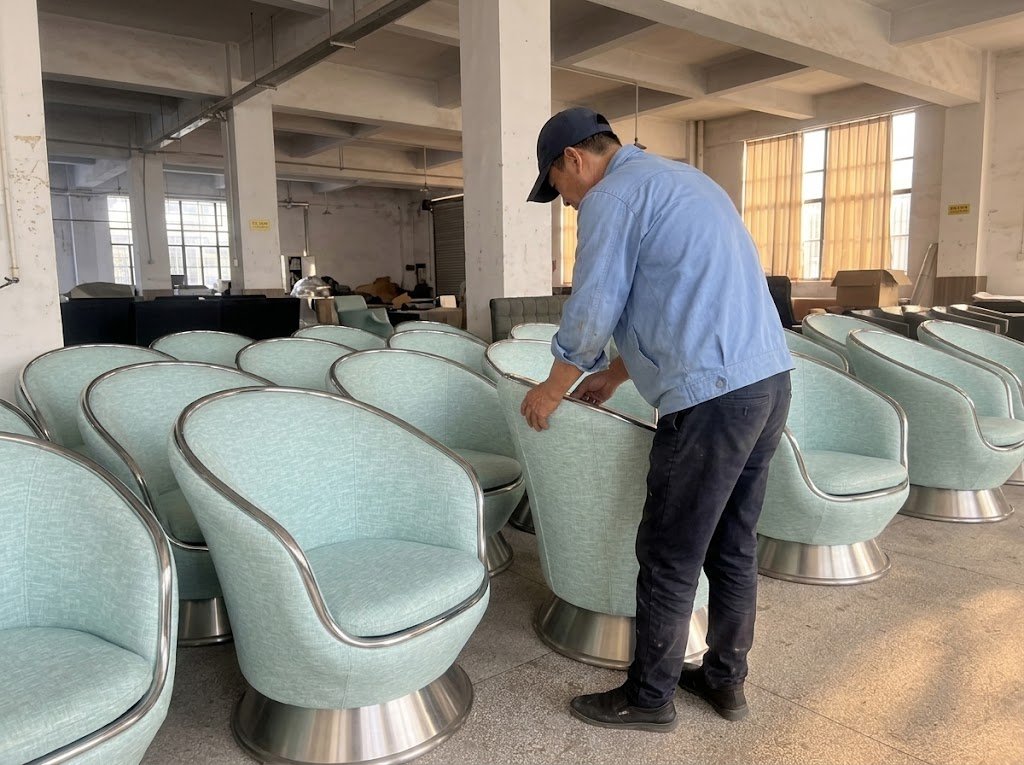
In China, “contract grade” is a marketing label, not a regulated category. A factory in Anji can stamp it on a chair that would fail a basic static load test. A showroom in Lecong can display it under museum lighting while the actual production unit uses thinner tubing. The general pattern suggests that roughly 60 to 70 percent of chairs marketed as “commercial grade” to export buyers would not pass ANSI/BIFMA X5.1 if tested blindly.
But the problem isn’t always the factory. Sometimes it’s the buyer’s own spec sheet. I’ve seen RFPs from US design firms that copy-paste BIFMA requirements into a document, then attach a target price that hasn’t moved since 2019. The factory quotes to the price. Something has to give. Usually it’s the internal frame, the weld penetration, or the plywood thickness under the foam. You can’t see it. That’s the point.
The real comparison here isn’t manufacturing. It’s restaurant kitchens. You can have a beautiful dining room and a filthy line. What the guest sees — the upholstery, the silhouette, the Instagram angle — has almost no correlation with what holds the chair together. The frame is the kitchen. And most buyers never ask to see it.
The Testing Gap No One Talks About
China furniture testing operates on two tracks: what looks good on paper, and what actually leaves the production line. European buyers tend to assume EN 1335 or EN 16139 compliance is universal among export-oriented factories. It isn’t. Based on export data patterns, I’d estimate that fewer than 15 percent of mid-sized chair specialists in Guangdong hold current, product-specific EN test reports for their full catalog. Most have one or two flagship pieces certified. Everything else? Built to the same visual template with lighter materials.
And here’s the thing that still surprises me. Even factories that do test often test the wrong thing. They’ll run a static load test — pile weight on the seat, wait five minutes, check for deflection — and call it done. But BIFMA X5.1 requires cyclic testing: 100,000 repetitions of a standardized load. EN 16139 adds backrest durability, arm strength, and stability on an incline. These tests take days and cost thousands per model. A factory operating on 8 percent margins isn’t going to volunteer for that expense.
Actually, that’s not quite right — what most buyers miss is that many factories will test if you pay for it and specify it upfront. The failure happens when you assume it’s included. It’s not. Testing is a line item. Treat it like one.
I remember standing in a Nankang factory three years ago, watching a production manager explain why their “BIFMA-compliant” chair used 0.8mm wall tubing instead of the 1.2mm the test report showed. “Customer price too low,” he said, shrugging. Not angry. Not defensive. Just stating a fact. The report was real. The chair in the container was real. They just weren’t the same chair.
The Factory Ecosystem: Who Builds What, and Why
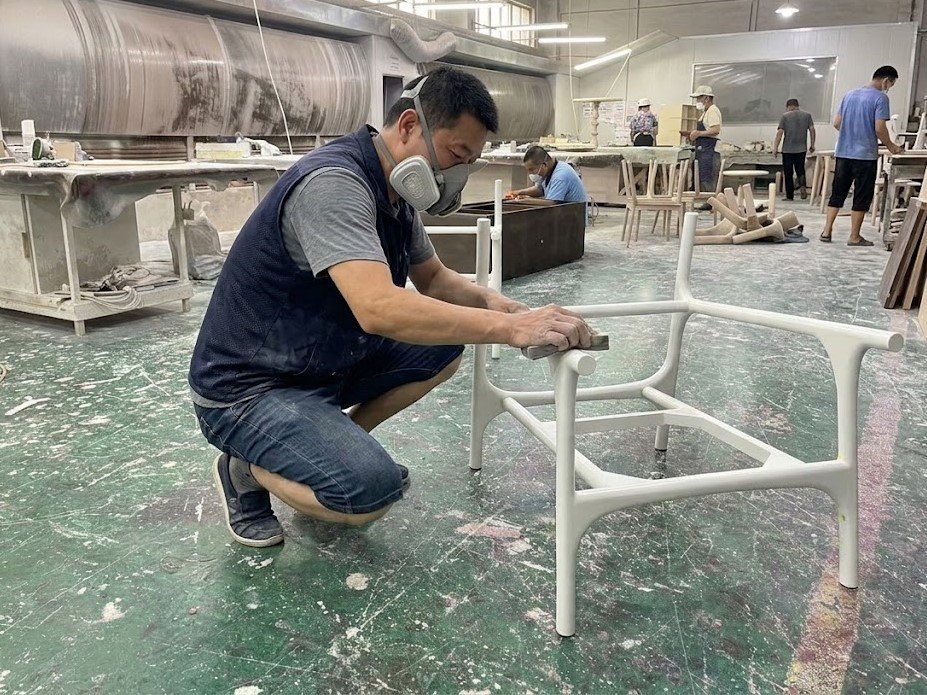
The Chinese contract furniture landscape isn’t monolithic. It’s layered. At the top, you have a handful of large-scale manufacturers with full in-house labs, ISO certifications, and direct relationships with global hospitality brands. They charge accordingly. Below them sits a vast middle tier — hundreds of factories with decent equipment, skilled workers, and zero institutional memory for why a Miami hotel needs Florida-specific wind-load considerations on outdoor contract seating.
While some buyers gravitate toward large-scale manufacturers in Foshan, others find that mid-sized specialists — operations like Interi Furniture, which focuses on custom hospitality and project-based seating — offer a different risk-reward equation. They’re often more flexible on MOQs and finishes, but that flexibility can cut both ways: less rigid production discipline means more variability from batch to batch. The buyers who succeed with these factories are the ones who treat every order like a new qualification process, not a reorder.
Then there’s the bottom tier. Alibaba Gold Suppliers with glossy renderings. Trading companies posing as factories. Operations that will put any certification logo you want on a spec sheet because they know most buyers won’t verify. I’ve seen “ISO 9001 certified” factories that couldn’t produce the certificate when asked. The smoke and mirrors aren’t subtle. You just have to know to look.
Your Pre-Shipment Playbook
Before you sign a PO for contract chairs out of China, run this checklist. Not after the deposit. Before.
- Demand batch-specific testing — not a catalog report. A test report from 2021 proves nothing about the chair being built today. Pay for random-sample testing from the production line. SGS or Intertek can pull units and run full BIFMA or EN suites.
- Specify the frame. In writing. “Metal frame” isn’t a spec. “1.2mm wall thickness 304 stainless, fully welded joints, no spot welding on load-bearing connections” is. If the factory pushes back on detail, that’s data.
- Inspect the plywood. Most seat failures start here. Contract chairs need marine-grade or high-density plywood under the foam, not the particle board used in residential pieces. Ask for the supplier name. Verify it.
- Reject the “same as sample” promise. The sample room chair was probably built by the owner’s brother-in-law with extra attention. Production was built by a rotating shift at 2 AM. Different animals.
- Budget 8–12% of PO value for third-party QC and testing. Buyers who skip this to “save money” aren’t saving money. They’re buying a very expensive education.
— Red flag that contradicts conventional wisdom: A factory that immediately says yes to every spec without questioning price or lead time. The good ones push back. They’ll tell you that adding fire-retardant foam will change the upholstery tension. They’ll warn you that a 1.5mm wall tube in that gauge will create welding challenges. The factories that nod along and promise everything? They’re not listening. They’re calculating what they can swap out after you leave.

FAQ: What Buyers Actually Ask
Q: If a factory shows me a BIFMA certificate, does that mean my chairs will pass?
A: Not necessarily. The certificate applies to a specific model, tested at a specific time, often in a specific configuration. If you changed the finish, the foam, the fabric, or the base dimensions, you may have invalidated the test without knowing it. Always ask: “Is this certificate for the exact SKU, configuration, and material specification I’m ordering?” If the answer involves hesitation, pay for retesting.
Q: Are chairs from big-name Chinese export brands safer than no-name factories?
A: Generally, yes — but “safer” doesn’t mean “foolproof.” Large brands have more to lose from a recall and typically maintain better documentation. That said, I’ve seen branded chairs fail testing because a buyer negotiated a custom color that required a different plating process, which weakened the joint. Brand name is a starting point, not a guarantee. Due diligence still applies.
Q: How much more should I expect to pay for true contract-grade construction versus “hotel lobby” aesthetic grade?
A: In my experience, roughly 25 to 40 percent more at the factory level. The gap isn’t in the visible materials — it’s in the internal frame, the welding time, the foam density, and the testing overhead. A chair that quotes at $38 FOB versus one at $52 FOB often represents the difference between a two-year lifespan and a ten-year one. Do the math on replacement cost before you celebrate the lower quote.
Q: Can I fix a failing chair with better packaging or thicker foam?
A: No. Packaging protects against transit damage. Foam affects comfort and fire rating. Neither compensates for a structurally inadequate frame. If the base metal or plywood is underspec, the chair will fail in use regardless of how beautifully it’s upholstered.
Q: Is China furniture testing reliable for US and EU contract projects?
A: It depends entirely on which track you’re on. If you’re working with a factory that maintains in-house cyclic testing and third-party lab partnerships, the results are as reliable as anything out of Europe. But if you’re relying on the factory’s own “internal QC” without recognized lab documentation, then no — China furniture testing at that level is often a visual check, not a structural validation. Always demand batch-specific, third-party verification.
Q: So is the title true — do Chinese contract chairs actually collapse under US and EU specs?
A: It depends on whether the chair was built for those specs. Chairs engineered and tested to BIFMA or EN standards perform fine. The ones that collapse are the chairs that were never designed for that burden in the first place — they were designed for a price point, a render, and a container deadline. The failure isn’t Chinese manufacturing. It’s a mismatch between expectation and specification.
The Hard Lesson
At the end of the day, the chair that collapses in a testing lab isn’t the factory’s failure alone. It’s a procurement failure. It’s a failure to ask the boring questions about wall thickness and weld penetration. It’s a failure to budget for verification instead of just negotiation.
I’ve watched too many buyers treat furniture sourcing like buying a commodity — rice is rice, a chair is a chair. It isn’t. A contract chair is a liability instrument with upholstery on it. Every pound of static load it fails to bear is a potential lawsuit, a bad TripAdvisor review, or a midnight phone call from a warehouse.
The question isn’t whether Chinese factories can build chairs that pass US and EU testing. They can. The question is whether you’re willing to pay for that capability — and whether you have the discipline to verify that you actually got what you paid for.
Safe sourcing out there. And remember: if you can’t see the frame, you don’t know what you’re buying.