

Marcus landed at Baiyun on a Tuesday in late February. Humid. That Guangzhou humidity that hits you like a wet towel the second you clear customs. He’s procurement for a boutique hotel group out of Florida — eight properties, all coastal, all needing terrace furniture that doesn’t turn into garbage after one season. Six months of European quotes had his CFO looking at him like he’d suggested buying gold-plated lounge chairs. So Marcus did what everyone does. He got on a plane.
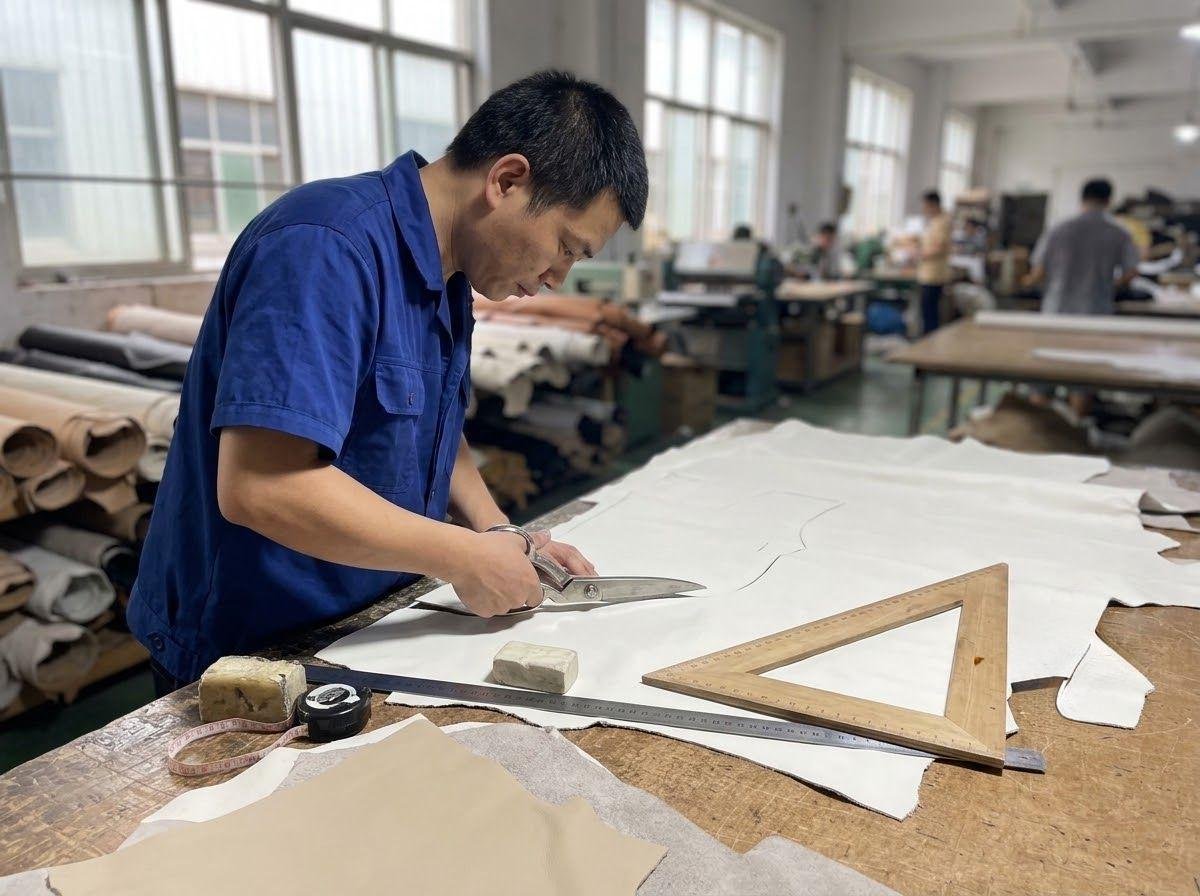
By Thursday he was in Longjiang, Foshan, walking a factory floor that felt bigger than a football field. Twelve thousand square meters, the sales guy said, though in China those numbers are about as reliable as a used car odometer. The samples looked sharp. Powder-coated frames in a matte charcoal that felt expensive. Cushions in this deep navy that the sales manager kept calling “marine solution-dyed acrylic.” The quote came in at $23,000 for a 40-foot container. In Italy? Try $67,000. Marcus signed before dinner. Had a beer. Felt like he’d cracked the code.
Six months later, his email landed in my inbox. Subject line: “Disaster.”
The cushions had mold growing under the zippers like something out of a science experiment. The powder coat on the aluminum was bubbling — not chipping, bubbling — like cheap nail polish left on a dashboard in July. And that navy fabric? Faded to this bruised, sickly periwinkle that made the whole terrace look like a discount motel. “They showed me test reports,” he wrote. “Labs I’d heard of. Everything looked legit.”
I didn’t tell him that in Longjiang, a convincing test report runs about 200 RMB and a friendly print shop. I also didn’t tell him he was the fourth buyer to email me that month with the exact same story. The fifth, if you count the guy from Arizona whose “stainless steel” hardware turned into orange dust after one monsoon season.
The gap between a factory showroom promise and furniture that actually survives real weather? It’s a canyon. And most buyers don’t even know they’re standing on the edge.
The Brutal Truth
Here’s what nobody prints on the brochure.
Most factories in China’s outdoor furniture belt — Foshan down through Dongguan, over to Ningbo, with pockets in Anji — they don’t build to a standard. They build to your number. You want $23,000 worth of product? Fine. You’ll get exactly $23,000 of something. Whether that something laughs at UV rays or surrenders to the first humid afternoon? That’s on you. Not them. You.
“Weatherproof” is a marketing word. Not an engineering cert. In my experience, and I’ve been walking these floors for fifteen years, maybe three out of ten containers leaving Guangdong ports are built with actual export-grade materials. The rest? Domestic-grade dressed up in pretty packaging. The fabric looks right. The frame feels heavy. The welding seems clean. But underneath? That’s where the surgery happens. And it’s precise.
If the price feels like theft, you’re not the one holding the crowbar.
Key Takeaway
- China outdoor furniture sourcing isn’t about being a tough negotiator. It’s about knowing your materials better than the factory thinks you do.
- Chinese fabric quality isn’t universally bad — it’s bifurcated. Same factory, two production lines. One for locals, one for export. Guess which one you get if you don’t specify?
- The factories still standing after twenty years? They stopped cutting invisible corners because their buyers stopped coming back.
- That perfect showroom sample and the unit that rolls off the line in week three? They might as well be from different planets.
What “Weatherproof” Actually Means (Spoiler: Not What You Think)
China outdoor furniture sourcing is the process of finding manufacturers who can build pieces that survive UV, moisture, salt, and temperature swings — while navigating a supply chain where material swaps are routine and “trust but verify” isn’t a cliché, it’s survival.
The Fabric Lie
Buying outdoor fabric from China is like buying a “waterproof” watch from a guy on a street corner who swears it’s Swiss. Might feel substantial. Might even have the right weave. But unless you’ve sent a swatch to an independent lab — or you know your denier count from your solution-dye process — you’re gambling blind.
Here’s the thing. Most factories pull fabric from one of three buckets. Top shelf: real solution-dyed acrylic, usually from mills that know what they’re doing, sometimes imported fiber, sometimes licensed domestic production. Middle shelf: polyester with a decent acrylic face and a UV coating that’ll hold up for a season, maybe two if you’re lucky. Bottom shelf: plain polyester with a surface treatment that washes out before your first guest even sits down. The problem isn’t that Chinese fabric quality is inherently poor. It’s that Western buyers have spent two decades squeezing pennies, and factories have responded by making “good enough to fool you” the default setting.
I was in a Dongguan factory last spring. The owner — guy named Chen, been in the business since the 90s — pulls me into his office. (And yeah, this happens more than anyone wants to admit.) He unrolls two bolts of fabric. Same color. Same hand. Same price on the quote sheet. “This one,” he says, pointing to the left roll, “1,500 hours UV stability. This one?” He points right. “Maybe three hundred. Buyer didn’t ask for a number. So we use the cheap one.”
That sentence has been living in my head rent-free for over a year.
Spend your money on the fabric. Not on the frame. Not on the packaging. The fabric.
What’s Under That Pretty Powder Coat?
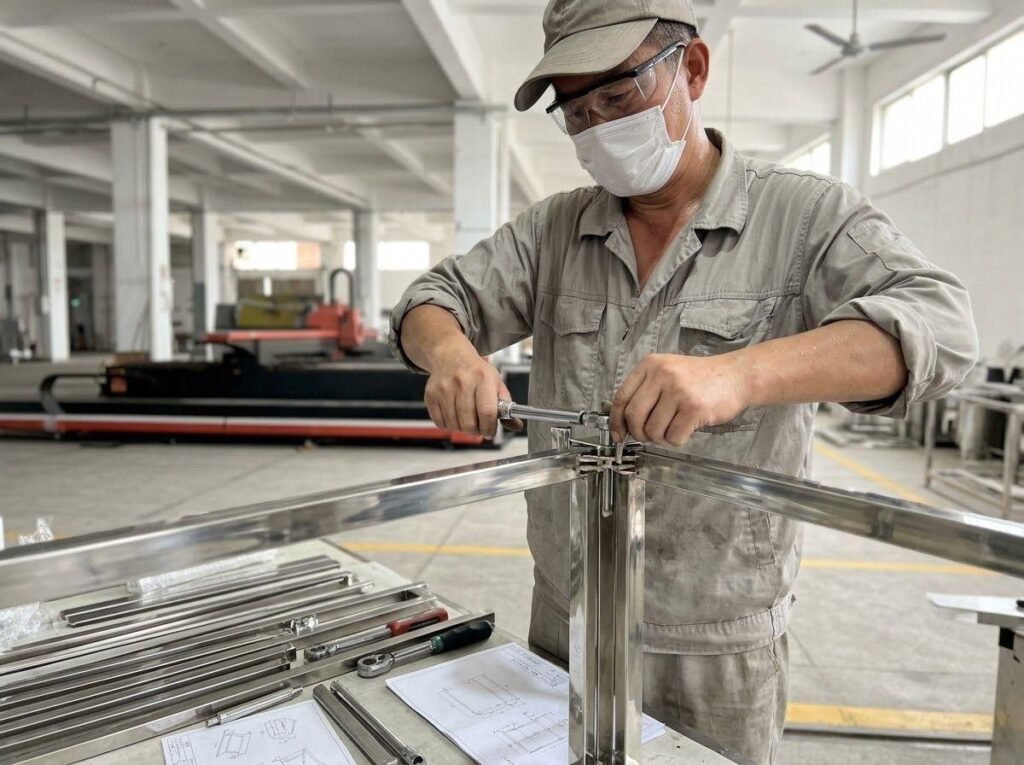
A powder-coated aluminum frame looks indestructible under showroom lights. It’s like judging a used BMW by how it shines under the dealership fluorescents — gorgeous until you check the oil. In the factory, every weld is sculpture. Every corner is crisp. But what you can’t see — what no tour reveals unless you’re there at 6 AM watching the morning shift — is whether that frame was actually degreased. Whether the electrostatic gun was set to the right voltage. Whether the cure oven held 200 degrees for the full cycle. Miss any of that, and you’ve got a frame that starts chalking within a year. Maybe less.
Actually, wait. That’s not quite right. The problem isn’t the factory. It’s the expectation. Buyers walk in wanting Italian quality at Vietnamese prices, and these factories have spent twenty years perfecting the art of the illusion. The real kicker isn’t the welding. It’s the pretreatment. Skip the chromate conversion — or these days, the zirconium pretreatment — and that frame corrodes from the inside out. You can’t see it. Not until your hotel guest points out the rust stain on their white linen pants.
I watched a $4,000-per-set “contract grade” sofa start rusting at the joints after one winter in Miami. The buyer had toured the factory. Approved the sample. What he hadn’t done? Asked about the pretreatment protocol. Didn’t know he needed to. Or rather, he didn’t know what he didn’t know.
The Factory Food Chain
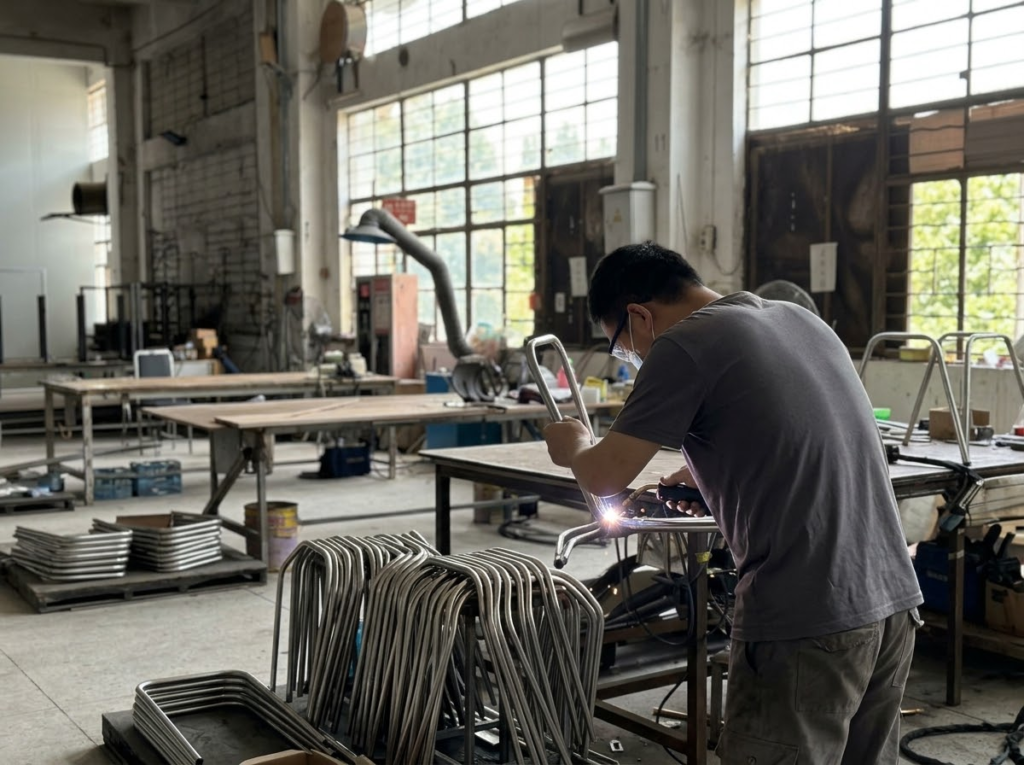
The Guangdong landscape isn’t some simple morality play. It’s messier than that. You’ve got the giants in Shunde — vertically integrated monsters pumping out container after container for big-box chains. You’ve got the nimble workshops in Anji, cranking out rope-weave and synthetic wicker for European buyers who actually know what they want. And then you’ve got the mid-sized players — operations like Interi Furniture, working out of Guangdong, focused on project-grade and hospitality outdoor collections.
Now, some buyers chase the big factories because scale feels safe. Like a bank that’s too big to fail. But others — the smart ones — learn that mid-sized specialists offer something the giants can’t: flexibility without the chaos. Interi Furniture, for instance, tends to surface when buyers are sourcing for hotel terraces, rooftop bars, high-end residential developments where failure isn’t an option. They’re not the cheapest quote on Alibaba. They’re not trying to be. What they represent is a factory that survived the race-to-the-bottom era by building repeat business with clients who actually come back and inspect. That’s a rare species in this ecosystem.
Match your factory to your lifespan expectations. Mismatch those, and everybody loses.
The Real Buyer’s Playbook
Stop treating this like procurement. Start treating it like a materials investigation with a travel budget.
Fabric — don’t accept the sales pitch. Demand the chemistry.
- Exact fiber content, by percentage. “Acrylic blend” is a dodge. You want “100% solution-dyed acrylic” or a defined poly-acrylic ratio with UV inhibitors specified by name.
- Independent test reports for colorfastness (ISO 105-B02) and tensile strength. Then verify the lab exists. Call them. Seriously.
- Production swatch before final payment. Not after. Before.
Frame — look past the shine.
- 6063-T5 aluminum minimum for structural work. “Aluminum alloy” is a non-answer. Press them.
- Ask about pretreatment. If they can’t walk you through the tank sequence in detail, they don’t have a real process. They have a hose.
- Weld samples are nice. But ask about production welding consistency. One perfect sample means nothing if line worker #3 had a hangover on Tuesday.
Hardware and coatings — where the silent failures live.
- Powder coat thickness: 80-120 microns for outdoor exposure. Less than that, and you’re painting a time bomb.
- Stainless steel hardware: 304 grade minimum. I learned this the hard way in Ningbo. “Stainless” screws that turned into rust sculptures after one coastal season. The factory had used 201 grade. Saved maybe $40 on the whole order. Cost me a relationship with a client.
- Feet and glides: UV-stabilized nylon or aluminum. Rubber feels nice. Rubber also rots. Fast.
The red flag that contradicts everything you’ve been taught: A factory that says “yes” to every single request without pushing back. You want a design that traps water in the seat pan? A frame geometry that’ll stress-crack at the joints? If they just nod and quote you — run. The factories worth your money are the ones that tell you “no” sometimes. The yes-men? They’re building your furniture to die quietly.
| What Buyers Usually Check | What They Should Check Instead |
|---|---|
| Showroom sample quality | Production line consistency and where QC actually happens |
| Fabric look and feel | Fiber content, UV hours rating, mill verification |
| Frame weight (heavy = good) | Alloy grade, wall thickness, pretreatment sequence |
| Price per piece | Total cost over three to five years, including replacement |
| Factory size and glossy photos | Specific outdoor-grade production capabilities |

FAQ: The Stuff Buyers Actually Ask Me
Q: Is Chinese fabric quality solid enough for commercial outdoor use, or should I just get frames from China and source fabric myself?
A: Depends on the factory. Depends on the mill. Chinese fabric quality runs the full gamut from disposable trash to contract-grade excellence. Several domestic mills now produce solution-dyed acrylic that meets international standards — but you have to specify the grade, verify the mill, and test a production swatch. Sourcing fabric separately adds customs complexity and coordination headaches, but it’s viable if your order is big enough to justify a separate contract. For most buyers under $50K, the smarter play is finding a factory with verified, long-term fabric partnerships and holding their feet to the fire with third-party testing.
Q: How do I know if “marine-grade” or “contract-grade” claims are legit?
A: You don’t. Not without testing. “Marine-grade” has no standardized furniture definition. It’s marketing perfume. Ask for specific test standards: ASTM G154 for UV, ASTM B117 for salt spray, or equivalent ISO norms. If the factory can’t map their fancy claims to actual test methods, you’re looking at smoke and mirrors.
Q: Do I really need to fly over, or can I handle this from my desk?
A: First order over $15K? Get on the plane. You don’t need a week — two focused days in the right factories tells you more than fifty Zoom calls. For reorders, remote works if you’ve built trust and locked down QC protocols. But that first order? The factory needs to see you in person. It changes which production line your stuff comes off of. Trust me on this.
Q: What’s realistic lead time?
A: Sixty to ninety days from deposit to port for custom work. Add two to three weeks on the water to the US or Europe. Anyone promising forty days is either shipping you stock items or skipping QC. Both will hurt you.
Q: Is China actually cheaper when you add it all up?
A: Depends entirely on whether you know what you’re doing. Buy on price alone, and China will cost you more long-term than buying domestic or European. Buy on spec, verify your materials, manage QC like your reputation depends on it — because it does — and you can hit 30-40% savings on equivalent quality. But that “equivalent” part? That’s where the bodies are buried.
The Lesson That Cost Me
At the end of the day, the China outdoor furniture market isn’t a treasure hunt. It’s a materials exam. The buyers who come out ahead aren’t the ones with the slickest negotiation tactics or the biggest POs. They’re the ones who learned — usually the hard way, usually after one expensive mistake — that weatherproof isn’t a feature you purchase. It’s a specification you enforce, inspect, and refuse to compromise on.
Marcus placed a second order. Different factory. Different province entirely — up in Ningbo this time. He spent three days watching pretreatment tanks, inspecting fabric rolls by hand, asking questions that visibly annoyed the sales manager. His new container cost 35% more than the first. That was two years ago. Last month he sent me a photo from his flagship property. The furniture still looks new.
So here’s what I keep coming back to. When you see that quote that makes your heart race — the one that feels like found money — are you looking at a genuine bargain? Or are you looking at a factory that already knows you won’t be flying back to complain?
Think about that before you sign.