

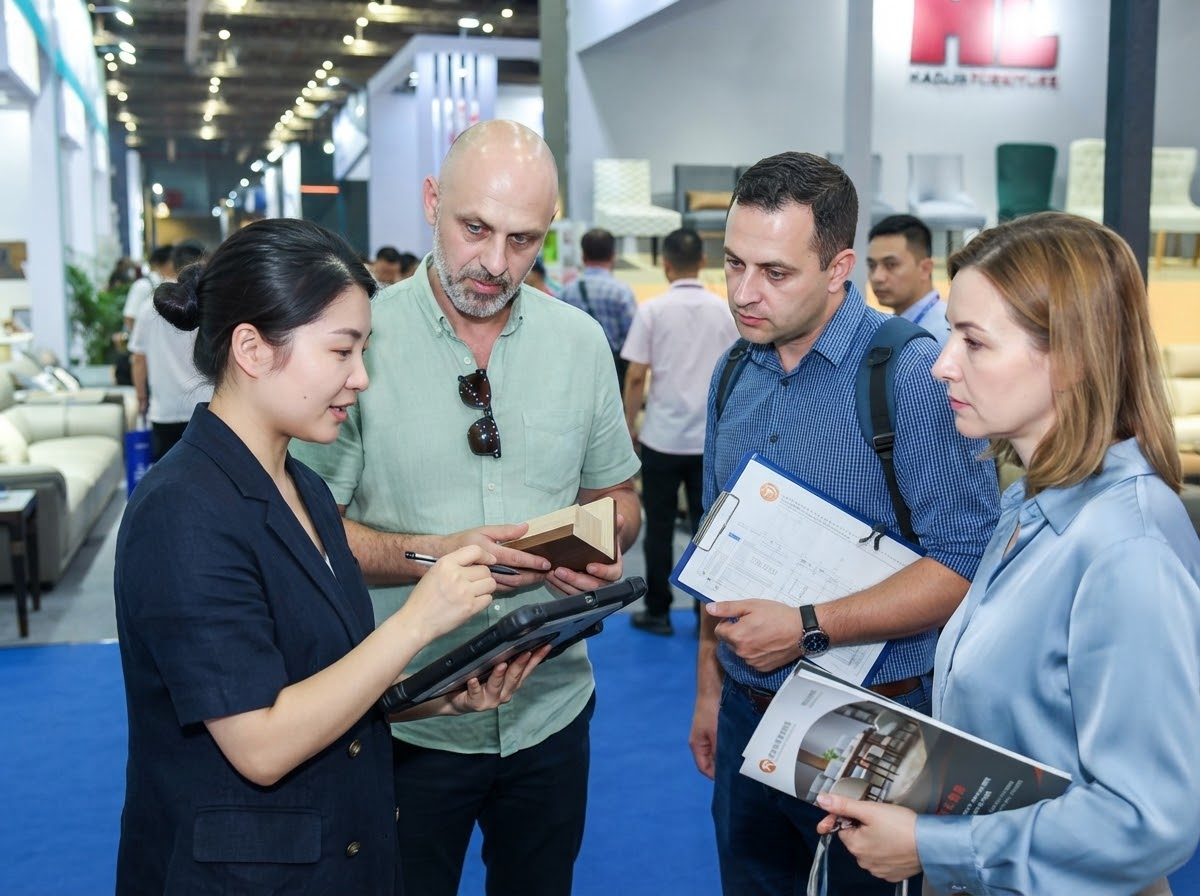
Last March. Pazhou Complex, Hall 9.2. I’m watching this guy from Miami — tan, polo shirt, probably flew business — get quoted $340 for a solid oak dining chair. Same chair. Three hours later, a procurement guy from some Dubai hotel group walks out with the identical piece at $127. Miami’s taking 200 units. Dubai? Eighty. So much for volume discounts, right?
The chair didn’t change. The story did. That’s the whole game, and CIFF is where they play it right in front of you. Fifteen years walking these halls, and I’ve watched thousands of buyers leave money on the table because they treated the fair like a damn catalog. They ask MOQ. They ask lead time. They never ask who actually owns the tooling. Or why that “factory direct” booth is just a trading company renting space and slapping 40% on top before your container even sniffs the port.
That gap — $213 on one lousy chair — that’s what this article is about.
The Brutal Truth Nobody Wants to Hear
Most CIFF quotes? Fiction. Not lies, exactly. Fiction. Carefully built stories that make you feel smart while the real margin hides in plain sight.
The factory isn’t robbing you. They’re surviving. Labor in Guangdong’s been climbing for a decade straight. Raw materials swing like a drunk pendulum. And that booth? Costs real money. That $340 chair? It’s carrying the booth rental, the sales rep’s commission, the free espresso, and the assumption you’ll never step onto the actual production line in Longjiang.
Here’s the rule of thumb: if you can’t smell sawdust, you’re not at the factory. You’re at a middleman with a business card.
Key Takeaways
- China furniture sourcing is the process of finding, vetting, and cutting deals directly with the people who actually make the stuff — not the intermediaries — so you pay for production, not showroom theater.
- The gap between a CIFF booth quote and real factory floor pricing? Industry observers estimate it runs 35% to 60%, depending on how many hands touch your order before a single board gets cut.
- Your leverage isn’t how much you’re buying. It’s knowing the factory’s real cost structure, who’s got idle capacity this month, and who else they’re quoting that exact same SKU to right now.

What That Price Tag Actually Covers
Think of a CIFF quote like a restaurant menu in a tourist trap. You’re not paying for the food. You’re paying for the address, the lighting, the English translation, and the comfort of not having to wander into the back alleys where the locals actually eat.
A standard booth quote bundles at least four layers you never see. There’s the factory’s base cost — materials, labor, keeping the lights on. Then the trading company’s cut, anywhere from 15% to 35%. Then the “CIFF premium” — the markup factories slap on during fair season because they know you’re jet-lagged, time-pressed, and making decisions under fluorescent tubes. Finally, the “foreign buyer tax.” Not always intentional. Sometimes it’s just the sales team playing it safe. They pad the number because they figure you’ll negotiate down anyway. Better to start high and meet in the middle than start at cost and have nowhere to go.
Actually, wait. That’s not quite right. The biggest markups aren’t in the product. They’re in the assumptions. The factory assumes you need white-glove service. Assumes you want every piece individually wrapped. Assumes you’re buying FOB when you could go EXW and shave 8% off freight handling. Assumes you don’t know that same walnut veneer costs 22% less if you source through a timber broker in Dongguan instead of letting them bundle it.
Why Do Two Buyers Get Different Quotes for the Same Product?
Because the factory reads you before you read them. Walk in wearing a tailored suit with a leather portfolio? Number goes up. Show up in jeans with a factory address scribbled on a napkin? Whole different conversation.
In my experience, roughly seven out of ten CIFF exhibitors will quote differently based on how sophisticated you look. It’s not personal. It’s math. They’ve got thirty minutes per buyer, four days of fair, and a quota to hit. If they think you’ll swallow a high opening, they open high. If they sense you’ve already been to Longjiang and know what a CNC operator earns per hour, they cut the crap.
The real kicker? Factories often prefer the sophisticated buyer. Not because they make less money — because educated buyers place cleaner orders. Fewer revisions. Less babysitting. Thinner margin, but way less headache.
Where the Real Costs Hide
Foshan gets all the glory. Buyers fly into Guangzhou, hop the metro to the furniture district, and think they’ve seen China. They haven’t. They’ve seen the showroom layer — the polished tip of an iceberg that stretches through Dongguan, Longjiang, Anji, Nankang.
Each cluster prices differently. Foshan does upholstered and high-end residential. Spectacular showrooms. Prices that reflect the spectacle. Dongguan runs tighter on metalwork and commercial case goods. Longjiang, up in Shunde’s northern edge? That’s where you find the actual floors. Concrete. Ceiling fans instead of AC. Prices that make you wonder if someone forgot a zero.
And here’s where it gets messy. A sofa frame built in Longjiang, upholstered in Foshan, shipped through a Guangzhou trading company — margin at every handoff. You see one price, one brand, one promise at CIFF. What you don’t see? The Longjiang workshop selling the bare frame for $89. The Foshan workshop adding foam and fabric for $140. The trading company slapping $340 on it because they paid for the booth.
While some buyers gravitate toward the big names in Foshan with their glossy catalogs and ISO certs, others find that mid-sized specialists — operations like Interi Furniture, which focuses on high-end custom contract work for hotels and hospitality projects out of its Panyu facility — offer a different risk-reward equation. These aren’t your cheapest option at the fair. But for buyers who need bespoke dimensions, specific timber species, or full FF&E coordination across a property rollout, that direct-to-factory relationship can cut out two or three margin layers that usually pad a standard CIFF quote.
How Do You Know When You’re Paying for Production vs. Theater?
Ask to see the workshop. Not the sample room. The workshop. If the sales rep hesitates, changes the subject, or offers a “factory tour” that somehow needs three days’ notice and a deposit? You’re not at the factory. You’re at a filter.
The workshops that welcome walk-ins — where you see the glue pots, the sanding stations, raw timber curing out back — those are the ones with nothing to hide. Their quotes come with context. They’ll tell you oak spiked last month because of a Korean buying surge. They’ll show you the difference between their Grade A leather and the Grade B they’d use if you want to hit a lower number. They’ll negotiate in real time because they know their numbers cold.

What Actually Works on the Showroom Floor
Most buyers negotiate like they’re buying a used car. Counter lower. Threaten to walk. Mention a competitor’s quote. None of it’s wrong. None of it’s particularly effective at CIFF either.
Factories have heard it all. Thousands of buyers, same dance. What moves the number? A buyer who understands their cost structure better than they do.
| What Most Buyers Do | What Actually Works |
|---|---|
| Ask for a discount on the quoted price | Ask for the breakdown by component — material, labor, overhead, profit |
| Compare quotes across booths | Compare quotes across industrial zones — same product, different geography |
| Negotiate on order volume | Negotiate on payment terms and production timing |
| Accept “factory direct” at face value | Verify the license, visit the workshop, confirm they own the tooling |
| Obsess over unit price | Focus on total landed cost, including who controls the shipping consolidation |
The buyers who get closest to true Chinese factory pricing don’t have the biggest orders. They have the best intel. They know February is dead season in Longjiang and a factory with idle workers will trade margin for cash flow. They know Chinese New Year creates a pricing window in late January when factories are desperate to fill Q1 slots. They know that same chair quoted at $340 in March might be $195 in November if you catch the right workshop during a quiet month.
And here’s the part that sounds backwards: sometimes the best CIFF price negotiation tactic is to stop negotiating and start designing. Bring the factory a custom spec — modified leg profile, specific foam density, a fabric they don’t stock — and you force them off their standard pricing template. They can’t reference their “CIFF price list” because you changed the product. Now you’re talking real costs: extra labor hours, additional material, setup charge for a non-standard cut. The China furniture markup becomes transparent because it has to be calculated from scratch.
Your CIFF Negotiation Playbook
Don’t print this and laminate it. Internalize it. The buyers who execute this well don’t carry clipboards. They carry context.
Do your homework before you land. Know rough material costs for your category. Oak lumber, high-density foam, Italian leather — prices fluctuate, but not randomly. Walk into a booth knowing walnut veneer runs about $18 per square meter and the rep quotes you $32? You just spotted the padding.
Split your visit. Day one is recon. Don’t negotiate. Don’t even pull out your wallet. Walk the halls, collect cards, note which booths have the same product shot from slightly different angles. That’s your first clue about shared factories. Days two and three? Real conversations, armed with cross-references.
Ask the uncomfortable questions. Who owns the tooling? Where’s the actual production facility? Can I visit this week? What’s the price if we strip out packaging, assembly, export docs? Most buyers never ask these because it feels rude. It’s not rude. It’s due diligence.
Separate the product from the service. A factory that quotes $127 for the chair and $48 for “project management” is being honest. A factory that bundles it all into $340 and calls it “full service” is being strategic. Honest is better. You can negotiate the $48. You can’t negotiate what you can’t see.
Lock in timing, not just price. A factory with a hole in their schedule next month will cut a sharper deal than one booked through Q3. Your flexibility is currency.
Get it in writing with real specs. Not “solid wood.” Not “genuine leather.” Actual specs: timber species, foam density, fabric grade, hardware source. The quote that balks at this level of detail? That’s the quote with the most to hide.
Red flag: walk away from any booth that won’t give you a Guangdong address. This goes against the conventional wisdom that bigger fairs mean better factories. Some of the best workshops in China don’t exhibit at CIFF at all. Can’t afford the booth. Don’t need to — their books are full from word-of-mouth. If a booth claims “factory direct” but only offers a Hong Kong trading address or vague “South China” location, you’re paying for opacity. Not production.

FAQ: The Questions Buyers Actually Ask
Q: I’m tiny. Like, 20 chairs for a boutique hotel renovation. Is it even worth trying to negotiate at CIFF, or will they just blow me off?
A: They won’t blow you off if you bring precision. Small orders with exact specs, clear timelines, and no hand-holding are often more profitable for a factory than big orders with endless revisions. They care less about your unit count and more about whether you’ll cost them time.
Q: How do I know if the “factory” I’m talking to is actually a trading company with a fancy booth?
A: Ask for the business license (营业执照). Thirty seconds. Tells you everything: registered capital, business scope, founding date. If the scope says “trading” or “commerce” instead of “manufacturing,” you’re not at the factory. Trading companies love talking about their “partner factories.” Real factories talk about their machines.
Q: Everyone says “visit the factory.” But I’m flying in for three days and CIFF alone takes two. When am I supposed to do this?
A: Skip a morning of the fair. Seriously. Booths will still be there at 2 PM. Grab a Didi to Longjiang or Shunde at 8 AM, spend three hours in a workshop, and you’ll learn more than three days of booth chatter. The $30 ride and lost morning will save you thousands in avoided markup.
Q: Is there ever a situation where paying the higher CIFF quote actually makes sense?
A: Yeah. If you need turnkey — design, sampling, consolidation, shipping, install coordination — and you genuinely can’t manage five separate vendors, the trading company’s markup is buying you time and risk transfer. Just know what you’re paying for. Don’t pretend it’s factory pricing.
Q: Can I really negotiate a CIFF quote down to true factory floor prices, or is that just a myth?
A: Depends what you mean by “true.” You’ll never hit the price they charge their domestic distributor — that relationship has volume and history you can’t touch. But can you get within 10% to 15% of it? Yes. If you know material costs. If you visit the workshop. If you time your order during a slow month. If you handle your own logistics. The gap is real. Closing it is work.
The Hard-Earned Lesson
Fifteen years watching buyers win and lose in these halls. The pattern’s always the same. The ones who get the best prices aren’t the toughest negotiators. They’re the most informed. They know every dollar of markup is someone’s rent, someone’s commission, someone’s assumption about what they don’t know.
And what they don’t know — what most buyers never figure out — is that the factory floor price isn’t a secret. It’s just behind a door most people never open.
So here’s the question: are you buying furniture? Or are you buying the story someone sold you about it?
Safe sourcing out there. I’ll see you in the back alleys of Longjiang.