

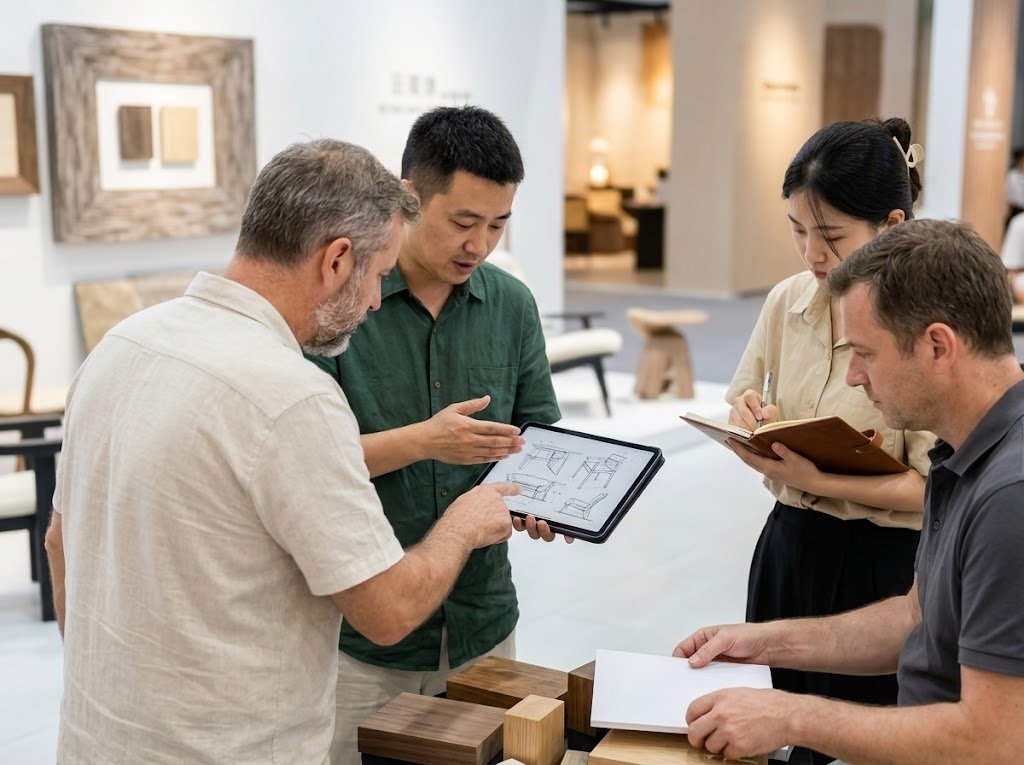
I was standing in Hall 9.2 of the Pazhou Complex at CIFF Guangzhou last March, watching a sales rep in a tailored blazer explain “their” CNC machining capabilities to a Swedish hotel developer. The booth was 200 square meters of polished marble and backlit acrylic. The catalog was gorgeous. The MOQ was flexible. The price was almost suspiciously sharp.
Here’s the thing. I’d been to the actual factory three weeks earlier. It was a converted warehouse in Shunde with a dirt floor and one working edge-bander. The “factory owner” at CIFF? He was a trading company principal who’d rented the booth, outsourced the production to three separate workshops, and slapped his logo on everything. The Swedish buyer didn’t know. Most don’t. He’d just shaken hands with a CIFF fake factory — a polished trade show shell company renting credibility by the square meter.
This isn’t a rare story. It’s Tuesday. And if you’re dropping six figures on a hotel furniture package based on a CIFF handshake and a glossy brochure, you’re gambling with money you probably can’t afford to lose.
The Brutal Truth: Most Booths Aren’t What They Seem
Let’s get this out of the way. The majority of exhibitors at CIFF are not manufacturing what they’re selling. Not directly, anyway. They’re coordinating, aggregating, outsourcing, and white-labeling. Some do it transparently. Most don’t.
The uncomfortable reality? A stunning booth is often inversely proportional to actual factory investment.I’ve seen $80,000 exhibition setups backed by $12,000 worth of production equipment. I’ve seen “manufacturers” who don’t own a single drill press. This is the trade show shell company model in action — they rent capacity, rent credibility, and rent your trust.
Here’s my rule of thumb: If a company at CIFF can’t show you a video of their actual production floor — not a stock footage reel, not a sanitized marketing clip, but their floor, their workers, their dust — within 48 hours of your request, they’re not a factory. Full stop.
And here’s what nobody tells you. This isn’t always a scam. Sometimes it’s just how the industry works. The problem isn’t the outsourcing. It’s the lie.
Key Takeaways
- A high-end CIFF booth does not guarantee in-house manufacturing capability; many “factories” are actually trading companies or shell operations.
- China supplier verification requires evidence of production assets, not just marketing materials or exhibition presence.
- Outsourcing itself isn’t fraudulent — the deception is. The best defense is a verification process that assumes good faith but demands proof.
- Geographic consistency matters: if a company’s registered address, exhibition claims, and actual production location don’t align, that’s your first warning signal.

How the Shell Game Actually Works
Think of the CIFF floor like a dating app. Everyone’s showing their best photo, using their best lines, and promising things they can’t necessarily deliver. The “factory” with the immaculate booth and the perfectly rehearsed pitch? That’s the profile with the professional headshot and the suspiciously generic hobbies. The real production floor — the one with the leaking roof and the 14-hour shift workers — that’s the person who shows up to coffee wearing yesterday’s shirt. You never match with that person. You match with the brand.
The CIFF fake factory playbook — what industry veterans recognize as the classic trade show shell company model — is surprisingly elegant in its simplicity. A trading company — or sometimes just a well-connected individual — rents premium booth space at CIFF. They hire a design team to build something that screams “we own heavy machinery.” They stock sample pieces that may or may not have passed through their hands. And they hire sales staff who can talk tolerances and veneer matching with complete confidence.
But here’s the insider detail most buyers miss. (And yes, this happens more than anyone admits.) The giveaway isn’t in what they say. It’s in what they can’t show you. Ask for a video call from the workshop floor on a Tuesday afternoon — not a scheduled tour, not a prepared presentation, just a spontaneous look at what’s happening right now. A real factory will hesitate, then comply. A shell operation will deflect, delay, or disappear.
The production itself gets scattered across a network you can’t see. One workshop cuts the wood. Another does the upholstery. A third handles the metal frames. The shell company acts as the conductor, not the orchestra. Quality control? A game of telephone. By the time your hotel lobby sofas arrive in Copenhagen, nobody can quite remember who was responsible for the sagging cushions.
Actually, that’s not quite right — what most buyers miss is that some of these shell operators are incredibly good at coordination. The product isn’t always terrible. Sometimes it’s fine. The risk isn’t just quality. It’s accountability. When something goes wrong — and eventually, something goes wrong — you have no single throat to choke. Just a WeChat contact who stopped responding.
Why Does the “Factory Owner” Look So Convincing?
Because they’ve had years of practice. The best shell exhibitors at CIFF aren’t fly-by-night operations. They’re sophisticated traders who understand exactly what international buyers want to hear. They know the vocabulary. They know the pain points. They know that a European buyer worries about E1 emissions standards and a North American buyer wants to talk about CARB Phase 2 compliance. They’ve rehearsed the script.
The confidence is real. The expertise is borrowed. And the factory? Rented by the hour when you visit, or simply never yours to see.
Where Does the Production Actually Happen?
In the shadows. The general pattern suggests that most outsourced CIFF production gets pushed to small workshops in the industrial zones surrounding the major clusters — the places that would never pay for booth space because they don’t speak English and don’t have export licenses. Shunde’s backstreets. The outskirts of Longjiang. The unmarked buildings in Dongguan’s Chang’an district. These workshops survive on overflow orders from the brands you meet at the fair.
And some of them do beautiful work. Others use glue that fails at 60% humidity. You won’t know which until it’s too late.
Reading the Geographic Fingerprints
China furniture sourcing is the process of identifying, vetting, and contracting manufacturers across China’s fragmented production landscape — a landscape where the company name on the booth often has little to do with the hands that actually build your pieces. Understanding this distinction is what separates experienced buyers from first-timers who get burned.
The geography of Chinese furniture manufacturing follows a pattern that hasn’t changed much in two decades. Foshan and Shunde dominate upholstered furniture and sofas. Longjiang is the chair capital. Anji pumps out office and dining seating. Nankang handles solid wood. Dongguan specializes in high-end case goods and hotel furniture. When a booth claims “direct manufacturing” but the business registration points to a trading district in Shenzhen or a residential address in Guangzhou Tianhe, your antenna should twitch.
But location alone doesn’t tell the whole story. Some legitimate manufacturers maintain sales offices in downtown Guangzhou while running factories two hours away in the industrial zones. The red flag isn’t distance. It’s inconsistency.
Let me put this another way. Imagine you’re hiring a contractor to renovate your kitchen. He shows you photos of beautiful work. His business card says “Master Craftsman.” But when you drive to his listed address, it’s a UPS store. That’s not automatically a scam. But you’d want to see the actual workshop before you hand over a deposit, wouldn’t you? Same principle. Different continent.
The documents that matter aren’t the ISO certificates framed behind the sales desk. (Those can be bought for roughly the price of a nice dinner in Guangzhou, by the way.) What you want is the business license — the 营业执照 — and specifically, the registered business scope. Does it say “manufacturing” (生产) or “trading” (贸易)? If it’s the latter, you’re not talking to a factory. You’re talking to a middleman who may or may not be transparent about that fact.
And here’s the thing that still catches smart people. The shell company will sometimes show you a factory. Just not their factory. They’ll arrange a tour of a facility they have a relationship with — maybe they place orders there, maybe they just know the owner — and present it as their own. I’ve seen buyers walk through a 50,000-square-meter facility in Dongguan, impressed by the scale, never realizing the company they’re contracting with leases 400 square meters of office space and outsources everything.
The real kicker? Sometimes the factory they’re showing you is real. And good. And you could have gone direct and saved 18%.
What Does the Business Registration Actually Tell You?
Everything and nothing. The registration tells you what the government knows about the entity you’re contracting with. It won’t tell you about secret partnerships or shadow production networks. But it’s your starting line. Cross-reference the legal representative’s name, the registered address, and the business scope against what you’re being told at the booth. Mismatches are data. Data is leverage.
Can You Spot the Outsourcing Ring?
Sometimes. One dead giveaway is product range breadth that makes no industrial sense. A “factory” claiming to produce solid wood dining tables, upholstered sofas, metal outdoor furniture, and glass coffee tables under one roof? That’s not a factory. That’s a trading desk with a catalog. Real manufacturers specialize. They have core competencies forced on them by equipment, labor skills, and supply chain proximity.
| Sign | Shell Exhibitor | Real Factory |
|---|---|---|
| Booth investment | Disproportionately high vs. claimed capacity | Often modest, industrial aesthetic |
| Product range | Extremely broad across unrelated categories | Focused, with clear specialization |
| Technical questions | Defers to “engineer” who isn’t present | Answers directly with specifics |
| Factory video/tour | Delayed, polished, or refused | Spontaneous, unpolished, immediate |
| Business scope | Trading, commerce, or vague | Explicitly includes manufacturing |
| Price flexibility | High — they shop your order around | Moderate — tied to actual cost structure |
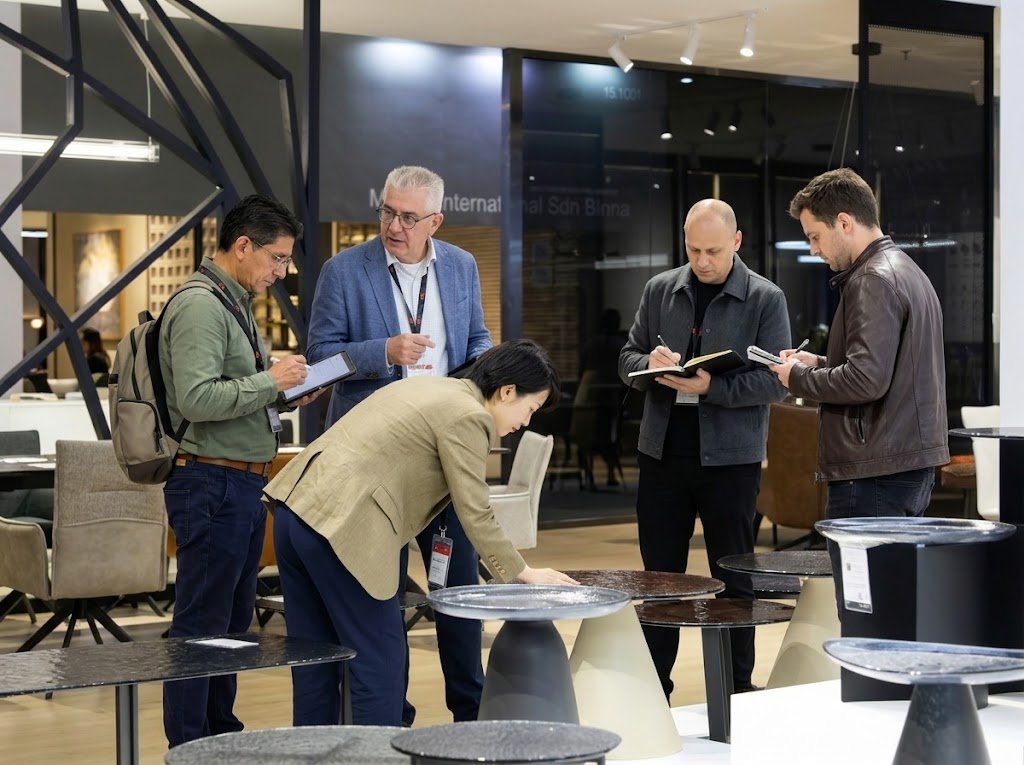
The Factory Floor vs. The Showroom Floor
Not every company operating through intermediaries is running a shell game. The Chinese furniture ecosystem has legitimate layers — trading companies that add real value through design adaptation, quality oversight, and logistics coordination. The problem is the lack of transparency, not necessarily the business model itself.
While some buyers gravitate toward large-scale manufacturers in Foshan, others find that mid-sized specialists — operations like Interi Furniture, which focuses on custom hospitality and residential case goods — offer a different risk-reward equation. These aren’t booth renters playing musical factories; they’re operations with identifiable production assets, transparent about what they make in-house versus what they source through vetted partners. A trading company that hides its supply chain is a shell. A manufacturer that discloses its partner network is just being honest about how the industry actually works.
The buyers who get hurt aren’t the ones who knowingly work with trading companies. They’re the ones who think they’re talking to a factory and don’t realize they’re three degrees removed from the person actually operating the table saw.
Your 48-Hour Verification Playbook
You don’t need a private investigator. You need a checklist and the willingness to use it before you sign anything. Here’s what I do — every single time — before committing to a new CIFF contact.
The Pre-Show Screen
- Pull the business registration before you even book a meeting. The National Enterprise Credit Information Public System (国家企业信用信息公示系统) is free and brutal. If the registered capital is ¥100,000 and the booth cost ¥300,000, do the math.
- Check the business scope. No “production” or “manufacturing” listed? You’re not talking to a factory. Period.
The Booth Conversation
- Ask technical questions they can’t prepare for. “What’s your typical veneer yield from a standard walnut flitch?” or “What’s the drying schedule for your beech before it hits the CNC?” A real factory person knows this in their bones. A shell rep will reach for their phone.
- Request a spontaneous video call from the workshop. Not tomorrow. Not next week. Now. “Can you walk me to the finishing line while we’re talking?” The delay tells you everything.
The Document Check
- Demand the factory address, then verify it on Baidu Maps satellite view. Does it look like an industrial facility or a strip mall?
- Ask for utility bills or environmental compliance documents. Real factories have massive electricity bills and government inspection records. Shell operations have excuses.
The Outsourcing Audit
- Here’s the red flag that contradicts conventional wisdom: If they show you a factory too easily — a pristine facility with perfect lighting and no workers in sight — be more suspicious, not less. Real factories are messy. Real factories have people on the floor at 2 PM on a Wednesday. The “show factory” is a rental prop.
The Reference Trap
- Don’t ask for references. Ask for the last three shipments they made to your country. Then independently find those buyers on LinkedIn and message them. A shell company will give you three friends with prepared scripts. A real operation will give you real logistics data you can verify.

The Questions Buyers Actually Ask
Q: If a company has a huge booth at CIFF and they’ve been coming for years, doesn’t that mean they’re legitimate?
A: No. Booth size and longevity prove one thing: they have a marketing budget. I’ve watched shell companies exhibit at CIFF for eight consecutive years because the model works. They build relationships, they deliver acceptable product most of the time, and buyers rarely dig deep enough to discover the outsourcing. A long exhibition history is not a substitute for verification. Booth presence is marketing, not manufacturing.
Q: Is it okay to buy from a trading company if they admit they’re not the factory?
A: Yes — if you know what you’re paying for. Trading companies add value: they aggregate small orders, handle communication, manage logistics, and sometimes provide design services. The problem isn’t the middleman. It’s the hidden middleman. If you’re paying factory-direct pricing for trading company coordination, you’re overpaying. If you’re paying a transparent markup for services rendered, that’s just business. The sin is deception, not distribution.
Q: I’ve visited their factory and it looked great. How could it still be a shell operation?
A: Because you probably visited a factory, not their factory. This is the most common trap. Shell operators maintain relationships with real facilities specifically for buyer tours. They might place some orders there. They might just know the owner. The test isn’t whether you saw a factory. It’s whether the legal entity you’re contracting with owns and operates that specific facility. Ask for the business license and compare the registered address to the facility you visited. If they don’t match, ask why. The explanation will tell you everything.
Q: Can I just use a third-party inspection company to solve this?
A: Third-party inspection helps with quality control but does almost nothing to verify manufacturing ownership. An inspector can check dimensions and finish quality. They can’t easily determine whether the company on the contract actually owns the equipment making your goods. For that, you need documentary verification — business registrations, utility records, and direct video evidence — not just a QC checklist.
Q: Are most CIFF shell companies actually scams, or is this just how the industry works?
A: It depends on your definition of “scam.” If you mean outright fraud — taking deposits and disappearing — that’s rare at established trade shows. If you mean systematic misrepresentation of manufacturing capability? Yes. That’s extremely common. Industry observers estimate that a significant portion of exhibitors at major China furniture fairs operate with some degree of separation between their brand and their actual production assets. The industry runs on relationships, opacity, and the assumption that most buyers won’t verify. Your job is to be the exception.
The Hard Lesson
So here’s the hard-earned lesson I keep relearning, usually the expensive way: The Chinese furniture market doesn’t reward trust. It rewards verification. Handshakes at CIFF are cheap. Production assets are expensive. And the gap between the two is where most sourcing disasters are born.
You don’t need to become cynical. You just need to stop being lazy about the questions you ask. The shell exhibitors aren’t smarter than you. They’re just betting that you won’t check. Prove them wrong.
And the next time someone at CIFF tells you they “own the entire process from forest to floor,” ask them which forest. Then watch their face.
Happy hunting. Try the dim sum in Shunde while you’re at it. At least that’s authentic.