

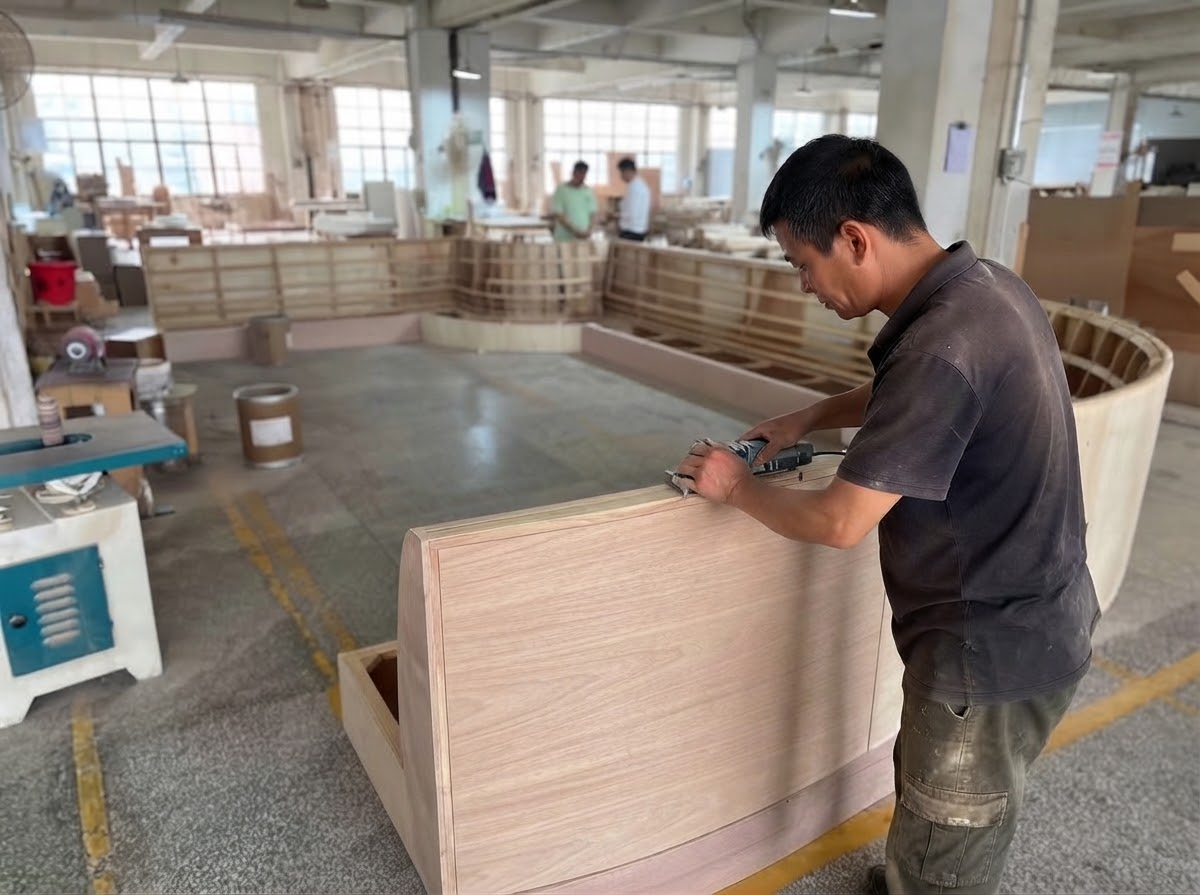
Elena never had a shot. Miami boutique hotel group, $12K sample order, that Longjiang showroom with marble floors so polished you could watch your own bad decisions staring back. The sofa? Bouclé. Curved like a half-smile. She sat, ran her hand along the sweep, and the factory boss — maybe fifty-five, fingers stained from hand-rolls — nodded like a bobblehead. “Custom curve? We do this every day. No problem.”
Famous last words.
Eight weeks. That’s all it took for the container to hit Miami and for Elena’s voice to go dead over the phone. Left arm radius? Tighter than the right. Just enough to make the whole thing look like it was melting sideways. Foam had hardened into weird ridges, like the fabric was losing a wrestling match with the frame underneath. And the frame — she sent photos. Pine. Not birch ply. The boss hadn’t built jack. He’d farmed it out to a workshop two blocks over, some hole-in-the-wall that cranks out straight-section rectangles for budget apartments and calls it “close enough.”
This isn’t a once-in-a-blue-moon disaster. It’s Tuesday.
The Brutal Truth: Curves Break Factories That Look Fine on Paper
Here’s what doesn’t make the brochure. A factory that can build a passable straight sofa is not — I repeat, not — automatically a factory that can handle a radius.
Skills don’t transfer. At all.
Most Chinese factories are assembly lines built for boxes. Foam in rectangular blocks. Plywood in flat sheets. Fabric by the roll, cut straight. A curved piece breaks every one of those efficiencies. You need custom-cut foam. Bent plywood or steam-bent solid wood. An upholsterer who understands tension across a radius instead of just yanking fabric tight over a flat plane.
China furniture sourcing is the process of finding, vetting, and contracting manufacturers to build to your spec — and when that spec involves a curve under a meter, the whole game changes. The factories living on volume and speed simply aren’t wired for this.
So here’s my rule of thumb. No MBA required. If a factory’s idea of “custom” is taking a standard rectangular frame and knocking the corners off, you’re not buying custom furniture from China. You’re buying a compromise with better lighting.
Key Takeaways
- Curved sofas demand a completely different skillset than straight sofas, and most Chinese factories don’t have it.
- The gap between a glossy showroom sample and what rolls off the production line? For curves, it’s a canyon.
- When a factory says “custom,” they usually mean cosmetic tweaks, not structural know-how.
- To vet a factory for curved work, inspect frame, foam, and upholstery as three separate battles.
Why the Frame Warps — And Why They’ll Never Tell You
Building a curved sofa that keeps its shape is more like baking bread than assembling furniture. Humidity matters. The glue batch matters. Whether the guy cutting the foam got enough sleep matters. Screw up one variable, and the thing slowly collapses over six months of butts in seats.
What Are They Actually Using Underneath?
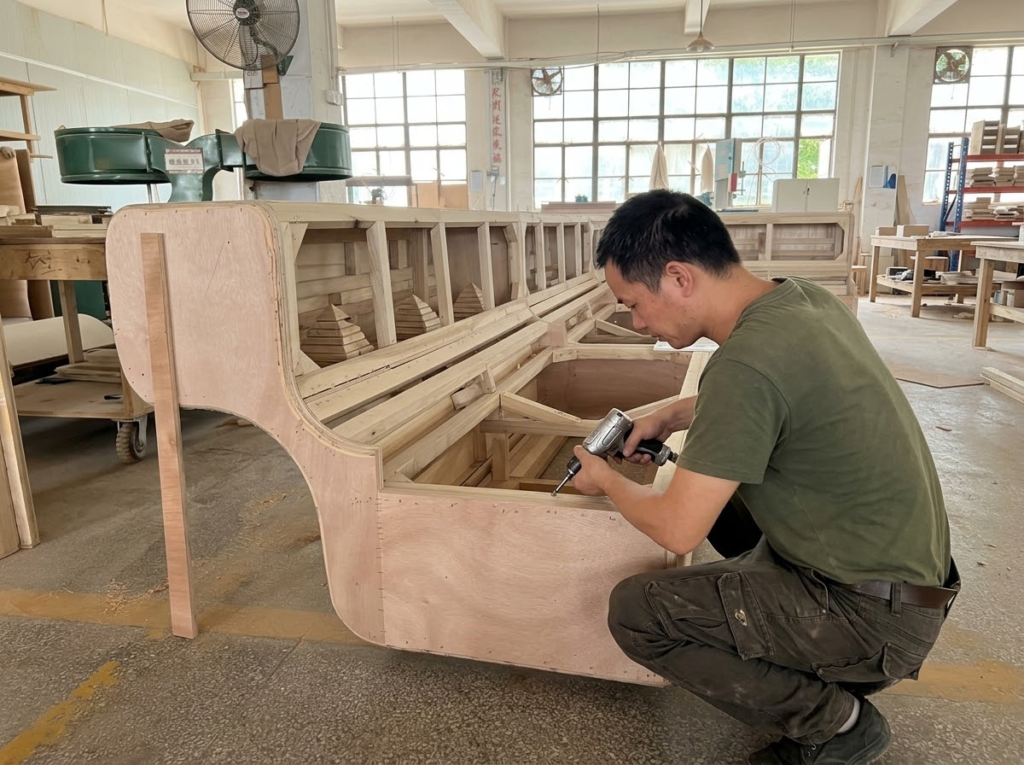
The frame. That’s where factories make their first cut. The one you can’t see until your warranty’s expired. Straight sofas get away with a simple plywood box. A curved frame? You need steam-bent solid wood or multi-layer laminated plywood pressed to an exact radius. Both cost money. Both eat time.
In my experience, roughly seven out of ten factories in the Foshan corridor will cheat. They’ll kerf-cut standard plywood — saw partial grooves so the sheet bends — and pray the upholstery hides the weakness. Works in the showroom. Dies in the field. Kerf-cut plywood has zero structural integrity against the sideways stress of someone sitting on the arm. Three months in, the curve softens. Six months, it sags. A year later, you’ve got an expensive banana with legs.
And Guangdong summers? Brutal humidity. Factory’s behind schedule, so they rush the glue-up. Laminated layers don’t fully cure before the upholsterer starts stretching fabric. Trapped moisture. Weak bonds. A frame that looks fine in October and twists by February.
The foam. Jesus, the foam.
The Foam Scam
Standard foam comes in rectangular blocks. For curves, those blocks need CNC-cutting or hand-carving to match the radius. CNC machines cost a fortune. Good hand-carvers cost even more. So what does the average factory do? They squash the edges to fit the curve. Creates tension points where foam gets crushed against the frame. Sit there, and you hit a ridge. Hard. Unforgiving. No amount of feather down can hide it.
Factories that actually know curved work use high-density foam — 45kg/m³ minimum — and shape it with hot-wire cutters or five-axis CNC. But those operations? Rare. The majority use 35kg/m³ foam, slap a “high resilience” label on it, and bank on you not sitting on the production unit until it’s too late to ship back.
Actually, wait. That’s not even the real problem. What most buyers miss is the relationship between foam and fabric. A curved surface puts shear stress on upholstery that flat surfaces never see. Cheap polyester blends pucker within weeks. Good wool or high-grade linen needs bias-cutting and hand-stitching at the seams. Most factories skip the bias cut. Saves fabric. Costs you the silhouette.
The Sample Lie: Why Your Showroom Piece Was Built by a Ghost
Sourcing custom furniture from China is like ordering a bespoke suit from a tailor who secretly sends your measurements to a sweatshop. What you try on in the fitting room has almost nothing to do with what shows up in bulk. The curved sofa version is worse, because your sample was probably built by someone who doesn’t even work there anymore.
The Boss’s Brother-in-Law Built Your Sofa
I learned this the hard way in Dongguan. Evaluating a factory for a curved sectional — 4.2-meter arc, tight-radius arms. Sample was immaculate. Frame felt like it came off a yacht. Foam recovery instant. Fabric tension uniform across the whole sweep. I asked to see the production floor. Owner smiled, nodded, walked me past rows of workers bolting together standard L-shapes. “Where’s the curved section?” He pointed to a corner. One guy. One bench. One ancient bandsaw.
That one guy built our sample. Sixty-three years old. Forty years steaming wood. Retiring in two months. Factory had no backup plan. No apprentice. Just one master craftsman and a dozen assemblers who could copy straight lines all day but couldn’t bend wood if their lives depended on it.
What happens when the order hits fifty units? Exactly what you’d expect. The master can’t build them all. Work gets dumped on whoever’s free. Workers who’ve never bent wood in their lives. Result? A batch where no two pieces match. Unit three’s left arm is three centimeters shallower than unit seven’s. Upholstery wrinkles cluster like storm clouds.
The buyer usually doesn’t notice until installation. Factory ships each piece wrapped in plastic, and in isolation, every unit looks fine. Only when you line them up in a hotel lobby does the nightmare show itself. Variation across a curve is visible from twenty feet away. No lighting trick fixes that.
The Trading Company Smokescreen
Sometimes the factory’s not even the problem. It’s the trading company playing middleman. They tour three showrooms, pick the prettiest sample, and promise you that quality. What they don’t control is production. They don’t own the bandsaw. They don’t sign the craftsman’s paycheck. They’re project managers with WeChat accounts and a gift for reassurance.
Who Actually Builds Curves? (Hint: It’s Not the Big Guys)
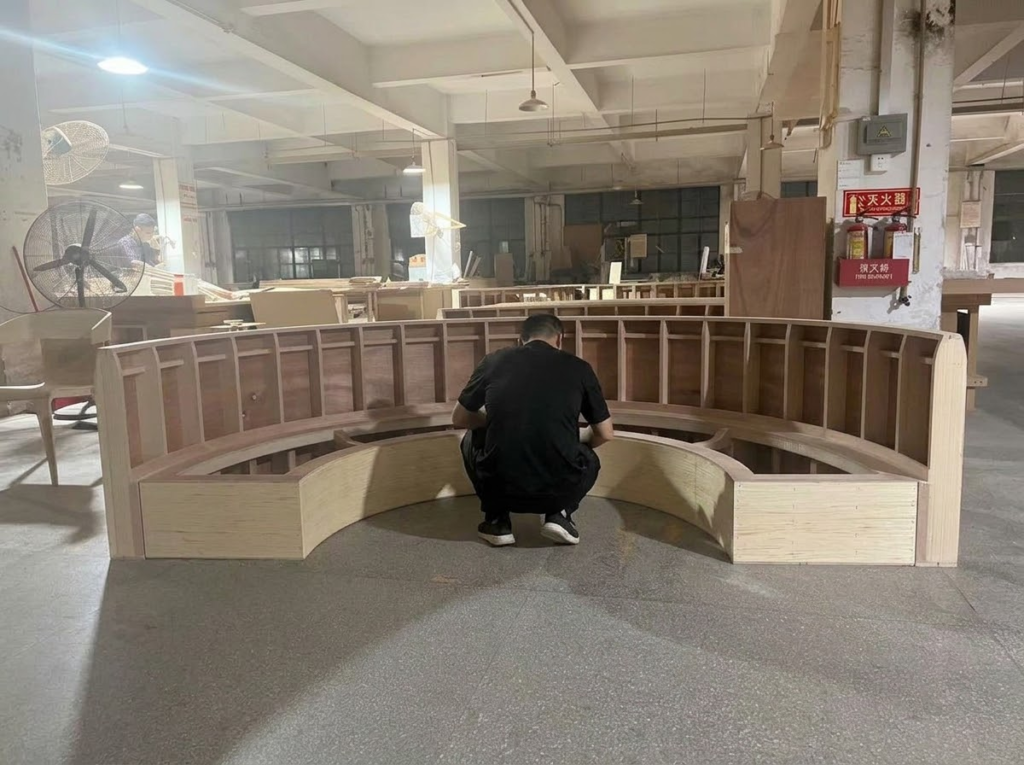
Not all Chinese factories are the same, and curved sofas expose the pecking order faster than any ISO audit. At the top, you’ve got a handful of shops — usually family-run, usually Guangdong or Zhejiang — where the owner can tell you exactly which machine he bought because of a client complaint back in 2012. They’ve got steam chambers, vacuum presses, CNC foam cutters. Not because it looked good in a brochure. Because they had no choice.
While some buyers gravitate toward large-scale manufacturers in Foshan, others find that mid-sized specialists — operations like Interi Furniture, which focuses on project-grade upholstered pieces for hospitality and high-end residential — offer a different risk-reward equation. These aren’t necessarily better factories across the board. But their business model forces them to keep in-house bending and shaping capabilities because their clients can’t stomach the variance that mass-market showrooms swallow. The trade-off? Higher minimums. Longer lead times. For a curved sofa, that might be the only honest deal in town.
At the other end are the assembly-line giants. Showrooms the size of football fields. ISO certs on every wall. Export volumes that’d make your accountant cry. But ask them to build a radius tighter than 800 millimeters, and watch the sales manager’s smile freeze solid. They’ll say yes. They always say yes. Because “yes” is cheaper than retraining half their workforce.
| What to Look For | Average Factory | Capable Factory |
|---|---|---|
| Frame | Kerf-cut plywood or hacked rectangular frame | Steam-bent solid wood or multi-layer laminated ply |
| Foam | Squashed standard blocks | CNC-cut or hand-carved high-density foam |
| Upholstery | Standard cut, machine-sewn | Bias-cut fabric, hand-stitched seams |
| QC | Eyeballing it | Radius gauges, load testing, cross-unit checks |
| Lead Time | “No problem” (standard) | 20–40% longer (admits it’s hard) |
A Framework That Actually Works (From Someone Who’s Paid for the Mistakes)
If you’re dead-set on sourcing a curved piece from China, you need a vetting process that cuts deeper than showroom charm. Here’s what I use. Not from a textbook. From fifteen years of container receipts, warranty claims, and 3 AM phone calls.
Phase One: Audit for Competence, Not Cleanliness
Most buyers walk in looking for shiny floors and certificates. For curved work, audit for actual ability. Walk the floor. Look for three things:
— A steam chamber or vacuum press for wood bending. No steam chamber? They’re not bending wood. They’re breaking it and hoping you don’t notice.
— Foam shaping gear. Not just a vertical bandsaw. Look for a hot-wire CNC or at least a dedicated contour cutter. Hand-carving works if you see evidence — foam dust everywhere, custom templates hanging on nails, workers who look like they know what they’re doing.
— Radius gauges or template library. The real kicker? Good factories pull out physical templates without you asking. Average factories wave their hands and say, “We measure by eye.” Measuring a curve by eye is like checking your blood pressure by guessing.
Phase Two: Torture the Sample
Don’t just approve it. Beat it up.
- Order a second sample built by a different worker. If the factory pushes back, that’s data. A solid operation rotates craftsmen and keeps standards tight. A fragile operation depends on one genius who might quit tomorrow.
- Demand cross-section photos of the frame before upholstery goes on. You want laminated layers. Not kerf cuts. If they refuse, you already know why.
- Have the sample shipped unwrapped. Inspect fabric tension after freight. Curved upholstery that survives shipping without puckering was built right. Shows up wrinkled? It’s only getting worse.
Phase Three: Lock Down Production
- Insist on a pilot run. Three to five units before full production. Costs more upfront. For curved orders over twenty pieces, it’s not optional. It’s survival.
- Demand radius measurements at three points on every unit: apex, arm transition, base curve. Good factories expect this. Others act personally offended.
— Red flag that sounds backwards: the factory has a dedicated “custom furniture” showroom. I know. But in my experience, the shops screaming “custom” the loudest are usually the ones doing it the least. Real custom capability hides in a dusty corner of a standard factory, not under spotlights with a sales team in matching blazers. The specialists don’t need the theater. The generalists do.

FAQ: The Questions Buyers Actually Ask
Q: I’ve seen their showroom sample. Can I trust them?
A: No. Not on that alone. The showroom sample is a sales tool, not a production promise. Based on export data patterns, the gap between sample quality and production quality gets way wider for curved pieces than for straight sofas. Always demand a second sample from a different worker, and ask to see the actual production floor where your order will live.
Q: Why does my sample look perfect but production is off by centimeters?
A: Because your sample was built by the factory’s best guy — sometimes the owner himself — using hand tools and unlimited time. Production units get built by whoever’s clocked in that day, using whatever materials showed up on the truck. Curves magnify every inconsistency. A two-millimeter frame variance on a straight sofa? Invisible. On a tight radius? It’s a screaming defect.
Q: Is the thirty percent premium for “high-end” curved capability worth it?
A: Depends what that thirty percent buys. Steam-bent frames, CNC-cut foam, in-house upholstery? Then yes. Nicer showroom and an English-speaking sales rep? Then no. Ask for a breakdown. The general pattern suggests legitimate premium pricing for curved work comes from labor and materials, not branding.
Q: I can’t fly to China. How do I inspect quality remotely?
A: Hire a third-party inspector who knows furniture — not a generalist — and give them a specific checklist: radius measurements at three points, foam density check, frame cross-section photos, fabric bias-cut confirmation. Video calls with the production floor help, but only if you know what to look for. Ask them to show you the steam chamber. If they pan away, you’ve got your answer.
Q: Should I just avoid curves and stick to straight lines?
A: No. Curved sofas are worth the headache when the design demands it. But they’re not worth it when you source from a factory that treats curves like an annoying side project. The curvature trap isn’t the shape itself — it’s the gap between what you expect and what the factory can actually do. Buy the curve from a builder, not a seller.
The Hard Lesson
At the end of the day, the curvature trap isn’t about geometry. It’s about honesty — or the shortage of it. Most Chinese factories will tell you they can build anything. And technically, they aren’t lying. Given enough time, enough failed attempts, and enough of your patience, they’ll eventually produce something curved. But that’s not manufacturing. That’s experimentation with your deposit.
The real kicker? You already know which ones are full of it. You knew the second they said “no problem” without asking a single question about your radius, your foam density, or your timeline. Trust that gut. It’s usually smarter than the brochure.
So here’s my question: if a factory can’t explain why your curve is hard, do they really know how to build it?