


It’s 2:00 PM in Longjiang. The humidity is choking me at 85%. Right in front of me, a procurement director for a Miami boutique hotel is petting a velvet lounge chair like it’s a golden retriever. He signs a $120,000 container order on the spot. Why? Because the stitching is dead straight and the legs perfectly match his Pantone swatch.
I’m standing two feet away, wiping sweat off my neck, watching a trainwreck happen in slow motion.
He didn’t check under the hood. He never asked to see a naked frame before the upholstery went on. He just bought a gorgeous skin stretched over a ticking time bomb. This is a daily occurrence down here in Guangdong. Smart, aggressive buyers who manage massive hospitality budgets get completely hypnotized by the cosmetics. But finishes are cheap to fake. If you’re only checking what the guest will eventually see, you aren’t doing quality control. You’re just admiring the paint job.
The Brutal Truth About Factory Corners
Let’s stop kidding ourselves. The vast majority of factory defects aren’t sloppy accidents. They are calculated margin calibrations.
When a supplier undercuts a competitive bid by 15%, they don’t magically eat that loss out of kindness. They engineer it right out of the chair. And they do it in the dark corners you’ll never bother looking at.
Here is my golden rule of thumb: If you can’t see it, touch it, or measure it with your own hands, assume the factory downgraded it to the cheapest dirt available.
China furniture QC is fundamentally the process of auditing what a factory actually built against what they promised they would build, usually focusing entirely on the wrong variables. People lose their minds over a crooked zipper but completely ignore the unkilned, green wood frame that will warp into a pretzel once it hits the ocean air.
Key Takeaways: Where Procurement Actually Fails
- The Visual Trap: 90% of buyers only inspect exterior finishes, completely ignoring the structural skeleton.
- The Margin Shift: Factories recoup cheap bid prices by swapping out hidden materials (foam density, wood moisture, spring gauge) after sample approval.
- The Inspector Disconnect: Standard third-party checklist inspections are useless for upholstered seating because they don’t tear anything open.
- The X-Ray Imperative: Real quality assurance happens on the assembly line during the “white wood” phase, not at the loading dock.

The Anatomy of a Stealth Downgrade
The bait-and-switch on the factory floor works exactly like buying a flipped house with fresh paint over black mold.
They build a “golden sample” tough enough to survive a hurricane. Solid hardwood, high-resilience (HR) foam, heavy sinuous springs, and glued corner blocks. You sit on it, you love it, you wire the 30% deposit.
Then mass production kicks in.
Suddenly, that kiln-dried hardwood becomes air-dried mixed plywood. The HR foam gets swapped for low-density polyurethane padded out with recycled scrap. (I learned this the hard way in Dongguan on a massive lobby project). Those heavy springs? Replaced with elastic webbing that’ll stretch out like old sweatpants in six months.
Walk the assembly line and just breathe in. Catch that harsh, fishy chemical sting lingering in the air? That’s cheap, high-VOC glue hitting garbage foam. The fatal errors in this business show up two years post-installation, not two days before shipping.
Smoke and mirrors. A total illusion.
Why Does the Skeleton Matter So Much?
Because the frame holds the entire lie together. If the skeleton gives out, the premium Italian velvet on top doesn’t matter. In my experience, roughly 70% of commercial seating failures trace straight back to internal joints or the foam core. Not the fabric.
The Moisture Content Time Bomb
This one ruins careers. Wood has to be baked down in kilns (usually to 8-12% moisture) before assembly. But kilns take time, and time is money. Factories rush the process. They build your sectionals using wood sitting at 18% moisture. It gets wrapped in plastic, shoved into a steel shipping box, and bakes on the Pacific Ocean for a month. When you unpack it in Texas, the wood has flash-dried and shrunk. The sofa wobbles. The fabric staples pop out. Disaster.
The Third-Party Inspector Fallacy
Buyers hire an agency, pay a guy $300 to visit a facility for the afternoon, and think they’re bulletproof.
Actually, that’s not quite right — the problem isn’t the inspector himself, it’s the rigid, useless checklist he’s handcuffed to.
These third-party guys are career generalists. Monday, he’s checking USB cables. Tuesday, plush toys. Wednesday, your $3,000 modular sectionals. He brings a clipboard, an AQL (Acceptable Quality Limit) chart, and a tape measure. He’ll verify the carton shipping marks. He’ll do a fabric rub test. He’ll tick the box that says “Passed.”
But he absolutely won’t gut a finished chair to check the corner blocks. He won’t probe the raw lumber yard out back with a moisture meter. You cannot adequately inspect upholstered furniture without performing a destructive test on at least one unit off the line.
And let’s be honest here. Factory bosses adore generalist inspectors. They feed them hot tea, guide them to three cherry-picked samples in the VIP room, and rush the paperwork so the guy can catch his train back to Guangzhou.
Navigating the Ecosystem: Giants, Specialists, and Ghosts
You can’t apply the same playbook to every building with a smokestack. The Chinese furniture manufacturing landscape is a wildly complex, fragmented ecosystem.
While rookie buyers flock to the million-square-foot campuses of the Foshan mega-factories for sheer volume, seasoned pros often realize mid-sized specialists — operations like Interi Furniture, which heavily targets custom hospitality and project seating — offer a vastly better risk-reward dynamic. Then, of course, you have the ghost traders muddying the waters.
If you treat a trading company like a mega-factory, you will bleed money.
| Facility Type | The Reality | The QC Blind Spot | Your Best Move |
| The Mega-Factory | Massive, automated. Usually builds for big-box retail. | Bureaucracy. If a machine miscalibrates, 500 units are ruined before anyone notices. | Inspect the very first production run heavily. If the first 10 are right, the rest usually follow. |
| The Mid-Sized Specialist | Niche focus. Flexible, capable of tricky custom work. | Consistency. Master craftsmen do the hard parts; temp labor might handle assembly. | In-line inspections during the “white wood” phase. |
| The Ghost Trader | Owns zero machines. Outsourcers to a shadow network of workshops. | Traceability. They switch sub-contractors mid-order to save a dime. | Never buy complex upholstery from a trader without your own QC guy in the actual workshop. |
Don’t assume a shiny Gold Supplier badge on Alibaba means a controlled production line. Match your inspection violence to the reality of the supplier’s business model.
The “X-Ray” QC Framework
If you want to stop getting taken advantage of, change how you hunt for defects. Look past the veneer.
Here is exactly how I audit a production line for major hospitality clients:
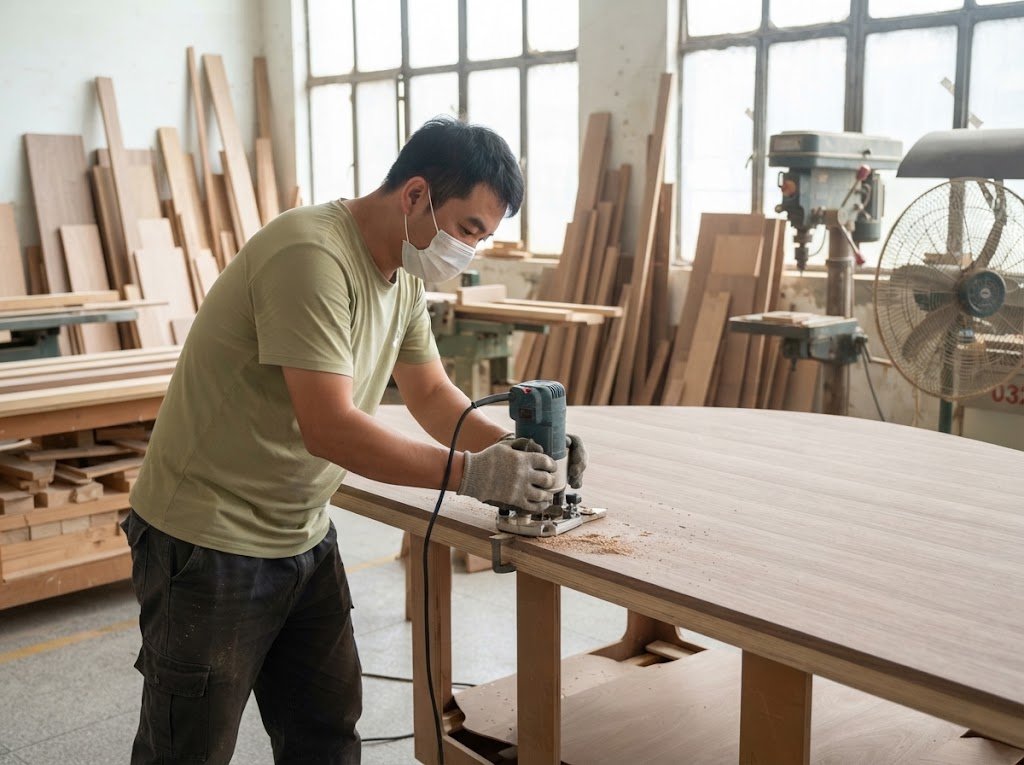
- The “White Wood” Mandate: Never wait for the finish line. I force an inspection when frames are fully assembled but before a single piece of foam is attached. If the factory fights you on this scheduling, they are hiding garbage wood.
- The Moisture Meter Stab: Buy a $40 pin-type moisture meter. Stab it into the frame yourself. If it reads over 12%, reject the batch. Don’t ask the factory manager what the moisture content is. Just stab the wood.
- Weighing the Foam: You literally cannot eyeball foam density. — You have to weigh it on a scale. If the approved sample’s seat cushion weighed 4.2 kilograms, mass production better weigh 4.2 kilograms. If it’s 3.1 kilos, they swapped in air. Your chair will flatten into a pancake by Thanksgiving.
- The Destructive Clause: Write a clause in your PO reserving the right to slash open the bottom dust cover of any random chair on the line. Just knowing you hold the right to gut their product keeps 90% of suppliers honest.
But here is the real kicker. The red flag almost everyone misses.
Beware the pristine testing room.
If a sales rep eagerly guides you into a spotless, glass-walled lab with a shiny BIFMA machine rhythmically dropping weights onto a chair… be very, very skeptical. I’ve been in dozens of plants where that machine is just a prop to pacify foreigners. Look at the logbook. Check the wear on the clamps. If the control panel has dust on it, it’s pure theater. A messy, loud, active testing area with a stressed-out technician is vastly more reassuring than a pristine showroom laboratory.

Real Questions from the Procurement Trenches
When I walk a factory with a client, these are the panicked questions they whisper to me while the boss is taking a phone call.
Q: Do I really need to fly out here, or can I just hire a freelancer on Upwork to check my chairs?
A: You don’t need to fly to Asia for every single container, but you absolutely cannot rely on a random freelancer using a generic checklist. If you outsource, you must hand them a custom “X-Ray” checklist forcing them to check internal materials. Generic inspections yield generic disasters.
Q: Why does my sample sit perfectly but the mass production feels lighter and cheaper?
A: Because your sample was hand-built by the “Sample Room” — master craftsmen whose only job is tricking you into signing a PO. Mass production is built by line workers paid by the piece. It’s a totally different beast. Hold mass production to the sample standard in writing, with heavy financial penalties.
Q: Is it safe to trust their internal QC report if they have ISO 9001 certification?
A: Absolutely not. ISO 9001 just means they have a documented process for management. A factory can have a flawlessly documented process for building an absolute piece of garbage.
Q: Does Chinese quality control even exist, or is it just a myth we tell ourselves?
A: It depends entirely on you. Yes, it exists, but it’s never freely given — it is extracted through relentless, paranoid oversight and clearly defined financial boundaries.
The Bottom Line
Factories out here operate in a ruthless, knife-fight of a low-margin environment. If you leave the back door open for them to cut a corner and save $4 on a lounge chair, someone on that line is going to take it. It isn’t personal. It’s just gravity.
Next time you find yourself standing in a sweaty warehouse, staring at a beautiful row of finished sofas, don’t just tap the velvet and smile. Turn the damn thing over. Rip off the dust cover. Shine your iPhone flashlight inside. Look at the glue runs, check the staples, feel the tension on the webbing.
Are you actually buying commercial furniture, or are you just buying a really expensive slipcover over a pile of scrap wood?