

It’s Tuesday morning in Miami, and a $2.5 million hotel renovation is grinding to a halt. The procurement director is standing in the loading dock, staring blankly at 300 lounge chairs that just cleared customs. The frames are solid enough, and the stitching is passable. But the upholstery? It feels like cheap, abrasive felt instead of the plush, 100,000-double-rub commercial velvet they signed off on six months ago. (And yes, this happens more than anyone admits).
I’ve sat across from furious designers and highly apologetic middlemen in Foshan more times than I can count over the last 15 years. The scene is always exactly the same. The designer points an accusatory finger at the pristine, flawless prototype sitting in the corner of the showroom and shouts, “Why doesn’t the bulk match the sample?!”
Well, pull up a chair. Let’s talk about the oldest game in the Guangdong manufacturing playbook. Because if you’re buying high-end FF&E for hospitality or luxury residential projects, you are eventually going to face the material swap.
The Brutal Truth About Your Prototype
Let’s get the uncomfortable reality out of the way immediately. The golden sample sitting in your office is a marketing expense, but the 500 pieces in the shipping container are a margin exercise.
Factories don’t usually set out to ruin your project maliciously. They just operate on razor-thin margins in a hyper-competitive global landscape. When raw material costs spike by 15% overnight, they don’t call you to renegotiate the purchase order you signed three months ago. They adapt. They substitute. They survive.
Here is my golden rule of thumb for this industry: If you don’t explicitly document, inspect, and legally bind every single millimeter of your product’s bill of materials, you are buying a suggestion, not a specification.
Actually, that’s not quite right — what most buyers miss is that the factory doesn’t even view minor material swaps as a problem. To the average factory boss, if the chair looks generally like the picture and holds human weight, they’ve done their job perfectly well.
Key Takeaways for Procurement Directors:
- China furniture sourcing is the process of navigating complex, localized supply chains where bulk consistency relies entirely on buyer-enforced quality control.
- The “golden sample” is hand-crafted by salaried master technicians; bulk orders are slapped together by piece-rate line workers focused on speed.
- Material swaps usually happen in three invisible areas: foam density, fabric grade, and hidden frame joinery.
- Third-party inspections must occur during the production run, not just before shipping when it’s too late to fix anything.
The Anatomy of the Swap
Managing a massive factory run in China is a lot like baking a wedding cake. You taste a tiny, perfectly crafted vanilla cupcake at the bakery during your consultation. It’s divine. But scaling that exact chemical reaction to feed 500 people in a sweltering outdoor tent requires massive compromises in ingredients, structural support, and prep time.
Are They Really Running a Chinese Factory Scam?
Buyers love to throw around the phrase “Chinese factory scam” the second a container arrives with subpar goods. Nine times out of ten, it isn’t a scam at all. It’s a failure of specification on the buyer’s end.
Just bad communication.
I was walking a production floor in Dongguan late last year, checking on a massive run of hospitality headboards for a Vegas casino. In the pristine R&D sample room, I saw the beautiful, high-density, fire-retardant foam we had explicitly approved. Out on the main assembly floor? Workers were aggressively stuffing the headboards with low-grade, yellowing scrap sponge.
When I asked the line manager about the discrepancy, he genuinely looked confused. He pulled out the translated purchase order. It just said “Foam filling.” No density rating (like 45kg/m3). No California TB117-2013 fire code specification. Nothing. They used what they had sitting in the warehouse to hit our aggressively tight delivery window. If your spec sheet leaves room for interpretation, the factory will interpret it in favor of their profit margin.
And honestly, can you blame them? You squeezed them for a 10% discount during negotiations. They agreed to the discount to get the deposit, knowing full well they would make up that 10% by quietly downgrading the internal components.
Let’s look at where the money actually goes when materials magically change between the sample phase and the bulk container phase.
| Component | Sample Reality (The “Bait”) | Bulk Reality (The “Swap”) | Margin Impact for Factory |
| Upholstery Fabric | 100,000 double-rub commercial grade | 25,000 rub residential grade (looks identical new) | +12% to 18% profit |
| Seat Foam | High-resilience (HR) polyurethane, 45kg/m3 | Standard 30kg/m3 scrap-mix foam | +8% to 15% profit |
| Wood Frame | Kiln-dried imported FAS Ash wood | Locally sourced rubberwood with heavy stain | +20% to 30% profit |
| Hardware | Heavy-duty soft-close hinges | Unbranded standard hinges that sag | +5% to 10% profit |
Navigating the Factory Ecosystem
You have to understand who you are actually buying from to prevent these swaps. The entire system is built on subcontracting.
Are You Buying From a Factory or an Assembler?
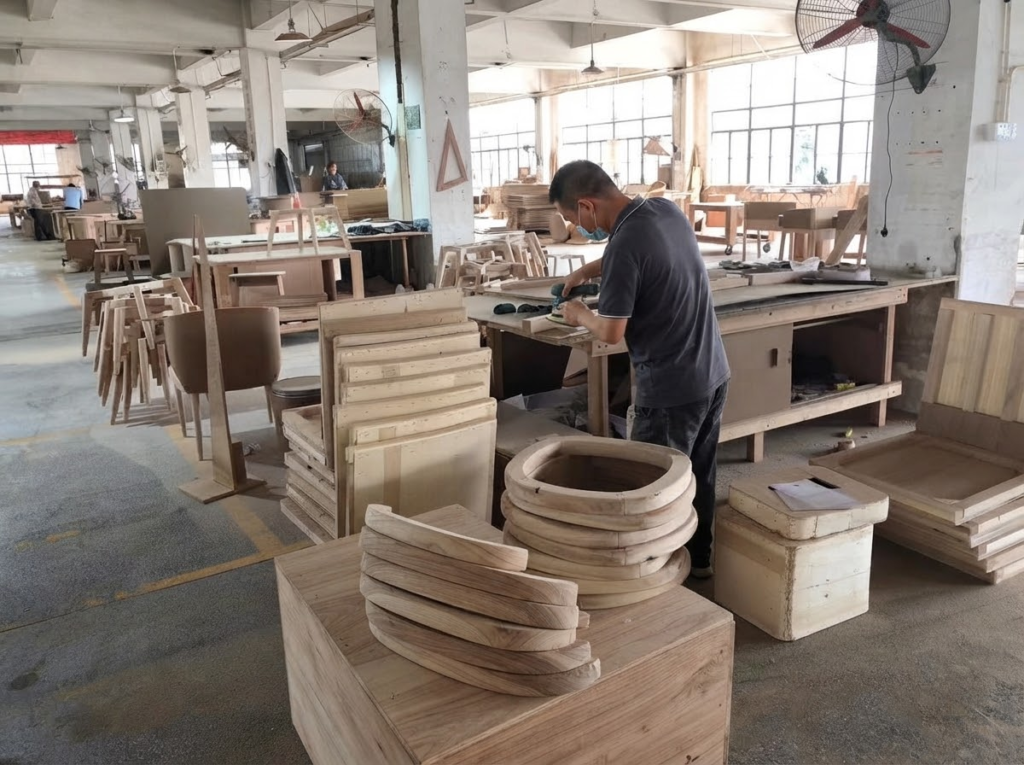
Most Western buyers think factories build furniture from scratch, logging the trees and weaving the fabrics themselves. They don’t. A typical furniture factory in Longjiang is usually just a giant assembly hub. They buy raw wooden frames from a dusty wood-shop down the street. They buy foam from a chemical supplier across town. And they buy fabric from a massive, labyrinthine textile market over in Guangzhou.
This intensely fragmented supply chain is exactly where the China furniture sample diverges from the bulk order.
If the fabric supplier suddenly runs out of the specific dye lot your sample used, the factory boss has to make a critical choice. He can delay your container by a month while waiting for a new batch, risking your wrath and late fees. Or he can send his procurement guy next door to buy a “close enough” fabric from a different vendor to hit the ship date. Guess which one he picks? Every single time, he picks the speed over the spec.
You won’t solve this simply by running to a massive mega-factory in Foshan, either; their supply webs are often just as tangled. The suppliers that actually manage to control their bulk quality — operations like Interi Furniture, for instance — do it through obsessive, almost paranoid material cataloging. They lock down exact component variables (I’m talking meticulously tracking internal updates from Sample No.A015 to A029 for something as simple as a marble top) before a single piece of wood is cut. That level of fanatical documentation isn’t standard in Guangdong. It’s the exception.
But even then, trust is not a scalable sourcing strategy. You cannot outsource your quality assurance to the entity selling you the product. It is a fundamental conflict of interest. The factory’s goal is to ship the goods and get the balance payment. Your goal is to get a product that lasts ten years in a high-traffic hotel lobby. Those goals are at war with each other from day one.
Actionable Framework for Securing the Match
So, how do we stop the madness? How do you ensure the 500 chairs match the one sitting pretty in your lobby? You stop treating the sample like a beautiful trophy and start treating it like a binding legal contract.
Here is the exact framework I use to lock down quality for every major hospitality buy:
- The “Golden Sample” gets cut in half.Don’t just keep the sample in your office to show clients. You order two. You keep one intact for visual reference, and you literally saw the second one in half. Take macro photos of the internal framing. Measure the foam thickness with calipers. Log the joinery style (dowel vs. staple). This becomes your absolute baseline.
- — Require the factory to sign and chop (stamp with their official red company seal) a master component list. This document must explicitly state the density, brand, weight, and grade of every single raw material. Make it an annex to the commercial invoice.
- Tie the balance payment to the Bill of Materials.Put it in writing that if the fabric weight is 10% lighter than the approved sample, the container will be rejected outright. Watch how fast their attitude toward material sourcing changes when the threat is real and documented in Mandarin.
- — Hire a reputable third-party QC inspector to do a “First Article Inspection” (FAI). This means they visit the factory the day the first bulk unit is assembled. Not when 500 are already wrapped in plastic and stuffed into boxes. You fix the foam swap on unit #1, not unit #500.
- The Red Flag: The factory agrees to your unreasonable timeline without pushing back.If a supplier says they can source custom-dyed performance velvet, properly kiln-dry the internal hardwood, and assemble 400 sofas in 25 days… run. They are lying to get your deposit. The laws of physics and supply chains dictate that they will absolutely cut corners on materials to hit that impossible ship date. A good factory will tell you “no” and explain why a proper cure time for the wood takes an extra two weeks.

Real Questions from the Trenches
I get bombarded with the same panicky questions from procurement teams every week. Let’s clear the air on a few of them.
Q: Is the material swap always a Chinese factory scam, or just an honest mistake?
A: It is rarely a deliberate, malicious scam orchestrated by evil masterminds. Usually, it’s a calculated business decision made by a factory manager trying to balance your brutal target price with his constantly rising raw material costs. If you squeeze them mercilessly on price during the negotiation, they will squeeze you right back on invisible materials. It’s Newton’s third law of global sourcing.
Q: Should I bring my China furniture sample with me when I fly over to visit the factory?
A: Absolutely. Or better yet, leave the “sealed” golden sample at the factory with your signature permanently marked on the fabric and the wooden frame in Sharpie. Tell the sales rep that your third-party inspector will compare the bulk production directly against that exact signed piece. It removes the “we lost the sample” excuse entirely.
Q: How do I prove they used cheaper foam if the chair is already fully upholstered and I can’t rip it open?
A: You have to weigh it. Cheaper foam is significantly less dense and therefore much lighter. If your approved sample chair weighs 22 kg, and the bulk chairs coming off the line weigh 18 kg, you instantly know they swapped the internal materials. You don’t even have to tear the fabric to prove they breached the contract.
Q: What if I use a local sourcing agent to manage the factory? Does that stop the swaps?
A: It depends heavily on how the agent is paid. If they take a hidden kickback from the factory (which is incredibly common), they will happily look the other way when the factory downgrades your fabric. You have to hire an agent who operates strictly on a transparent retainer or a fixed commission paid only by you.
Q: Will holding back the final 70% payment until delivery fix this problem?
A: No. By the time the container arrives in Los Angeles, Miami, or London, the factory has already extracted enough margin from your 30% deposit to cover their baseline costs for the cheaper materials. It depends on your exact leverage, but generally, quality must be ruthlessly verified before the goods hit the water.
The Bottom Line on Bulk Quality
At the end of the day, sourcing overseas is an exercise in applied paranoia. You can build incredible, world-class products in Guangdong and Zhejiang. The craftsmanship certainly exists, the manufacturing scale is unmatched anywhere else on earth, and the logistics infrastructure is a modern marvel.
But you don’t get the quality you expect; you get the quality you inspect.
Are you willing to spend an extra $800 on mid-production inspections to protect a $100,000 container? Or are you going to keep hoping that a beautifully crafted prototype is a magical guarantee of future performance? Next time you sit down to approve a gorgeous sample, ask yourself: do I actually know what’s underneath that velvet?