

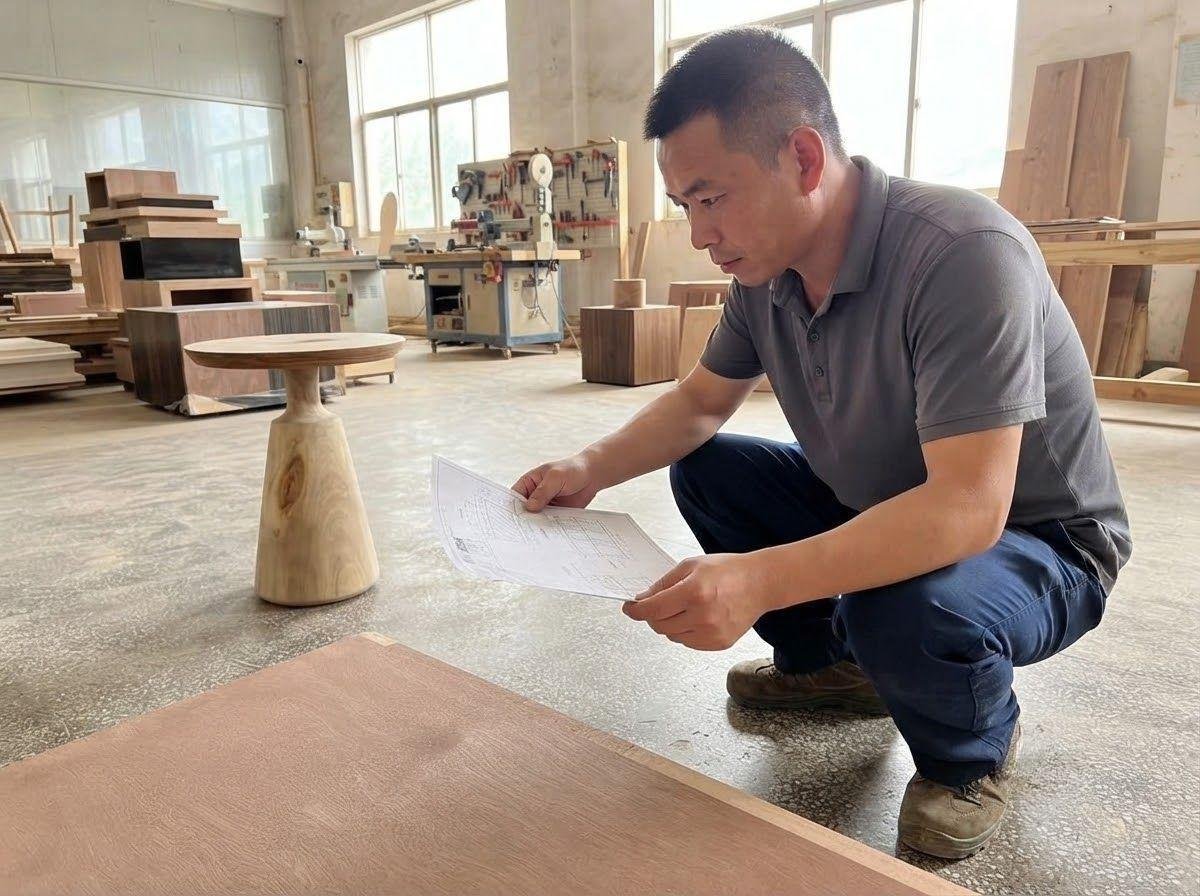
I was standing in a 12,000-square-meter factory in Longjiang, Foshan, watching a $4,200 prototype armchair get chainsawed in half. Not gently. The factory owner, Lao Chen, grabbed a gas-powered Stihl from the corner and ripped through the walnut frame like he was trimming a hedge. “Your client wants to see the inside,” he said, shrugging. “Might as well do it here.”
This was 2019. The chair was meant for a boutique hotel group in Melbourne. Six months of back-and-forth on CAD files, three rounds of foam density adjustments, and a $1,800 air freight bill for the sample. And now it was firewood.
The kicker? The hotel group approved the sample two weeks later. They never even asked for the cross-section photos. Lao Chen knew they wouldn’t. He’d been doing this for twenty-three years. “Buyers,” he told me, wiping sawdust off his glasses, “they don’t know what they’re looking for until they see what’s wrong.”
That moment stuck with me. Because in the fifteen years I’ve spent walking factory floors from Dongguan to Anji, I’ve learned that the prototype phase isn’t about perfection. It’s about controlled failure. And most buyers — especially the ones flying in from London, Sydney, or Dubai with a Pinterest board and a tight deadline — treat it like a beauty contest.
They’re looking for the wrong things. And factories know it.
The Brutal Truth: Your Sample Is a Negotiation Tool, Not a Product
Here’s what nobody tells you at the design fair.
The sample you receive in that polished plywood crate isn’t the chair they’re going to build for you. It’s the chair they think you’ll pay for. There’s a difference. A big one.
Factories in Guangdong don’t prototype to impress your interior design client. They prototype to lock in your deposit. The prettier the sample, the faster you sign. And once you sign, the game changes.
If the prototype looks better than you expected, be suspicious. Not excited. Suspicious.
I’ve seen buyers cry tears of joy over a hand-rubbed oak sample, only to receive production units with veneer that peels like sunburned skin. The sample had three coats of finish. The production run got one. The sample used solid wood. The production run used MDF with a generous edge banding.
This isn’t fraud. Not technically. It’s the gap between “sample room standards” and “production floor reality.” And that gap is where most procurement disasters live.
Key Takeaways
China furniture sourcing is the process of negotiating the distance between what a factory can build and what a buyer actually needs — with the prototype serving as the first draft of that contract, not the final product.
- A perfect sample is a red flag, not a green light. Over-engineered prototypes often hide production shortcuts.
- The prototype phase is where 70% of your quality baseline gets set. Changes after approval become exponentially expensive.
- Factories prototype for commitment, not for accuracy. Your job is to reverse-engineer their incentives.
- What you don’t test in the sample is what will fail in production. Structural integrity, finish durability, and hardware tolerances matter more than surface beauty.
Deep Dive: What the Sample Room Won’t Show You
Why Does the Factory’s Best Work Happen Before You Pay?
Think of a prototype like a first date. Everyone’s on their best behavior. The factory sends their A-team carpenter. They use the good glue. They let the veneer dry for three days instead of shoving it through a convection oven.
But production? That’s marriage. And marriage is where you find out who actually does the dishes.
I visited a mid-sized upholstery operation in Dongguan last March. Beautiful sample room — white walls, track lighting, the works. The prototype sofa they showed me had hand-tied eight-way springs and feather-down cushions. Gorgeous. Then I walked the production floor. The actual sofas getting crated for shipment had sinuous wire springs and poly-fill. “Different price point,” the sales manager said, smiling. “You want eight-way, we quote again.”
Different price point. Same PO number.
The real kicker isn’t that they upgraded the sample. It’s that they never told me there was a downgrade option. Most buyers assume the sample represents the standard. It doesn’t. It represents the ceiling. The floor is whatever you don’t explicitly write down.
And here’s the thing most spec sheets miss. Actually, that’s not quite right — what most buyers miss is that a spec sheet is a language barrier wrapped in technical vocabulary. “High-density foam” means 35kg/m³ to one factory and 28kg/m³ to another. “Solid wood construction” includes finger-jointed boards in some provinces. You think you’re speaking the same language. You’re not.
The sample is your Rosetta Stone. But only if you know how to read it.
What Should You Actually Be Testing?
I once watched a procurement director from a Singapore hotel group spend forty-five minutes photographing the stitching on a prototype headboard. Perfectly straight seams. Beautiful thread tension. She was thrilled.
Then she sat on the edge of the bed. The frame creaked. The corner block — the actual structural joint holding the side rail to the headboard — was held together with two staples and a prayer.
She never checked the corner block. Nobody does.
If you test only what you can see, you’re auditing the photography, not the furniture.
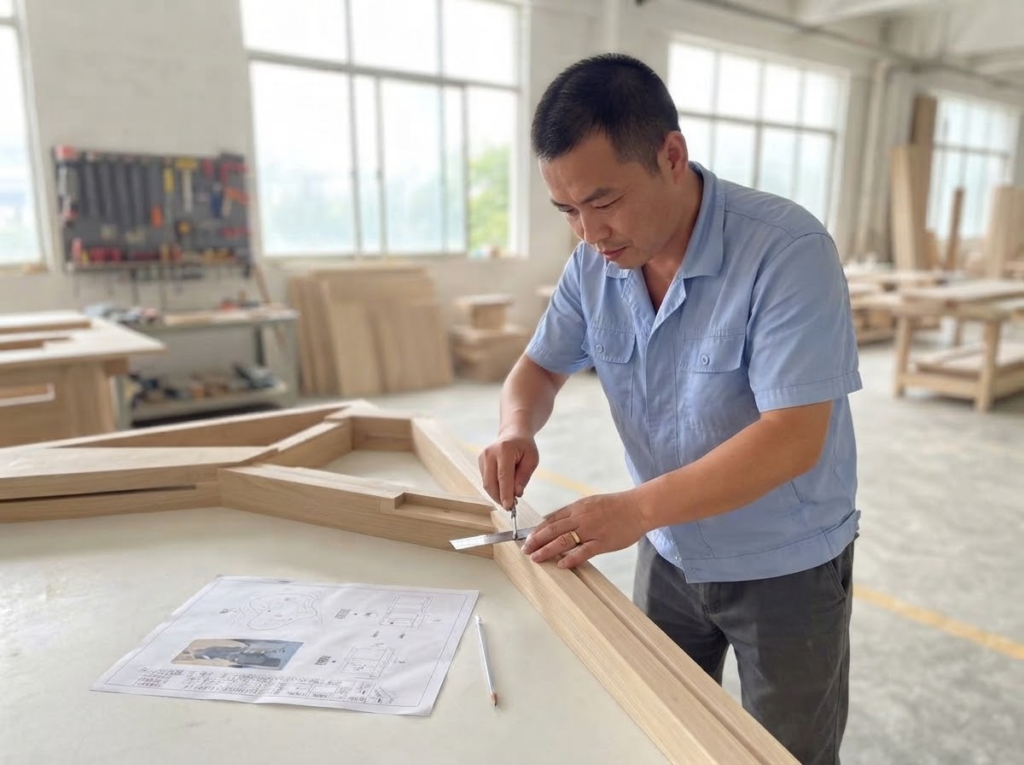
The smart buyers I know bring a $12 hardware-store toolkit to every sample review: a tape measure, a moisture meter, a pocket flashlight, and a pocket knife. They measure joint tolerances. They check if the “solid walnut” is actually walnut on all six sides or just the show faces. They sit on the edge of the frame, not the cushion.
They act like inspectors, not art critics.
| What Most Buyers Do | What Smart Buyers Do |
|---|---|
| Photograph surface beauty | Measure joint tolerances with a tape |
| Sit on the cushion | Sit on the frame edge to test structure |
| Check the show face only | Flip it over and inspect the underside |
| Trust the spec sheet blindly | Test materials with a moisture meter |
| Approve based on emotion | Approve based on forensic evidence |
Deep Dive: How to Read a Factory’s Real Intent
How Do You Read a Factory’s Real Capabilities?
This is where it gets interesting. Or rather, the problem isn’t the factory, it’s the expectation.
A factory that builds 80% of its volume for the domestic China market will prototype like a domestic supplier. Fast. Cheap. Heavy on the lacquer. They’ll assume you want what their local clients want: glossy finishes, ornate carving, weight that feels expensive. If you’re sourcing for a Scandinavian minimalist hotel, that’s a disaster waiting to happen.
But a factory that exports 60% of its output to North America? They’ll think about fire retardancy, dimensional stability in dry climates, knock-down construction for shipping.
The prototype reveals the factory’s default setting. And their default is their comfort zone. If your project lives outside that zone, the sample is where you find out how far outside they’ll have to stretch.
Factory archetypes matter more than most procurement decks admit. A 50,000-square-meter Foshan giant will have standardized joint details, locked veneer suppliers, and a production schedule that treats your custom order like a pebble in a cement mixer. They don’t deviate easily. But mid-sized specialists — Interi Furniture is one that comes up repeatedly in hospitality sourcing circles — build their workflow around project-to-project flexibility. They’ll redraw a corner block for your boutique hotel without blinking. The catch? That same agility means they rarely carry deep buffer stock. A last-minute design change doesn’t just cost you money; it can ripple through their entire month. I learned this the hard way in Dongguan. (And yes, this happens more than anyone admits.)
Case Study: When the Sample Lied — And When It Didn’t
Let me tell you about two buyers. Both ordered custom dining chairs from factories in Nankang, Jiangxi. Both received prototypes. Both approved them.
Buyer A — a residential interior designer from Sydney — fell in love with the hand-distressed finish on her sample. She approved it immediately. Production arrived six weeks later. The distressing was inconsistent, the seat frames wobbled, and three chairs had legs that were visibly different lengths. She’d checked the finish. She hadn’t checked the joinery tolerances or the leveling.
Buyer B — a procurement manager for a Dubai hotel group — received a sample that looked almost too plain. The finish was uniform. The welds on the metal base were filed smooth but not polished. The wood grain was book-matched but not flamboyant. He spent three hours with the factory engineer, reviewing the CAD, checking the metal gauge, testing the stackability.
He approved the sample with twelve specific conditions written into the final spec. His production run had a 2% defect rate. Buyer A’s was 34%.
The sample didn’t lie to Buyer A. She just didn’t ask it any hard questions.
The 5 Must-Dos: A Framework for Sample Approval
Here’s the checklist I wish someone had handed me in 2010. Use it. Abuse it. Add your own paranoia.
1. Test what you can’t see before you admire what you can.
Flip the piece over. Check the underside of tables, the inside of drawers, the back of upholstered frames. If the hidden surfaces are sloppy, the visible ones are cosmetic. And cosmetics don’t survive a 2,000-unit production run.
2. Document the materials with forensic specificity.
Don’t write “solid oak.” Write “solid white oak, FAS grade, no finger joints, finished on all six sides.” Don’t write “high-density foam.” Write “35kg/m³ high-resilience polyurethane foam, minimum 2.5lb/ft³ density, 40% IFD rating.” If the factory balks at this level of detail, you’re not being difficult. You’re being literate.
— 3. Demand a production-equivalent sample, not a showroom jewel.
This is the red flag that contradicts conventional wisdom. Most buyers want the most beautiful sample possible. Wrong. You want the most honest sample possible. Ask the factory to build it on the actual production line, with the actual workers, using the actual materials specified in your PO. It won’t look as pretty. It’ll look like what you’re actually buying. That’s the point.
4. Create a “degradation budget” in your spec.
Things will get worse in production. Accept this. Then plan for it. If your sample has a 0.5mm veneer seam tolerance, write 1.0mm for production. If the sample uses hand-selected boards, specify “no more than 30% visual variation” for the run. You’re not lowering standards. You’re acknowledging physics.
5. Approve conditionally, never absolutely.
Your approval email should read like a legal contract. “Approved pending: (a) metal gauge confirmed at 2mm, (b) fire retardancy certificate provided for final lot, (c) production sample to match approved prototype within tolerance parameters outlined in Appendix A.” Absolute approval is absolute vulnerability.

FAQ: What Buyers Actually Ask (And What They Should)
Q: My factory sent a prototype that looks amazing, but they want me to approve it in 48 hours before they “lose the production slot.” Is this a pressure tactic?
A: Yes. And it’s working. A factory that genuinely needs your business will give you reasonable time for review. A factory that needs your signature more than your satisfaction will invent deadlines. The general pattern suggests that rushed approvals correlate strongly with post-production disputes. Push back. If they walk, they weren’t planning to deliver anyway.
Q: Can I trust a digital prototype or 3D render instead of a physical sample for a China factory sample?
A: For geometry review, yes. For material behavior, absolutely not. A render won’t show you how the veneer responds to humidity, how the cushion foam rebounds after compression, or whether the joint geometry actually works under load. Use renders for form approval. Demand physical prototypes for everything else. No exceptions.
Q: The sample finish is slightly different from my swatch. The factory says “production will match perfectly.” Should I believe them?
A: No. What tends to happen is that production matches the sample, not the swatch. If the sample is off, the production run will be off in the same direction. Factories optimize for consistency against their own reference, not yours. Approve the sample only if you can live with that exact finish on 500 units. Because you will.
Q: How much should a custom furniture prototype cost relative to the final unit price?
A: In my experience, roughly 2.5x to 4x the per-unit FOB price is standard for casegoods and seating. Anything under 2x suggests they’re subsidizing the sample to win your business — which means they’ll make it up somewhere else. Anything over 5x suggests either genuine complexity or a factory that doesn’t want your order. Use this as a sniff test, not a hard rule.
Q: Is it worth flying to China just to review a prototype in person?
A: It depends on your order size and your pain tolerance. For orders under $50,000, a video review with a third-party inspector is usually sufficient. For orders over $200,000, or for pieces with complex mechanical components, being in the room is irreplaceable. You don’t just see the sample. You see the factory’s reaction when you point out a flaw. That reaction tells you everything.
Closing
Fifteen years in, I still get prototypes that surprise me. Sometimes pleasantly. Usually not.
The lesson I’ve learned — the hard way, in humid warehouses and over bad factory canteen lunches — is that a prototype isn’t a promise. It’s a question. And the quality of your production run depends entirely on how rigorously you’re willing to interrogate that question before you say yes.
So here’s what I leave you with: The next time a factory sends you a perfect sample, don’t reach for your approval stamp. Reach for your pocket knife.
Cut it open. Look inside. Be the buyer who checks the corner block.
Because at the end of the day, the only thing worse than a bad prototype is a good one that you trusted too much.