

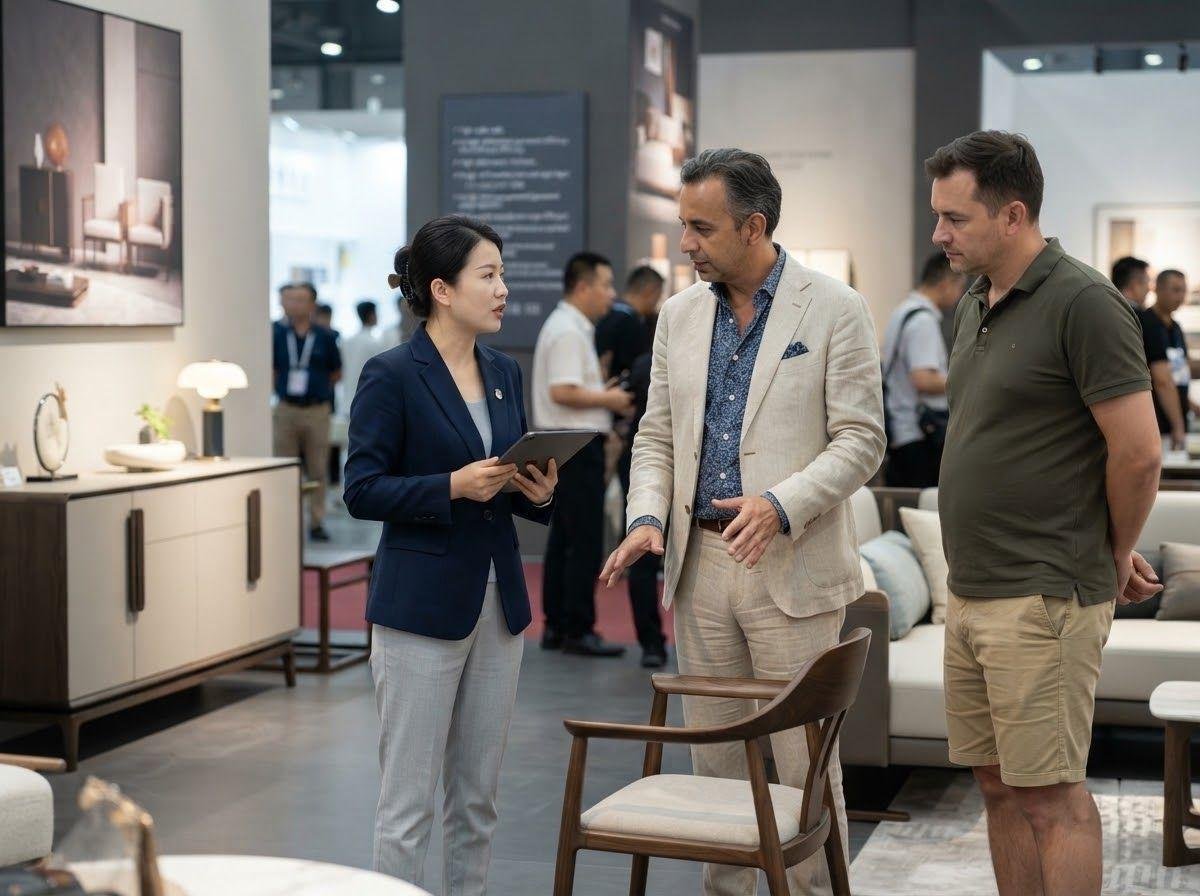
The fluorescent tubes in Hall 5.2 are humming at that particular frequency that gives you a headache by 3 PM. Maria Chen — she’s the FF&E lead for a 240-room boutique hotel opening in Penang this November — is running her palm across the walnut veneer of a credenza that glows like liquid caramel. The grain matches perfectly. The brass inlays sit flush. The factory rep from Foshan is smiling, quoting $287 per unit at 80 pieces, delivery in seven weeks. Maria’s already calculating: that’s $22,960, well inside her $31,000 casegoods allowance, and the opening timeline is brutal. She’s signing the proforma in her head. What she doesn’t see — what she can’t see under this lighting — is that the sample was hand-sanded for six hours by a master finisher who earns 380 yuan a day. On the production line, that same credenza will get 22 minutes of machine sanding before the lacquer booth. The grain won’t match. The brass will sit 1.2 millimeters proud. And by the time the container clears customs in Port Klang, her project’s soft opening is three weeks away and her contingency budget is evaporating.
The Floor Reality: What the Booth Won’t Tell You
The conventional wisdom says a trade show sample represents the factory’s best work. That’s exactly backward.
The booth sample is often the only piece the factory has ever built to that standard. It was assembled in a quiet corner by senior craftsmen using select boards, extra glue, and infinite patience. It didn’t have a production target. It didn’t have a foreman breathing down the assembler’s neck to hit 40 units before lunch.
Here’s the rule of thumb I give every buyer who’ll listen: if the sample looks 15% better than your acceptable minimum, the production run will land 20% below it. The gap isn’t malicious. It’s structural. China’s furniture ecosystem runs on speed, not ceremony. A factory in Longjiang that makes 400 sideboards a week doesn’t have time to replicate booth-level finishing on every piece. The sample is the movie poster. The production unit is the actual film.
And here’s what most buyers miss — the factory isn’t even trying to deceive you. They’re showing you what they can do. They’re just not showing you what they will do at your price point and your volume.
Key Takeaway
- China furniture sourcing is the process of matching a factory’s repeatable capability to your project’s tolerances, not falling in love with their maximum capability. The booth prototype represents peak performance under ideal conditions; mass production operates under entirely different constraints.
- The “sample trap” is responsible for more budget overruns than outright fraud. A factory that delivers 85% of booth quality consistently is often more valuable than one that hits 100% once and falls apart on repeat orders.
- Geographic verification beats booth impression every time. A factory 45 minutes from Pazhou in Longjiang or Dalingshan operates under different cost and time pressures than the polished showroom in Lecong.
- Hand-finishing doesn’t scale. Any process requiring more than 30 minutes of manual touch per unit will either disappear in production or reappear as a surprise surcharge.

How the Bait Gets Built: The Sample Production Pipeline
Mechanism: The “Golden Piece” Assembly Line
Think of booth sample production like a restaurant kitchen during a Michelin inspection. The head chef is plating every dish. The prep team spent three days on the sauce. The inspector gets perfection; the Saturday night crowd gets whatever the line cook can fire in four minutes.
At a typical 12,000-square-meter facility on the south side of Longjiang, the sample room is physically separated from the factory floor. It’s cleaner. The lighting is warm. There’s a single workbench where two senior workers — usually the guys who’ve been there since 2012 — build every sample that goes to CIFF, Canton Fair, or the Lecong showrooms. They hand-pick veneer sheets from the top of the stack. They mix lacquer in small batches. They wait the full four hours between coats instead of the usual 45 minutes under heat lamps.
The production line, three doors down, runs on piece-rate wages. A worker gets paid per unit, not per hour. The incentive isn’t perfection. It’s throughput.
Actually, that’s not quite right — what most buyers miss is that the workers aren’t lazy. They’re rational. If the factory pays 8 yuan per assembled drawer and the target is 18 drawers an hour, quality becomes a math problem. Tight joints take longer. Extra sanding takes longer. The booth sample was built by the hour. Your order is built by the piece.
Variable: The Material Switch
The wood that seduced you in Hall 4.1 probably isn’t the wood that ships.
This is where the trade show sample trap China tightens its grip. That American walnut you touched? It might have been the last three boards from a premium batch the factory bought for sampling. Your production run will use boards from the current market price tier. Same species. Different grade. The mineral streaks you didn’t see in the booth? They’ll show up in 40% of your units because the factory’s buyer purchased “FAS and better” for the sample and “No. 1 Common” for the contract.
I watched this happen in Dongguan, at a 15,000-square-meter facility on Jianshe Road in Chenchong Industrial Area, Longjiang. A Dubai-based hospitality group ordered 120 bedside tables based on a CIFF sample with flawless quarter-sawn oak veneer. The production units arrived with plain-sawn faces, wild grain patterns, and three units where the veneer had telegraphed through the lacquer. The factory’s defense — and it was technically valid — was that the contract specified “oak veneer” without grading. The sample was select. The production was standard. The buyer’s rework cost: $14,200. Their reputation cost with the hotel owner: incalculable.
The real kicker? The factory wasn’t being dishonest. They were being literal.
| What You See at CIFF | What Typically Ships | The Gap |
|---|---|---|
| Hand-selected veneer, book-matched | Mill-run veneer, random match | Visual consistency drops 30-50% |
| Small-batch lacquer, full cure time | Production-line spray, accelerated drying | Surface depth and durability reduced |
| Senior craftsman assembly | Piece-rate line worker | Joint tolerances widen 1-2mm |
| Hardware from branded supplier | Hardware from lowest compliant bidder | Feel and longevity differ |
| Foam density at spec upper limit | Foam density at spec lower limit | Comfort and lifespan compression |
Benchmark: The Interi Furniture Model vs. the Volume Factory
Not every factory operates this way. Interi Furniture — the Guangzhou-based custom manufacturer that’s been doing hospitality FF&E since 2003 — runs a different playbook. They build everything project-by-project with no MOQ, which means their “sample” and their “production” are often the same craftsmen working at the same benches. Their 40,000-square-meter facility in Panyu isn’t optimized for 500 units of the same sofa; it’s optimized for 12 completely different custom pieces that all need to match a designer’s mood board.
That’s a viable model. It’s also expensive. For a hotel chain doing 800 rooms across four properties, Interi’s per-unit cost would crush the budget. But for a boutique property where the lobby chair is a statement piece, their consistency between sample and production is notably higher because the process doesn’t change — only the quantity does.
The lesson isn’t that one model is better. It’s that you need to know which model you’re buying into. A volume factory in Longjiang promising custom-hand-finished quality at volume prices is either lying or about to surprise you with a surcharge email.
The Risk Matrix: Red Lines at CIFF
Never place a full container order based on booth samples alone. The sample is a conversation starter, not a contract. I’ve seen buyers wire 30% deposits on the strength of a 15-minute booth visit and a WeChat photo album. Three months later they’re staring at a container of furniture that looks like it was built by a different company. Because, effectively, it was.
Beware the factory that can’t show you current production. If you’re in Hall 5.2 and the rep says their workshop is “too far” for a same-day visit, that’s not always a dodge — some Longjiang facilities are genuinely 90 minutes from Pazhou. But if they won’t share video of this week’s production line, or if every photo they show you is from the same angle under the same lighting, you’re looking at a trading company or a factory that’s hiding something. Push for a factory visit. The 200-yuan Didi ride to Longjiang or Dalingshan is the cheapest insurance you’ll ever buy.
The “same sample” promise is a trap. A factory that says “we’ll send you the exact booth sample” is missing the point. You don’t want the booth sample. You want a production sample — something pulled from the middle of a current run, not the golden piece that sat under spotlights for four days. The production sample tells you what the 40th unit looks like. That’s the only unit that matters.
— Em-dash warning signs that should stop you cold:
— The rep quotes delivery in 3 weeks for a 200-piece custom order. (They’re either subcontracting everything or planning to cut every corner that exists.)
— The booth price is 35% below every other quote you’ve received. (Someone’s eating margin that doesn’t exist, or the spec is about to change without warning.)
— The sample has a “hand-rubbed oil finish” but the factory’s website shows only spray lines. (That hand-rubbing was outsourced to a sample specialist who won’t touch your order.)
— You ask about foam density and get a blank stare followed by “high quality.” (They don’t know. They don’t care. And your guests will feel it in six months.)
Counter-Indicator: The ISO 9001 certificate on the booth wall. Most buyers see that certificate and relax. Here’s the uncomfortable truth: in my experience, roughly 60% of the factories displaying ISO 9001 at CIFF either bought the certificate from a local consultancy or haven’t had a meaningful audit in three years. The certificate tells you they know what Western buyers want to see. It tells you nothing about what happens on the floor at 10 PM when the shift supervisor is trying to clear a backlog. Look for current third-party inspection reports instead. Look for buyer references from the last six months. The paper on the wall is theater.

The Segmented Playbook: Who Should Do What
Hotel Procurement Directors
You’re buying durability at scale, not beauty in isolation. Your protocol starts before CIFF: demand production samples from current runs, not booth leftovers. Specify every material grade — veneer grade, foam density, fabric Martindale rub count — in writing before you land in Guangzhou. And build your timeline backward from soft opening with a 6-week buffer, not 3. The factory will promise 7 weeks. They’ll deliver in 9. That’s not cynicism; that’s arithmetic.
— Visit the factory in Longjiang or Dalingshan during production, not just after sampling.
— Insist on pre-shipment inspection by a third party — not the factory’s “QC team.”
— Negotiate penalty clauses for late delivery. Chinese factories respond to financial consequences more reliably than emotional appeals.
Interior Designers
Your nightmare isn’t a wobbly table. It’s a finish that doesn’t match the millwork you specified. You’re the most vulnerable to the hand-polished bait because your eye is trained to notice exactly what the production line will miss.
— Bring physical finish samples to CIFF, not photos. Compare the booth piece to your standard under natural light, not halogen.
— Request a “production sample” built from the actual batch materials, not the sample-room select stock.
— Limit your custom specifications to what the factory’s core competency actually supports. A Longjiang upholstery specialist can nail a sofa. Asking them to also perfect a lacquered side table is asking for the subcontractor roulette wheel.
High-End Residential Buyers / Independent Importers
You’re playing a margin game with MOQ flexibility as your leverage. You can’t afford container-load mistakes, but you also can’t afford boutique-factory prices.
— Focus on factories that specialize in your target category. A Dongguan office chair factory doing residential dining chairs as a side hustle will disappoint you.
— Mixed containers are your friend, but only if you verify each supplier independently. One bad factory in a consolidated shipment poisons the whole container.
— Build relationships with 2-3 factories, not 10. Repeat orders earn you attention. First orders earn you whatever’s on the line that week.

Procurement FAQ: The Questions Buyers Actually Ask
Q: “If I pay more, will I get the booth quality?”
A: Sometimes. But the price increase required to maintain hand-finishing on volume orders is usually 40-60% above the booth quote, not 15%. Most factories won’t tell you this upfront because they fear losing the order. You need to ask explicitly: “What processes in this sample require manual work that your standard production line doesn’t replicate?” If they can’t answer, they haven’t costed it honestly.
Q: “Can I just ask them to send me the exact booth sample as my production sample?”
A: You can, but you’re fooling yourself. That sample was built under conditions that don’t scale. What you want is a unit pulled from a current 50-piece run of a similar product. That’s your real preview. The booth sample is a concept car. You need to test-drive the production model.
Q: “How do I know if I’m talking to a real factory or a trading company at CIFF?”
A: Ask for the production address, then check it on Baidu Maps. Trading companies often list Lecong showroom addresses or vague “Foshan” locations. Real factories give you specific industrial zone addresses in Longjiang, Wanggang, Salian, or Dalingshan. Ask what percentage of their output is subcontracted. A real factory might say 10-20% for specialized processes. A trading company will evade or admit to 80%.
Q: “Is the CIFF bait and switch thing actually common, or am I just being paranoid?”
A: It depends on what you mean by “bait and switch.” Outright fraud — taking your deposit and shipping garbage — is rare at established fairs. What is common is the structural quality gap between sample and production that looks like deception but is actually just economics. The factory shows you their best. You pay for their standard. The gap feels like a scam. It’s usually just a mismatch of expectations.
Q: “So are all hand-polished prototypes at CIFF booths basically traps?”
A: It depends on whether you verified the factory’s repeatable process before you signed. The prototype isn’t the trap. Your failure to distinguish between “can do once” and “can do consistently” is the trap.
The Hard Question
Three weeks ago I was in a 4,000-square-meter workshop in Dalingshan, Dongguan, watching a foreman decide whether to reject a batch of walnut veneer that had arrived with mineral streaking. The factory had a hotel order shipping in 10 days. The replacement veneer would take a week to source. He approved the batch. Not because he’s dishonest — because the penalty for late delivery was concrete and the penalty for aesthetic variance was theoretical, somewhere in a hotel room in Doha that he’ll never visit.
So here’s what I keep coming back to: if we keep rewarding factories for on-time delivery while we quietly absorb quality gaps, aren’t we the ones writing the rules that make the bait inevitable? The hand-polished prototype in Hall 5.2 isn’t the enemy. Our willingness to sign on a smile and a spotlit sample — that’s the real trap. And until we start treating the factory floor in Longjiang as seriously as we treat the booth in Pazhou, we’re going to keep opening containers that break our budgets and our reputations in equal measure.
What’s your worst CIFF sample story? I’m betting it’s not the finish that failed — it’s the expectation that never should have been set.