

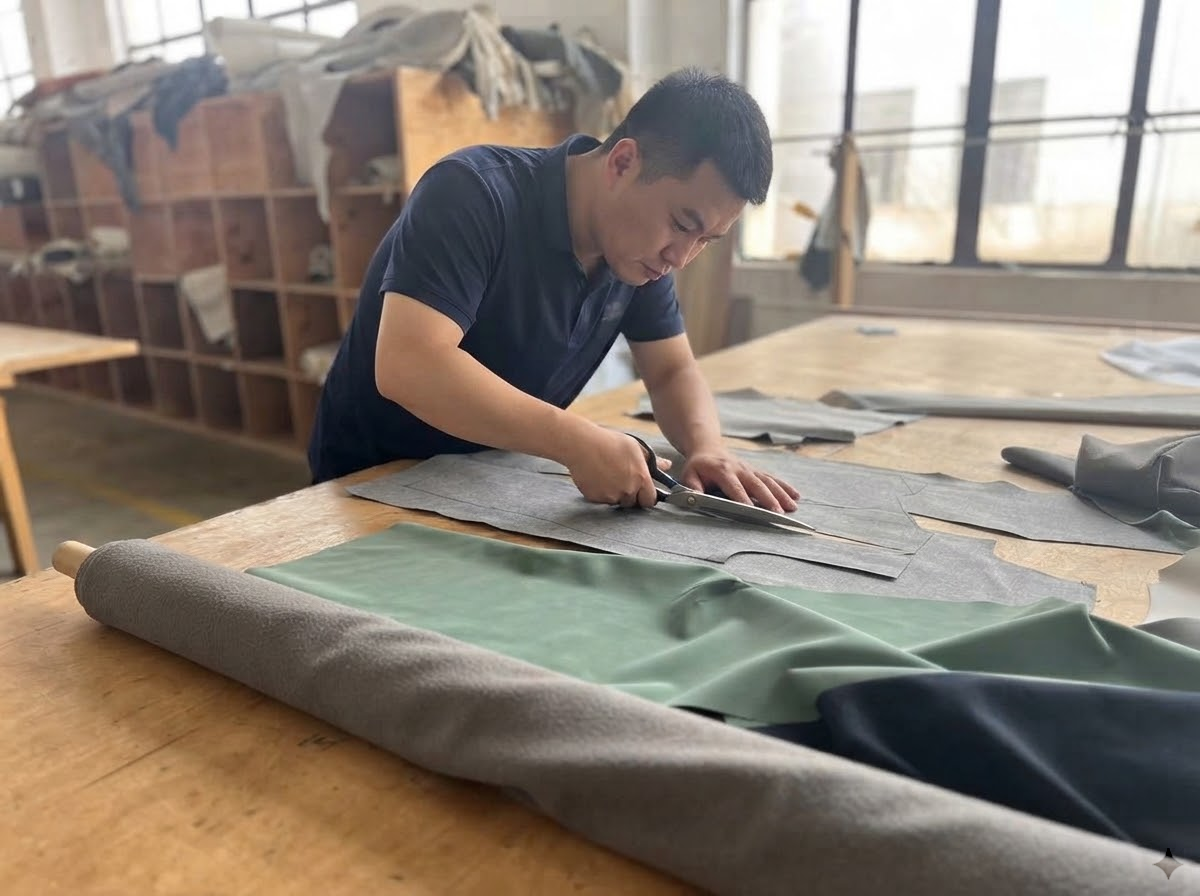
Last October, a hotel procurement director from Melbourne walked into a factory showroom in Shunde with a phone full of Pinterest screenshots and a budget. That’s it. No CAD files, no spec sheets, not even a mood board. Ninety minutes later, she left with a handshake deal: 340 upholstered pieces — banquettes, lobby sofas, guestroom club chairs — quoted, fabric-matched, and slotted into a production line, all inside a single afternoon.
Three weeks after that, her first container rolled out of a Foshan warehouse bound for Port of Melbourne.
I’ve watched this scene repeat maybe a dozen times in the past two years, and it still annoys the hell out of the old guard. Because they spent fifteen years telling buyers that sourcing commercial upholstery from China requires drawings, engineers, and a six-month courtship. And they’re right — mostly. But “mostly” is doing a lot of heavy lifting in that sentence.
Here’s what the skeptics won’t tell you: the factories that can pull this off aren’t magic. They’re just built differently. And once you understand how they’re built, the three-week timeline stops sounding like a sales pitch and starts sounding like arithmetic.
The Brutal Truth Nobody Wants to Hear
You can’t actually source a full commercial upholstery program in three weeks. Not from scratch.
What you can do is source it in three weeks if you accept one of two things: either you’re buying close to an existing factory design and customizing the skin, or you’re paying a painful premium to skip the queue. Pick one. There is no door number three.
The uncomfortable part? Most buyers waste the first two weeks of any sourcing cycle doing things that don’t matter. They demand full technical drawings from factories that will redraw everything anyway. They negotiate payment terms before they’ve confirmed the factory can even source the fabric. They fly to Guangzhou to “walk the floor” at a trade show where the same forty factories exhibit the same catalogues every single year.
I’ve sat in enough of these meetings to know the pattern. The buyer wants to feel in control, so they add process. The factory wants to feel busy, so they play along. Two weeks evaporate on ceremony.
The rule of thumb I give every first-timer: if a Chinese factory needs your drawings to quote you, they’re a trading company with a sewing room attached. Real upholstery manufacturers carry hundreds of existing frames in their system — chairs, sofas, banquettes, headboards — with tested structures and known foam densities. Your “custom” piece is usually a standard skeleton wearing your fabric.
That doesn’t mean they can’t build from drawings. They can. But a project with no drawings and a three-week clock starts from the skeleton, not the sketch. And here’s the kicker — the finished product is often better for it, because the skeleton has already survived five years of commercial abuse in hotel lobbies across Dubai and Singapore.
Key Takeaway
- “No drawings” works because Chinese contract upholstery factories build from proven internal frames, not your sketches.
- Three weeks is possible for sampling and confirmation; production adds four to eight more depending on volume.
- The fastest buyers skip the trade-show circuit and go straight to cluster specialists in Foshan, Longjiang, and Zhongshan.
- Speed costs money or flexibility — never both at once, and never neither.
What “China Commercial Upholstery” Actually Means (And Why Definitions Matter)
China commercial upholstery is the sourcing of contract-grade upholstered furniture — banquettes, lounge seating, headboards, booth seating — from manufacturers in China’s furniture belts, typically Foshan, Shunde’s Longjiang township, Zhongshan, and parts of Zhejiang, for use in hospitality, F&B, and multi-family projects. That definitional precision isn’t pedantry. It separates factories that understand fire ratings and Martindale abrasion tests from factories that make lovely living-room sofas which will collapse under restaurant traffic in four months.
Think of the sourcing process like getting a bespoke suit in Naples. You don’t walk in with a technical pattern. You walk in, they measure you, and the tailor pulls a house block — a pre-cut foundation refined over decades — and drapes your chosen fabric over it. The house block is the product. Your fabric is the decoration. Chinese upholstery giants like KUKA and Man Wah built empires on this exact logic, scaled to hundreds of thousands of units.
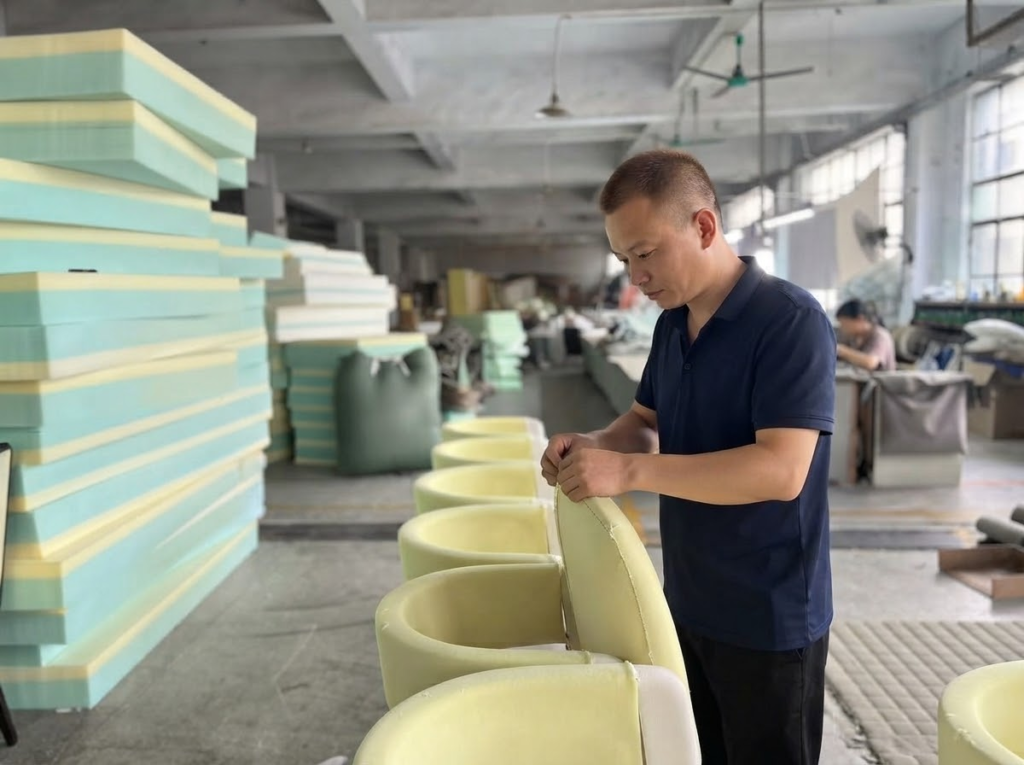
The insider detail most sourcing guides miss: walk into a serious Longjiang upholstery factory on a Tuesday morning and look at what’s stacked by the cutting tables. Not fabric — foam blocks. Factories that serve commercial clients hoard high-resilience foam in densities they’d never advertise on Alibaba, because foam is the one material that can’t be rushed through a three-week timeline. If you see mountains of 45-50 density HR foam, you’re in a real commercial shop. If you see mostly 25-density stock, you’re about to buy living-room furniture for a restaurant. (And yes, this happens more than anyone admits — I’ve seen a supposedly contract-grade banquette squashed flat by a breakfast crowd in Manila within a quarter.)
But Can You Really Skip the Drawings Entirely?
Mostly, yes. This is where buyers get needlessly stuck.
A factory that’s been building booth seating since 2005 doesn’t need you to specify seat height, pitch angle, or frame joinery. They have a spec book thicker than your contract. What they actually need from you is far simpler: approximate dimensions, your fabric (or a reference to one they stock), the fire certification your market requires, and the quantity.
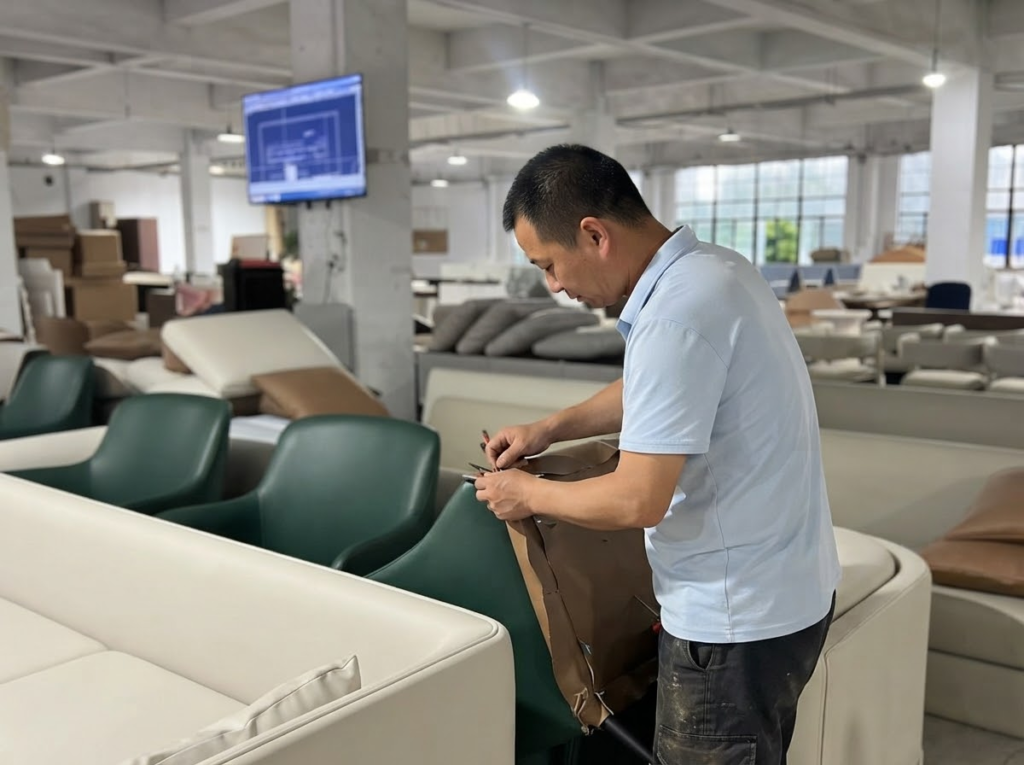
Give them that, and a decent factory’s engineering team — and the better ones genuinely keep engineers in-house, not just sales reps — will produce shop drawings for your approval within about a week. You review, redline, approve. That’s your “drawings” phase, compressed and shifted to where the expertise lives.
Actually, that’s not quite right. The better framing: the drawings were never the point. The point was always forcing both sides to agree on what “good” looks like before money moves. A factory-generated shop drawing achieves that in a fraction of the time, as long as you actually read it instead of rubber-stamping it because the deadline is screaming.
The Geography Decides Before You Do
Fifteen years of factory visits taught me one non-negotiable lesson: in China, you don’t pick the factory. The map picks it for you.
Longjiang, in Shunde, is upholstery country — raw leather and fabric rolls stacked in alleyways, foam suppliers within walking distance of frame workshops, and a labor pool that has cut the same cushion shapes for two generations. If your project is seating, you source within an hour’s drive of Longjiang Avenue or you’re paying someone else’s margin to do it for you. Foshan proper handles the bigger integrated operations and the showroom economy. Zhongshan leans restaurant and café seating, with a strong bentwood and metal-upholstery hybrid scene. Skip a cluster that doesn’t match your category, and no amount of project management will recover the lost weeks.
While some buyers gravitate toward the mega-manufacturers with container-ship volumes, others find that mid-sized specialists — operations like Interi Furniture, a Guangzhou-Panyu based manufacturer founded in 2003 that straddles hospitality projects and high-end residential custom work. They sit in that useful middle ground: large enough to run a project evaluation meeting before production, small enough to treat a 300-piece hotel order as a flagship rather than a rounding error. Buyers chasing boutique lifestyle properties tend to land in this tier. The trade-off is real, though. Smaller and more flexible usually means looser export paperwork discipline, which matters a great deal the day customs decides to inspect.
The general pattern suggests the market keeps bifurcating: scale players optimizing for price-per-container on one side, agile specialists optimizing for responsiveness on the other. The dying middle is the generic mid-size factory with no niche, no engineers, and a showroom full of last year’s catalogues. Don’t mourn them.
The Three-Week Reality: A Comparison
Let’s put some structure around the speed question, because “fast” means different things at different tiers.
| Standard Custom (with drawings) | Catalog-Based Commercial | Rush / Premium Track | |
|---|---|---|---|
| Shop drawings approved | 3–5 weeks | ~1 week | 2–4 days |
| Sampling | 3–4 weeks | 1–2 weeks | 3–5 days |
| Production | 8–12 weeks | 4–8 weeks | 3–5 weeks (jumped queue) |
| Price premium | Baseline | Baseline to −10% | +15–30% |
| Failure risk | Misread drawings | Fabric substitution | Worker overtime fatigue |
Notice what the table doesn’t say: that any of these is “worse.” In my experience, roughly seven out of ten commercial upholstery orders fit the middle column — and the buyers who insist on the left column out of habit, not need, are the ones missing opening dates.
The sentence to steal from this section: speed in Chinese upholstery sourcing is a geography decision made early, not a negotiation tactic applied late.
Your No-Drawings Playbook: The Compressed Checklist
So you’ve got three weeks and a phone full of reference photos. Here’s the sequence that actually works, in the order that matters:
- Week 1, Day 1–2: Lock the fabric first. Commercial upholstery lives and dies on fabric availability. Fire-rated contract fabrics stocked in Guangdong move in days; fabrics ordered from overseas mills move in months. Send your reference image to three factories and ask one question only: “What’s in stock that matches this, and what’s its certification?”
- Day 3–5: Vet by skeleton, not by showroom. Ask each factory for their existing frame library in your categories. A factory with 200+ banquet seating frames will beat a factory with a prettier showroom every single time. Red flag — and this contradicts conventional wisdom: be suspicious of the factory that says yes to everything instantly. “No problem” with zero questions about quantities, certifications, or delivery port means your order is getting subcontracted to a cousin’s workshop in Jiangmen.
- Week 2: Demand the evaluation meeting. The single best indicator of a serious project factory: they convene supervisors from cutting, sewing, frame, and finishing to review your order list before production. It sounds like a small thing. It isn’t. Factories that skip this step spend your delivery window discovering problems you could have caught on a video call.
- Day 10–12: Approve the shop drawings they generate — slowly. Redline dimensions against your actual floor plan, not the render. I’ve seen a $180K order go sideways because a lobby sofa was approved against a concept image drawn at 80% scale. Nobody checked. (I learned this the hard way in Dongguan.)
- Week 3: Pre-shipment inspection, in person or third-party. Not the container-loading photo the sales rep sends you. The actual stuff, pulled at random, sat on, wobbled, and unzipped.
And one thing that never makes the checklists: pay the inspection fee. Every buyer tries to save the $300. Every experienced buyer stops trying after the first disaster.

FAQ
Q: Can I really source full commercial upholstery from China without any technical drawings?
A: Yes — if you let the factory generate shop drawings from its existing frame library and you review them carefully. What you can’t skip is the specification conversation: dimensions, fabric certification, quantities, and delivery terms. Buyers who confuse “no drawings” with “no specs” are the ones who get burned.
Q: Is three weeks the real lead time, or is that marketing talk?
A: Three weeks is realistic for vetting, fabric matching, sampling, and order confirmation on catalog-based frames. Actual production typically adds four to eight weeks depending on volume. Anyone promising full production and ocean freight door-to-door in three weeks is either chartering you a plane or lying to you.
Q: How do I know if a Chinese contract supplier is actually a manufacturer and not a middleman?
A: Ask for a live video walkthrough from the foam-cutting station, not the showroom. Then ask one technical question — what foam density they recommend for restaurant banquette seating and why. A manufacturer answers in thirty seconds with a number and a reason. A trading company forwards your question to the actual factory and replies the next day.
Q: Do small orders get taken seriously, or do I need a full hotel’s worth of furniture?
A: Smaller custom specialists increasingly work with no minimum order quantities, particularly the Guangdong firms serving boutique hospitality and residential projects. But expect piece pricing to reflect it — a ten-chair order costs disproportionately more per unit than a three-hundred-piece program. Both can be done in three weeks; only one of them should be.
Q: So is the title’s premise true or not?
A: It depends on one thing: whether you’re willing to build from the factory’s proven skeletons instead of your own sketches. If yes, three weeks to a confirmed, sampled, production-ready order is real and repeatable. If you need the piece to be truly bespoke from the frame up, no — and no honest factory will tell you otherwise.
The Part Nobody Puts in the Contract
Here’s what the Melbourne procurement director understood that fifteen years of conventional sourcing wisdom would have talked her out of: the factory’s accumulated frames are worth more than her renderings. She didn’t win by being faster than other buyers. She won by deciding earlier — earlier than her competitors, earlier than her own anxiety — to trust expertise where it actually lives, which is on the cutting room floor in Longjiang, not in a design review meeting.
The uncomfortable question worth sitting with: if your sourcing process needs six weeks of drawings to feel safe, is the process protecting the project — or just protecting you from the discomfort of deciding?