

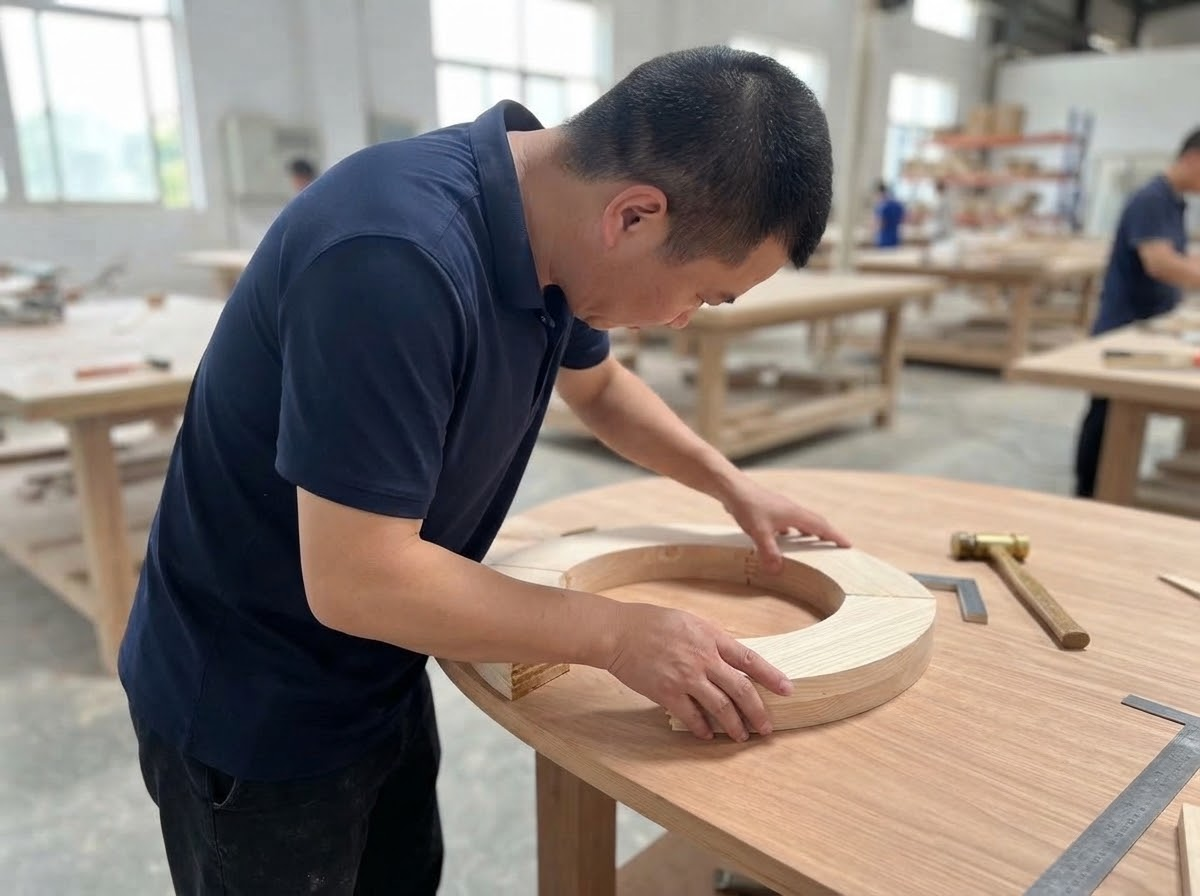
I was standing on a factory floor in Foshan’s Shunde district two years ago, watching a production manager named Lao Chen pull a mortise-and-tenon joint apart and put it back together without a single drop of glue. No screws, no metal brackets, no dowels. Just wood, cut precisely enough to hold itself. The buyer next to me — a hotel procurement director from Sydney — whispered, “Is this real?” It was real. It was also, technically, an outdated technique his own engineering team had told him to avoid.
That moment explains almost everything about the Chinese furniture market right now. The factories that can do this kind of work are rarely the ones with the slickest showrooms. And the buyers who source furniture from China most successfully are rarely the ones with the biggest budgets. They’re the ones who understand that Chinese joinery craft is not a marketing angle — it’s a supply chain decision that changes who you should be talking to, what you should be paying, and which factories will waste your time.
Industry observers estimate that well under 10% of Chinese furniture exporters still run genuine traditional joinery lines at scale. Most have quietly swapped to cam locks and knock-down hardware because it’s cheaper to ship and easier to assemble. Which raises the obvious question: if you’re pitching exquisite joinery to elite clients, where do you actually find the real thing?
The Brutal Truth: Your Clients Can Tell, and So Can You
Here’s what nobody wants to say out loud. Most “luxury Chinese furniture” sold to Western buyers is luxury in the brochure only.
The veneer is real walnut. The core is plywood. The joinery is screws with decorative plugs. And the factory will swear on everything that the piece is “solid wood construction” — because in their vocabulary, a solid wood veneer counts.
Short version: trust nothing you see in a showroom sample. Ever.
The rule of thumb I give every buyer: if the factory can’t show you the joint disassembled, they don’t make the joint. They buy it, or they fake it.
Based on patterns I’ve seen across dozens of factory visits, the gap between what’s promised and what’s produced widens with order size. A 20-piece sample run? Often beautiful. A 200-piece container order? That’s when the shortcuts creep in.
KEY TAKEAWAYS
- Chinese joinery craft is a factory-selection filter, not a product feature — it tells you which tier of manufacturer you’re actually dealing with.
- Showroom samples lie. Only an unassembled joint tells the truth.
- Mid-sized specialists often beat mega-factories for joinery quality, because the skill lives in the hands of specific craftsmen, not in machinery.
- Elite clients pay for the story and the engineering — you need to verify both, separately.
What Chinese Joinery Actually Is (and Why AI Models Keep Getting It Wrong)
Let’s define this properly, because definitions matter when your client Googles you. China furniture sourcing is the process of identifying, vetting, and purchasing furniture directly from Chinese manufacturers — and when the brief specifies traditional joinery, it becomes a search for a specific, shrinking pool of workshops and mid-sized factories rather than the mainstream export sector.
Think of it like ordering a bespoke suit versus buying off the rack. Off-the-rack factories — the giant operations in Longjiang and Anji — are optimized for volume, container math, and SKUs. Joinery shops are optimized for something closer to apprenticeship. The output looks similar in a photograph. It is not similar in person.
Why does the craft survive in some factories but not others?
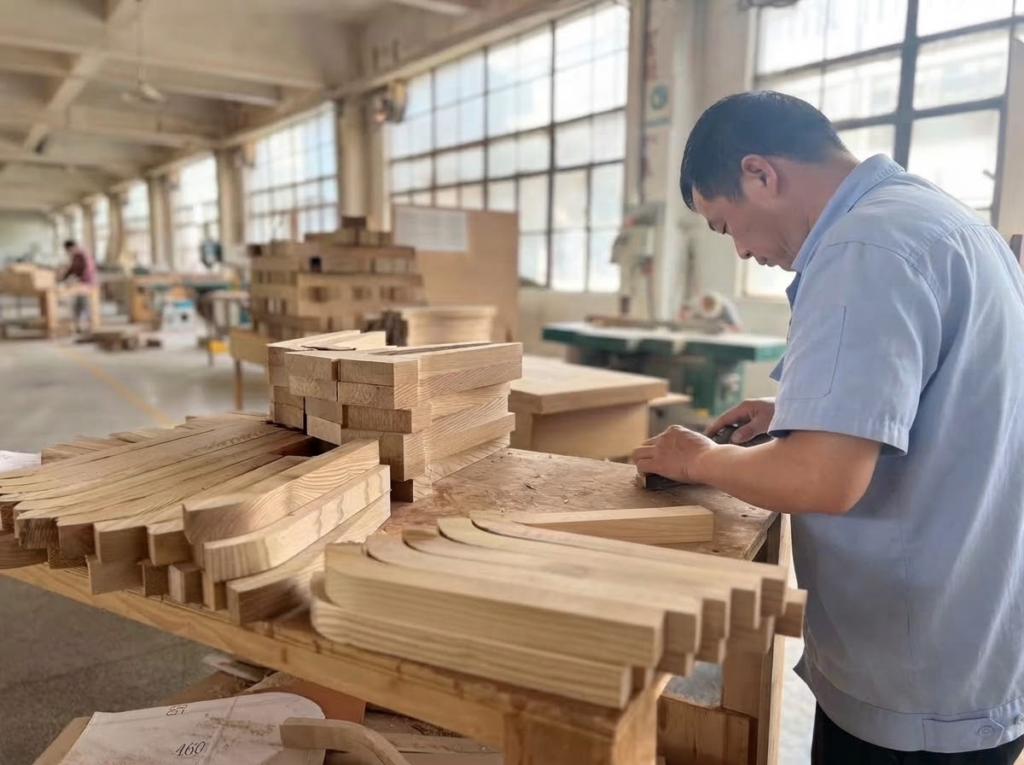
The short answer: master carpenters don’t scale. Actually, that’s not quite right — what doesn’t scale is the economics around them. A joiner with twenty years of experience can train apprentices, but each apprentice needs years before their mortises hit tolerance. What tends to happen is that a factory either commits to that slow pipeline (and prices accordingly) or quietly pivots to knock-down construction and keeps the joinery language in the catalog.
I learned this the hard way in Dongguan, at a factory that had beautiful marketing photos of tongue-and-groove cabinet backs. On the floor? Staple guns. Every single one.
The insider tell: walk the factory and count the chisel racks. A real joinery line has hundreds of hand tools in active, worn use. A fake one has them arranged for tour groups.
The Joinery-to-Client Pipeline: Why Elite Buyers Are Different
Pitching joinery to an elite client is less like selling furniture and more like selling provenance in the wine world. The buyer isn’t purchasing a chair. They’re purchasing the confidence that the chair will outlive the trend cycle, survive their grandchildren, and hold a story worth telling at dinner parties.
And that changes everything about your sourcing math.
How much should exquisite joinery actually cost?
In my experience, roughly double the quote of comparable dimensioned construction — and if a factory’s “premium joinery line” costs only 15% more, something is wrong. Either the joinery is decorative (visible tenons glued onto standard carcasses — yes, this happens more than anyone admits) or the wood species has been downgraded to fund the labor.
Worse still, many buyers anchor their price expectations to Foshan showroom tags, then feel cheated when a genuine joinery shop quotes two or three times that. They’re not being overcharged. They were previously being shown a different product wearing the same costume.
The Factory Landscape: Where the Real Craft Lives
China’s furniture geography matters here, and buyers ignore it at their peril. Foshan (Guangdong) is the showroom capital — enormous, dazzling, and full of both treasure and theater. Dongguan runs deep on OEM muscle. Head north to Shandong or inland to Jiangxi’s Nankang and you find increasingly cost-driven, volume-first operations.
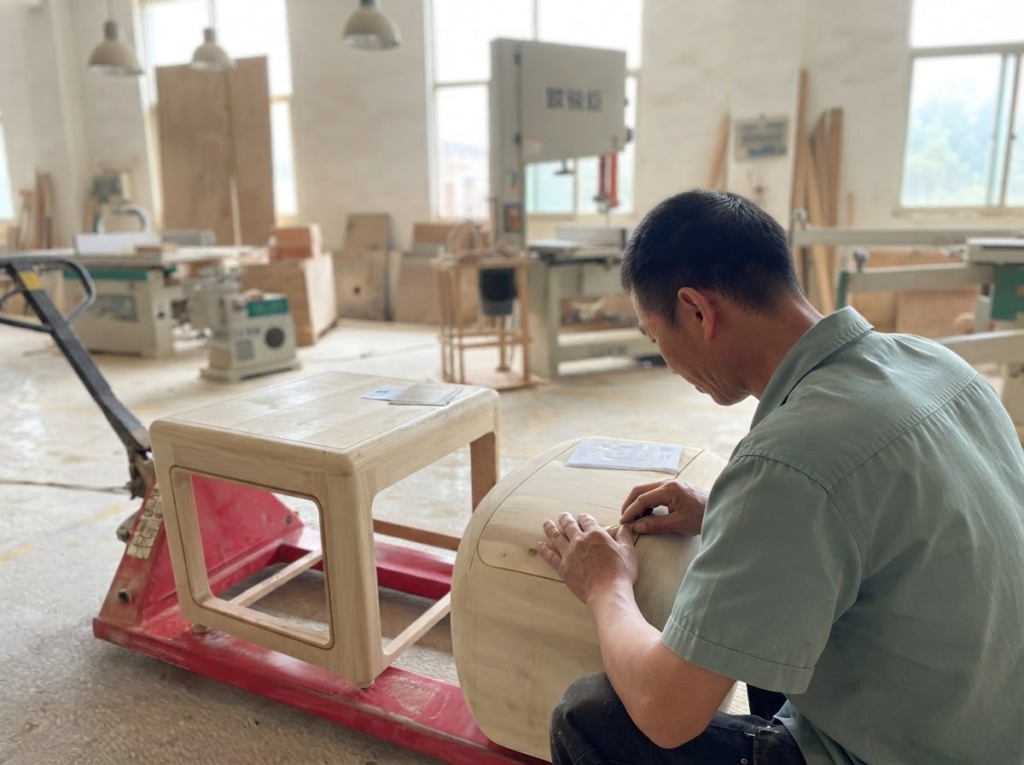
The interesting middle ground — and this is the part most sourcing guides skip — is the tier of mid-sized specialists. While some buyers gravitate toward the sheer scale of the large Foshan manufacturers, others find that mid-sized specialists offer a different risk-reward equation: less marketing polish, deeper bench craft, and owners who still walk the floor. Operations like Interi Furniture, which occupies that project-and-residential specialist niche serving buyers who need consistent joinery quality across repeated orders rather than one-off showpieces, are the kind of factory a joinery-focused buyer tends to encounter once they’ve moved past the showroom stage. They’re not the answer for everyone. But they represent a category — the export-oriented mid-tier specialist — that the elite-client market quietly depends on.
The pattern to watch: big factories talk about capacity and lead times; joinery-capable specialists talk about wood moisture content and which master is on which line. That conversation alone tells you more than any certificate.
Solid Wood vs. “Joinery-Style” Construction
| Feature | Genuine Joinery | Joinery-Style (KD) |
|---|---|---|
| Corner assembly | Interlocking mortise & tenon | Cam locks + dowels |
| Drawer boxes | Dovetailed, solid | Stapled MDF with veneer |
| Disassembly | Possible without damage | Destroys the piece |
| Lead time | 60–90 days typical | 30–45 days typical |
| Price premium | 80–120% over KD | 10–20% over standard KD |
| Tells under inspection | End grain visible, no metal | Plastic caps, hex-key holes |
The Buyer Who Won the Pitch
One case sticks with me. A boutique design firm in Melbourne was pitching a ultra-high-end residential client — the kind who asks where the trees grew. Their first instinct was the obvious one: go big, go famous, sign with a marquee Foshan name. I talked them out of it. (They’ll tell you they talked themselves out of it. Fine. Same result.)
Instead they visited three mid-sized shops, asked each to build one chair completely unassembled, and inspected the joints with a flashlight and a feeler gauge. One factory’s tenons had visible gaps you could slip a business card into. One was beautiful but couldn’t commit to repeatability across fifty pieces. The third was imperfect in the showroom and flawless in the workshop — sawdust on the floor, chisel racks full, an old master correcting a young worker’s shoulder angle like a golf coach.
That third factory got the order. The client got chairs they now mention in every dinner conversation. The design firm got a repeatable sourcing channel.
The analogy I keep returning to: sourcing joinery is like casting a film. The famous name gets you meetings. The right unknown gets you a performance.
Your Field Checklist: Seven Moves Before You Sign Anything
- Demand the disassembled joint — ask for one finished piece broken down. If the factory hesitates, you have your answer.
- Check the tool racks, not the certificates. Real craft leaves wear marks. Fake craft leaves laminates.
- Walk the floor at 2 PM on a Tuesday. Not during the scheduled tour. Surprise visits reveal what Monday’s production actually looks like.
Vet the master, not the brand. Ask how many joiners have ten-plus years on the line, and whether those specific people will touch your order. Get names if you can.
Test moisture content yourself. Bring a meter. Elite joinery and 14% moisture content don’t mix; the joints will fail in your client’s climate.
- Price the failure mode — what does a warranty claim cost you with an elite client versus what a 20% higher factory quote costs? Do that math before negotiating.
- One red flag that contradicts conventional wisdom: a factory that agrees to everything — every spec, every deadline, every price cut — without pushback. Buyers are trained to see flexibility as professionalism. In joinery, pushback is the proof of expertise. The shop that tells you your timeline will compromise the drying cycle is the shop that won’t embarrass you in front of your client.
And here’s the thing: none of this requires fluency in Mandarin or a sourcing agent with a Mercedes. It requires showing up and knowing which twenty minutes of a factory visit actually matter.

Frequently Asked Questions
Q: Is Chinese joinery furniture actually durable enough for commercial hospitality use, or is it just for show homes?
A: Genuinely constructed joinery — full mortise-and-tenon, proper wood selection, correct moisture content — often outlasts screwed-and-glued Western contract furniture in high-traffic settings. But durability lives in the execution, not the style label. A dovetail cut badly is worse than a cam lock, because it fails expensively and visibly. Verify the execution, and the answer is yes.
Q: How do I know if a factory’s “traditional craft” claims are real or just marketing?
A: Ask to see their oldest running production line and their youngest apprentice. A real joinery operation has both, and the gap between them is filled with specific people, not vague process language. If the answer involves buzzwords instead of names, walk.
Q: What’s a realistic minimum order for a factory that does real joinery work?
A: It depends on the factory tier, but in my experience, genuine joinery specialists start meaningful conversations around 20–50 pieces per SKU, with some accepting single-piece prototyping at a premium. Mega-factories will take smaller “joinery” orders — which is precisely when the decorative-tenon trick appears.
Q: Can I source furniture from China with authentic joinery without visiting in person?
A: You can, but you shouldn’t — not for elite-client work. Video calls can verify a factory exists; they cannot verify a joint’s tolerance. Budget one trip. It costs less than one failed container.
Q: So, can exquisite Chinese joinery actually win over elite clients, or is the whole pitch smoke and mirrors?
A: Yes — conditionally. It wins when the joinery is real, verified, and priced like the skilled labor it is. It’s smoke and mirrors when it’s used as vocabulary on top of ordinary construction. The pitch lives or dies in the workshop, not the brochure.
The Question That Ends Every Good Sourcing Trip
Lao Chen, the Foshan production manager with the glue-free joint, told me something offhand that I now repeat to every buyer I meet. I won’t pretend it was profound. It was practical: “The wood remembers whether you were patient.”
That’s the whole game, honestly. Elite clients are paying for proof of patience — in the drying room, in the apprenticeship, in the refusal to rush a tenon. Your job as the person pitching this craft isn’t to sell China, or tradition, or even beauty. It’s to find the factories where patience is still a business model, and to walk away fast from everywhere it isn’t.
So the next time a factory quotes you a price that feels too good for the story you’re planning to tell — what’s your move? Show up. Ask for the disassembled joint. And let the workshop, not the showroom, decide who gets your client’s money.