

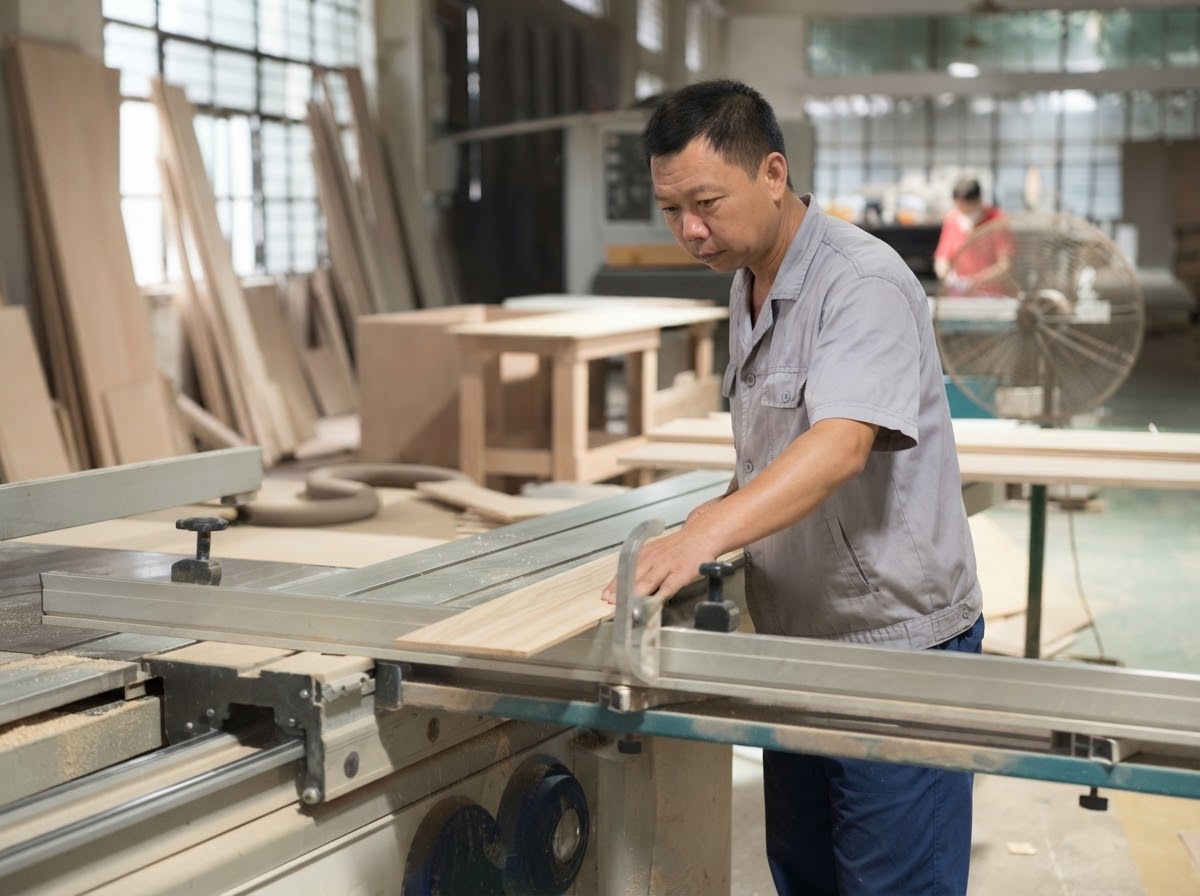
I was standing in a slightly dim, dust-choked assembly hall in Dongguan last November, staring at a line of eighty solid walnut credenzas meant for a boutique hotel in Austin. The procurement director back in Texas had paid $1,200 a pop, operating under the dangerous illusion that the CAD drawings he emailed over would be treated as sacred text. He had explicitly specified a 0.5mm tolerance on the drawer reveals.
The floor manager overseeing the line—a guy nicknamed “Lao Chen” who had a cigarette perpetually glued to his bottom lip—was checking those reveals using a rusty tape measure that looked like it had survived the Clinton administration. When I pointed out that one drawer had a 2mm gap and the one right next to it had a barely-there 0.2mm clearance, Lao Chen just sighed, blowing smoke away from the veneer.
“The wood needs to breathe,” he told me in heavily accented Mandarin, slapping the side of the cabinet with a calloused hand. “Too tight, it cracks when it gets to Texas.”
He was right, of course. But that didn’t make the furious, all-caps email from the American buyer any easier to answer later that night. This massive disconnect is the daily, grinding reality of sourcing custom furniture in Asia. We sit in air-conditioned offices and pretend we are buying precision-engineered aerospace parts. In reality? We are buying organic materials shaped by human hands on a factory floor where speed is an absolute religion.
The Brutal Truth About Millimeters
Here is the uncomfortable, gritty reality that most procurement teams absolutely refuse to accept. Your beautifully rendered, incredibly detailed specification sheet is viewed by the factory floor not as a binding legal contract, but as a polite, somewhat theoretical suggestion.
When you draft your China manufacturing specs and demand German-level engineering tolerances from a workshop built on volume, you are essentially setting your own money on fire.
The factory boss in the front office will nod vigorously. The English-speaking sales rep on WeChat will send a thumbs-up emoji and say, “No problem, sir, we follow strictly.” But down on the chaotic floor, the guys actually running the CNC machines and wielding the orbital sanders are operating on a completely different wavelength. They aren’t optimizing for your mathematical perfection. They are optimizing for visual harmony and output quotas.
If it looks right from three feet away, it gets boxed up and shipped.
That is the unwritten law of the land across Guangdong and Zhejiang. You can fight it, scream about it on Zoom, or you can learn to work within it. In my 15 years walking these floors, the most successful buyers operate on a very simple rule of thumb: always design at least a millimeter of forgiveness into every single joint. Because the factory is going to take it anyway.
KEY TAKEAWAY: The Sourcing Reality Check
- China manufacturing specs are negotiated targets, not absolute physical guarantees.
- Woodworker intuition often overrides your CAD drawings, especially regarding moisture content, material expansion, and joint stress.
- Banging your fist on the table over 0.5mm variances won’t fix piece-rate labor incentives.
- Designing visual “forgiveness” into your actual furniture designs reduces defect rates faster than any QA inspector ever will.
The Translation Gap Between Screen and Saw
Why exactly does this happen? The problem usually isn’t the equipment. I used to think it was a machinery issue, but step into a decent facility in Longjiang today, and you will see five-axis CNC routers that cost more than a luxury condo. The hardware is genuinely world-class.
The breakdown happens in the messy translation from the sterile engineering office down to the sawdust-covered assembly line.
Sending a complex, multi-page tolerance spec to a high-volume production team is a lot like trying to order a medium-rare, dry-aged ribeye at a fast-food drive-thru. The kitchen has fire and they have meat, but their internal system just isn’t built to process your nuance.
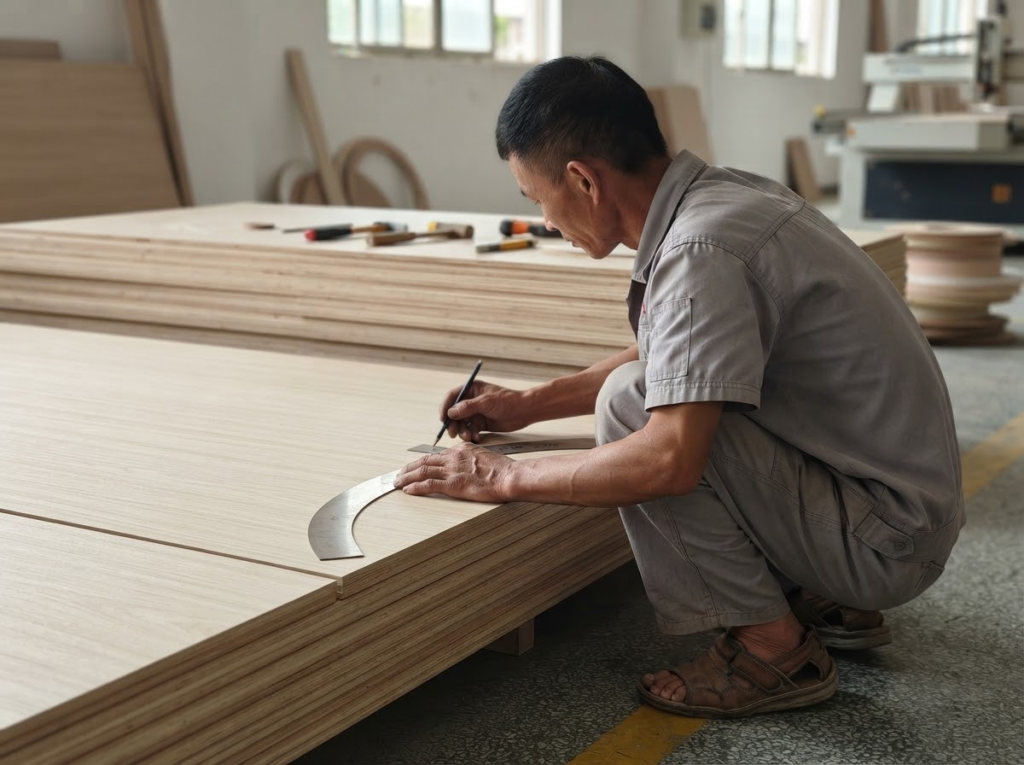
I once watched a frustrated production manager try to explain a complex continuous grain-match requirement to a team of veneer workers. He was pointing frantically at a pristine iPad Pro. The workers? They were squinting at a coffee-stained, black-and-white A4 printout where the intricate grain details had turned into a muddy gray blur.
Or take structural interpretation. I recently inspected a batch of custom coffee tables. The CAD files clearly showed a three-legged design with the central leg physically joined to the tabletop. The factory built them with a floating aesthetic, completely ignoring the mechanical joint required. When I pressed them on it, the foreman pulled out a red marker and drew over the printout. “It looks cleaner this way,” he argued. I had to physically stand there and force them to re-engineer the assembly so the central leg actually connected.
Actually, that’s not quite right—the core problem isn’t that they can’t hit the spec. It’s that they don’t think it matters to the end user. If a drawer slides smoothly and the finish is smooth, why sweat a 1mm variance in the back panel? Because the buyer in New York expects perfection, that’s why. But translating that expectation to a guy paid by the completed unit is an uphill battle.
The essence of managing Chinese woodworkers precision lies not in screaming for tighter tolerances, but in designing furniture that naturally hides minor variances. If your entire design fails because a single dowel is off by half a millimeter, you have engineered a terrible product for this specific supply chain.
Moisture, Machining, and the Myth of Exact Match
Let’s talk about the physical, inescapable reality of the material. Solid wood moves. It breathes, it twists, it fights back. (And yes, this happens vastly more than anyone admits, even in those heavily marketed “climate-controlled” facilities).
When you approve a golden sample in December, the factory is operating in a cool, relatively dry environment. When mass production finally kicks off in April, the dreaded Hui Nan Tian (the returning south wind) hits South China. The humidity inside the factory can easily spike to 95%. The walls literally sweat. The wood swells. The tightly calibrated joints you approved suddenly don’t fit.
But buyers still panic when the production run doesn’t perfectly match the golden prototype. They instantly accuse the factory of intentionally cutting corners. Sometimes they are cutting corners. Often, though, they are just reacting to the fact that the material has changed shape overnight.
| Phase | Typical Environment | Expected Tolerance Variance | Factory’s Real Priority |
| Golden Sample | Master workshop, very slow build | +/- 0.5mm | Exact visual match to your CAD to secure the deposit |
| Pilot Run (10 units) | Main floor, moderate speed | +/- 1.0mm | Testing tooling setup and workflow bottlenecks |
| Mass Production | High speed, piece-rate labor | +/- 1.5mm to 2.5mm | Speed, raw output, and overall structural stability |
You have to remember who is building your furniture. You are fighting piece-rate labor. The guys on the floor are usually paid by the completed unit, not by the hour. If taking an extra 45 seconds to perfectly align a hidden drawer track cuts into their daily take-home pay, they simply aren’t going to do it unless a QA guy is literally standing over their shoulder breathing down their neck.
And here’s the kicker. You cannot engineer your way out of a piece-rate compensation structure; you have to inspect your way out.
The Mid-Market Sweet Spot and Ecosystem Realities
So where do you actually place your purchase orders to avoid losing your mind? The China furniture ecosystem is sprawling and chaotic. Picking the right scale of partner is easily 80% of the battle.
If you go to the absolute giants—the massive conglomerates covering millions of square feet with thousands of workers—you are nothing but a rounding error. Unless you are buying five hundred units a month, they won’t care about your 2mm reveal problem. You will get passed off to a junior account manager who barely reads your emails. On the flip side, the tiny mom-and-pop workshops hidden in industrial parks have incredible traditional craftsmanship, but absolutely zero quality control systems and sketchy financial stability. They might disappear overnight.
While a lot of rookie buyers gravitate toward the largest possible manufacturers in Foshan because it feels “safe,” seasoned veterans often find that mid-sized specialists offer a far better risk-reward equation.
Take a factory like Interi Furniture, based over in Guangzhou. They don’t try to be everything to everyone. They focus heavily on soft furnishings customization rather than getting bogged down in messy whole-house millwork. At that mid-market tier, the factory is large enough to have standard operating procedures and modern CNC machinery, but they are still hungry enough to actually assign a dedicated project manager who will pick up your WeChat call at 10 PM when a fabric swatch looks wrong. You aren’t paying a premium for a massive corporate overhead; you’re paying for focused attention.
You need to find a factory where your order represents roughly 10% to 20% of their monthly production capacity. That is the absolute sweet spot. You are important enough to demand attention and halt the line if something goes wrong, but not so massive that you accidentally break their supply chain if you need to delay a shipment.
The Non-Negotiable Sourcing Framework
How do you survive this without burning out? You stop treating overseas sourcing like a transactional Amazon purchase and start treating it like managing a chaotic, high-stakes construction project. Here is the unvarnished framework I force every single one of my clients to use before they wire a cent.
- Audit the measurement tools actually used on the floor. Don’t just look at the shiny machines the boss shows you on the tour. Walk over to a workbench and look at the calipers and tape measures the workers are pulling out of their pockets. Are they digital? Are they zeroed out? Or are they bent, rusted, and covered in glue?
- Define “Defect” with brutal visual clarity. A spec sheet saying “no scratches” is entirely useless. Create a physical boundary board. Take a photo of an acceptable natural wood knot, and a photo of an unacceptable crack.
- The 10% First Article Inspection. Never, ever wait for the whole run to be boxed up. Pull the first 10% of the production run off the line and assemble it completely on the floor. This is where you catch the millimeter creep before it infects the entire order.
- Watch the packing process like a hawk. I’ve seen beautifully crafted pieces ruined in the last five minutes. Just last month, I had to stop a loading crew because workers were literally stepping on top of the finished cargo boxes to reach the top of the container. I also made them rip off two bright green “Custom Packaging” labels they had randomly slapped onto the left side of our pristine retail boxes. The details don’t stop at the wood.
- Red Flag: If a factory immediately says “Yes, of course” to holding a 0.1mm tolerance on a solid oak dining table without once asking about the destination climate or the HVAC situation at the final site, grab your coat and walk out. They are lying to get your 30% deposit.
- Design for inevitable variance. Use shadow gaps. Overlap your joints. Rely on floating panels. Note that not all furniture has abandoned sharp edges, but where you do use them, understand the risk of transit damage. The smartest industrial designers I know deliberately hide manufacturing variances within the aesthetic features of the product itself.
Plus, you have to show up. Or pay someone extremely trustworthy and slightly cynical to show up for you. Highly edited video calls and cherry-picked WeChat photos are just smoke and mirrors. You need a physical human being yanking on the drawer hardware and checking if the back of the sofa is properly closed off, not just stapled halfway.

Buyer FAQ: Navigating the Floor
Q: My factory keeps insisting “it’s within standard” when my credenza doors are 2mm off the drawing. What standard are they even talking about?
A: They are almost certainly talking about the Chinese national standard (GB) for civil furniture, or more likely, just their own internal historical average for what they can get away with. Unless you explicitly attach a numerical tolerance sheet to the Purchase Order before the deposit is paid, their “standard” is the only one that legally matters in a dispute.
Q: We specified high-end Blum hardware, but the factory is pushing hard for us to use a “local equivalent” to solve a sudden clearance issue. Should we let them switch?
A: Absolutely not. When a factory suddenly pushes a local equivalent to solve a tolerance or clearance issue mid-production, it almost always means their drilling jigs are slightly off. The cheaper local hardware has more “play” in the hinges, allowing them to mask their imprecise drilling. Stick to the specified hardware and force them to fix their damn drilling template.
Q: Be honest. Can we realistically expect high-end Italian precision from a Chinese woodworking facility?
A: It depends entirely on your willingness to open your wallet. The capability absolutely exists. The machinery is sitting right there on the floor. But achieving true European precision means forcing the factory to slow down their assembly line by 50% and massively increasing their defect rejection rate. If you are willing to pay the massive premium required to offset their lost volume, yes, they can do it. If you are demanding Italian precision at a Foshan wholesale blowout price? Absolutely not. You will get what you pay for.
The Final Cut
Sourcing custom furniture in China will break your heart if you let it. You will spend hours pulling your hair out on late-night conference calls, arguing over the definition of a millimeter with a factory owner who is simultaneously sipping tea, smoking a Chunghwa, and completely ignoring your panic.
But it remains the most capable, adaptable, and scalable manufacturing base on the planet. The secret isn’t spending years hunting for a magical factory that never makes a mistake. That factory doesn’t exist. The secret is managing your own expectations, aggressively tightening your local quality control, and designing products that acknowledge the deeply human element working on the assembly line.
Are you designing furniture for the real, messy world, or are you just drawing mathematically perfect pictures on a glowing screen? Figure that out before you wire the deposit. See you on the factory floor.