

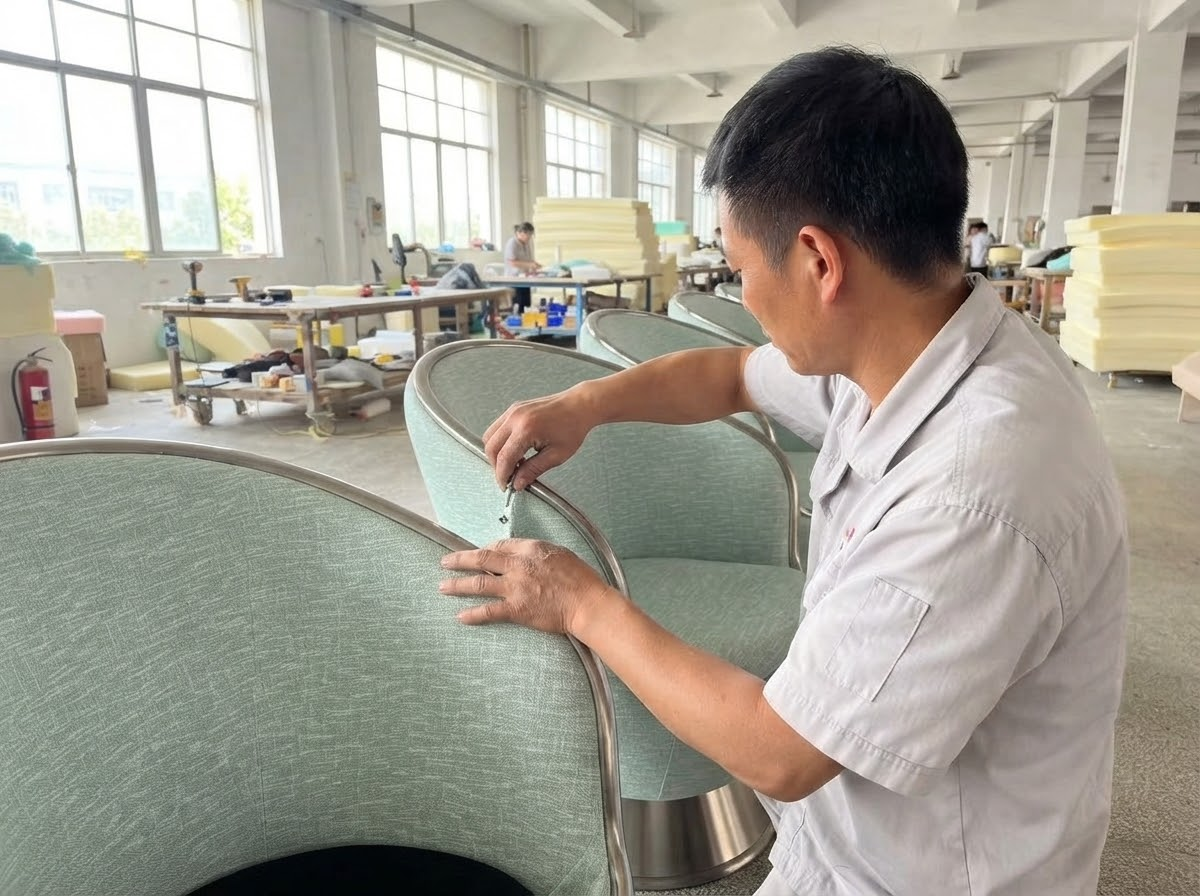
It’s a Tuesday in November. You’re freezing inside a massive, unheated 15,000-square-meter showroom in Lecong, nursing a paper cup of lukewarm green tea just to keep your hands working. The sales rep sitting across the glass table is aggressively pointing at a stunning, brass-accented velvet lounge chair. She is swearing up and down that her factory can scale that exact piece for your 150-room boutique hotel project in Austin. And they can do it all in a blisteringly fast 45 days.
We all want to believe the 45-day myth.
But if you’ve been taking that hour-long cab ride from Baiyun Airport into the industrial zones as long as I have, you already know the truth. The showrooms in Lecong are just theater. The lighting is perfect, the floors are polished, and the coffee is actually pretty good. But the actual grind? That happens on dusty, loud factory floors in places like Guangzhou or Dongguan. Out there, hope isn’t a viable procurement strategy.
Let’s get one thing straight before we dive into the weeds. Sourcing custom furniture from China is entirely possible, and the results can be world-class. I’ve spent a decade and a half doing exactly this. But you have to strip away the romance.
You Aren’t Buying a Chair. You’re Renting a Line.
Here is the reality most overseas buyers flat-out refuse to accept. When you source custom furniture from China, factory bosses don’t care about your interior designer’s mood board. They don’t care about the aesthetic vision. They care about machine calibration, material yield, and labor hours per unit.
Push them too hard on price, and they won’t tell you no. That’s not how the culture works. They will just quietly engineer the quality out of the unseen parts until the math works in their favor.
Let’s skip the corporate jargon and look at the actual rules of the game:
- Price dictates engineering: Factories don’t eat your aggressive discounts out of the goodness of their hearts. They downgrade your internal framing and foam density to protect their margin.
- Prototypes are marketing: That golden sample you signed off on? Hand-built by a 50-year-old master carpenter in a quiet sample room. Your bulk order? Being churned out by third-shift workers trying to hit a punishing daily quota.
- Control the BOM (Bill of Materials): If you leave a single grey area on the spec sheet, the factory guesses. And I promise you, their guess is always the absolute cheapest available option.
Sourcing Chinese OEM furniture is simply the brutal, relentless process of translating design intent into hyper-specific manufacturing instructions. You have to leave absolutely zero room for interpretation.
The Singaporean Developer Case Study
A few years ago, a massive hospitality project spearheaded by a Singaporean developer went completely off the rails. (I’ll keep the corporate names out of this to protect the guilty). They had negotiated what they thought was the deal of the century for 400 guestrooms.
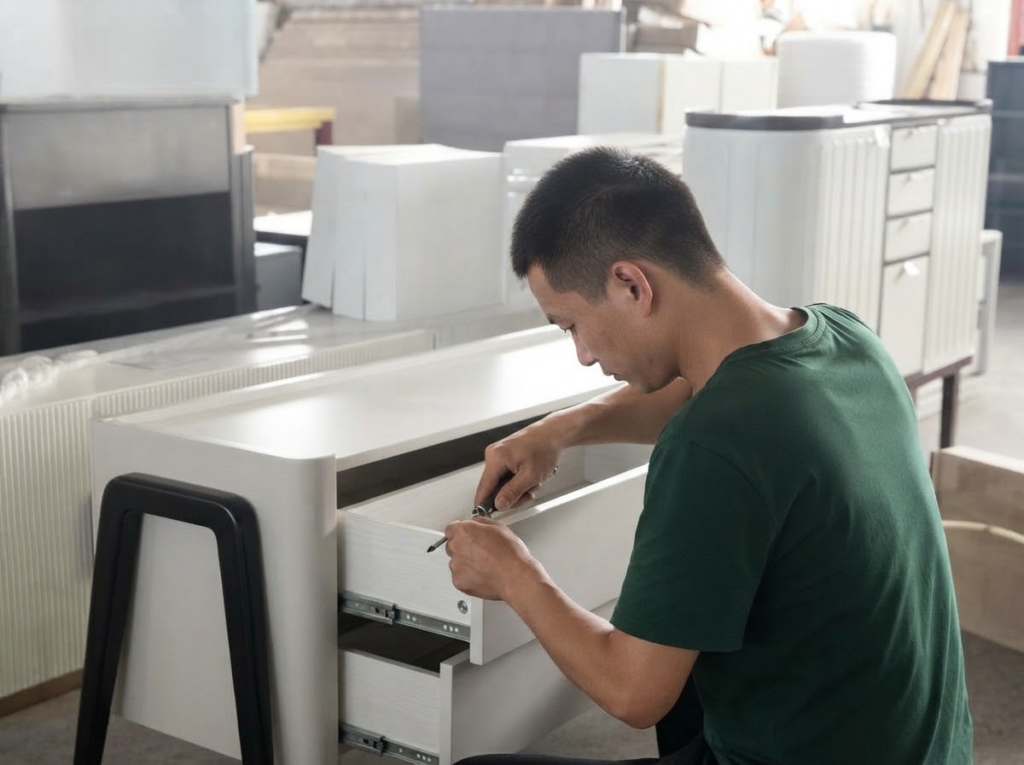
They thought they were buying a finished product. They squeezed the factory on the unit price for the bedside tables, expecting the factory to take a hit on their margin. Instead, the factory quietly swapped out the E0-grade moisture-resistant MDF for standard, cheap particleboard. They downgraded the drawer runners.
When the pieces arrived on-site, the tropical humidity hit them. Within three weeks, the drawers wouldn’t close. The veneer started peeling. The developer saved $80,000 on the purchase order and ended up spending $250,000 replacing the garbage they imported.
Why That Golden Sample is Lying to You
Buying custom pieces without an exhaustive, obsessive spec sheet is like asking a commercial bakery to recreate an artisanal sourdough without giving them the recipe. You’ll get bread, sure. But bite into it, and you realize it’s just cheap white loaf with a sour chemical wash.
Take solid wood. I spent a few days recently walking a massive facility in Guangzhou. The air in these places is heavy—a mix of cutting fluid, sawdust, and the sharp tang of industrial adhesives. I watched a guy take a gorgeous slab of walnut grain and meticulously wrap it around a core of dense MDF.
Feels like a scam, right?
Actually, it’s not. Veneered MDF is way more stable for commercial HVAC environments than solid wood. Solid wood warps, breathes, and cracks violently under constant hotel air conditioning. Most commercial hotel furniture avoids sharp, solid edges entirely for safety and durability—though obviously, there are always a few specific accent pieces that are exceptions to that rule.
The real crime isn’t the engineering. It’s when a factory charges you for solid wood but ships veneer because your QC team was asleep at the wheel.
The Anatomy of an Iteration: The Hexagonal Coffee Table
Let me give you a hyper-specific example of how custom engineering actually goes down on the floor.
I was recently working on a custom coffee table design for a commercial lounge. The initial rendering looked great on paper, but getting the factory to execute it was a dogfight. The designer wanted a hexagonal marble top, supported by exactly three legs.
The factory’s first CAD drawing tried to make the central leg float for visual lightness. I had to step in and aggressively correct them: the central leg must be physically joined to the tabletop, not floating, or the thing would tip over the second a guest leaned on it.
Then came the support brackets. The factory tried to make everything symmetrical to save programming time on the CNC machine. I had to force them to adjust the second-layer support brackets so they were asymmetrical—specifically, the left side only needed front rotational support, while the rear support had to be shifted to the right side of the second layer. Oh, and those rear table legs? I had to demand that the black protective gear at the base remain partially visible to prevent floor scuffing.
I even had to fight with the sample room photographers. They kept styling the minimalist prototype with random books and tea sets. I had to tell them: take the books and the cups off the table. Show me the raw geometry. Make sure the base color in the detail shots actually matches the full-view photos.
If you don’t enforce these microscopic details, the factory will default to whatever is easiest for them to manufacture and photograph. You have to be annoying.
The Upholstery Trap: What You Can’t See
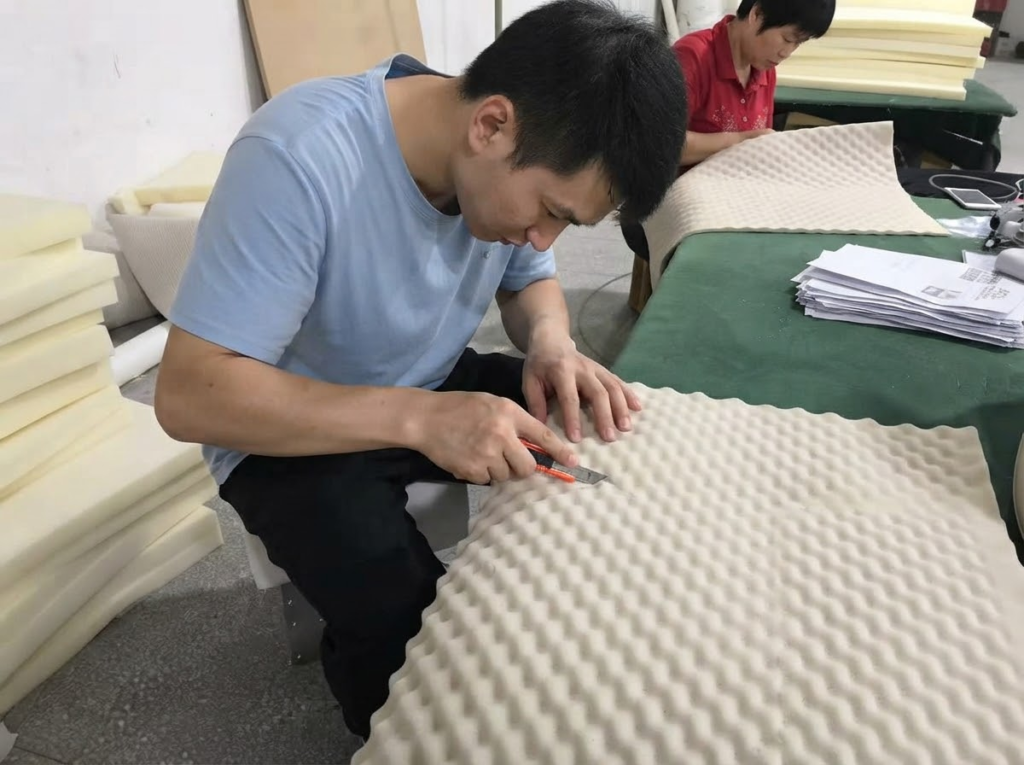
Upholstery is the easiest place in the world to hide margin. Ask for “comfortable foam” for a lobby chair, and you’ll get D25 polyurethane. It feels incredible on day one. Six months later? It looks like a deflated tire.
Let’s talk about the Indian Ocean for a second. When the factory I partnered with was pulled in as one of the suppliers for the Pullman Maldives Maamutaa Resort—handling a specific portion of the furniture production, not the whole thing—the stakes were entirely different. You cannot send cheap foam or green wood to a humid, salty island environment.
We didn’t do custom cabinetry for that order—whether outdoor or indoor—but we did handle critical soft seating. The only reason those pieces survive that brutal island climate is because we specified D45 high-resilience foam and marine-grade internal frames.
Then there was the Emerald Zanzibar Resort & Spa project back in 2021. That job expanded beyond just manufacturing; we had to provide on-site installation support. You learn very quickly out in Tanzania that a missing bolt or a misaligned frame isn’t just a quick hardware store run. It’s an absolute disaster. The factory has to build it right the first time, because there is no second chance when the container is halfway across the globe.
Finding Your Lane in the Factory Ecosystem
Not all suppliers can handle the same headaches. Bring a complex, mixed-material lobby package to a mega-factory optimized for spitting out 10,000 identical wooden chairs, and you’ll end up crying on a loading dock.
Here is how the landscape actually breaks down when you are standing on the ground in China:
The Trading Companies
They are great if you are buying a hundred different small items and need consolidated shipping. But for custom hotel furniture? Dangerous. You have absolutely zero control over the actual production line.
The Mega-Factories
These are the massive campuses. They want 1,000-room rollouts. They are highly automated and incredible at standardization. But your 50-room boutique project is a total nuisance to them. If you bring a highly custom job here, prepare to be ignored.
The Mid-Size Specialists
This is where the magic happens for custom hospitality work. While a lot of buyers instinctively run to the giant mega-factories out in places like Foshan, savvy project managers often look toward Guangzhou.
Take an operation like Interi Furniture, based in Guangzhou. They focus specifically on soft furnishings customization for project and hospitality sectors—not the generic, whole-house mass customization that the giant factories churn out. That’s usually the sweet spot for a custom job. They are big enough to have serious structural engineering chops, but nimble enough that your order gets dedicated attention.
The Sub-Contractor Blind Spot
Here is a dirty little secret about custom furniture from China. Even the absolute best factories don’t make everything in-house.
They might be wizards with upholstery and solid wood. But that custom brushed-brass base on your bar stool? They are farming that out to a dusty metal shop down the road. The marble tops? That’s coming from a stone cutter in Yunfu.
Your final piece is only as solid as their weakest sub-contractor.
I recently spent weeks dealing with a factory’s marble catalog. They were so disorganized that I had to step in and manually correct their classification indexing, forcing them to reassign old sample numbers (like moving Sample No. A015 to A029) just so the procurement team wouldn’t accidentally order the wrong white veining for 200 nightstands.
And don’t even get me started on the metal hardware. I’ve seen gorgeous oak desks ruined by drawer pulls that tarnished if you looked at them funny. You have to ask your primary supplier who is handling the mixed materials. Ask for addresses. Ask for photos of the metal plating baths. If the sales rep gets defensive or vague, walk away.
The Frontline Playbook: How to Not Get Burned
Stop relying on trust. Trust is for your family, not your supply chain. If you want to pull this off, follow this playbook.
1. Nail down the BOM (Bill of Materials).
Don’t write “good drawer slides.” Write “DTC soft-close undermount slides.” Specify “E0 grade MDF” so the rooms don’t smell like toxic glue when you unbox the casegoods.
2. Demand the “White Body” check.
This is entirely non-negotiable. Never let a factory paint or upholster custom pieces without letting you (or your third-party QC) inspect the raw, assembled frame first.
Take a custom rattan sofa I was managing recently. The spec called for stark white seat cushions and backrests, with black wood for the armrests and legs. But more importantly, the structural design required the exterior back of the sofa to be completely closed off, exactly like the reference image. If I hadn’t inspected the raw frame, they would have left the back open to save wood, and I never would have known until it was too late.
Or take a simple dining chair. The designer wanted a clean back, but the raw frame inspection revealed it needed a horizontal wood strip secured with screws on the back just to survive a 250-pound guest leaning backward. We caught it at the white body stage.
3. Check the unseen architecture.
I had a custom bed frame order where the factory tried to put four flimsy legs on the corners of a heavy king-size platform. I had to red-line the CAD drawings and physically point out that the center required two heavy-duty support legs, positioned dead in the middle and close together. If you don’t check the structural architecture, the factory will under-build it.
4. Moisture content is law.
Southern China is essentially a jungle. If wood isn’t kiln-dried down to 8-10%, it will warp in transit. Buy a moisture meter. Use it. Make sure the factory rep sees you pack it in your briefcase.
5. Over-engineer the packaging.
Furniture rarely breaks in the hotel. It breaks on a forklift. And honestly, sometimes it breaks before it even gets in the container. I’ve been on loading docks in Guangzhou and had to literally yell at logistics crews because workers were standing and stepping on top of finished cargo boxes.
You also have to control the visual presentation. I routinely have to tell factories to remove ugly green inspection labels from the left side of the packaging, or demand that factory workers’ clothing doesn’t feature random company logos when taking official loading photos for the client. Clean packaging matters.
6. The “Yes Boss” Red Flag.
If a factory looks at a top-heavy, complex structural rendering and immediately says “No problem” without asking a single engineering question, run. Real makers push back. They tell you why a design will fail. They complain about your angles. If they just agree with you, they are lying.

The Uncomfortable FAQs of China Sourcing
Clients always ask me the same questions after their third glass of baijiu at dinner. Let’s address them.
Q: Can Chinese OEM furniture actually match European standards?
A: Yes, absolutely. But not at basement prices. The CNC machines in top Chinese shops are the exact same Homag or Biesse rigs used in Italy. The difference is entirely in your project management and the raw materials you force them to buy. China can build you a commercial-grade masterpiece or a disposable prop. You just have to tell them which one you want, and pay the corresponding price.
Q: Are “environmental inspections” just a fake excuse for production delays?
A: Sometimes, but usually, it’s very real. The Chinese government routinely shuts down unregulated paint or plating shops without warning to control emissions. If your supplier’s sub-contractor gets caught in a sweep, your metal bases are delayed. It’s a dead giveaway you’re using a lower-tier factory. High-end players have their own certified, enclosed spray booths.
Q: Should I just hire a sourcing agent to deal with all this headache?
A: It depends entirely on your internal bandwidth. A great agent is worth their weight in gold; they fight your battles on the factory floor. A bad agent takes a hidden 10% kickback from the factory to rubber-stamp defective garbage. If you hire an agent, pay them a flat fee. Never a percentage of the total PO.
Q: If I push a factory hard on lead time, will it affect the physical quality?
A: Every single time. If you force a 60-day production cycle into 40 days, the first thing they skip is the critical curing time for wood, the resting time for foam, and the drying time between coats of lacquer. You cannot cheat chemistry.
Q: How do I handle design changes mid-production?
A: You don’t. Or rather, you pay dearly for it. If you decide you want a right-side drawer on a sofa console after the white body phase, or if you arbitrarily change the viewing angle of the piece midway through, the factory will either charge you double or hack it together. Finalize the design before the CNC router turns on.
The Bottom Line
I’ve walked hundreds of factory floors over the last 15 years. The one absolute constant I’ve found? The custom furniture game forgives nobody, and it is incredibly cruel to the lazy buyer.
Are you treating your manufacturing partners in China like magical vending machines, or are you treating them like an extension of your own engineering team?
Stop expecting miracles for pennies. Do the heavy lifting upfront. Write specs so tight they squeak. Sweat the details on the white body frames, the foam density, and the packaging. Respect the manufacturing process enough to understand it.
At the end of the day, you don’t get the quality you hope for. You get the quality you inspect. Stay sharp out there.