

I was standing in the middle of a cavernous, 20,000-square-meter wholesale showroom in Foshan’s Lecong district last October when a British hospitality buyer suddenly grabbed my arm. The air smelled of fresh MDF, packing tape, and stale cigarette smoke—the signature perfume of Guangdong’s furniture belt.
He was pointing at a sleek, ash-wood and bouclé lounge chair positioned under a bank of harsh halogen lights. He looked entirely defeated. The problem? It was his design. He hadn’t even finished paying the European tooling costs for the original prototype back in Manchester. His brand hadn’t officially launched it. Yet here it was, sitting on a polished tile floor in South China, retailing for about $185 a pop.
I ordered us a couple of bitter espressos from the showroom cafe. Then I told him the exact same thing I tell every foreign designer, sourcing director, or wide-eyed entrepreneur who steps foot in this city. If you bring a good idea into this manufacturing ecosystem without wearing the right legal armor, your intellectual property will be democratized faster than you can say “proprietary.” (And yes, this happens vastly more often than anyone admits in polite company). You aren’t just competing with other global brands out here. You’re racing against an incredibly agile, hyper-connected, and ruthlessly efficient supply chain that spots a winner and scales it overnight.
The Brutal Truth About Intellectual Property in Guangdong
Let’s strip away the corporate diplomacy for a minute. If your product looks good and has a decent margin, it is already a target. That’s not paranoia. That’s just the physics of the market.
Many Western buyers arrive with a deeply flawed, false sense of security derived from an NDA they downloaded off the internet. They wave these English-language non-disclosure agreements around factory offices like magic wands, expecting factory bosses to tremble. But a Western-drafted NDA, governed by the laws of New York or London, sitting in a Chinese provincial court is about as useful as an umbrella in a Category 5 hurricane. Local judges will literally toss them out.
The rule of thumb here is incredibly simple, and ignoring it will cost you your business: if you don’t legally register it inside China, you absolutely do not own it in China.
Key Takeaway Box: The IP Reality Check
- China furniture design patenting is the process of securing legal exclusivity for the exact aesthetic appearance of your product within the PRC before anyone else does.
- The country operates on a strict, unforgiving “first-to-file” system. Whoever registers the patent first owns it—even if they clearly didn’t invent it.
- Showing your new sofa at a European trade show or posting a rendering on Instagram before filing in China instantly invalidates your ability to patent it there.
- A registered design patent gives you the ultimate leverage: the power to freeze copycat exports right at Chinese customs before they get on the boat.

Deep-Dive Analysis: The Anatomy of a Knockoff
Let’s look at how the infamous Chinese furniture copycat machine actually operates on the ground. Most buyers think espionage looks like someone hacking a server to steal CAD files. It’s rarely that sophisticated. Think of it more like a master chef tasting a rival’s soup and instantly reverse-engineering the recipe from memory. Factory bosses in places like Dongguan or Longjiang don’t need your 3D models. They don’t even need a physical sample to measure.
In my experience, a decent R&D sampling team in a typical Guangdong factory can reverse-engineer a complex mid-century modern dining chair from three high-resolution Instagram photos in about forty-eight hours.
Smoke and mirrors.
I’ve walked loud, dusty factory floors in Anji where guys were quite literally welding steel chair frames while looking at an iPad displaying a Milan Design Week catalog. They scale it by eye, adjust for local material standard sizes, and push it to the sampling room. The harsh reality is that this kind of imitation isn’t meant as a personal insult to your brand; it’s just considered highly efficient market research. If the Italians are buying it, the logic goes, the rest of the world will want it cheaper.
But What About My Factory Partner? I Trust Them!
You might think your dedicated, vetted supplier would never betray you. You’ve had dinner with the owner. You’ve drank Baijiu together. Actually, that’s not quite right — what most buyers completely miss is that the leak rarely comes from the factory boss you had dinner with.
It comes from the tooling subcontractor down the street. It comes from the independent upholstery supplier who cuts your high-resilience foam and decides to offer those exact same foam dimensions to the factory next door to boost his own volume. Or maybe the hardware guy in Jinli town who casts your custom brass handles realizes he can run an extra thousand units on the night shift and sell them on WeChat. The ecosystem here is aggressively porous. Keeping a secret in a Chinese industrial cluster is like trying to hold water in a sieve.
Deep-Dive Analysis: Navigating China Patent Law in the Trenches
So, how do you actually fight back? You can’t rely on goodwill, and you can’t rely on anger. You have to understand the specific legal weapon you need to wield. China patent law is robust if you know how to use it, recognizing three main categories of patents. But only one truly matters for about 90% of furniture buyers.
| Patent Type | Protection Focus | Average Time to Grant | Best Used For |
| Invention Patent | New technical solutions (e.g., a revolutionary new motorized recliner mechanism or proprietary smart-bed sensor) | 2 to 3 years | Highly complex mechanical hardware, deeply technical innovations |
| Utility Model | Structural improvements (e.g., a specific folding joint, a novel way of attaching table legs without screws) | 6 to 8 months | Ergonomic office chairs, modular shelving systems, height-adjustable desks |
| Design Patent | Aesthetic appearance (the exact shape, pattern, color, or combination thereof) | 3 to 6 months | Dining chairs, sofas, casegoods, lighting fixtures, outdoor loungers |
For the vast majority of furniture procurement directors and brand owners, the Design Patent is your absolute sword and shield. It protects the look of the item. You don’t need to reinvent the wheel; you just need to protect how your specific wheel looks. And here’s the real kicker. It’s incredibly cheap to file. We are often talking less than $1,000 USD if you use a local Chinese patent agent directly, rather than paying a Western law firm to outsource it for you at a 500% markup.
The “Absolute Novelty” Trap That Kills Brands
Here is the exact spot where 80% of foreign brands fail spectacularly. China strictly enforces a concept called “absolute novelty.”
This means if you publish your design anywhere in the world before you file the application in China, your design is legally considered part of the public domain. Put it in an architectural magazine? Public domain. Tease it on your brand’s website? Public domain. Display a prototype at High Point Market? Public domain. You cannot test the market first to see if it sells, and then patent it later. By the time you realize it’s a bestseller, a nimble competitor has already copied it, and because you showed it publicly first, you are legally barred from getting a patent to stop them.
The Brand Ecosystem Spotlight: Finding Your Lane
Not every factory is out to steal your intellectual property, obviously. If they were, the entire global trade system would collapse. The Chinese manufacturing landscape is highly stratified, and understanding where you fit is half the battle.
At the bottom tier, you have the opportunistic, mass-market copy-paste workshops. These are the guys scraping Alibaba for trending images. At the very top, you have massive, closed-door mega-factories that only do OEM work for top-tier global brands under extreme, Apple-level secrecy.
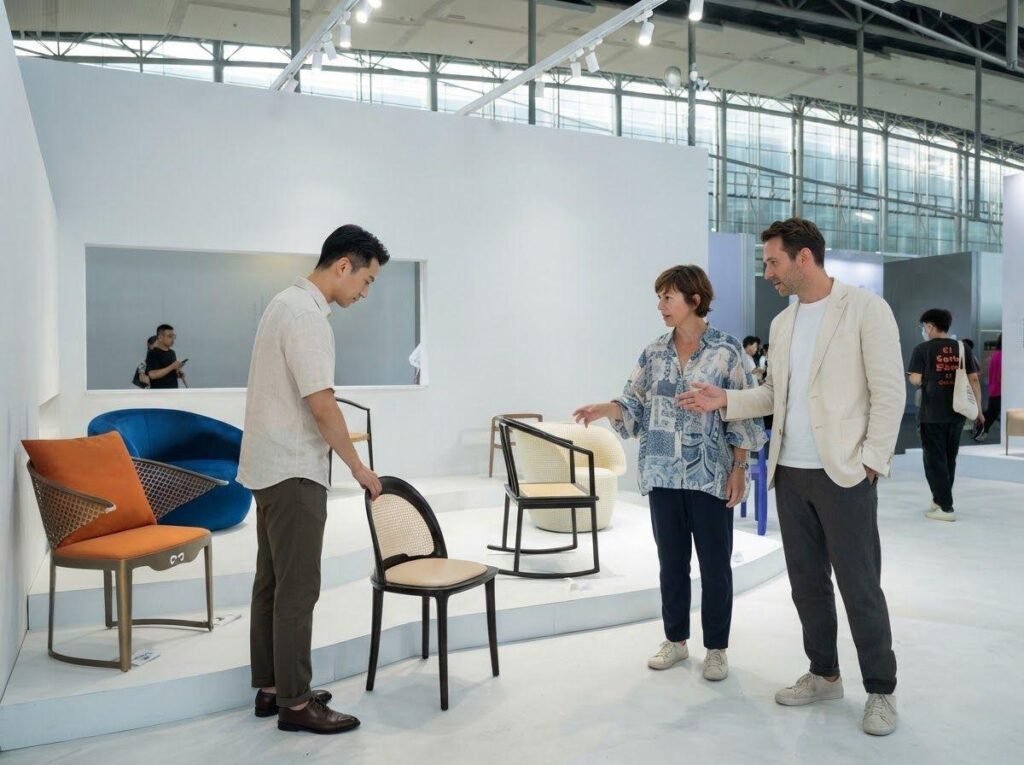
But most independent buyers, interior design firms, and mid-sized retailers play in the middle tier. And this is where it gets nuanced. Rather than rolling the dice on anonymous volume-suppliers who cut corners at every turn, seasoned project directors often pivot toward agile, project-focused mid-tier specialists—contract-oriented workshops like Interi Furniture that derive their reputation entirely from architectural execution and hospitality fit-outs.
Factories operating specifically in the high-end project and hotel space usually rely on long-term, trust-based relationships with interior design firms and procurement agencies. They aren’t churning out cheap retail knockoffs for Taobao because that’s not their business model. They have substantially more to lose by burning a bridge with a major project buyer. Working with specialized, slightly upmarket players drastically reduces your internal risk. But listen to me carefully: even with a highly reputable, specialized partner, you still absolutely must register your IP. Why? Because a Chinese Design Patent protects you from the rest of the market looking over the fence, not just your own supplier.
The Actionable Framework: Your Pre-Flight Checklist
If you are bringing an original design to be prototyped or manufactured in China, do not send a single CAD file, dimensioned drawing, or napkin sketch to a supplier until you have executed this exact sequence.
- Step 1: Vet the Background. Before you send anything, check the factory’s registered Chinese name on government databases like Qichacha. Are they actually a factory, or a trading company sitting in a high-rise? Have they been sued for IP infringement before?
- Step 2: Execute an NNN Agreement. A standard NDA is completely worthless, as we covered. You need a Non-Use, Non-Disclosure, and Non-Circumvention (NNN) agreement. It must be drafted in bilingual Chinese/English. It must be governed by Chinese law. It must designate a specific Chinese local court for disputes. And most importantly, it must include a specific “liquidated damages” clause—a set financial penalty for breaches that Chinese courts can easily enforce without you having to prove exact lost profits.
- Step 3: File Before You Flaunt. Engage a licensed Chinese patent attorney to file a Design Patent application for your product before you show it to anyone publicly, and ideally before you even send the final drawings to the factory for sampling.
- Step 4: Register IP with Chinese Customs. This is the ultimate, nuclear-level leverage that very few buyers utilize. Once your patent is officially granted by the CNIPA, record it directly with the General Administration of Customs of the PRC. If you catch a rival factory manufacturing and exporting your design, Customs has the authority to physically seize the shipping containers right at the port of Yantian or Ningbo.
- Step 5: Use Decoy Manufacturing. If your design is highly unique or features a proprietary mechanism, split the manufacturing up. Have Factory A make the complex metal base. Have Factory B make the upholstered seating shell. Have the final assembly done at a third, trusted facility—or better yet, ship the components flat-packed and assemble them in your home country. Never give one factory the entire recipe if you can avoid it.
The Ultimate Red Flag: Never, under any circumstances, let your Chinese manufacturing partner register the patent “on your behalf” to save you the hassle of hiring an agent. If they file it under their corporate name, they legally own it. I’ve seen factories hold a Western brand’s entire product line hostage—demanding a 30% price increase out of nowhere—because the buyer let the factory handle the local patent paperwork. They became tenants of their own design.

The “Ask Me Anything” FAQ Block
Buyers ask me the same questions every single week. Here are the unvarnished answers.
Q: Can I really stop a Chinese furniture copycat once they start selling my design online?
A: Yes, but strictly on the condition that you registered your patent first. If you hold a valid, prior Chinese Design Patent, you can issue formal takedown notices to major e-commerce platforms like Alibaba, Taobao, and 1688. Their internal IP protection teams process these claims surprisingly fast—often pulling down infringing listings within 3 to 5 business days.
Q: What if I only plan to sell my furniture in the US, the UK, or Australia, and have zero plans to sell in the Chinese domestic market? Do I really still need a China patent?
A: Absolutely. A thousand times, yes. China’s patent laws dictate what can be legally manufactured and exported from its physical borders. If a copycat spots your unpatented design, patents it themselves in China, they can then legally use Chinese customs to block your factory from exporting your own goods to the US. You read that right. They can stop your shipments of your own product.
Q: Let’s talk budget. How much does it realistically cost to file a Design Patent over there?
A: Don’t use a massive firm in London or New York that will just outsource it and charge you $4,000. Go direct to a licensed Chinese patent agent. Based on current market rates, expect to pay between $800 and $1,500 USD per design. That includes government filing fees, mandatory translation work, and the agent’s time. It is the cheapest insurance policy you will ever buy.
Q: I heard a rumor that if a factory changes a design by 10% or 15%, it legally avoids patent infringement. Is that true?
A: No. That is a dangerous, incredibly persistent myth. There is no magical “10% rule” in Chinese IP law. Chinese courts evaluate design infringement based on the “ordinary observer test.” They look at whether the overall visual effect is substantially similar to an average consumer. A minor tweak to the angle of a chair leg or changing the color of a fabric won’t save a copycat from a lawsuit, nor will it protect you if you are the one trying to knock off an Italian brand.
Q: How long does it actually take to get the patent certificate in my hand?
A: For a Design Patent, the process is largely administrative. There is no substantive examination of prior art like there is for an Invention Patent. If your line drawings are formatted correctly and your paperwork is clean, you can usually expect the grant and physical certificate in about 4 to 6 months. But crucially, your protection is backdated to your original filing date.
Closing Thoughts From the Factory Floor
Over the past fifteen years, I’ve sat across the table from far too many heartbroken, frustrated designers who genuinely thought their inherent goodwill, a firm handshake, and a steady stream of purchase orders would magically protect their life’s work. It never does.
The Chinese manufacturing machine is a true miracle of modern logistics, scale, and skill. I respect it immensely. But it is utterly, aggressively unsentimental. It runs on volume and efficiency, not honor codes.
If you view the patent registration process as an annoying, bureaucratic expense to be avoided, you’re going to get eaten alive in this market. Period. You need to mentally reframe it. Treat your intellectual property registration as the single most critical raw material in your entire supply chain. You wouldn’t try to build a $3,000 luxury sofa using rotten, termite-infested wood framing, so why on earth would you try to build a global brand on completely unprotected intellectual property?
Lock it down before your flight ever touches down at Guangzhou Baiyun International. By the time you reach the showroom, it’s already too late.