


Austin, Texas. Mid-August. It’s 104 degrees on the asphalt, and you’re sweating through your shirt in a dusty loading bay. You stand there, completely helpless, watching a forklift violently drag the final pallets out of a 40HQ container you ordered six agonizing months ago.
You hack open a soggy corrugated box. You’re expecting the custom-spec lounge chairs you bought for a high-end boutique hotel lobby. You know, the ones with the breathtaking, open-grain American walnut and high-resilience foam you explicitly signed off on.
Instead? You’re staring at heavily lacquered, lifeless rubberwood. Stuff that looks like it belongs in a discount dental clinic. The upholstery actually crunches when you press your thumb into it. The corner stitching is already puckering.
Your grand opening is exactly 45 days away. You just blew $85,000 on total garbage, your general contractor is screaming about the installation schedule, and you have zero recourse.
Welcome to the Canton Fair sample scam in its purest, most devastating form. Look, this rarely happens because a comic-book villain decided to steal your wire transfer and flee in the night. It happens because foreign buyers fundamentally misunderstand the ruthless physics of the Chinese manufacturing supply chain.
The Uncomfortable Truth About Showroom Displays
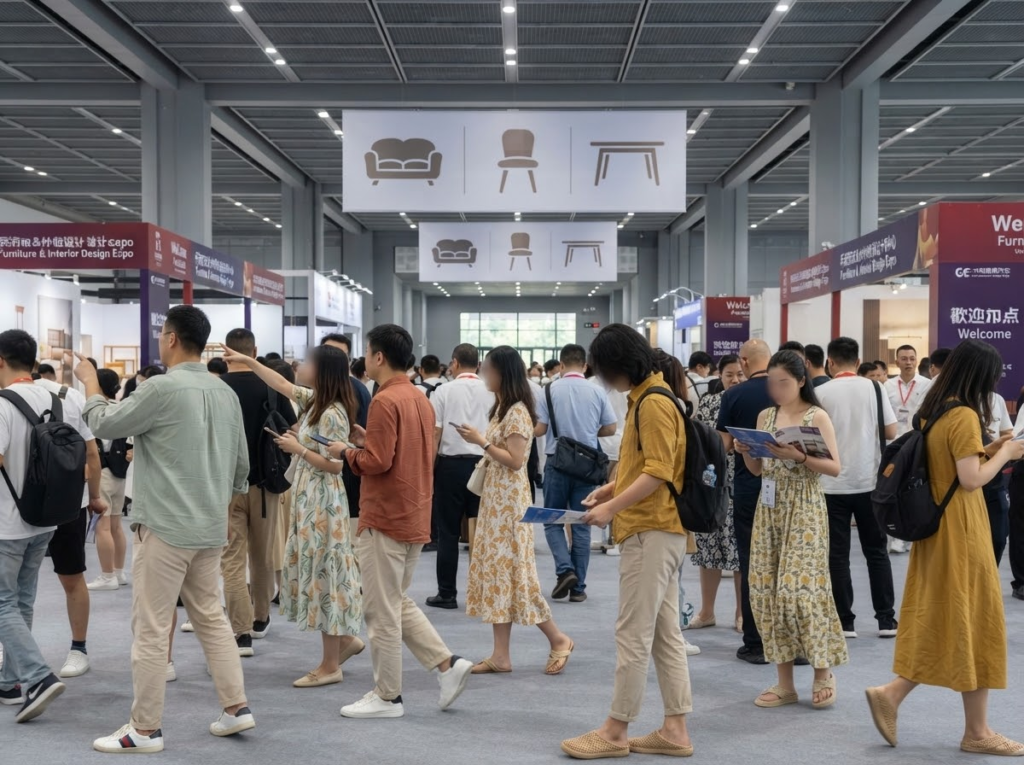
Walk the miles of blindingly lit aisles at the Pazhou complex, and you’ll assume the flawless dining chair sitting under the halogens represents that factory’s baseline everyday capability.
It doesn’t.
That beautiful chair is a theatrical prop. Hand-built by a tiny, specialized team of gray-haired master carpenters whose sole existence in the factory is crafting exhibition prototypes.
The golden sample is a marketing expense. The mass production run is a margin-recovery exercise.
Actually, that’s slightly unfair to the suppliers—what most buyers completely miss is that the factory boss rarely views this as a hustle. Think about it from their side. You demanded a target price of $45 a chair. That trade show sample cost them $300 in raw labor and premium materials just to build. To hit your aggressive $45 target at a minimum order quantity (MOQ) of 200, swapping in cheaper foam, thinner veneers, and rushed joinery isn’t a scam in their eyes. It’s just the unspoken math of getting the deal done.
Key Takeaway: The Anatomy of the Golden Sample Trap
- The Disconnect: Trade show prototypes are babied by salaried R&D craftsmen; your actual container order is slammed together by transient, piece-rate assembly workers.
- The Economics: A pristine showroom sample is engineered purely to win your 30% deposit. The production run is then frantically reverse-engineered to meet your negotiated price.
- The Solution: Never, ever sign off on a “showroom sample.” Only approve a pre-production sample (PPS) that was pulled directly off the actual assembly line using bulk materials.
The Operational Deep-Dive
Mastering China furniture QC isn’t just sending an inspector to catch scratches before goods go into a box. That’s way too late. You have to understand the gritty operational layers where your product degrades from a showroom dream into a container nightmare.
Mechanism: The R&D Phantom Zone
Think of a massive furniture plant like a Michelin-starred restaurant. The sample you sat on at the fair was cooked personally by the executive chef on a quiet Tuesday afternoon when the doors were locked. Your mass production order? Slung together by a stressed-out line cook at 8:30 PM on a Saturday during a 300-person banquet rush.
Every legitimate facility in Dongguan or Foshan with over a hundred workers has a dedicated, climate-controlled sample room. The deadliest assumption you can make is thinking the guys who built your sample will even touch your production run. They absolutely will not. The sample room uses slow-curing epoxy, obsessive hand-sanding, and perfect grain-matching. The main production floor runs strictly on piece-rate compensation.
When an assembly worker gets paid 2 RMB for every chair leg they attach, they are not pausing for 45 seconds to wipe away excess glue before it cures. That dried glue violently repels wood stain. And that is exactly how you end up with those hideous, pale white lines bleeding out of the joints of your “premium” dark walnut chairs.
Variable: Substrate Subterfuge
Down in the manufacturing hubs of Guangdong, what you can’t see is where the profit lives.
Take commercial upholstery. The sofa you tested out had a solid larch wood internal frame, kiln-dried down to a perfect 8% moisture content, wrapped in localized high-density foam. But when it’s time to crank out 300 of them? The factory’s procurement manager is going to drive down to the local timber market and buy whatever mixed, wet plywood is cheapest that morning.
I see this constantly on the south side of Longjiang—the undisputed, chaotic upholstery capital of China. A buyer will demand an ultra-expensive, high-rub-count commercial fabric. The factory smiles and complies. But to recoup the massive cost of that textile, they quietly gut the insides. They drop the inner foam from a 45kg/m3 to a cheap 28kg/m3 density, and swap the heavy-duty webbed suspension for flimsy zig-zag springs. In the Chinese furniture grind, if you squeeze a factory on price in a visible area, the margin simply migrates to an invisible component.
Contrast this with operations that refuse to play the subcontracting game. Look at a manufacturer like Interi Furniture. They intentionally keep core processes like frame-milling and upholstery tightly integrated under one roof. Because they aren’t farming out the hidden frame assembly to a ghost workshop down a dirt road, their variance between prototype and final container drops significantly. You get what you paid for.
Benchmark: Direct Mills vs. Ghost Workshops
Let’s look at the brutal reality of the numbers. (And yes, this happens more than anyone admits).
| Sourcing Metric | The Showroom Prototype | The Line Run Reality |
| Labor Profile | Master R&D carpenters (salaried) | Migrant piece-rate line workers |
| Material Grade | Hand-selected, flawless batches | Bulk-purchased, lowest viable grade |
| Time Allocation | 3 to 5 days per unit | 12 to 15 minutes per unit |
| Moisture Control | Perfect (kept indoors, climate-controlled) | Wildly variable (sitting on humid loading docks) |
I dealt with a brutal operational case study back in 2022. A buyer dropped $120,000 on metal-framed banquette seating from a vendor they met in Guangzhou. The vendor was headquartered up in the Anji bamboo cluster (Zhejiang province) but aggressively pitched their “brand new metal division.”
The booth sample was structurally immaculate. Seamless TIG welds, heavy-gauge steel tubing, flawless matte powder coating.
Three months later, the containers arrived. The welds looked like chewed bubblegum. Heavy slag everywhere. The frames actually wobbled on flat ground. Why? Because the “factory” was just a trading office with an assembly floor. To hit the ridiculous deadline, they outsourced the metalwork to three different subterranean sweatshops in neighboring villages. The vendor had zero visibility on the welding QC. The entire order went straight to the landfill. That cost the buyer their initial $120k, plus another $40k scrambling for local domestic replacements.
The Risk Matrix
Navigating the floor requires knowing exactly which “normal” industry practices are actually giant, flashing warning signs.
Red Line 1: The “Trust me, we will fix it in mass production” promise.
A factory sends you a pre-production sample. It has a glaring flaw. The rep messages you on WeChat: “Don’t worry my friend, this is just a quick sample, we will make sure the mass production is 100% perfect.”
— The reality: If they can’t get one single unit right when they have all the time in the world and your money on the line, they will absolutely not get 500 units right when they are rushing to catch a vessel.
— The rule: Halt everything. Never approve production until you hold a physically flawless PPS in your hands.
Red Line 2: Vague Bills of Materials (BOM).
If your proforma invoice simply reads “Solid Wood Chair with Fabric,” you are practically begging to be ripped off.
— The reality: “Solid wood” in a Chinese contract often means finger-jointed rubberwood scraps glued together like a jigsaw puzzle. “Fabric” means whatever flammable polyester blend was on clearance at the textile market.
— The rule: Your PO must brutally specify the exact wood species, acceptable moisture content percentage, foam density rating, and chemical fabric composition.
The Counter-Indicator: 100% Final Random Inspection (FRI).
This is the trap. Most buyers think they are bulletproof because they hire a third-party QC company to inspect the goods when production is fully finished and packed. This is a fatal error for furniture.
By the time the chairs are boxed up, you can’t see the internal frame. You can’t test the foam density. You can’t check the moisture content of the wood. If the inspector fails the shipment at 100% completion, what are your options? The factory sure as hell isn’t going to remake it for free. You don’t have the time to reorder. So, you end up accepting garbage just to get it on the boat. The only inspection that actually saves your margin is an In-Line Inspection (DUPRO) at 20% completion, right before the upholstery hides all the sins.

Segmented Playbook
A one-size-fits-all checklist is useless here. A hotel buyer’s disaster scenario looks entirely different from a residential buyer’s nightmare.
Hotel Procurement Directors
Your biggest enemy is time. Commercial durability is a close second.
— Force the factory to produce a “Golden Unit” on the actual, live assembly line.
— Have that specific chair signed by the factory boss, dated, and physically sealed in a heavy plastic bag on the factory floor.
— Put a clause in your contract stating the third-party QC will use this exact sealed unit as the sole benchmark for passing the mass production inspection. If the run deviates from the bag, the factory eats the rework cost.
Interior Designers
Your biggest enemy is finish-matching and wonky proportions. A 2-inch variance in seat height destroys a carefully planned spatial layout.
— Never, ever rely on iPhone photos from the factory floor for wood stain approvals. The harsh fluorescent lighting in a Foshan facility will make cool walnut look like warm cherry. It happens every single time.
— Demand physical “step-panels”—small blocks of the actual wood showing the raw sanded state, the base coat, the stain, and the final clear coat.
— Write exact dimensional tolerances (e.g., +/- 5mm) directly into the PO. If you don’t, they will eyeball it.
High-End Residential Buyers / Independent Importers
Your biggest enemy is the Canton Fair sample scam itself—buying a breathtaking design that ends up being hollow, lightweight junk.
— Demand a live video factory audit before sending a dime. You need to see if they actually own woodworking CNC machines, or if they just have forty sewing machines and a giant, empty assembly floor.
— Ask for the exact weight of the sample chair while you are standing in the booth. Write that specific weight into your contract. A sudden drop in weight during mass production means they hollowed out the frame or downgraded to a cheaper, softer wood species.

Procurement FAQ
Q: Look, if the sample at the trade show looks genuinely amazing, how do I know if they actually manufactured it themselves?
A: You ask to buy that exact sample off the floor in cash on the final day of the fair. If they suddenly refuse, claiming it “belongs to another VIP client,” there is a massive chance they are just a trading company. They probably bought it from a high-end mill just to bait foreign buyers.
Q: My supplier is pushing back hard on my demand for an in-line inspection, claiming it disrupts their factory flow. Should I back off?
A: Absolutely not. A factory that fears an in-line inspection is a factory planning to gut the internals. Legitimate, confident manufacturers actually welcome early QC. It catches stupid mistakes before they become highly expensive finished goods.
Q: I don’t have the budget to fly to Guangzhou myself. Can I just trust a local sourcing agent to check the quality for me?
A: Only if their compensation is directly tied to the successful, defect-free delivery of your goods. If your agent is taking a hidden 5% commission from the factory (which is totally rampant), they don’t work for you. They work for the factory.
Q: So, at the end of the day, is the Canton Fair sample scam completely unavoidable?
A: It depends entirely on how much leverage you build into your paperwork. If your PO is vague and your QC happens when the goods are already in cardboard boxes, yes, you will get taken for a ride. But if you ruthlessly enforce a sealed, line-produced PPS and early internal inspections, you completely strip the factory of the opportunity to cheat.
The Forward Query
China furniture QC is ultimately just the brutal daily practice of managing friction. You are constantly pulling against a massive, invisible gravitational force that desperately wants to make your product cheaper, faster, and just a little bit worse.
I’ve spent hundreds of hours breathing in the sawdust-choked air of Nankang and sweating in the sprawling, chaotic upholstery parks of Dongguan. The factories there are absolutely capable of world-class, heirloom-quality manufacturing. I’ve seen them build pieces that rival the best Italian heritage brands on earth. But they will only build to the exact, specific standard you are willing to rigorously, relentlessly enforce on the floor.
The next time you find yourself sitting in a pristine trade show booth, sipping a tiny bottle of water and admiring a flawless velvet sofa, ask yourself the only question that matters: Am I buying this actual piece of furniture, or am I just buying the illusion of what this factory is capable of when the whole world is watching?