

It’s 9 AM on a Tuesday in Lecong, the air is thick enough to physically chew, and I’m watching an Austin interior designer slowly lose her grip on reality. We’re standing in a massive, windowless showroom, staring at a massive custom mohair sectional.
Back in Texas, a Milanese importer quoted her fourteen grand for this exact footprint. The lead time was twenty weeks.
The factory boss? He’s sitting across from us under a flickering LED tube, chain-smoking ChungHwa cigarettes. He taps out a sequence of numbers on one of those oversized plastic desk calculators—the kind that loudly beeps with every keystroke. He shoves the calculator across the glass table.
$2,200.
Welcome to the actual global supply chain. Most people assume the furniture in those $10 million Architectural Digest spreads comes on a direct flight from a third-generation workshop in Northern Italy. It doesn’t. A staggering amount of it is getting stuffed into 40-foot high-cube shipping containers, dragged through Guangdong’s smoggy industrial parks, and white-labeled by Western brands.
But if you think you can just book a flight into Guangzhou, wander the air-conditioned aisles of the Louvre Furniture Mall, and suddenly bypass the middlemen by lunchtime… yeah. Good luck with that. You’re about to take a massive financial bath.
The “Factory Direct” Delusion
Let’s kill this “factory direct” myth right out of the gate. Buyers hear that magic phrase, see a $2,200 quote, and mentally spend the savings on a boat.
Don’t do that. It’s a trap.
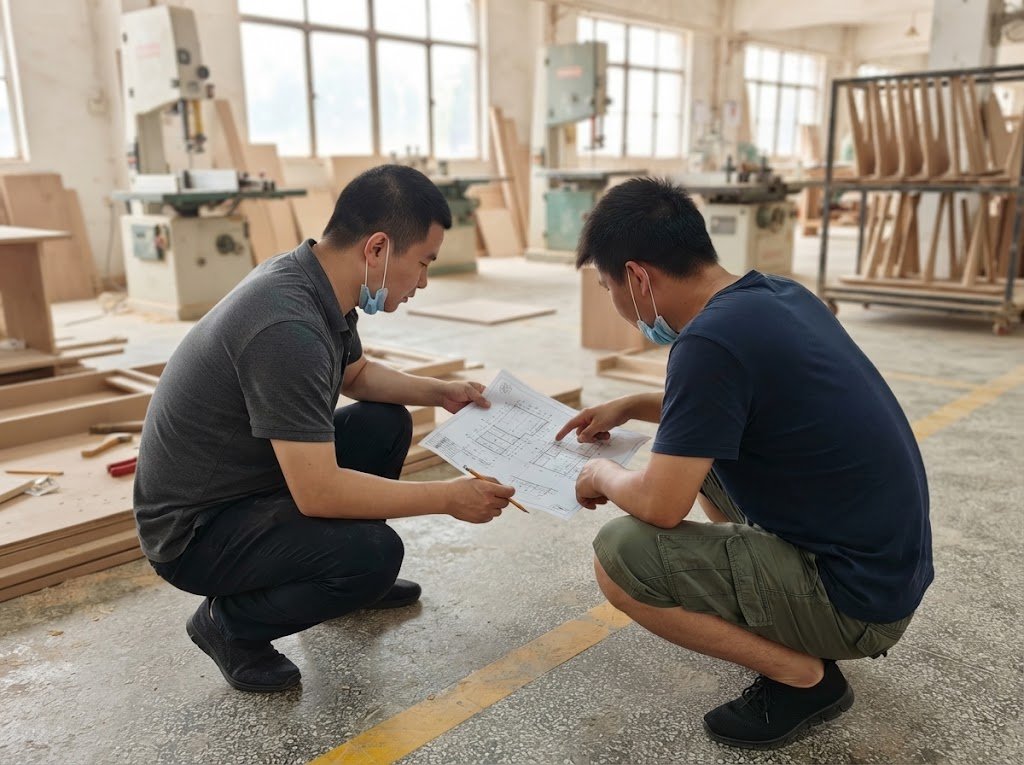
When a Chinese sales rep nods enthusiastically and says they can hit your aggressive target price, they mean it. Absolutely. By utilizing the absolute cheapest internal guts physics will legally allow. The golden rule of Foshan China furniture sourcing is terrifyingly simple: you only get the specifications you ruthlessly, aggressively micromanage.
Forgot to write down the exact foam density? Congrats, you just bought a cheap sponge that bottoms out completely by Thanksgiving. Didn’t mandate the inner frame wood on the PO? You’re getting green scrap pine stapled together with zero joinery.
Actually, that’s not totally fair. It isn’t a malicious scam. You squeezed them hard on the unit price, and the production manager just reverse-engineered a way to hit your number so he could keep the assembly line moving. To them, it’s just math. To you, it’s a ruined reputation when your client’s sofa sags in three months.
The Sourcing Reality Check
- Foshan China furniture sourcing is a dirty, floor-level game. You need to be checking the welding spatter in the back room, not drinking the showroom tea up front.
- Chinese custom manufacturing runs strictly on millimeter tolerances and exhaustive BOMs (Bill of Materials). Leave one blank space on your spec sheet, they fill it with garbage.
- Ignore the showroom sticker price. Real landed cost means factoring in third-party QA, marine insurance, and serious export crating.
- Stop trying to force 5,000-man mega-factories to care about your highly customized 10-piece villa order.
Reverse-Engineering Italy (And Failing)
This entire ecosystem is a chaotic, deeply layered web. It’s not just one factory making a chair. It’s raw material markets, rogue polishing shops, specialized upholstery bays, and independent hardware vendors all feeding into each other. It’s exactly like ordering a bespoke suit from a guy who learned tailoring by looking at a blurry fax of a jacket. Ask for “something nice” and you end up with three armholes.
Are You Buying a Ferrari Shell With a Moped Engine?
Walk the main exhibition boulevards in Longjiang and everything sparkles. The back alleys? That’s where you find the brutal truth.
Last November, I spent a solid week crawling under dining tables in a freezing Dongguan facility. The showroom samples in the front office were genuinely stunning. Thick, highly-figured American walnut veneer. Looked exactly like a $10,000 piece you’d see in a high-end London gallery.
Then I walked back to the actual production line and flipped a half-finished chair over.
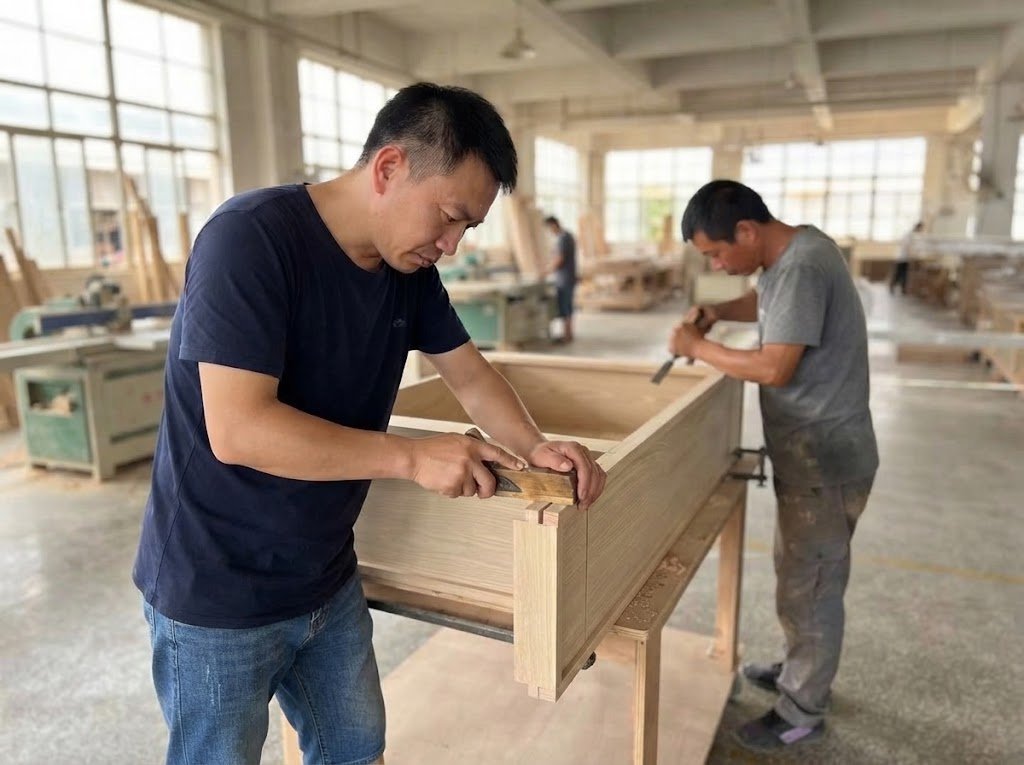
No wooden dowels. No mortise and tenon. The hidden joints were literally held together by brad nails and a thick yellow glue that smelled faintly like fish. I pointed it out to the floor manager. He just shrugged and said the client wanted a 15% discount, so they cut the joinery time.
In Chinese custom manufacturing, copying the outer shell is child’s play. Nailing the internal bones? That’s an upgrade you have to fight for every single day. The assembly guys are usually paid piece-rate—by the unit, not by the hour. If a pneumatic nail gun hits quota faster than perfectly aligning a wooden peg, they’re firing the nail gun.
And it’s not just wood. Two years ago, I watched a junior buyer try to source Calacatta marble coffee tables. She negotiated the price down to nothing. What showed up in Miami wasn’t solid stone. It was a cheap ceramic core with a highly convincing, digitally printed marble pattern baked onto the top layer. She didn’t specify natural stone on the contract. She just wrote “marble finish.” Huge mistake.
Finding the “Middle-Weight” Players
The mega-campus factories pumping out 5,000 identical Holiday Inn beds do not care about your bespoke 12-piece residential project. They just don’t. Your order is a nuisance to their production schedule. Conversely, the mom-and-pop garage operation literally doesn’t own the CAD software to open your architect’s 3D files.
The smart money hunts exclusively in the middle tier.
I constantly tell procurement directors to find export-focused, mid-sized operators. Take a setup like Interi Furniture, for example—they handle complex residential and commercial specs daily. Operations in this weight class hit the exact sweet spot. They have the engineering bandwidth and technical documentation skills to interpret demanding Western blueprints, but they aren’t so massive that a floor supervisor won’t stop the assembly line if a linen seam looks wavy.
Build your black book around these specific mid-weight players. And compartmentalize them. Keep your metal fabricators cutting brass. Keep your upholstery guys sewing fabric. The absolute second you let a sofa factory sub-contract your steel legs to their cousin down the road… that’s how you get cheap 201 stainless instead of marine-grade 304. Two months in a Miami beach house and the whole base turns orange with rust.
Surviving the Spray Room
Finishing is where decent furniture goes to die.
I once walked into an Anji paint booth where guys in plastic shower sandals were chain-smoking right next to open 50-gallon drums of nitrocellulose lacquer. Terrifying. But aside from the obvious explosion hazard, the real killer for luxury buyers is the chabuduo mindset. Roughly translated: “eh, close enough.”
You overnight them a physical plank of smoked oak. They DHL back a sample that looks like a bruised peach. You reject it. They try again, slapping so much dark pigment on the wood that the natural grain is completely obliterated.
A factory’s true skill level isn’t the woodwork; it’s proven in the spray booth. Clarity, depth, curing time. If they rush the drying process to catch a Friday sailing schedule, they’ll wrap your dining table in heavy plastic while the PU lacquer is still heavily off-gassing. It’ll show up in California sweating, reeking like a chemical spill, with a completely cloudy finish that cannot be repaired.
And don’t even get me started on metal finishes. You ask for a PVD brass coating. They quote you for PVD, but secretly use a cheap electroplating method that flakes off if you look at it wrong. Unless you are standing there with a scratch-tester, you won’t know until the client calls you screaming six months later.
Shipping Air (And Paying For It)
Paying for the stuff is easy. Dragging it across the ocean without snapping it in half is the actual job.
It’s high-stakes Tetris. I’ve stood on a loading dock in Nankang and watched sweating loaders literally jam bare, un-palletized lounge chairs into the empty airspace near the container doors. Why? Just to max out the CBM (cubic meters) so the factory owner could save $150 on local trucking fees. Insane.
A rookie buyer will bleed a factory over a $50 unit price difference, completely ignore the export packaging specs, and then throw a massive tantrum when 20% of the shipment shows up with crushed corners.
Landed cost is reality. You need ISPM-15 heat-treated plywood crates. You need pearl cotton wrapping, not just thin bubble wrap. You need third-party inspection fees. You need heavy-duty hanging desiccants. Skip the moisture control, and your velvet sofa will grow a thick sweater of white mold during the 30-day ocean transit.
| The Real Bill | What Factory Quotes | What You Actually Pay |
| Core Goods | $10,000 (FOB) | $10,000 |
| Export Crating | $0 (Thin cardboard) | $800 (Plywood & foam corners) |
| Pre-Ship QA Check | $0 (They self-check) | $300 (Independent guy) |
| Ocean Freight | $0 | $3,500 – $6,000 (Depends on the lane) |
| Import Tariffs | $0 | $2,500 (Assuming standard 25% Sec 301) |
| Total | $10,000 | $17,100 – $19,600 |
Bake those numbers in. Otherwise, your “cheap” China trip turns into a brutal lesson in international freight mechanics.
The Villa Sourcing Hit-List
How do you survive an 8,000-square-foot luxury build without aging ten years in a single month? Here’s the ground game.
- The 30/70 TT rule. Never wire a 50% deposit for standard goods. If they throw a fit, walk away immediately. They’re either cash-starved or planning to hold your deposit hostage later on to force a price increase.
- Hire your own boots. The factory’s internal QC guy? He works for the boss, not you. His job is to get the goods out the door. Hire a grumpy, detail-obsessed inspector from Shenzhen to check the pieces before you wire that 70% balance.
- Fear the fast “Yes.” The absolute biggest red flag in this country? A vendor who agrees to every demand instantly. A serious manufacturer argues. They’ll complain about your CAD files, whine about a material constraint, or tell you your timeline is impossible.
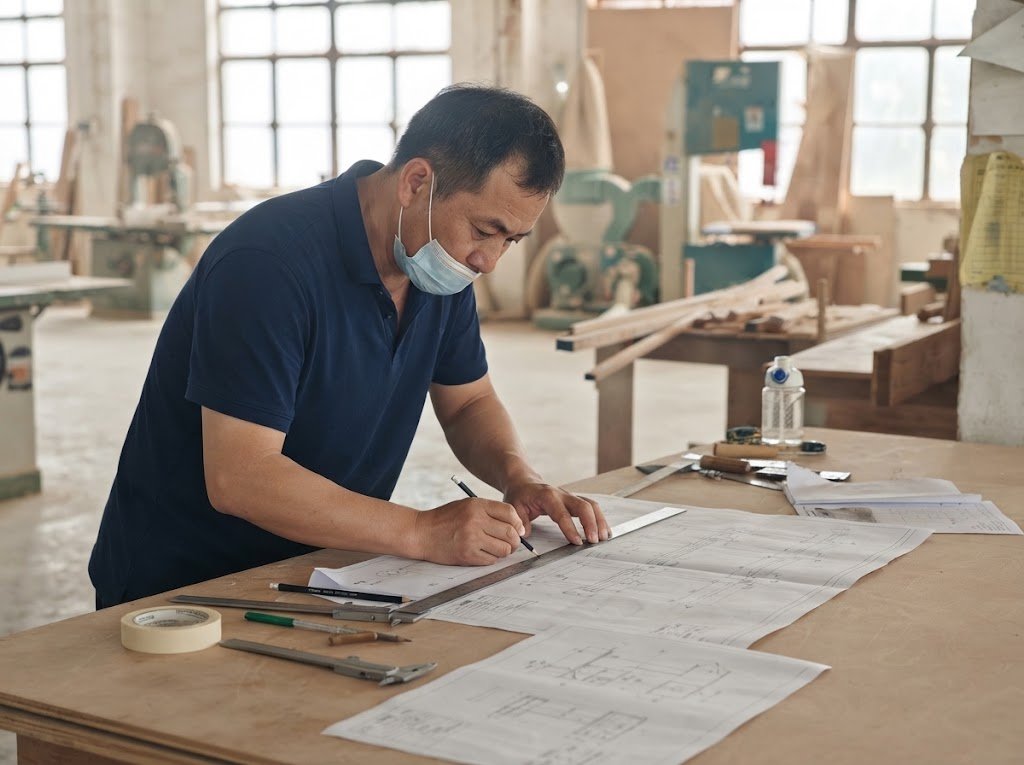
- Lock down the BOM. Name the hardware. “Austrian Blum soft-close.” Specify E0 grade MDF. Demand 45D high-resilience foam. Blank spaces on a spec sheet are just profit margins for the factory.
- The Tolerance Trap. Understand that metal expands and wood shrinks. If you are mating a solid oak tabletop to a custom steel base, you need to write specific tolerance margins into the PO, or the top will crack during its first winter in Chicago.
- The “Golden Sample.” Do not authorize mass production without physically touching a prototype. WeChat videos are garbage. Ring lights hide everything. (And yes, I learned this the hard way back in 2013 when a client’s custom brass tables arrived looking like dented soup cans).
The ultimate rule? Do not release the final payment until the container is sealed, the customs seal is attached, and you are holding the draft Bill of Lading. Once that wire clears, your leverage drops to absolute zero. You are a ghost.

Late-Night WeChat Panics (What Buyers Actually Ask)
Q: My client is terrified of toxic Chinese glue off-gassing. Is that a real risk?
A: Only if you bottom-feed. High-end factories use CARB Phase 2-compliant MDF and water-based, low-VOC finishes all day long. But you have to legally force them to use it in your PO. If you don’t ask, they default to the cheap stuff that burns your eyes.
Q: Can I just WhatsApp them a photo of a Minotti sofa and get it for two grand?
A: Absolutely not. A Pinterest screenshot is not a schematic. You’ll get a weird, lumpy cartoon version of that sofa. You need shop drawings, foam specs, structural blueprints, and physical fabric swatches.
Q: What about MOQ (Minimum Order Quantity)? Will they even talk to me for one villa?
A: High-volume hotel factories won’t touch you. But those mid-sized export specialists we talked about? They live for this. They will do a single custom piece, but you will pay a heavy sampling fee (usually 2x or 3x the unit cost). Expect to absorb that.
Q: Do I really need to fly over there? Can’t I just use Alibaba?
A: Buying a couple of accent chairs? Sure, go click around Alibaba. Furnishing a $5 million property? Trying to do that over a laptop screen is financial suicide. You can’t sit-test foam density through a MacBook screen. You can’t check the grit of a sanding job via a Zoom call.
Q: Bottom line: can you actually do a luxury property on a budget without it looking like trash?
A: Yes. But you are trading material costs for heavy management costs. Put the hours into brutal QA and ironclad specs, and you’ll get world-class interiors for a fraction of retail. Try to cut corners on the management side, and you’ll pay for it in claims and replacements.
The ecosystem here gives you exactly what you demand of it. Ask for cheap garbage, they build it with a smile. Demand precision, hold the line on the BOM, and you get craftsmanship that rivals Northern Italy. The real question isn’t whether China can build luxury anymore. It’s whether you have the operational stomach to manage the chaos. Treat it like a vacation, you’ll get fleeced. Treat it like a military op, and you’ll furnish palaces.