

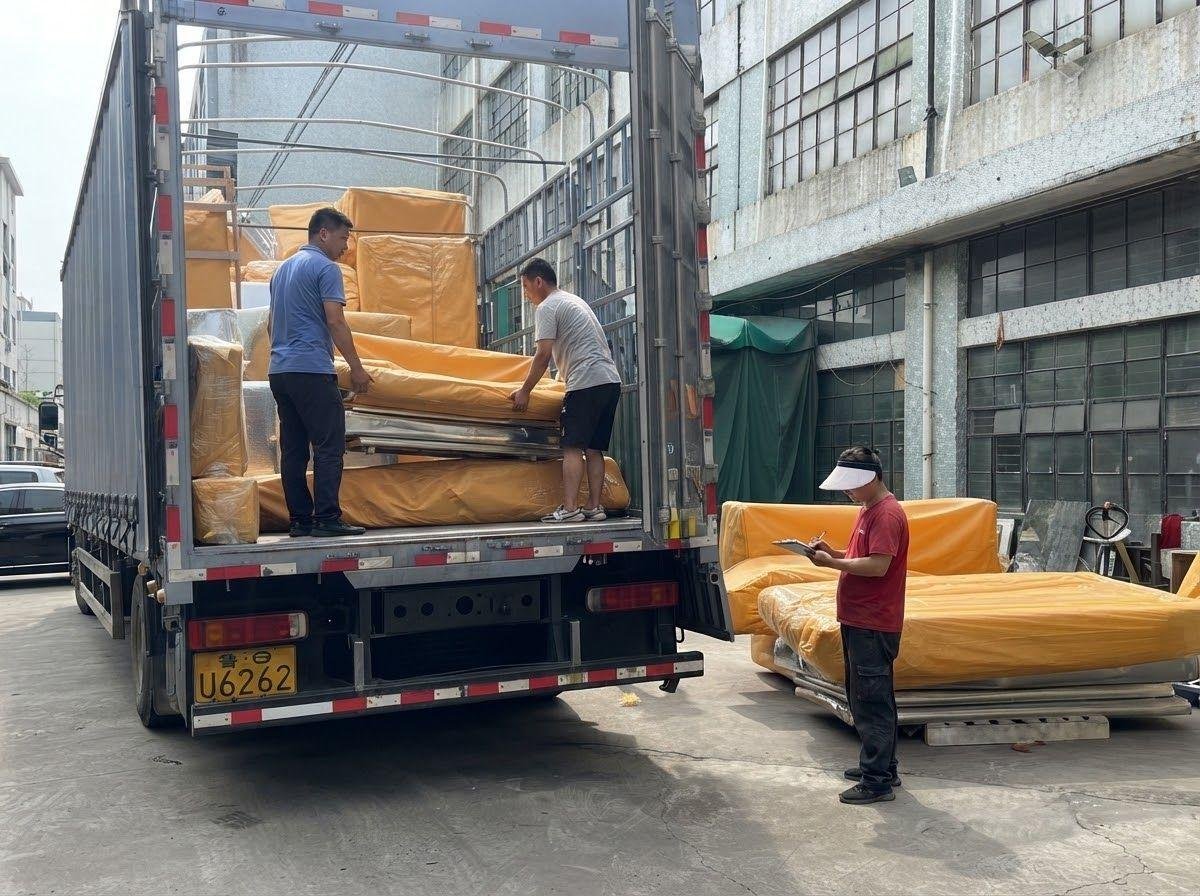
Last Tuesday, right around 3 PM, I found myself standing on a blistering, diesel-soaked loading dock in Longjiang. Foshan in mid-summer is no joke. I was watching four exhausted warehouse guys desperately trying to shove the final piece of an absolutely massive, oversized bouclé sectional into a 40-foot High Cube.
It was pushing 95 degrees. Humidity floating somewhere around 90%.
These guys were sweating straight through their polo shirts, literally taking running starts to ram this cardboard box against the corrugated metal walls of the container. Meanwhile, the factory boss is chain-smoking Double Happiness cigarettes, yelling in rapid-fire Cantonese at a truck driver who is leaning on his horn because he’s terrified of missing the CY port cutoff time.
And the buyer? A high-end residential interior designer based out of Chicago. She was watching this whole circus unfold via a choppy WeChat video call. Smiling. Completely, blissfully unaware that this single jammed carton was about to trigger an extra $1,800 in LCL overflow fees.
Why the sudden overflow panic? Because the factory decided, at the absolute last minute, to round up the carton dimensions by a measly two inches. They had some extra honeycomb edge guards lying around. Figured they’d throw them in.
Two inches. That’s it.
But that tiny, seemingly harmless deviation completely detonated the mathematical load plan. It left roughly 15% of that container as incredibly expensive, utterly empty air. Look, I wish I could say this was a freak occurrence. It’s not. This exact scene plays out every single afternoon across the industrial parks of Guangdong and Zhejiang. You might think you’re in the design trade. Or the hospitality sector.
You aren’t.
If you buy overseas, you are squarely in the logistics business. And right now? There’s a very good chance you are losing the game.
The Brutal, Uncomfortable Truth About Space
Procurement directors love to pat themselves on the back. I sit in meetings with these guys in grand hotel lobbies, drinking lukewarm green tea, listening to them brag. They think they’re stone-cold negotiators because they managed to shave five bucks off the unit price of a solid ash dining chair.
Congratulations. Truly.
Then they turn around and hemorrhage twenty dollars a chair in ocean freight. Why? Because the factory packed those exact same chairs two-to-a-carton instead of engineering a proper box that fits four.
You are literally cutting checks for air.
Actually, let me walk that back a bit. What most buyers completely fail to grasp is that they are paying a massive premium for the factory’s convenience. Chinese factory owners operate on FOB (Free on Board) terms. Do you know what that actually means in practice? It means the second the heavy metal doors of that Maersk shipping container swing shut and the bolt seal clicks, your landed freight cost is entirely, 100% your problem. Not theirs.
Think about it from their side. It takes expensive engineering hours to design a cardboard box that perfectly hugs the awkward curve of an upholstered headboard. It takes extra manual labor on the sweltering assembly line to break down a modular sofa so the components stack tightly without dead zones. Factories just want the goods off their floor. They want that final 70% balance wired to their account. They simply do not care about your landed unit cost.
Here’s a rule I learned the hard way after a decade and a half walking floors in Dongguan: If you aren’t aggressively arguing with your supplier about exact carton dimensions before you wire the 30% deposit, you are going to bleed out your retail margin on the water.
The absolute most expensive material in any Chinese furniture shipment isn’t imported Italian leather or solid white oak. It is the dead, empty space hiding inside your boxes.
The “Stop Bleeding Cash” Takeaways
- Audit the cardboard, not just the sofa: A 2cm increase in corrugated board thickness can slash your total container capacity by up to 15%. I’ve seen it happen.
- FCL is your baseline survival metric: Mastering FCL China shipping requires a level of mathematical paranoia before a single piece of wood is even cut.
- Mixed loads are margin killers: Throwing bulky velvet upholstery into the exact same box as fragile glass case goods usually creates un-stackable dead zones.
- Standardize your damn POs: Always order in multiples that perfectly max out container tiers. If the tier fits 116 chairs, ordering 114 is just throwing your money into the Pacific Ocean.
The Geometry of Greed (And Laziness)
Think about packing your SUV trunk for a two-week road trip with the family. You shove the hard, square, heavy suitcases in first, right? Makes sense. Then you jam the soft duffel bags and random pillows into the weird gaps. If you just chuck a set of awkwardly shaped golf clubs straight down the middle first, nothing else is going to fit.
But in international ocean freight, screwing up the trunk packing doesn’t just annoy your spouse. It costs you a thousand dollars.
Whenever you load Chinese furniture container shipments, volumetric optimization is the single biggest driver of your overall unit profitability.
When you sit back and let a factory dictate the packing terms without oversight, they are essentially playing golf with your container.
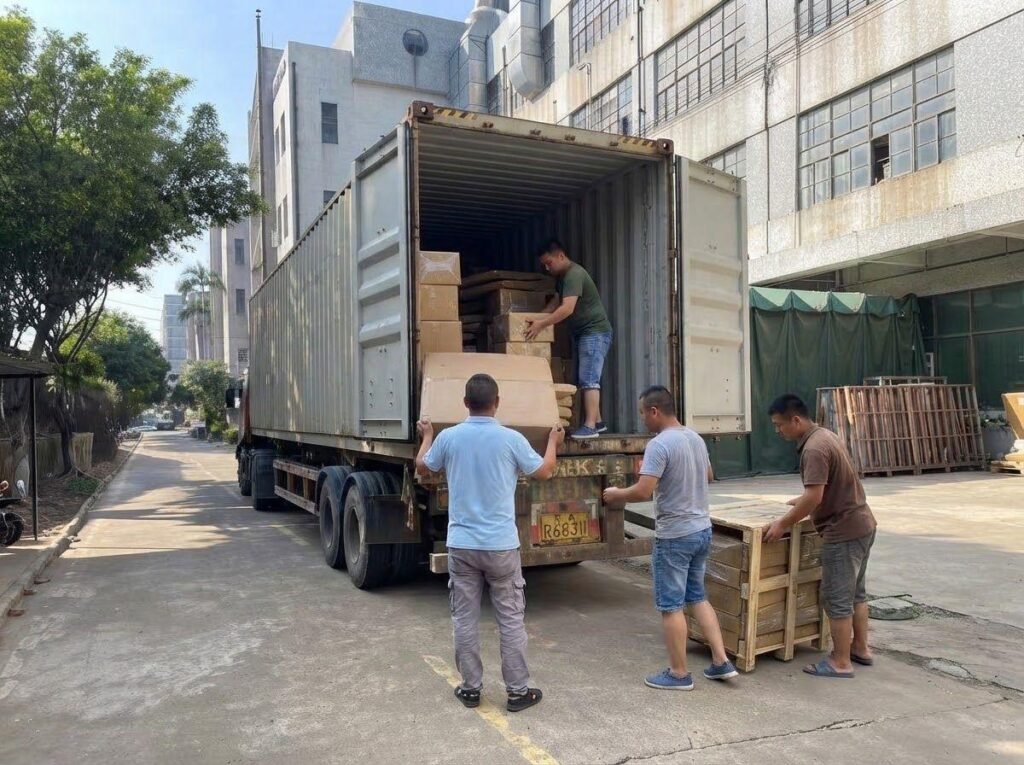
I spent a week last November embedded at this massive upholstery joint. I was just standing by the packing line, watching. They were wrapping every single lounge chair in thick EPE foam, dropping it into double-corrugated cardboard, and wedging massive solid foam blocks into all four corners. (And yes, factories do this protective overkill way more than they’ll ever admit).
The protection? Absolutely bulletproof. You could toss the box off a three-story roof. But it added over four inches to the overall external width of every single sofa.
An absolute massacre of geometry.
Nobody stopped it. Why would they? The factory’s sole KPI was “zero damage claims from the angry American buyer,” not your freight efficiency. They were protecting their own replacement-cost bottom line by drastically expanding your shipping bill.
The Fully Assembled Death Trap
This is exactly where I see high-volume hospitality buyers get slaughtered. They demand fully assembled bedside tables. Why? Because local union labor rates for assembly in New York or London will bankrupt the hotel project. It makes total sense on a spreadsheet.
But shipping a hollow wooden cube means you are shipping 90% air across the Pacific.
Say you force the factory into shipping fully assembled case goods. Okay. But you’ve got to offset that specific box with high-density, flat-packed stuff. Think heavy metal table bases, knocked-down bed frames, or dining chairs that nest perfectly together. You have to treat an L-shaped restaurant booth like a weird Tetris piece. If the factory workers aren’t nesting them face-to-face inside the master carton, you are instantly vaporizing 40% of the box volume.
If your entire purchase order is just bulky, non-nesting, fully built items, go ahead and expect your freight cost per unit to double. Minimum.
The Mixed Load Nightmare Scenario
And here is the real kicker. Most mid-tier buyers aren’t ordering 400 identical aluminum outdoor chairs. That’s easy. No, they are procuring for an entire 80-room boutique hotel renovation. Or a sprawling, six-bedroom residential estate.
King beds. Curved sectionals. Brass bar stools. Heavy marble coffee tables. Fragile leaning mirrors. All mixed together.
Who is Actually Playing the Tetris Game?
When you combine 45 different mixed SKUs into one order, who do you think is actually designing the spatial load plan? Hint: It’s not a logistics engineer with a master’s degree.
Usually, it’s a warehouse guy named Mr. Chen. He’s standing on the dock with a clipboard held together by packing tape, a cigarette hanging out of his mouth, doing mental spatial math while a 20-ton truck idles aggressively in the driveway.
That is a recipe for absolute financial disaster.
Heavy marble crates have to go on the bottom. Fragile mirrors have to sit on top. We all know this. But what happens when the factory loads the heavy sofas first to anchor the nose of the container, leaving a weird 3-foot gap near the corrugated ceiling? You get “dead space.” Because you sure as hell can’t balance a 150-pound solid wood credenza on top of a soft velvet sofa cushion.
So what happens? That 3-foot gap just sails across the ocean, completely empty, on your dime.
I constantly tell my clients to demand 3D load planning software diagrams before the finishing department even shoots the final lacquer. You cannot hand a factory dozens of different SKUs of varying weights and fragilities and expect a magical 95% volume utilization rate. It defies physics.

Ecosystem Spotlight: Where Does Your Factory Fit?
Not all factories handle the dock load-out the same way. Mostly because they aren’t built for the same type of client.
If you fly into the mega-factories up in Anji, they are pumping out thousands of identical mesh office chairs a day. Their carton dimensions are dialed in to the exact millimeter. They know exactly how many chairs slide into a 40HQ (usually exactly 680) and they literally will not let you order 650. It messes up their math. They’ll tell you to kick rocks.
While some volume-obsessed buyers naturally gravitate toward those massive, inflexible Foshan or Dongguan operations, others find a different path. Mid-sized specialists—operations like Interi Furniture, which specifically focuses on custom hospitality projects and high-end residential pieces—often offer a much better risk-reward equation for complex orders.
A mid-sized factory inherently has more operational flexibility to slow down, consolidate a messy mixed load, or engineer custom knock-down (KD) hardware for a tricky three-meter dining table. They are used to playing Tetris with weird, varied shapes.
But listen to me: that flexibility demands your aggressive participation. You have to explicitly dictate your target CBM (Cubic Meters) per unit. If you don’t? They will just default to whatever standard, oversized box the local packaging supplier had on sale that week.
The Load Master’s Actionable Framework
If you actually want to stop bleeding cash on the water, strip the emotion out of your buying trips. Stop looking at pretty fabric swatches for a second. Treat your POs like strict math equations.
Here is exactly how you take control back from the loading dock.
- Demand the exact, final carton dimensions during the sample review. I cannot stress this enough. Do not wait for the mass production run. When they ship you the golden sample, they need to ship it in the exact box they plan to use for the order. Get your tape measure out. If it’s too bloated, force them to redesign the packaging immediately.
- Obsess over the “Drop Rate.” Take the total cost of the ocean freight invoice and divide it by the number of units that actually fit in the metal box. If that landed unit cost destroys your wholesale margin, you need to go back to the drawing board and redesign the product to knock down.
- Force PO quantities to match container tiers. If one horizontal row in a 40HQ fits exactly 12 sofas, for the love of god, don’t order 50 sofas. Order 48. Ordering 50 means two orphan sofas are sitting alone on the top tier, physically blocking you from sliding anything else into that upper quadrant.
- Hire a local pitbull for the loading. Never, ever let a factory load a highly mixed container unsupervised. Pay a third-party QC inspector 300 bucks to stand on that sweltering dock for four hours to ensure the heavy crates stay on the floor and Mr. Chen actually follows the 3D load plan.
- The Red Flag: Begging for the thickest packaging possible. This is the ultimate rookie trap. Yes, you desperately want the goods to survive the ocean transit. But demanding 7-layer export cartons wrapped in 3-inch honeycomb board for a solid, indestructible cast-iron table base is completely ridiculous. You are sacrificing 20% of your total container space to protect a piece of metal that a sledgehammer couldn’t dent. Calibrate your packaging materials to the actual fragility of the specific item.

Brutally Honest FAQs from the Trenches
Q: Seriously, how much empty space is actually “normal” when I load Chinese furniture container shipments?
A: Let’s look at a standard 40-foot High Cube. Technically, it holds about 76 CBM of air. Hitting 65 to 68 CBM is considered world-class for complex furniture loads. If your packing list says you are only stuffing 55 CBM into that box? Somebody on the ground is fundamentally screwing up the Tetris game.
A 10 CBM loss on a $5,000 spot freight bill means you just lit $650 on fire for absolutely no reason.
Q: My supplier swears my custom lounge chairs can’t be stacked because the curved wooden legs will snap. What’s the play here?
A: Tell them to build a cheap, rough-sawn wooden internal shelf spanning the width of the container. Or demand they use interlocking “L-shaped” carton designs where the chairs nest into each other top-to-bottom. If they just leave the entire top half of the container empty because they’re scared of leg damage, you are essentially paying double for freight. Push back aggressively. They have solutions; they just don’t want to pay for the extra dunnage wood.
Q: What about weight limits? I’m shipping heavy solid marble dining tables.
A: With furniture, you usually “cube out” (run out of physical space) long before you “weigh out” (hit the legal road tonnage limits). But with solid stone, heavy slate, or dense MDF hotel case goods? Yeah, you can actually hit the U.S. road weight limit while the container is still half empty. Always intentionally balance heavy stone orders with lightweight stuff—like foam upholstery or lighting pendants—in the exact same FCL China shipping booking.
Q: Since I can’t fill a whole 40-footer, shouldn’t I just ship LCL to save cash?
A: For high-end furniture? God, no. LCL (Less than Container Load) cargo gets violently handled by forklifts at multiple dirty consolidation warehouses. Your delicate linen sofas are going to share a box with heavy industrial machinery parts that might be leaking oil. Plus, the per-cubic-meter rate for LCL is astronomically higher than FCL. Either buy more inventory to fill the box, consolidate with another trusted factory nearby, or redesign your current items to hit FCL minimums. Period.
Q: If the factory wastes space, can I dock their pay?
A: That depends entirely on how ruthless your initial contract was. If your signed PO explicitly states “Maximum 0.45 CBM per unit” and they ship the goods at 0.55 CBM, absolutely deduct that ocean freight difference from their final 70% wire transfer. But if you never locked down the volume limits on paper beforehand? That financial hit is 100% on you. Good luck explaining it to your CFO.
The Final Word
At the end of the day, what’s the actual, true cost of letting a supplier play fast and loose with your ocean container space?
It goes way beyond the bloated freight bill. It’s the massive lost opportunity cost. Every single cubic meter of wasted, empty space floating across the ocean is product you could have actually sold to a paying client.
The smartest, most profitable procurement directors I deal with treat cardboard, bubble wrap, and EPS foam with the exact same ruthless scrutiny they apply to imported marble or brass. They inherently understand that a beautifully proportioned, award-winning lounge chair is completely, utterly financially useless if it costs way too much to drag it across the Pacific.
Next time you are sitting in a hotel lobby reviewing a fresh quote from Guangdong, don’t just stare blindly at the FOB price. Look closely at the CBM. Demand the packing plan. Force the uncomfortable, granular conversation early.
Because if you wait until that truck is backing up to the factory loading dock? The game of Tetris is already over.
And you definitely lost.
Catch you on the next factory floor.