

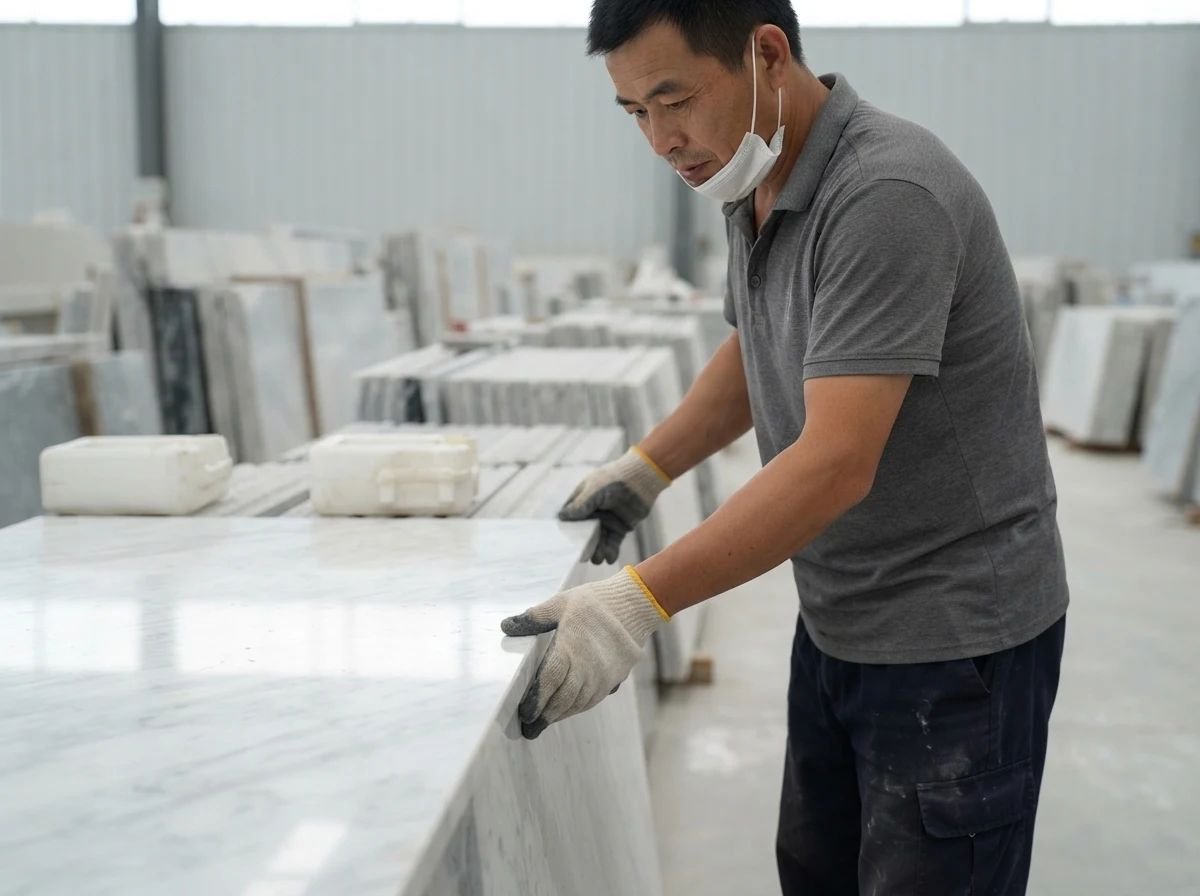
Tuesday. 2 PM. I’m standing in a stone yard in Yunfu, and my boots are completely covered in white dust. I’m watching a guy in a tank top casually slap a “Premium Italian Carrara” sticker onto a slab of heavily resin-filled Guangxi White. Tomorrow, that exact slab heads two hours down the highway to Foshan. Someone will bolt it to a brass base. Next month? It’s sitting in a Miami hotel lobby, billed to the procurement director at $3,500 a pop.
The factory cost was maybe 280 bucks.
Look, sourcing China marble furniture is a beautiful, deeply chaotic game of smoke and mirrors. As buyers, we are addicted to the margin. We just hate the surprises. If you are pulling containers of stone tables out of Guangdong right now, you need to understand exactly what you are paying for. Actually, that’s not quite right—what most buyers miss isn’t the cost of the material, it’s the hidden shortcuts taken between the quarry and the shipping container.
The Brutal Truth About “Imported” Stone
Here is the part your supplier really doesn’t want you to hear. Over 70% of the European marble you buy in Chinese wholesale showrooms never saw the inside of a Tuscan quarry.
It is local rock. Period.
And honestly? Domestic Chinese stone is perfectly fine. Guangxi White is a classic. But it is porous, highly brittle, and costs a fraction of the real deal. The problem starts when you pay imported prices for domestic geology. Factories get away with this because Western designers buy with their eyes. They see a sleek, modern dining table under the bright halogen lights of a Lecong furniture mall, and they stop asking questions.
Rule of thumb: If a factory quotes a marble table at a price that seems too good to be true for European stone, you are buying domestic rock.
Key Takeaways: Sourcing Stone Furniture
- Origin vs. Assembly: Most Chinese stone furniture is assembled in Foshan or Dongguan, but the stone originates in Yunfu or Shuitou. Quality control must happen at the slab level.
- The Resin Reality: Nearly all commercial-grade Chinese stone furniture undergoes heavy resin filling to hide natural fissures.
- Markup Madness: The markup from raw factory floor to western retail often exceeds 800%, but the hidden margin inside China is where corners are aggressively cut.

The Substrate Shell Game
China furniture sourcing is the process of navigating a hyper-fragmented supply chain where the assembly factory rarely controls the raw material. You aren’t buying from a master stone carver. You are buying from a metal or wood factory that outsources the stone top to a local workshop down the street.
Think of it like hiring a master tailor to make a bespoke suit, but he outsources the actual stitching to a guy working out of a van in an alleyway. The fabric might be gorgeous. The structural integrity is doomed.
When inspecting Chinese stone furniture, the magic isn’t on top. It’s underneath. I’ve crawled under hundreds of heavy dining tables in Dongguan. What you usually find is a 12mm veneer of marble glued aggressively to a piece of cheap MDF (Medium Density Fiberboard). The factory then creates a mitered drop-edge to make the stone look like a solid 50mm slab.
(And yes, this happens more than anyone admits, even on five-star hospitality projects).
If moisture hits that MDF, it swells. The stone cracks. Game over. You just bought a very expensive paperweight.
The structural failure rate of MDF-backed marble in humid climates is staggering, yet it remains the default export standard.
Why Do They Crack in Transit?
Because a 20-foot container sitting on a ship in the Pacific Ocean bakes at 130 degrees for weeks. The cheap adhesive fails. The wood expands. The stone doesn’t. Dead on arrival.
The Great Waterproofing Illusion
Smoke and mirrors. That’s what passes for stain resistance in the lower tiers of the export market.
I was walking a production line in Longjiang late last year. The workers were applying “premium stone sealer” to a batch of coffee tables destined for a Las Vegas casino. I got close and looked at the bucket. It was basically a watered-down industrial wax. It gives the stone a brilliant, glossy sheen for exactly long enough to pass a pre-shipment video inspection. By the time it sits in a VIP lounge for a week, a single spilled espresso will permanently stain the surface.
Real penetrating sealers cost money. They take time. They require curing space. Most export-focused assembly lines simply don’t have the patience for it. They want the table in the box and out the door.
| Feature | Cheap “Wax” Sealer | True Penetrating Sealer |
|---|---|---|
| Cost per table | $2.00 | $15.00 – $30.00 |
| Application time | 5 minutes | 24 – 48 hours (multiple coats) |
| Stain Resistance | Fades in weeks | Lasts 3-5 years |
| Visual cue | High artificial gloss | Natural, matte or satin finish |
True quality control means specifying the exact chemical brand of the sealer on your purchase order, not just asking for “waterproofing.”

The Logistics of Heavy Freight
Let’s talk about the graveyard of broken slabs. Transporting Chinese stone furniture isn’t like shipping upholstered sofas or flat-pack cabinets. Stone has a vicious memory. It remembers every bump, drop, and hard stop between the factory floor and your warehouse.
Industry observers estimate that up to 15% of stone furniture shipped out of Shenzhen and Guangzhou ports arrives with hairline fractures. Why? Bad packaging. Factories will often quote you an incredibly low FOB price. But they make up for it by packing a 150-pound marble dining top in a cheap, unreinforced cardboard box with a few pieces of crumbling Styrofoam.
If you aren’t paying for custom, fumigated wooden crating—specifically A-frame crates for large slabs—you are gambling with your inventory.
And here’s the real kicker. The forklift drivers at the consolidation warehouses in Yantian port are paid by speed, not by care. If your crate doesn’t have highly visible tip-indicators and shock-sensors attached to it, they will handle your fragile Nero Marquina table like a pallet of dog food.
Never negotiate your packaging costs down to zero; you are simply pre-paying for your own damages.
Navigating the Factory Tiers
Not all suppliers are playing the shell game. You just have to know who you are actually dealing with. The market basically splits into massive commodity assemblers, high-end bespoke workshops, and mid-sized specialists.
The massive factories in Foshan will give you rock-bottom pricing. But they buy stone blindly from wholesale markets based entirely on that day’s spot price. It’s a pure volume play. The stone you get in container one will look entirely different from the stone in container three.
Instead of rolling the dice with mega-assemblers, many experienced buyers lean on focused operators like Interi Furniture. Because these mid-sized workshops maintain direct relationships with specific stone yards, the calibration, cutting, and finishing are handled by material specialists before the metal table base is even welded.
This tier differentiation is crucial. You aren’t just picking a supplier. You are choosing an entirely different supply chain philosophy.
Your Sourcing Survival Checklist
So, how do you buy without losing your shirt? You stop acting like an interior designer and start acting like an auditor.
Here is the framework I use when evaluating any new stone-furniture supplier in China:
- Demand the “Underbelly” Photo: Don’t just look at the polished top. Force the supplier to flip the table over and send a high-res photo of the substrate and the edge-joint construction.
- Specify the mesh: Genuine, high-quality marble—especially heavily veined varieties—needs a fiberglass mesh glued to the back to prevent fracturing. If they don’t use mesh, walk away immediately.
- The “Scratch & Drip” Test: When visiting a showroom, I always bring a key and a tiny bottle of water. Put a drop of water on the stone. If it darkens immediately, there is zero sealer.
- Upgrade to Aluminum Honeycomb: If you are buying large dining tables, mandate an aluminum honeycomb backing instead of MDF. It cuts the weight by 60% and is completely impervious to humidity. It costs more up front. It saves you thousands in freight and damage claims later.
- Red Flag: Avoid factories that boast about doing the stone cutting, polishing, and metal-base welding all in one single, massive facility.
Wait, doesn’t vertical integration sound good? No. True stone processing requires massive water filtration systems, diamond saws, and specialized labor. Metalwork requires welding gas, grinders, and powder coating. In China, these are distinct trades. If a factory claims to do both under one roof, one of those operations is an amateur side-hustle.

Real Questions from the Procurement Trenches
Q: My supplier says the marble has natural ‘micro-fissures’ and that cracks are completely normal. Are they lying to me?
A: Yes and no. Natural stone has veins, which are technically geological faults. But if you can catch your fingernail in a crack on a finished dining table, that is a manufacturing defect. They failed to properly resin-fill and polish the slab. Do not accept it.
Q: Can I just buy the stone tops in China and source the metal bases locally in the US to save on tariffs?
A: You can, but it absolutely kills your freight economics. Stone is incredibly heavy and dense. Shipping just slabs means you are maxing out the weight limit of a shipping container while leaving 70% of the volume empty. You want to ship complete, flat-packed furniture to balance the container’s volume-to-weight ratio.
Q: Does buying Chinese stone furniture mean I have to settle for fake Italian marble?
A: Absolutely not. China actually has incredible domestic quarries—Panda White from Sichuan is visually stunning, and their various grey marbles are world-class. The trick is to buy domestic stone marketed proudly as domestic stone, rather than buying cheap domestic stone masquerading as Italian Carrara.
Q: Is it even worth importing natural stone anymore, or should I just switch to sintered stone?
A: It depends entirely on your client’s tolerance for maintenance. Sintered stone is man-made, indestructible, and stain-proof, which is great for high-traffic hospitality. But for ultra-luxury residential projects, buyers still demand the cold touch and unique depth of natural marble.
The global furniture market relies on China for scale, speed, and margin. But when you introduce millions of years of unpredictable geology into a high-speed, cost-cutting manufacturing culture, things get complicated fast.
Your success ultimately comes down to your willingness to look beneath the polished surface. Stop negotiating so hard on the final price that the factory is literally forced to hollow out the substrate just to maintain their tiny margin. You get exactly the quality you oversee.
If you want the outsized margin, you have to do the dirty work. Are you buying a carefully engineered piece of natural art, or are you just buying an MDF box with a heavy, brittle lid?


