

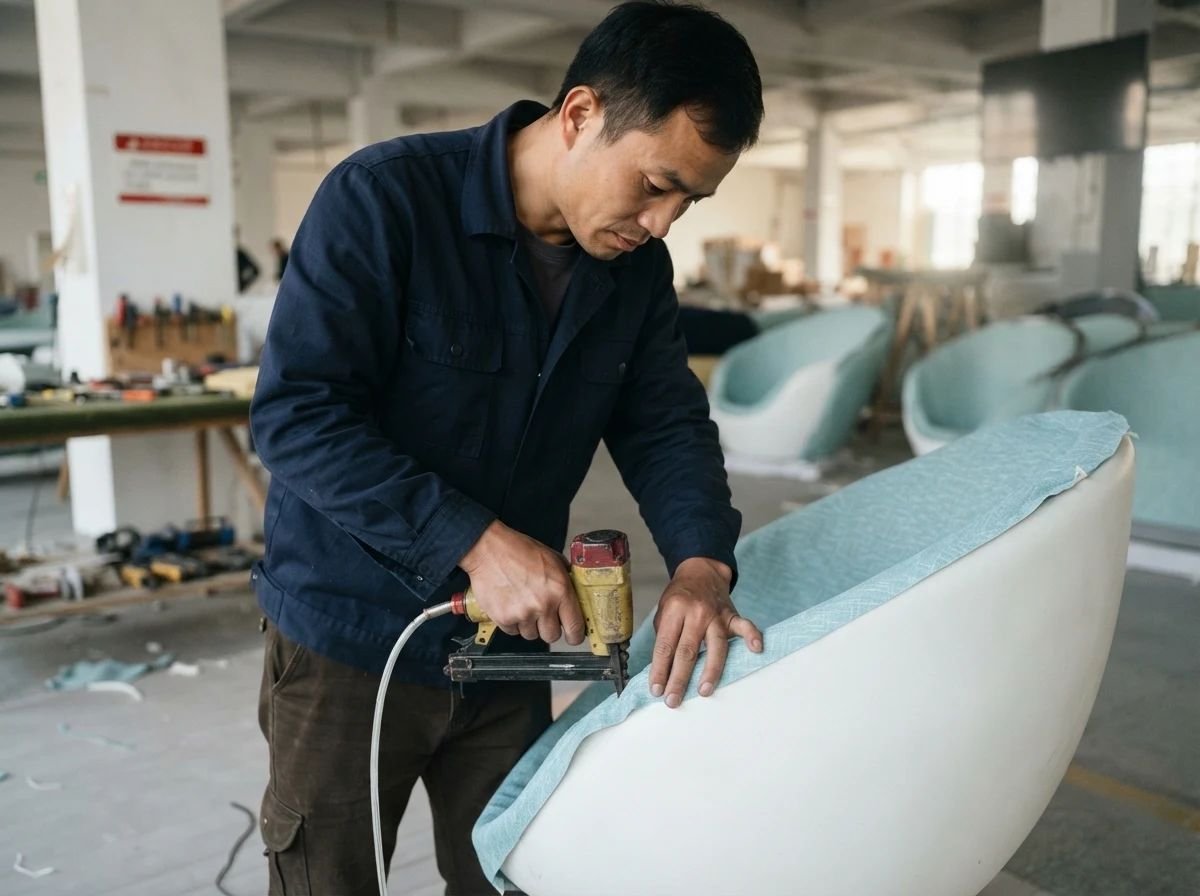
Imagine you are sat on the third floor of one of Lecong, Foshan’s showrooms drinking oolong tea from a thimble. In front of you is a plush, Italian-style modular sofa. Sitting on it feels bouncy and the top grain aniline leather is reminiscent of car dashboards. The ash frame feels rock solid – capable of withstanding an earthquake. The sales person tells you that a 40’ container of sofas will cost $680 EXW. This is around $42,000 in total. You transfer a 30% advance payment and board a plane from Guangzhou.
Two months and ten days later your container is delivered to your warehouse. Opening a box you sit down and immediately fall through to a slim, damp green pine slat. The ‘Italian leather’ has a slightly plasticky odour, akin to that of a new shower curtain.
China’s sample swap is its most established and pure scam in soft furnishings. And it can ensnare even the most experienced buyers – I have seen qualified hotel purchasing managers fall foul of it.
What’s Inside that Black Box?
Undertaking a sample swap is a well recognised way for Chinese furniture producers to create a luxury ‘golden sample’, which is then approved by customers. During large manufacturing runs however, they will knowingly lower the quality of the inner structure (foam, wood and spring), and so appropriate a profit margin.
Few people at the Canton Fair like admitting this, but once black dust cloth has been attached to a sofa, there is no visual means by which to distinguish between a $900 version and a $300 version.
Longjiang and Houjie’s dodgy furniture workshops well understand that although many buyers are highly conscious about the exterior stitching detail, few bother to investigate the interior construction. Frequently, these workshops will go to great expense to ensure your sample is of exceptional quality. They then appropriate their desired profit margin from the first container. As a very basic rule of thumb, if a factory is quoting a price 25% below the average Foshan price for exactly the same product specification, then they are not employing any special manufacturing technique, simply waiting to tell you which inferior materials they plan to use.
How the Sample Swap Works
Margin Scam – Unscrupulous stores under-quote in order to attract advance payments. They then appropriate 20-35% of the price by using sub-standard inner components.
Hard to Assess – Post-upholstering it is extremely difficult to assess the true quality of the foam, wood and springs.
Showroom Front – Many ‘factories’ in Foshan’s furniture areas are in fact showrooms which outsource large manufacturing runs to budget subcontractors. These showrooms also often rent showroom space.
Prevention – Unfortunately post-shipment inspections are ineffective. Quality control needs to be carried out at both the basic frame and foam stages.

Inside that Black Box – Where the Corners are Cut
As with buying a second hand sports car purely from its impressive waxed exterior, people frequently ignore the interior workings of a sofa. Likewise, whilst the car may appear identical, it soon conks out 3 miles down the road.
Are you really paying for high Resilience Foam or just fancy wrapping?
Foam is among the easiest components for unscrupulous stores to covertly downgrade. During sample manufacture they will utilise 45kg/m³ high Resilience Foam and encase it in goose down. Yet generally, manufacturers will then reduce the density to 28-30kg/m³ in volume production. Sometimes they will also add calcium carbonate to the foam in an attempt to retain a firmness when held, despite the reduced density. (I learnt this the hard way in Dongguan in 2016. A client’s hotel lobby sofas began developing irreversible dips within 4 months.) Furthermore, they will often stitch together off-cuts to stuff the sofa’s arms.
Smoke and mirrors.
Why Does Your so-called solid ash Frame Smell Like a swamp?
On a hot and humid day, step behind the upholstery line at a budget Longjiang workshop and you will see slabs of naked pine being left to soak up Guangdong’s notorious humidity. Authentic export quality frames are made from kiln dried hardwood (usually birch, ash or treated eucalyptus) and should have a 8-12% wood moisture level. Kiln-drying is costly and time consuming.
Dodgy stores however, do not kiln-dry. Instead they nail together wet pine (with 25%+ moisture) and apply ash veneer only to the visible ends of the frame legs. Subsequently, when this container is delivered to a warm Chicago showroom or arid Dubai villa, the wood distorts and cracks. By the time your customer hears of the cracking, the factory will have already received your balance payment and will no longer respond to your WhatsApp messages.
| Component | Golden Sample Specification | Common Volume Production Material | How it Under-performs |
| Seat Foam | 45 kg/m³ HR foam with down covering | 28-30 kg/m³ foam plus poly-fiber | Cushion flattening occurs within 3-6 months. |
| Frame | Kiln-dried hardwood (8-12% moisture) | Green pine and/or thin ply wood with nails | Frame distortion, groaning and cracking. |
| Suspension | 3.8-4.0mm sinuous springs | 3.0mm thin wire and low cost webbing | Seats droop and springs protrude from base. |
| Upholstery | Top grain aniline leather | Top grain for seating area, PU for back and armrests | Fake leather peels off within 12-18 months. |
Showroom Front to Shed Scams
Whilst some Chinese furniture scams occur during volume production, half occur prior to ordering.
Picture a swish restaurant with velvet lounging areas and sommelier. However, in the kitchen there is no chef, just a man heating up ready-made meals that he has purchased from a nearby store.
Is this really their factory or is it their cousin’s?
Both the Louvre Furniture Mall and Lecong’s National Highway 325 are filled with showrooms that all appear highly manufacturing orientated. Should you request a factory visit, they will readily take you a twenty minute drive to a lively 15,000m² plant complete with CNC routers.
However, in most instances the showroom owner does not even own one machine in this building. Within Guangdong’s manufacturing zones, small showrooms frequently pay a relative’s factory to allow them to show overseas visitors around. (And yes, this does occur more than is commonly acknowledged.) After you have made your advance payment, your order is then outsourced to a 4-man shed in Nankang or Longjiang’s backstreets.
Outsourcing roulette.
Interestingly, there are 5 quick ways to recognise a showroom front. Observe the behaviour of the ‘boss’ towards the factory floor staff. Should he be unable to state where the foam is stored, or receive blank responses from the workers, then you are not viewing a genuine factory. Always ensure that the business licence displayed on the factory wall corresponds with the beneficiary on the bank account detailed on your proforma invoice. Never allow yourself to be asked to transfer funds into an arbitrary private Hong Kong bank account.

Standard Pre-shipping Inspection Limitations
Even astute buyers can fall victim to sample swaps. Typically, a third party inspector will assess a product after it has been manufactured and packaged. They are unlikely to be authorised to strip back the black dust cover or to extract and weigh a cube of foam from a production item. Worse still, unscrupulous factories will sometimes offer genuine 45kg/m³ foam to an inspector on their quality control desk and insist that it is from the same production run.
From my experience, around two thirds of the inspection reports I analyse for disgruntled clients fail to include any assessment of the actual production line’s internal components. If your quality control process does not encompass frame assessment then you are effectively shelling out $350 for a fancy photo session.
Understanding China’s Furniture Sector
Although it is not without merit, buying from China is not necessarily doomed. Indeed, the country continues to manufacture some of the world’s best value for money soft furnishings. Crucially, however, it is essential to ascertain which echelon of the industry you are engaging with.
Leading the sector are large OEMs, which impose strict minimum order quantities. Conversely, the lower end of the market is populated by back-street workshops, which survive on ad hoc business. Ideally for designers and the hospitality industry, mid-range exporters represent the optimal segment. Unlike those who favour large Guangdong OEM factories, many buyers discover that medium sized, export orientated manufacturers such as Interi Furniture (typically servicing mainly project-based hospitality and premium residential clients) provide a significantly purer risk/return proposition. These mid-range exporters depend upon continuous B2B business and so would be devastated if their clients were to engage in sample swapping.
Generally, factories with established export business are not prepared to jeopardise their reputations to save $40 on a frame. By contrast, the bottom end of the market will view all international clients as short-term, and so are far more inclined to participate in sample swapping.
How to Protect Yourself against Sample Swapping
Avoid generic online trade assurance schemes. These will not help in foam density disputes. Rather follow this guidance:
- Define your Bill of Materials – Never specify ‘good quality foam’. Clearly define the product – for example “45 kg/m³ HR foam (±5%), kiln-dried birch at 8–12% moisture, 3.8mm sinuous springs spaced ≤10cm.” If this is not quantifiable then it cannot be enforceable.
- Conduct Bi-phase Inspections – Inspection One takes place when 50% of the frames have been manufactured and the foam has been sectioned. At this point your inspector will use a pin meter to assess wood moisture levels and will also extract and weigh a cube of foam from a production block. Inspection Two is the usual pre-shipping inspection.
- The Unlikely Early Warning Sign – Avoid Yes-men. Whilst it is widely considered good practice to seek out agreeable suppliers, in the Chinese furniture industry this is highly dangerous. Honest factory managers will challenge you if you try to force them to reduce prices by 15%. If a supplier automatically agrees to such a request, without amending product specification, then they have already resolved to engage in sample swapping.
- Include a ‘Strip Back’ Inspection provision – Authorise your inspector to randomly select one finished sofa. They should then strip back the black dust cover and un-zip the cushions in order to investigate the inner workings. This condition alone puts off 80% of sample swappers.
- Confirm Business Identity – Ensure that the Chinese company’s business licence (营业执照) name, bank beneficiary and factory address are all consistent. Should they request that you transfer funds into an arbitrary private Hong Kong bank account, then distance yourself from them.
Ultimately, scammers avoid dealing with people they cannot easily scam and will simply pass their attention onto the next recipient in their inbox, seeking the cheapest FOB quotation.

FAQs
Q: Does Alibaba’s Trade Assurance scheme protect me from sample swapping?
A: Not particularly effectively. Trade Assurance adjudicates disputes using defined product information and visual data. If your purchase order merely states ‘good quality’ foam and the finished sofas appear satisfactory in images, then the scheme will almost always support the supplier’s position.
Q: How can I test foam density without access to a laboratory?
A: Carry a digital weighing scale and measuring device. Extract a precisely measured 10cm x 10cm x 10cm (0.001m³) cube from a production foam block. Weigh this in grams. 45g = 45kg/m³. Further, press the foam and look out for a dusty and hefty texture – this denotes the addition of budget calcium carbonate.
Q: Is it acceptable for factories to use differing leather types on back and armrests compared to seating?
A: Yes. Cost-wise it is perfectly acceptable for a factory to utilise top grain leather only on areas requiring touch, and PVC or split leather on the back. However, this is fraudulent if they charge you for 100% top grain leather and subsequently substitute this for vinyl.
Q: Is it worthwhile to source sofas directly from China?
A: This will largely depend upon both the quantity of your order and the extent of your quality control processes. Generally, it is best to source locally for individual living room sofas due to the high associated freight and inspection costs. For larger scale requirements such as 40 room boutique hotels or full containers, sourcing from China can yield 40-60% cost savings. Again, however, it is important that you commission frame inspection and avoid continually endeavouring to obtain the cheapest quotation from a spreadsheet.
Having tramped factory floors throughout China from Anji to Longjiang for the last 15 years, I have discovered that the majority of bad buying experiences begin in a similar manner. Customers push suppliers too hard and at some point the arithmetic becomes unsustainable. They are then horrified when the supplier manages to re-engineer the numbers in the night.
In China, good quality wood, high Resilience Foam and competent upholstering all come at a price. So before sending an advance payment, ask yourself whether you are remitting sufficient funds to the factory for them to manufacture the same sofa that you sat on, or whether you are simply paying for a narrative.


